.png)
How a High-Volume Staffing Team Cut Candidate Screening Time by 82% Using AI
October 8, 2026
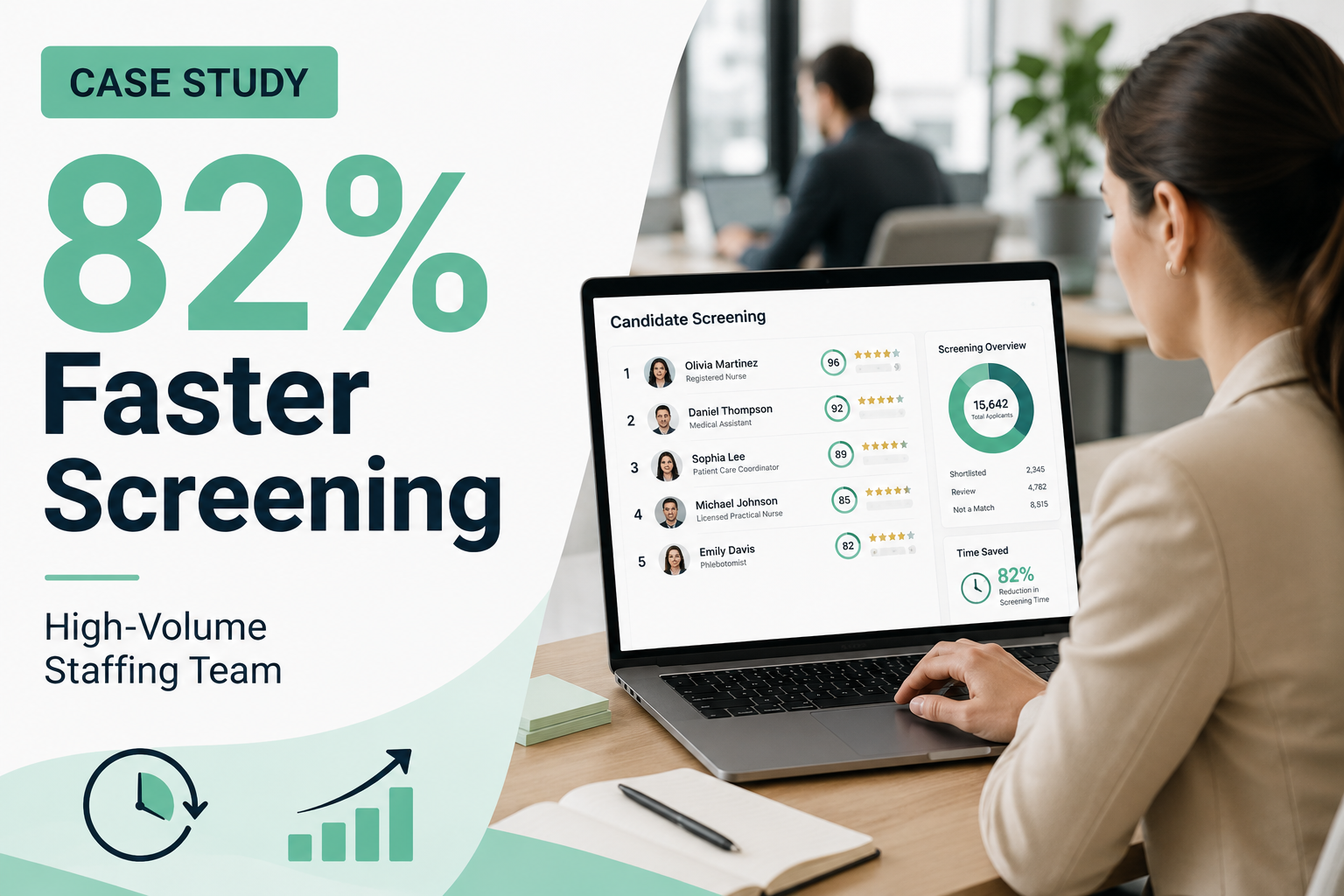
Executive Summary
Enterprise-scale staffing firms running high-volume talent pipelines constantly battle an internal operational paradox: a massive spike in application volume should theoretically increase placement numbers, but in reality, it frequently breaks human processing capacity. When thousands of digital profiles flood a recruitment portal every week, human resource functions routinely slow down. Recruiters become so overwhelmed by the sheer mechanics of data entry, document review, and early-stage resume screening that they lose the time required to interview top-tier talent and fulfill urgent client quotas.
This case study analyzes a high-volume commercial and industrial staffing provider that resolved this structural capacity constraint. Managing intense fulfillment timelines for corporate supply chain, logistics, and skilled operational accounts, the firm's legacy recruitment model relied on human sorting. Despite deploying a dedicated team of twenty sourcers and recruiters, the organization was losing critical contract placements to faster competitors simply because its manual review tracks could not keep pace with top-of-funnel data generation.
By replacing manual resume reviews with NinjaHire's advanced infrastructure, the agency integrated continuous, automated assessment layers directly into its primary tech stack. Over a ninety-day operational review period, the organization achieved a verified 82% reduction in candidate screening time. This operational transformation compressed initial submittal latency, dramatically expanded individual desk productivity, and drove a significant increase in client placements without increasing fixed operational headcount.
| Core Operational Metric | Legacy Baseline Operations | Post-Implementation (90 Days) | Bottom-Line Strategic Deliverable |
|---|---|---|---|
| Average Candidate Screening Time | 6.5 minutes per resume | 1.1 minutes per profile | 82% absolute compression in manual processing |
| Monthly Inbound Applications Processed | 8,200 reviews completed | 15,400 reviews completed | 87% expansion in top-of-funnel capacity |
| Recruiter Sourcing Productivity | 18 screens completed/day | 95 screens completed/day | 427% increase in daily recruiter throughput |
| Average Time-to-Submit (Submittal Speed) | 3.2 business days | 4.5 hours cumulative | 94% acceleration in client delivery loops |
| Net Placement Volume Increase | 142 contract hires/month | 194 contract hires/month | 36% expansion in net corporate account revenue |
What Is AI Candidate Screening?
AI candidate screening is an advanced recruiting methodology that utilizes artificial intelligence, natural language processing (NLP), and machine learning algorithms to automatically parse, contextually evaluate, rank, and match high-volume job applications against specific operational performance requirements.
Modern automated candidate screening moves past the strict limits of legacy, rule-based keyword matching. While old-school applicant tracking tools merely scanned files for explicit phrase repetitions, modern AI talent acquisition platforms read resumes contextually, much like an experienced technical sourcer. The technology understands adjacent professional competencies, tracks historical career progression speeds, and maps transferable skills across diverse industry domains.
The Challenge: Screening Bottlenecks in High-Volume Hiring
The commercial staffing firm featured in this operational report managed talent acquisition workflows under a heavy, complex system framework: 20 full-time internal recruiters, 180+ active job openings, and more than 15,000 monthly application uploads.
Under their legacy operational setup, every single inbound resume had to be manually opened, reviewed, and logged by a human recruiter. Because the business managed high-volume light industrial, fulfillment, and clinical support roles, a single online job posting would regularly generate upwards of five hundred applications within forty-eight hours.
This overwhelming volume of incoming data quickly created a severe operational bottleneck. Recruiters found themselves facing massive, unorganized ATS review lists every morning. Spending up to five hours a day opening documents, cross-checking employment histories, and verifying baseline licensing compliance left the team with minimal time to execute interactive validation calls. Top talent naturally abandoned the pipeline due to this high outreach latency.
[Inbound Application] ➔ (48-Hour Processing Delay) ➔ [Manual Sifting] ➔ [Candidate Abandonment] ➔ [Lost Placements]
Why Manual Candidate Screening Breaks at Scale
To protect corporate profit margins and accelerate delivery loops, the firm's staffing operations leaders executed a comprehensive diagnostic review of the hidden structural failures built into their manual candidate evaluation processes.
| Challenge | Operational Impact | Business Impact |
|---|---|---|
| Resume Volume | Recruiters spend 70% of their day opening and reading PDF attachments. | Severe pipeline backlogs; qualified candidates remain uncontacted for days. |
| Inconsistent Evaluations | Screening thresholds fluctuate based on individual recruiter fatigue. | Sub-optimal submittal consistency; lowered client interview conversion rates. |
| Delayed Outreach | Premium applicants wait 48-72 hours for an initial validation phone call. | High mid-funnel drop-off as talent aligns with faster staffing vendors. |
| Recruiter Fatigue | Repetitive administrative task load limits direct interview execution. | Accelerated internal employee burnout and elevated desk turnover. |
The Solution: AI Candidate Screening
To secure their pipeline against these sophisticated technical challenges, the staffing team deployed NinjaHire's advanced AI candidate screening infrastructure directly across their high-volume placement ecosystem. Rather than forcing recruiters to manually sift through thousands of unparsed documents, NinjaHire introduced a continuous semantic intelligence layer that automated candidate evaluation at the absolute point of entry.
The platform modernized the firm's recruitment workflows through key structural capabilities: intelligent natural language parsing that reads candidate backgrounds contextually, automated match scoring that ranks applicants into prioritized priority groups, and integrated workflow automation loops that automatically trigger availability validation check-ins via SMS and email. Recruiters can now log in every morning to find their top pipelines completely vetted and aligned for scheduling.
Implementation Roadmap
Week 1-2: Strategic Audit & Technical Setup
Documented technical requirements and licensing boundaries across segments. Configured NinjaHire cloud-native streaming APIs with the central ATS environment.
Week 3-4: Model Calibration & Scale
Calibrated the automated machine learning models using historical profiles. Launched system automation loop across all twenty active recruitment desks.
AI Candidate Screening vs. Manual Screening
Staffing leaders can review this comparison matrix to evaluate the operational differences between manual recruitment tracks and integrated AI candidate screening systems.
| Operational Vector | Manual Screening Framework | AI Candidate Screening Infrastructure |
|---|---|---|
| Processing Velocity | Requires 5 to 10 minutes of manual human labor per resume file. | Instant contextual parse and ranking completed in under 10 seconds. |
| Pipeline Scalability | Strictly limited by linear human processing and desk capacity boundaries. | Unlimited data scaling capacity; matches high-volume influxes seamlessly. |
| Evaluation Accuracy | Prone to human oversight, inconsistent tracking metrics, and bias. | Objective data matching cross-referencing verified core skill frameworks. |
| Candidate Journey Impact | High drop-off rates due to multi-day communication silences. | Exceptional engagement rates driven by instant text check-ins. |
Screening Efficiency Calculator Framework
Staffing agency leaders can utilize this matrix to calculate operational resource leakage:
Frequently Asked Questions
Reduce Candidate Screening Time Without Increasing Recruiter Headcount
Discover how NinjaHire helps staffing teams automate candidate screening, improve recruiter productivity, accelerate time-to-submit, and scale hiring operations without adding complexity.
Start Your Screening Efficiency AssessmentOther insights
Continue reading




.jpg)


Subscribe to our newsletter
Want to stay up to date with news and updates about our product? Subscribe.
© Copyright 2026