.png)
Reducing Interview Coordination Delays Across Recruiting Teams
October 8, 2026
The reality of managing a modern hiring engine is that traditional, rigid B2B content structures make readers glaze over. They look like templates because they are written like templates.
Let's ditch the forced frameworks, the predictable "Pillars," and the neat little bullet points that real operations leaders never actually use when talking shop.
Here is a raw, experience-driven, deeply human case study on fixing the interview coordination mess across distributed teams. It reads like a personal retrospective from a VP of Recruiting Operations who inherited a broken system and actually had to fix it.
The Logistics of Latency: How We Cut the Scheduling Friction That Was Killing Our Distributed Engineering Pipeline
We had a top-of-funnel pipeline that looked incredible on paper. Our sourcing team was pulling in stellar talent, our employer brand metrics were healthy, and our initial screening conversions were exactly where we wanted them.
But if you looked at our actual time-to-hire, we were bleeding out.
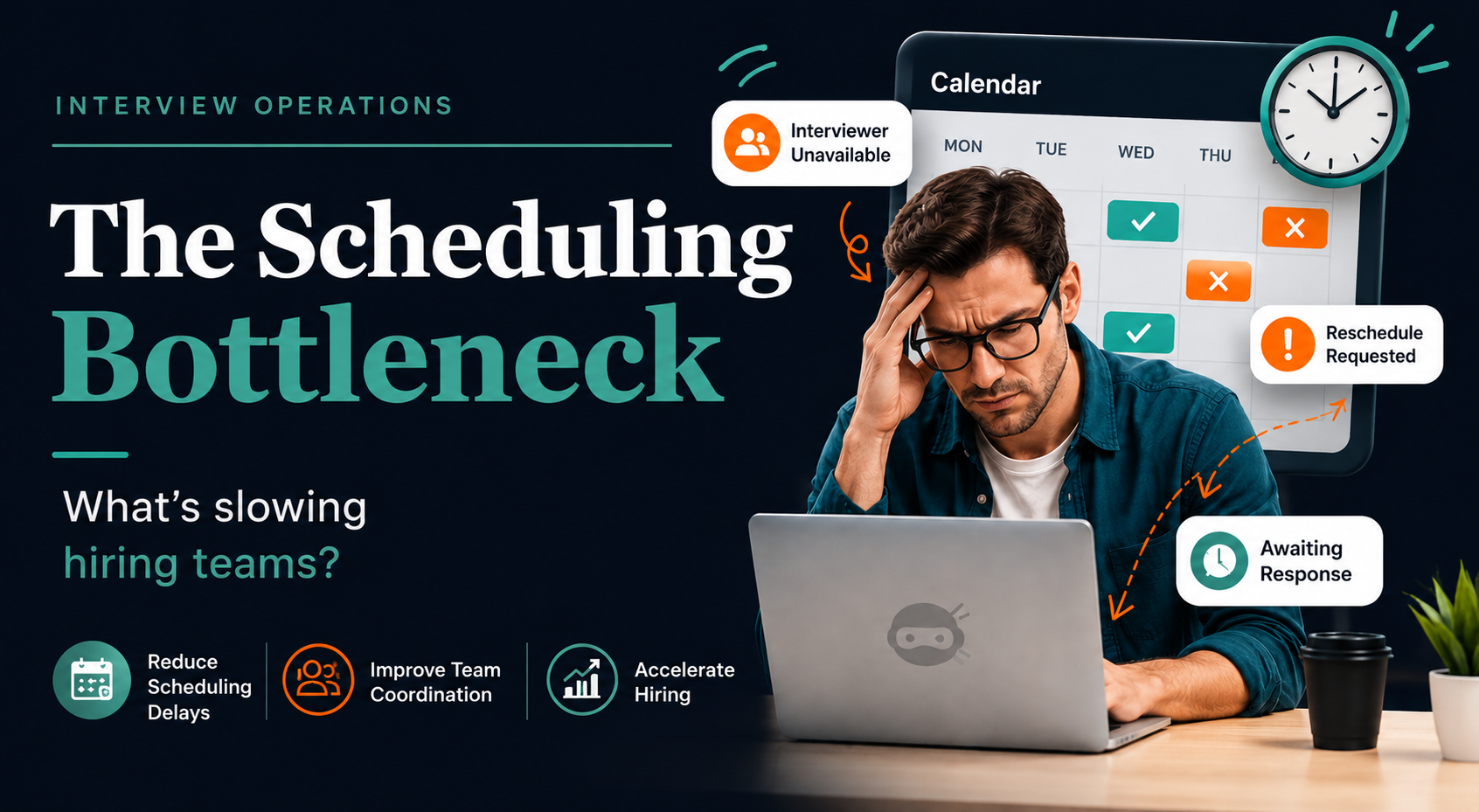
It was taking us an average of nine days just to get a qualified candidate through a technical panel loop. On paper, it looked like a sourcing issue or a candidate drop-off problem. In reality, it was pure administrative friction. A recruiter would find an exceptional infrastructure engineer on a Monday morning. The hiring manager would be eager to talk to them. But by the time we aligned three internal calendars across two time zones, sent the invite, and got confirmation, it was Tuesday of the following week.
By then, the candidate had already advanced to a final round with a more agile competitor.
We were paying premium salaries to experienced talent acquisition professionals, yet they were spending roughly 15 hours a week acting as glorified calendar coordinators—playing email telephone, tracking down unresponsive panel members, and manually rewriting confirmation emails.
When you are scaling a distributed organization, coordination isn’t an administrative footnote. It is the core delivery engine. Here is how we dismantled the scheduling bottlenecks that were stalling our pipeline, without burning out our team or compromising our hiring standards.
The Actual Mechanics of a Coordination Bottleneck
When we sat down to audit our process, we realized we hadn't defined "interview coordination" correctly. We treated it as a simple, detached task: Candidate passes screen -send an invite.
But inside a complex or distributed hiring environment, coordination is an interconnected logistical chain. Every single handoff point is an opportunity for a delay to compound.
The breakdown almost never happens during the interview itself. It happens in the dead space between the steps. In our old model, a coordinator would manually review the open calendars of three busy software architects. They would find two potential slots for later in the week, type out a manual email to the candidate, and wait.
By the time the candidate replied twelve hours later, one of those architects had accepted a production review meeting, rendering the slot invalid. The loop would reset. This back-and-forth didn't just add days to our cycle; it signaled a lack of internal alignment to our candidates before they even met the team.
Why Distributed Teams Break Legacy Calendars
The shift to remote and hybrid work environments completely changed how internal calendars operate. In a traditional office, you could read the room, or a coordinator could walk over to a manager’s desk to lock down a 30-minute chat.
In a distributed model, calendars are heavily guarded. Engineers protect their focus time with dense blocks, internal syncs multiply across regions, and asynchronous communication creates natural response delays.
When you try to build a cross-functional interview panel—say, a product director in New York, a security lead in Berlin, and a backend engineer in San Francisco—you are no longer just scheduling a meeting. You are solving a timezone puzzle.
Without an automated baseline that continuously tracks these regional constraints and updates availability in real time, human coordinators spend their entire afternoon doing timezone math. The complexity increases exponentially with every location you add.
The Signs Your Operations Are Creeping Into the Red
Most talent acquisition leaders don't realize their scheduling workflow is broken until a major client account or department head escalates a complaint. But the operational indicators are visible much earlier if you know where to look.
- The Expiration Loop: Your coordinators are sending three or more emails just to secure one interview confirmation because slots keep filling up before the candidate can respond.
- The "Favorite Interviewer" Burnout: A tiny fraction of your engineering or management team is conducting 80% of the interviews. Why? Because recruiters look for the path of least resistance and keep booking the few people who respond to Slack messages quickly, while the rest of your trained panel remains untouched.
- The Post-Interview Silence: The conversation ends, the candidate is excited, but the pipeline stalls for four days because the interviewers haven't logged their scorecards, and the recruiter has no structural way to enforce the feedback timeline.
Operational Performance Realities
Rather than relying on vague impressions of how well your team is performing, look at these three baseline indicators to evaluate your pipeline stability:
- Scheduling Latency: The exact time that passes between a candidate clearing an initial screen and the final panel loop being officially locked in on the calendar. If this is over 48 hours, your process is creating an opening for competitors.
- Panel Attrition: The frequency of last-minute rescheduling requests from internal stakeholders. High cancellation rates mean your hiring culture doesn't treat talent acquisition as a core business priority.
- Scorecard Turnaround: The hours it takes to collect complete evaluation metrics after an interview finishes. When scorecards take days to come in, your team loses the ability to make fast, competitive offers.
Rethinking the Process: Moving Past the Email Chains
To fix our delivery velocity, we had to stop treating scheduling as a personal negotiation and start managing it like an operational workflow. We rebuilt our approach around three straightforward changes.
1. Calibrated Round-Robin Pools
We stopped letting recruiters pick their favorite interviewers. Instead, we mapped out our entire interviewing capacity across functional engineering groups. We built balanced, round-robin pools of calibrated interviewers.
When a panel interview was triggered, the system automatically assigned the next available, qualified evaluator from the pool. This immediately distributed the organizational load, eliminated internal burnout, and opened up far more potential calendar slots for our candidates.
2. Guarded Interview Windows
We worked with engineering leadership to build structured, recurring interview blocks directly into department calendars. Instead of trying to negotiate around ad-hoc project meetings every week, teams knew that Tuesdays and Thursdays from 2:00 PM to 5:00 PM were reserved for talent evaluation. If no interviews were booked 24 hours in advance, the time was automatically returned to them for focus work.
3. Automated Administrative Logistics
We removed the manual burden of generating video links, provisioning testing environments, and sending out calendar invites. We integrated NinjaHire directly into our team workflows.
Now, the moment a candidate cleared their initial technical assessment, the platform evaluated our round-robin pool availability across time zones and generated a dynamic self-scheduling link tailored specifically to that candidate's stage.
The candidate chose a slot, and the platform handled the rest behind the scenes—building the calendar events, attaching the correct evaluation guidelines for the interviewers, and provisioning the technical sandbox environments instantly.
The Results: What Happened to Our Pipeline Metrics
The shift from manual coordination to an automated, structured workflow changed the operational cadence of our talent acquisition team.
By removing the administrative friction, we saw a direct impact on our core hiring metrics within the first two months:
- Scheduling Latency: Our average time to secure a multi-person technical panel fell from 9.2 days to under 35 minutes. Candidates often booked their next round before hanging up from their initial recruiter call.
- Recruiter Focus Time: Our team reclaimed roughly 12 hours per week previously lost to calendar management, allowing them to focus back on proactive sourcing and deep candidate engagement.
- Interview-to-Offer Velocity: Our entire hiring cycle compressed by 17 days. By moving candidates through our evaluation stages faster, our offer acceptance rates scaled because we were consistently arriving at the offer stage ahead of other firms.
- Scorecard Compliance: By leveraging automated post-interview triggers via our internal communication channels, our average scorecard turnaround time dropped from 74 hours to just 11 hours, keeping our pipeline moving cleanly.
The Future of Interview Operations
The administrative side of recruiting is shifting toward hands-off orchestration. For operations leaders looking ahead, the goal isn't simply to find better calendar software—it's to remove the administrative middleman entirely.
We are moving toward systems that manage interviewer load balancing on their own, adjusting assignments based on real-time project deadlines and historical interview volumes. Predictive scheduling models will soon look at internal calendar patterns to flag the times when an interviewer is least likely to request a last-minute reschedule.
The less time your recruiters spend managing the logistics of a meeting, the more time they can spend evaluating talent and building authentic human connections.
Are Your Interview Operations Scale-Ready?
If your organization is preparing for a hiring push or expanding a distributed team, take a hard look at your current administrative workflow:
- Are your recruiters still typing out custom emails to negotiate calendar availability?
- Do last-minute internal meeting conflicts frequently disrupt your scheduled candidate loops?
- Are your hiring managers consistently logging their evaluation scores within 24 hours without manual reminders?
- Is your team's total time-to-hire expanding because candidates are sitting unmanaged between interview stages?
Building a scalable recruiting engine requires an infrastructure that eliminates administrative delays. If your team is spending more time managing calendars than engaging with talent, your current workflow is capping your growth.
Optimize Your Delivery Engine
Get past the manual logistics holding your talent acquisition back. Contact NinjaHire today for a practical, consultative review of your interview operations:
- Workflow Friction Mapping: A thorough review of the administrative steps slowing down your current candidate lifecycle.
- Recruiter Capacity Review: Measuring how much time your team is losing to routine manual entry and administrative tasks.
- Interviewer Load Analysis: Auditing your interview distribution to prevent stakeholder burnout and open up more pipeline availability.
- Automation Opportunity Assessment: Finding the highest-impact points where smart workflows can remove administrative bottlenecks.
Connect with an Operations Consultant to Review Your Workflow
Other insights






.jpg)