.png)
AI Hiring Software That Reduces Candidate Drop-Offs

May 28, 2026
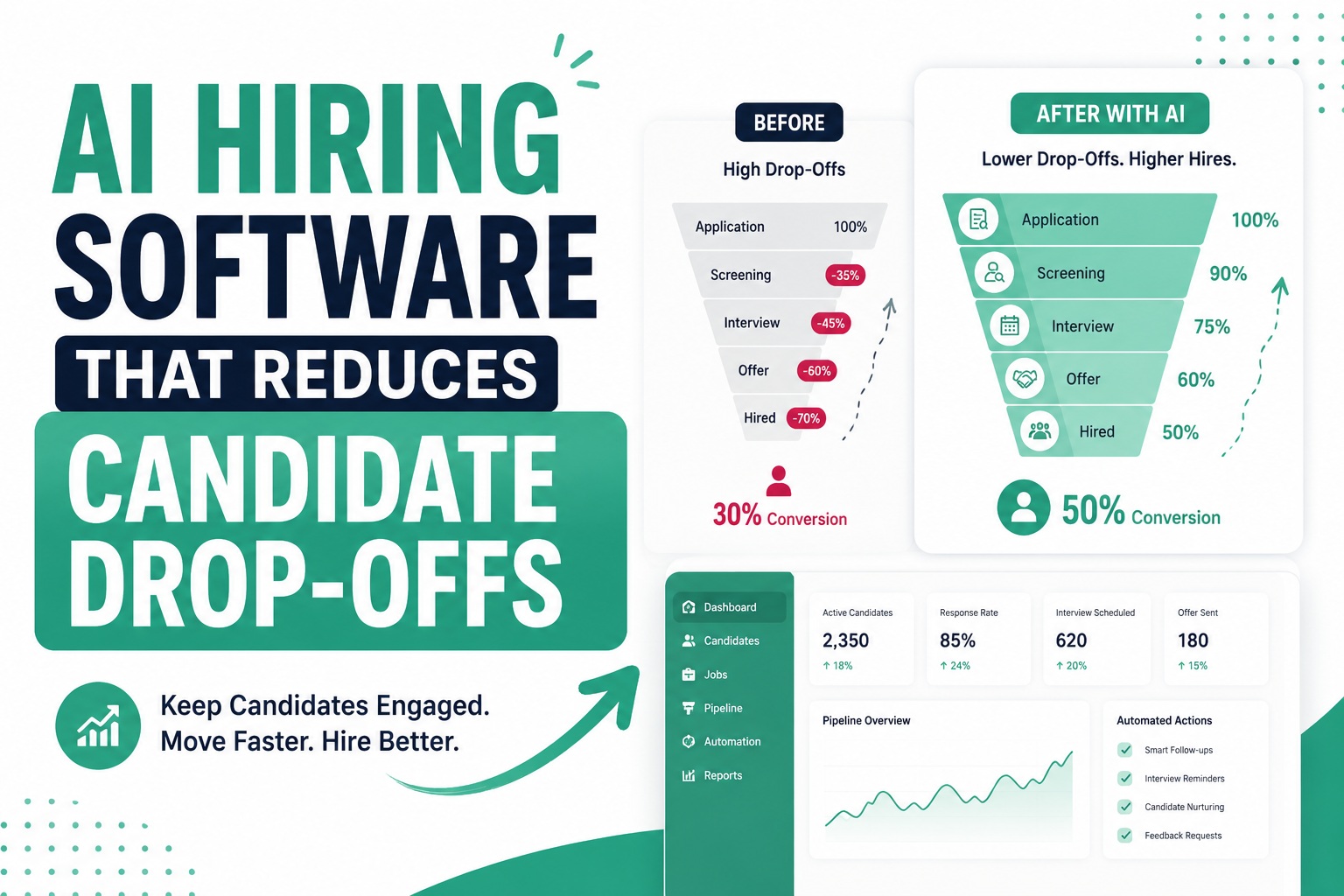
If you run a staffing agency or manage a high-volume talent acquisition team, you already know the real bottleneck isn’t finding candidates. It’s keeping them.
Every day, solid talent slips out of your hiring funnel. It happens when a qualified applicant finishes a screening call, waits four days for an update, gets impatient, and accepts an offer from a competitor who moved faster. It happens when an enterprise recruiter gets buried under 300 applications, forgets to send a calendar link, and lets a great pipeline go cold.
Candidate ghosting, interview no-shows, and hiring funnel leakage are rarely caused by a lack of candidate interest. Instead, they are operational workflow problems. When recruiter response speeds drop and manual scheduling loops take over, candidate engagement breaks down.
For high-volume hiring teams and staffing firms, manually managing every touchpoint is no longer sustainable. Resolving this requires shifting away from basic database tracking and moving toward active candidate pipeline automation.
Why Candidates Drop Out of Hiring Pipelines
Candidates drop out of hiring pipelines primarily because of slow communication, manual scheduling delays, and fragmented follow-ups. When talent acquisition teams rely on manual workflows to move applicants through the hiring funnel, lag times naturally increase. Candidates interpret long periods of silence as a lack of interest, leading them to disengage, ghost recruiters, or accept competing offers.
What causes candidate drop-offs in recruiting?
The root cause of candidate pipeline leakage is a mismatch between recruiter capacity and communication speed. Manual recruiting bottlenecks—like back-and-forth email scheduling, delayed screening feedback, and a lack of consistent nurturing—create dead zones where candidates feel ignored and abandon the process.
[QUOTE CARD: “Most candidate drop-offs happen because recruiting workflows move too slowly.”]
When analyzing your recruiting funnel, drop-offs generally stem from three distinct operational friction points:
- The Black Hole Effect: Applicants submit a resume and hear nothing for a week. By the time a recruiter reaches out, the candidate has already moved on.
- Scheduling Friction: A recruiter sends an email to book an interview, the candidate replies the next day, the recruiter checks their calendar a day later, and the slot is gone. This back-and-forth loop drags out hiring cycles.
- Inconsistent Follow-Ups: Recruiters get overwhelmed by high req loads, causing them to prioritize immediate placements while letting secondary pipelines or silver-medalist candidates go completely cold without updates.
What Is AI Hiring Software?
AI hiring software is an operational technology layer that integrates with your existing applicant tracking system (ATS) to automate candidate engagement, screening, and interview scheduling workflows.
Unlike traditional databases that merely store resume data, AI recruiting software actively manages the candidate pipeline. It uses intelligent workflows to interact with applicants in real time, answer common questions, collect screening details, and move qualified talent directly into a recruiter's calendar without manual intervention.
Where Candidate Drop-Offs Actually Happen
Pipeline leakage doesn't occur all at once; it happens at specific handoff points throughout the hiring lifecycle. To fix it, you need to look at each stage of your funnel as an operational milestone.
The table below breaks down exactly where talent acquisition teams lose candidates and how recruiting workflow automation solves the problem.
The AI Hiring Workflows That Improve Candidate Engagement
To scale your placements without burning out your delivery managers, you need to transition your team away from manual administrative work. Implementing targeted recruiting funnel automation ensures no candidate is left waiting.
AI Follow-Up Automation
When high-volume hiring teams manage hundreds of applicants across multiple job orders, manual follow-ups inevitably slip through the cracks.
- The Problem: Recruiters focus on candidates closest to an offer, leaving early-stage applicants waiting days for feedback.
- The Automation: When a candidate changes status in your workflow, an automated, personalized SMS or email triggers instantly. Whether it's an interview confirmation or a polite rejection, communication is immediate.
- Recruiter Impact: Recruiters save hours every week on manual drafting, while candidates receive real-time visibility into their application status.
AI Scheduling Automation
Calendar management is one of the single biggest drains on recruiter productivity.
- The Problem: Playing phone tag to lock down a 15-minute phone screen delays the hiring cycle by days, giving candidates time to disengage.
- The Automation: Once a candidate passes initial criteria, the system automatically sends a dynamic scheduling link. The candidate picks a time that works for them, and the meeting is populated across both calendars along with video links or dial-in details.
- Recruiter Impact: Eliminates scheduling administrative tasks entirely, filling calendars with pre-qualified interviews while reducing no-shows through automated text reminders.
AI Candidate Nurturing
Most staffing firms sit on goldmines of archived talent inside their ATS, but rarely have the time to engage them effectively.
- The Problem: Thousands of previous applicants remain untouched because recruiters only focus on active, incoming applications.
- The Automation: Re-engage past candidates by matching their profiles with new openings via targeted, automated outreach campaigns. The system checks their availability and interest before handing them off to a human recruiter.
- Recruiter Impact: Builds a warm, predictable talent pipeline, significantly lowering your overall cost-per-hire and dependency on job boards.
AI Communication Workflows
Modern candidates prefer quick, direct communication over formal, long-form emails that sit unread in crowded inboxes.
- The Problem: Traditional email outreach often sees low open and response rates, which slows down pipeline velocity.
- The Automation: Deploy multi-channel communication strategies that combine email with automated SMS workflows. This ensures urgent updates—like schedule changes or interview preparations—reach the candidate's phone instantly.
- Recruiter Impact: Drastically increases response rates and cuts down overall time-to-hire.
AI Screening
Reviewing every single inbound application manually creates a severe operational bottleneck at the top of your hiring funnel.
- The Problem: Recruiters spend hours scanning resumes, often missing top talent simply because they couldn't review the application fast enough.
- The Automation: Introduce interactive, conversational screening workflows immediately following an application. The system collects essential data points—such as shift availability, certifications, and salary expectations—to bubble up the most qualified profiles.
- Recruiter Impact: Teams shift their energy away from cold database filtering and spend their time talking to pre-qualified applicants.
Workflow Reminders
Interview no-shows often happen simply because a candidate forgot or lacked clear logistics information.
- The Problem: Candidates miss interviews because they lost track of the invite details, or didn't receive a confirmation reminder.
- The Automation: Set up automated text and email notifications that go out 24 hours and 2 hours before a scheduled interview. These messages include location details, video links, and an easy option to reschedule if plans change.
- Recruiter Impact: Drastically reduces interview no-shows, protecting your team's schedule and preserving your clients' trust.
How AI Hiring Software Improves Candidate Pipeline Efficiency
By removing manual friction points from your day-to-day operations, your recruiting funnel transforms from a leaky bucket into a highly predictable pipeline.
The operational difference between legacy manual processes and automated workflows comes down to speed, consistency, and scale.
How Staffing Teams Reduce Candidate Ghosting
Candidate ghosting is a direct symptom of communication delays. When a staffing firm lets a candidate sit in silence, that individual assumes the opportunity has closed or that the agency is disorganized. To reduce ghosting, staffing teams must prioritize speed, consistency, and accessibility.
- Optimize for Speed to Interest: In high-volume sectors, the firm that contacts the candidate first wins. Setting up automated outreach within minutes of an application ensures you engage talent while your role is still top-of-mind.
- Adopt Multi-Channel Outreach: Do not rely solely on email. Integrating SMS communication into your workflows achieves significantly higher open and response rates, keeping candidates engaged on the channels they use most.
- Provide Continuous Milestone Updates: Candidates ghost when they don't know where they stand. Automated nurturing workflows keep talent informed at every stage, explaining what comes next even during longer background checks or client review cycles.
- Simplify the Rescheduling Process: Sometimes candidates miss an interview due to unexpected personal conflicts. If rescheduling requires playing phone tag, they will often ghost. Providing a simple, automated link to reschedule with a single click preserves the relationship and keeps them in your pipeline.
Human Recruiters + AI Hiring Automation
A common misconception is that adding automation to your workflow makes the recruitment process feel cold or mechanical. In reality, the exact opposite is true.
When recruiters are forced to spend 70% of their day sending confirmation emails, copy-pasting tracking data, and chasing people for interview times, they have very little bandwidth left for actual human connection. They are forced to rush through phone screens and treat applicants like numbers on a spreadsheet.
By offloading repetitive, administrative tasks to intelligent software workflows, you give your team the time needed to build genuine relationships.
The goal isn't to replace human intuition or judgment with algorithms. The goal is to use automation to handle the logistics so your team can focus on what they do best: assessing culture fit, coaching candidates through interview prep, negotiating offers, and delivering an exceptional client experience.
To see how easy it is to set these guardrails up yourself, take a look at our step-by-step guide on how to build an AI-powered recruiting workflow from scratch without a tech team.
How to Choose AI Hiring Software
Every software vendor claims to use AI, but not every platform is built to solve operational recruiting challenges. When evaluating systems for your staffing agency or enterprise talent team, skip the high-level marketing buzzwords and focus on core operational functionality:
- Native Workflow Automation: Can the platform trigger specific actions based on changes within your pipeline stages? If you move a candidate to "First Interview," will it automatically send the calendar link and update your tracking?
- Deep Integration Capabilities: Does the software sit cleanly on top of your existing ATS? You don't want your recruiters logging into five separate databases just to send a text message or view a screening result.
- Multi-Channel Communication: Look for systems that support seamless email and SMS delivery from a unified platform, allowing you to meet candidates wherever they are most responsive.
- Intuitive Usability: If a system is overly complicated, your recruiters won't use it. Choose a platform built with an intuitive interface that requires minimal training to deploy.
- Clear Pipeline Analytics: Can the software show you exactly where applicants drop out? Look for robust reporting tools that track response times, interview conversion rates, and overall pipeline velocity.
Conclusion
Plugging the leaks in your hiring funnel isn't about sourcing more resumes; it's about optimizing the candidate journey you already have. When you eliminate manual scheduling delays, automate tedious follow-ups, and keep candidates continuously informed, drop-off rates naturally decline.
NinjaHire provides the underlying recruiting workflow automation tools that staffing agencies and talent teams need to keep their hiring pipelines moving smoothly. By managing the logistics of screening, communication, and scheduling automatically, NinjaHire allows your recruiters to focus on closing placements.
Ready to improve your candidate pipeline efficiency? Start Free with NinjaHire today