.png)
.jpeg)
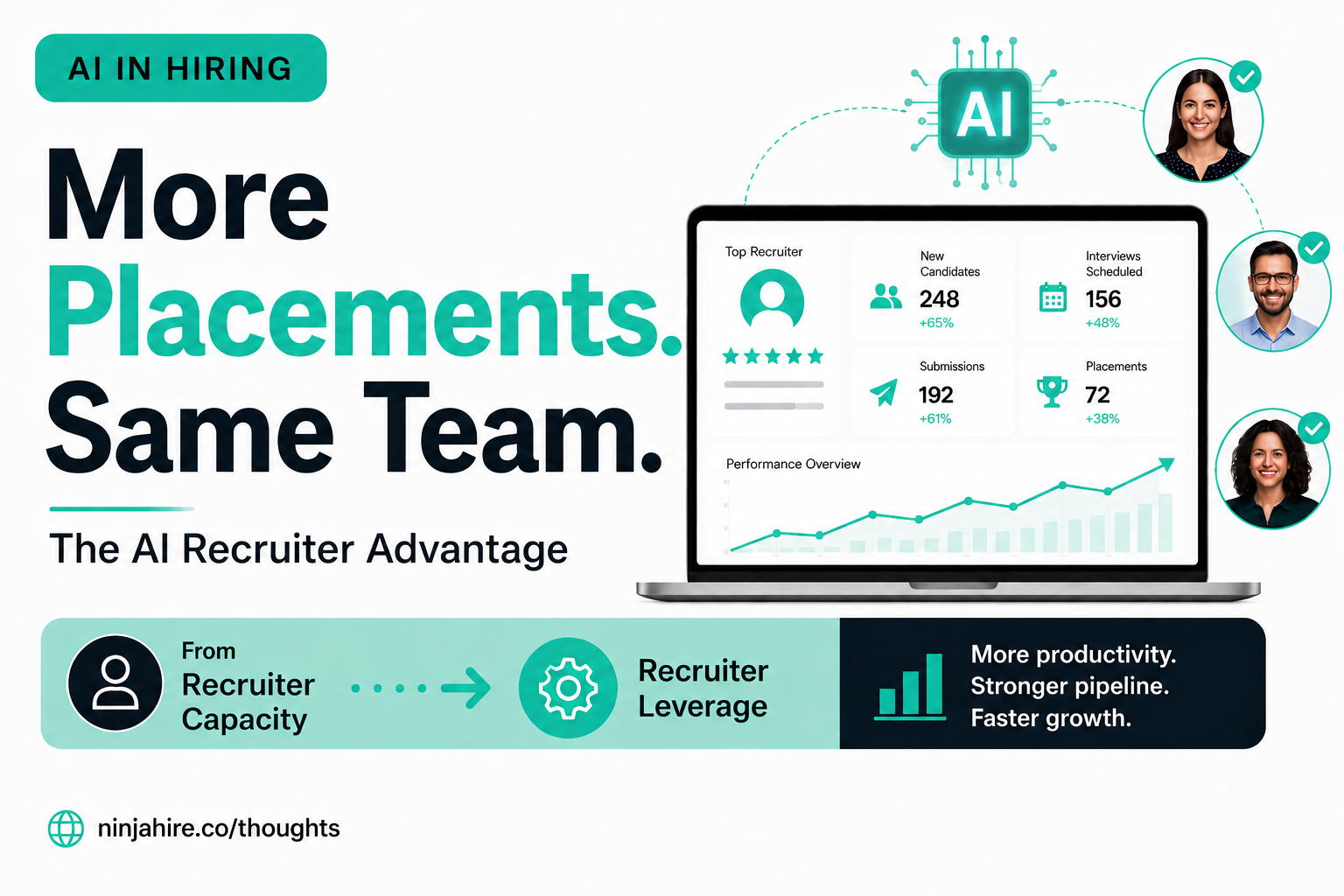
Every staffing agency founder recognizes the pattern. You hit a revenue target and hire more recruiters. Headcount grows, overhead grows, complexity grows. Somewhere around fifteen recruiters you realize each new hire produces less than the first five did. Margins thin. Growth feels like a treadmill.
The agencies breaking this pattern are not finding better recruiters. They are building better recruiting infrastructure. AI recruiter software turns each recruiter into a force multiplier: sourcing hundreds of candidates simultaneously, engaging talent across channels without manual follow-up, and generating placement activity that would have required three times the headcount two years ago.
This guide covers what AI recruiter software is, how it works, what it replaces, and how staffing agencies can evaluate whether their current stack supports the next level of scale.
of recruiters spend more than half their time on automatable tasks
LinkedIn Talent Solutions, 2024
more placements possible per recruiter with AI-assisted workflows
Staffing Industry Analysts, 2024
of staffing firms cite recruiter capacity as their primary growth constraint
SHRM, 2024
global staffing industry market size, with AI accelerating consolidation
Staffing Industry Analysts, 2025
Why Staffing Agencies Hit Growth Ceilings
Every agency scales the same way early on: a few high-performing recruiters, strong founder relationships, a focused niche. Then demand increases and the solution feels obvious: hire more. But linear headcount scaling produces diminishing returns faster than most founders expect.
Deloitte's Global Human Capital Trends report found that organizations relying primarily on headcount to scale recruiting see an average productivity decline of 18 percent per hire once teams exceed twelve recruiters. Coordination complexity and management overhead begin to offset each new hire's output.
Key Insight
The growth ceiling most staffing agencies hit is not a talent ceiling. It is a workflow ceiling. The bottleneck is not the number of people doing the work. It is the volume of work each person can execute at the quality level clients expect.
Table 1: Recruiting Growth Bottlenecks
| Bottleneck | Hours Lost / Week | Primary Impact | AI Automatable |
|---|---|---|---|
| Candidate Sourcing | 8 to 12 | Pipeline volume limits | 70 to 85% |
| Follow-Up Outreach | 6 to 10 | Candidate drop-off | 80 to 90% |
| Resume Screening | 5 to 8 | Slow pipeline advancement | 60 to 80% |
| Interview Scheduling | 4 to 7 | Candidate experience degradation | 85 to 95% |
| Client Reporting | 3 to 5 | Account management overhead | 75 to 90% |
| Talent Re-Engagement | 2 to 4 | Underutilized candidate database | 80 to 90% |
A recruiter managing a full pipeline in a traditional operation loses between 28 and 46 hours per week to tasks that could be automated. Recruiting at full capacity is structurally impossible under a manual workflow model.
What Is AI Recruiter Software?
Definition: AI Recruiter Software
AI recruiter software is a technology platform that uses artificial intelligence to automate the core operational tasks of recruiting: candidate sourcing, resume screening, candidate engagement, interview scheduling, and workflow coordination. Unlike a traditional ATS, which stores and organizes recruiting data, AI recruiter software actively executes recruiting tasks, enabling each recruiter to manage significantly higher candidate and placement volumes.
The simplest way to understand AI recruiter software is through what it does versus what traditional tools do. An ATS records what happened. AI recruiter software executes what needs to happen next.
Where a traditional workflow requires a recruiter to manually review candidates, write outreach, track responses, and repeat for each person in the pipeline, an AI recruiter platform executes those steps autonomously. Recruiters stop spending most of their time on execution and start spending it on judgment: evaluating candidates, managing clients, negotiating offers, and solving placement challenges that require genuine human expertise.
How AI Recruiter Software Works: The Five Pillars
AI Candidate Sourcing
Multi-source talent discovery with ranked shortlists generated automatically from job matching models.
AI Candidate Screening
Automated resume parsing, fit scoring, and skills extraction without manual review of every profile.
AI Candidate Engagement
Multi-touch, multi-channel outreach sequences that keep candidates engaged throughout the lifecycle.
AI Workflow Coordination
Automated sequencing of recruiting stages, handoffs, scheduling, and routing based on pipeline status.
AI Recruiting Analytics
Real-time pipeline visibility and recruiter productivity insights for operational decision-making at scale.
When all five pillars operate as an integrated system, the compound effect on productivity is significant. Recruiters are no longer the bottleneck. The pipeline becomes self-advancing, with AI handling execution and recruiters managing strategy and relationships.
"The agencies building durable competitive advantage are treating their recruiting technology as infrastructure, not as software. Infrastructure does the work. Software just stores the records."Staffing Operations Executive
The Recruiter Productivity Problem
The most consistent finding across major recruiting research is the same: recruiters spend the majority of their time on work that does not require a recruiter. LinkedIn Talent Solutions shows recruiters spend an average of 13 hours per week sourcing for a single role. SHRM data indicates administrative tasks consume 30 to 40 percent of recruiter time. Gartner found workflow inefficiency costs organizations 22 percent of recruiter productivity annually.
spent sourcing candidates for one role per week, per recruiter
LinkedIn Talent Solutions, 2024
of recruiter time spent on administrative and coordination tasks
SHRM, 2024
annual productivity loss from recruiting workflow inefficiency
Gartner, 2024
lost per recruiter daily switching between fragmented tool stacks
Josh Bersin Research, 2024
Table 2: Recruiter Time Allocation (Traditional Workflow)
| Activity | Avg Hours / Week | % of Work Week | AI Automatable |
|---|---|---|---|
| Sourcing and Search | 10 to 14 | 25 to 35% | 70 to 85% |
| Outreach and Follow-Up | 8 to 12 | 20 to 30% | 80 to 90% |
| Resume Screening | 5 to 8 | 12 to 20% | 60 to 80% |
| Interview Scheduling | 3 to 6 | 7 to 15% | 85 to 95% |
| Pipeline Reporting | 2 to 4 | 5 to 10% | 75 to 90% |
| Relationship Building | 5 to 8 | 12 to 20% | Requires human judgment |
| Client Communication | 3 to 5 | 7 to 12% | Partial: 40 to 60% |
How AI Recruiter Software Improves Productivity
Table 3: Traditional vs. AI-Enabled Recruiting Productivity
| Task | Traditional | AI-Enabled | Gain |
|---|---|---|---|
| Sourcing | Manual; 1 to 2 platforms; 10 to 14 hrs/week | Automated multi-source; shortlists in minutes | 3 to 5x more candidates reviewed |
| Outreach | Manual; ~40 to 60 candidates managed | AI sequences; 200 to 500+ candidates managed | 4 to 8x pipeline capacity |
| Screening | 3 to 6 min per resume, manual | AI score and flag; reviewed in seconds | 10 to 20x faster qualification |
| Scheduling | Email back-and-forth; 2 to 4 days | Automated link; same-day booking | 85 to 95% time reduction |
| Follow-Up | Under 2 touchpoints per candidate | 6 to 10 automated touchpoints | 2 to 3x response rate improvement |
| Reporting | 2 to 4 hrs per client report | Real-time dashboards; automated | 75 to 90% time reduction |
Operational Insight
The agencies achieving the highest placement-to-recruiter ratios have automated the execution layer of recruiting so thoroughly that each recruiter spends most of their time on the activities that directly drive placements: relationship management, candidate evaluation, and client engagement.
ATS vs. AI Recruiter Software: What Is the Difference?
An ATS is a record-keeping and workflow tracking system. It captures applications, stores candidate data, and tracks stage progression. It does not execute recruiting work; it records that recruiting work was done. AI recruiter software is an execution layer that uses ATS data to actively drive sourcing, outreach, screening, and coordination without requiring recruiter action at each step.
Table 4: ATS vs. AI Recruiter Software
| Capability | Traditional ATS | AI Recruiter Software |
|---|---|---|
| Primary Function | Track and record recruiting activity | Execute and automate recruiting workflows |
| Candidate Sourcing | Job board posting only | AI-driven multi-source sourcing |
| Candidate Screening | Keyword filtering only | AI scoring and ranked shortlists |
| Candidate Engagement | Manual sends only | Automated multi-channel sequences |
| Scheduling | Manual coordination | Automated with calendar integration |
| Intelligence | Static data system | Learns from placement outcomes |
| Talent Pool Activation | Manual search required | Automated re-engagement campaigns |
| Scalability Model | Scales with headcount | Scales with infrastructure |
| Reporting | Activity tracking only | Real-time pipeline analytics |
Key Distinction: An ATS tells you what happened in your pipeline. AI recruiter software drives what happens next. Both are necessary. Only one creates the recruiter leverage that allows staffing agencies to scale placement volume without scaling headcount proportionally.
Features Staffing Agencies Should Look For
Not all AI recruiter software delivers the same capabilities. Many products use AI terminology to describe what are essentially upgraded versions of traditional recruiting tools. The checklist below covers the capabilities that distinguish true AI recruiter software.
Table 5: AI Recruiter Software Buyer Checklist
| Feature | Core Question | Minimum Standard |
|---|---|---|
| AI Sourcing | Does it source across multiple channels automatically? | At least three integrated sourcing channels with ranked output |
| Screening | Does it score candidates without manual review of every profile? | Automated fit scoring with configurable criteria |
| Engagement | Does it execute multi-touch outreach without recruiter action per step? | Minimum five-step sequences across two channels |
| Scheduling | Does it eliminate manual scheduling coordination? | Automated scheduling with calendar integration |
| ATS Integration | Does it sync with your ATS bidirectionally? | Native or documented API integration |
| Analytics | Does it provide real-time pipeline and performance data? | Live dashboards without manual report generation |
| Scalability | Can one recruiter manage significantly more candidates? | Evidence of at least 3x candidate capacity increase |
How Fast-Growing Staffing Agencies Use AI Recruiter Software
IT Staffing Technology Recruiting at Scale
IT staffing firms operate in one of the most candidate-constrained markets in recruiting. AI recruiter software enables these agencies to execute faster at the sourcing and engagement stage. When a new requisition opens, the system immediately searches talent pools and external sources, initiates personalized outreach within hours, and begins a structured follow-up sequence. AI-enabled IT staffing operations consistently reduce time-to-first-qualified-candidate-presentation by 40 to 65 percent compared to manual workflows.
Healthcare Staffing Compliance-Sensitive High-Volume Recruiting
Healthcare staffing operates under complex compliance requirements. AI recruiter software addresses this by automating candidate engagement sequences that keep professionals moving through credentialing pipelines, and by surfacing compliance status within recruiter dashboards so no placement is delayed by a missed document request. Agencies using workflow automation report 30 to 50 percent reductions in time-to-placement for travel nursing and per diem assignments.
Executive Search Relationship-Driven Recruiting with AI Precision
Executive search professionals often worry that automation undermines their relationship-driven model. In practice, AI recruiter software handles research, outreach coordination, and scheduling logistics: the operational work that does not require human development of relationships but still consumes significant recruiter time. This frees search professionals to focus on the conversations and counsel that constitute their actual value. Research and initial outreach cycles typically compress by 50 to 70 percent.
MSP Recruiting Managed Service Program Operational Excellence
MSP recruiting involves high-frequency, multi-client operations with tight SLA requirements and structured reporting obligations. AI recruiter software automates requisition intake, candidate matching, and submission workflows. When a new req comes in through the VMS, the system identifies matching candidates, initiates outreach, coordinates scheduling, and generates the submission-ready candidate profile. MSP leaders report managing 30 to 50 percent more client programs per recruiter without SLA deterioration.
High-Volume Staffing Light Industrial, Retail, and Logistics
High-volume staffing is where AI recruiter software capacity advantages are most immediately visible. When a recruiter is responsible for filling 50 to 100 positions per week, manual workflows make the target mathematically impossible. AI sourcing identifies available candidates in target labor markets. Automated screening identifies placement-ready candidates by availability and location. High-volume operations using AI recruiter software report fill rate improvements of 25 to 45 percent and time-to-fill reductions of 40 to 60 percent driven entirely by workflow automation.
From Recruiting Automation to Agentic Recruiting
The most important development in recruiting technology in 2025 is a fundamental shift in how AI operates within recruiting workflows. The industry is moving from AI-assisted recruiting, where AI helps humans work faster, to agentic recruiting, where AI autonomously plans and executes multi-step workflows on behalf of the organization.
In agentic recruiting, the AI does not wait for a recruiter to initiate each action. It operates proactively: monitoring new requisitions, identifying matching candidates, launching engagement workflows, and coordinating next steps based on defined criteria. Gartner projects organizations adopting agentic AI in talent acquisition will achieve 35 to 60 percent reductions in cost-per-hire by 2027.
The Agentic Recruiting Advantage
Agentic recruiting is not about removing recruiters from the process. It is about elevating what recruiters do within the process. When AI handles execution, recruiters focus exclusively on the judgment and relationship work that creates placement outcomes.
Choosing the Right AI Recruiter Software
The AI recruiting software market has grown significantly and ranges from point solutions with bolt-on AI features to purpose-built recruiting infrastructure platforms. The questions below separate genuine AI recruiter software from tools that use AI terminology to describe incremental improvements.
- Does it automate sourcing? Not just job posting. Active AI-driven candidate identification from multiple sources.
- Does it automate engagement? Not just email templates. Triggered multi-touch sequences that execute without recruiter action per message.
- Does it reduce recruiter workload measurably? Vendors should provide documented productivity evidence, not just feature lists.
- Does it integrate with your ATS? Bidirectional data sync matters. Manual data transfer eliminates productivity gains.
- Does it increase placements per recruiter? The ultimate ROI metric for a staffing business is placements, not activities.
- Does it support agentic workflows? Can it execute multi-step sequences autonomously, or does it require recruiter initiation at each stage?
Table 6: AI Recruiter Software Evaluation Matrix
Why Recruiting Infrastructure Matters More Than Recruiter Headcount
There is a strategic insight at the center of every high-growth staffing agency built in the last three years: recruiter headcount is a linear growth model. Recruiting infrastructure is an exponential one. When you invest in infrastructure that multiplies each recruiter's output by a factor of three or four, you get a fundamentally different business. Revenue per recruiter increases, cost per placement decreases, and margin expands.
"The staffing firms that win the next decade will not be those with the most recruiters. They will be those with the most productive recruiters. That distinction is determined almost entirely by the quality of the infrastructure those recruiters operate on."Staffing Agency Operations Leader
Staffing Industry Analysts data shows that top-performing staffing firms by gross margin percentage in 2024 consistently have 20 to 35 percent higher revenue per recruiter than the industry average. The operational difference in every case is the degree to which those firms have automated the execution layer of their recruiting operations.
higher revenue per recruiter at top-performing staffing firms vs. industry average
Staffing Industry Analysts, 2024
candidate pipeline capacity per recruiter on AI-enabled platforms
NinjaHire Platform Data, 2024
projected cost-per-hire reduction from agentic AI adoption by 2027
Gartner, 2024
productivity decline per recruiter when teams scale past 12 without automation
Deloitte, 2024
Modern staffing agencies require recruiting infrastructure capable of sourcing, engaging, coordinating, and executing workflows at a level that manual operations cannot match. NinjaHire was built as a recruiting infrastructure platform for agencies serious about scaling placement volume without proportional headcount growth. The platform integrates AI-driven sourcing, automated engagement, intelligent screening, workflow orchestration, and real-time analytics into a single operating environment that gives each recruiter the leverage to execute at a level traditional tools cannot support.
The Future Belongs to Staffing Agencies That Build Leverage, Not Just Teams
The staffing industry is at an inflection point. The agencies that grow over the next decade will not necessarily be those with the most recruiters. They will be the ones that figured out how to make each recruiter extraordinarily productive, building operational leverage that scales revenue without scaling overhead at the same rate.
AI recruiter software is the primary mechanism through which that leverage is built. Not because AI is a trend worth chasing, but because the tasks that have historically constrained recruiter productivity are now automatable at a quality and scale that makes a structural difference in how a staffing operation performs.
The question every staffing agency leader should be asking right now is not whether to invest in AI recruiting technology. It is whether their current technology is designed to help recruiters execute more work or simply to help them track the work they are already doing manually. Those are different products. And the gap between them is the gap between agencies that scale and agencies that plateau.