Prompts and Workflow

AI Recruitment Playbook: How Staffing Teams Use Claude to Source Faster

Praneeth Patlola
Founder, Ninjahire
.
5 min read

July 3, 2026

AI Recruitment Playbook: How Staffing Teams Use Claude to Source Faster
Staffing Strategy & Intelligence Playbook

AI Recruitment Playbook: How Staffing Teams Use Claude to Source Faster

The delivery machinery of modern staffing firms is experiencing an operational shift. Recruiters regularly spend a major portion of their desk hours on manual administrative tasks: interpreting complex job parameters, formatting boolean parameters, and drafting inbound campaigns from scratch. This workflow capacity limit impacts time-to-fill and placement growth across active accounts.

To clear these processing blockages, strategic recruitment teams use large language models like Anthropic's Claude. Moving past simple text-matching software, Claude’s deep semantic understanding maps talent footprints across complex domains, parses messy resumes cleanly, and optimizes outbound communications instantly.

Key Takeaways

  • Linguistic Framework Sourcing: Claude reads transferable engineering capabilities across adjacent industries beyond raw keyword matching.
  • Cycle Time Compression: Automating background screening and list formatting reduces early-stage turnaround to hours.
  • Human Core Focus: Offloading documentation mechanics frees recruitment specialists to focus completely on candidate relationship building and locking in offers.

What Is AI Recruitment?

Direct Definition

AI recruitment represents the strategic implementation of machine learning models, natural language processing, and automated software architecture to manage, optimize, and execute various stages of the talent acquisition lifecycle.

Rather than replacing human oversight, modern AI recruitment ecosystems act as persistent execution multipliers. The engine scans unstructured text blocks, matches incoming applicants against capabilities, organizes screening structures, and manages multi-channel engagement. This systematization handles database data congestion while keeping processing costs structured.

Why Staffing Teams Are Using Claude

Direct Answer

Recruitment groups utilize Claude primarily because its advanced reasoning model excels at handling complex, unstructured contextual datasets, which are common in staffing workflows like multi-page resumes, detailed job descriptions, and legal client contract parameters.

Claude’s massive context window enables it to trace candidate growth trajectories and flag experience inflation easily. Furthermore, the engine natively generates a professional, consultative conversational tone, making it perfect for preparing sharp submission summaries and unique outreach scripts that stand out in active talent channels.

10 Recruiting Tasks Claude Can Accelerate

Staffing teams use Claude to scale operations across ten core responsibilities:

1. Writing Complex Boolean Searches

Extracts core criteria from raw JDs and generates optimized Boolean strings for active databases.

2. Summarizing Dense Resumes

Condenses multi-page professional histories into scannable candidate snapshots highlighting milestones.

3. Creating Personalized Outreach Emails

Maps a profile directly to open job requirements, drafting highly specific cold emails.

4. Writing Targeted LinkedIn Messages

Compresses value metrics into concise, character-compliant InMail scripts.

5. Generating Behavioral Interview Questions

Builds targeted verification scorecards focused on complex technical proficiencies.

6. Executing Multi-Candidate Comparisons

Compares anonymized finalist records side-by-side inside an objective suitability matrix.

7. Optimizing Confusing Job Descriptions

Transforms rough client specification logs into clear, performance-oriented career descriptions.

8. Extracting Hidden Niche Skills

Parses unstructured project summaries to uncover secondary tools or environmental competencies.

9. Conducting Early Market Research

Maps regional talent densities and competitor organization footprints in new territories.

10. Drafting Vetted Recruiter Submission Notes

Polishes raw phone screen logs into structured, professional summaries ready for client reviews.

Claude vs. Traditional Recruiting Workflows

Process StageTraditional Manual TrackClaude-Assisted Track
Search Parameter DesignRecruiters spend 45 minutes testing keyword combinations.Outputs optimized search syntax across databases instantly.
Initial Profile ReviewManual reading of lengthy histories to isolate specific tool criteria.Extracts capability matches and flags gaps in seconds.
Outreach CreationDrafting template strings or manually formatting personalized blasts.Generates targeted, contextual outreach copies instantly.
Submission PrepManually re-typing recruiter screen text into formatted client summaries.Formats raw notes into client-facing summaries immediately.

Claude vs. ChatGPT for Recruiters

Direct Answer

While both platforms serve as useful business extensions, Claude’s larger context window and emphasis on analytical reasoning make it uniquely suited for processing extensive, data inputs like resumes and regulatory contracts safely.

ChatGPT performs cleanly for quick, high-impact conversational phrasing updates or immediate messaging text. However, for thorough evaluation tracking, Claude's linguistic parsing offers deeper contextual safety. It handles large multi-page records without dropping background parameters and maintains a highly consistent consultative voice.

Download the AI Recruitment with Claude Playbook

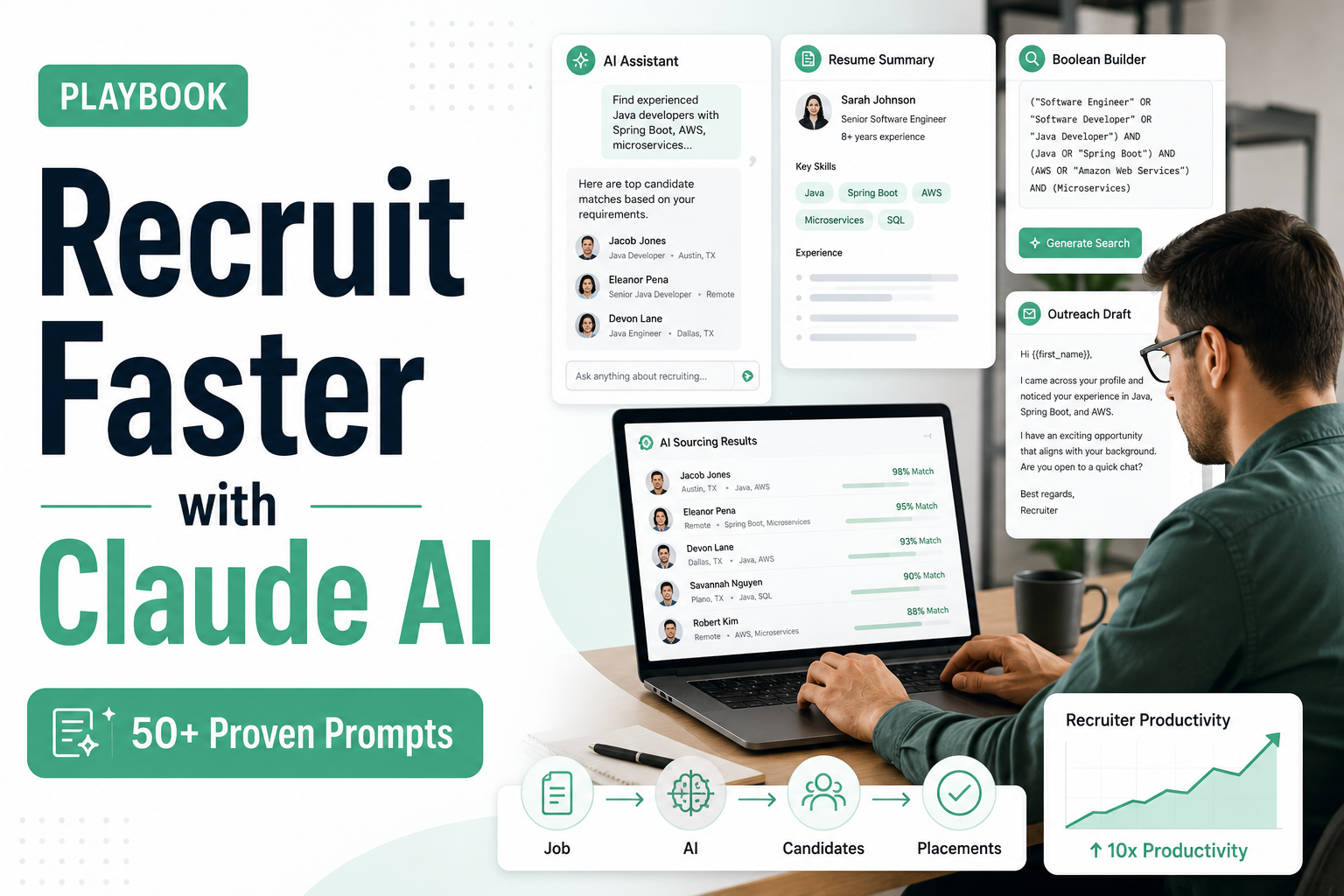
Get 50+ proven Claude prompts built specifically for staffing recruiters. Learn how to generate Boolean searches, summarize resumes, write personalized outreach, and improve recruiter productivity.

Download the Claude Playbook

The AI Recruitment Workflow

Integrating artificial intelligence across delivery setups requires an integrated approach. True efficiency happens when teams move past individual lookups and construct a unified loop connecting intake optimization with final submittals.

Job Intake ➔ Job Description Optimization ➔ Boolean Search Generation ➔ Candidate Sourcing ➔ Resume Review ➔ Candidate Outreach ➔ Screening ➔ Submission ➔ Placement

Where Human Recruiters Still Win

Key Takeaway

Artificial intelligence cannot replicate the human emotional intelligence, cultural assessment capabilities, and sophisticated negotiation strategies required to secure elite candidate commitment.

Large language models process text fields instantly, but they cannot form bonds with a passive candidate. Recruiters are indispensable for key relationship steps: qualification discovery, navigating complex compensation parameters, advising hiring managers on strategy, and closing final offers.

Common Mistakes Recruiters Make With Claude

Staffing teams can minimize platform friction by avoiding these four common tactical errors:

  • Missing Human Verification: Using outputs directly without checking credentials can allow tracking anomalies to slip into submissions.
  • Vague Query Structuring: Submitting simple requests like "find software engineers" yields generic results rather than aligned criteria pipelines.
  • Over-reliance on Automated Copy: Leaving messaging tracks completely unedited limits response spikes across critical candidate channels.
  • Data Compliance Mistakes: Putting sensitive internal identities or client pricing structures into public tools creates unnecessary operational exposure.

Mini Case Study: Scaling Processing Velocity

A high-volume contract staffing firm with 30 recruiters was struggling with a 5-day cycle time across target VMS accounts due to manual screening delays. By redesigning their pipeline with automated semantic screening frameworks, candidate matching tools, and coordinated mobile outreach drops, the firm transformed its output profiles inside 90 days:

Operational MilestoneLegacy Manual PerformanceConsolidated System Outcome
Average Turnaround Time-to-Submit5.2 business days18.5 hours cumulative average
Initial Candidate Sourcing Response18% response within 48 hours65% response within 60 minutes
Monthly Net Placement Volumes114 contract activations168 contract activations

30 Claude Prompts Every Recruiter Should Save

A complete set of 30 copy-pasteable prompt architectures engineered to optimize Claude's reasoning model and eliminate manual processing bottlenecks across the talent acquisition lifecycle.

1. Sourcing & Boolean Searches

Prompt 1: Raw Job Description to Boolean Matrix

Role Requirements: [Insert Job Description] Target Platform: [e.g., LinkedIn Recruiter / ATS Database] Act as an expert technical sourcer. Extract the core technologies, necessary methodologies, and preferred certifications from the requirements above. Identify standard industry synonyms and alternative job titles for these skills. Output an optimized, error-free Boolean search string using standard operators (AND, OR, NOT) designed to return the highest-density pool of qualified matching candidates. Exclude entry-level or unaligned skill parameters.

Prompt 2: Executive Leadership Sourcing Track

Target Mandate: [Insert Executive Brief / Leadership Requisition] Act as an executive search research director. Analyze the leadership mandate above. Identify the top 5 direct competitor target companies and 5 adjacent industries where talent possesses matching scaling capabilities. Generate a targeted executive Boolean search string that isolates key titles (e.g., VP, Director, Head of) while filtering out consultative agencies or interim profiles.

Prompt 3: X-Ray Search Engine Command String

Target Position: [e.g., Senior Security Engineer] Target Digital Platform: [e.g., GitHub / StackOverflow] Act as an open-source talent investigator. Construct a Google X-Ray search query string to bypass public profile paywalls. Use advanced search parameters (site:, intitle:, inurl:) to target raw portfolio repositories and profiles containing specialized code frameworks. Exclude non-resume keywords like job, hire, agency, or corporate.

2. Resume Analysis & Screening

Prompt 4: Contextual Requisition Alignment Check

Candidate Resume: [Insert Resume Text] Target Requisition: [Insert Key Role Requirements] Act as a forensic human resource screening assistant. Contextually scan the resume against the target requisition. Isolate the candidate's exact years of experience with the core technologies mentioned. Identify any employment timeline gaps or sudden industry shifts. Deliver a concise 150-word snapshot outlining their baseline technical suitability, primary project milestones, and three potential evaluation questions based on their history.

Prompt 5: Experience Inflation & Red-Flag Screener

Resume Raw Profile: [Insert Resume Details] Act as a senior risk mitigation recruitment auditor. Analyze this resume text for internal discrepancies. Flag any overlapping contract timelines, vague technical phrasing (e.g., 'assisted with' vs 'built'), or duplicate corporate descriptions that indicate potential resume inflation. Output a list of specific parameters to verify during the initial validation check call.

Prompt 6: Skill Architecture Validation Extraction

Unstructured Text Bio: [Insert Resume Body] Act as a system taxonomy parser. Scan the enclosed unstructured profile text to isolate secondary tools, framework versions, and operational environments that the candidate applied contextually but failed to list cleanly within a direct skills list. Organize these discoveries into a neat markdown table format categorized by competency.

3. Candidate Outreach & InMails

Prompt 7: Direct Cold Outbound Email Channel

Candidate Profile: [Insert Profile/Resume Details] Open Assignment Details: [Insert Job Context & Value Proposition] Act as a consultative executive talent advisor. Write a personalized 150-word outreach email to this candidate. Do not use generic corporate clichés. Reference a specific project milestone or technical competency from their profile history and explain exactly why it maps onto the open assignment goals. Ensure the tone is conversational, professional, and includes a clear, zero-pressure call-to-action for an exploratory schedule conversation.

Prompt 8: Short-Form Mobile InMail Sequence

Target Lead: [Insert Name & Current Title] Company Brand Value: [Insert Core Team Project Summary] Act as an agile talent attraction coordinator. Condense our core value proposition into a punchy, short-form LinkedIn message matching a strict 300-character capacity limitation. Focus entirely on the candidate’s immediate operational impact, completely removing corporate introductions. End with a clear mobile booking option.

Prompt 9: Persistent Multi-Channel Follow-up Cadence

Initial Unanswered Email Text: [Insert Prior Text Details] Act as a persistent but polite relationship community manager. Write a brief, high-conversion follow-up thread (one email variation, one SMS text variation) to reactivate candidate interest. Keep the focus around current contract market rate parameters and timing updates, ensuring no robotic phrasing is applied.

4. Interview Question Generation

Prompt 10: Technical Alignment & Red-Flag Verification

Open Assignment: [Insert Job Parameters] Specialization Tier: [e.g., Senior Infrastructure Architect] Act as a principal technical screening director. Generate a structured interview guide containing 5 specific behavioral and competency validation questions for this role. For each question, provide a detailed explanation of what an ideal, high-tier candidate answer should include, alongside clear red-flag phrases that suggest weak operational experience or inflated credentials.

Prompt 11: Real-World Scenario Case Assessment

Core Challenge Target: [e.g., Managing an unexpected critical database scaling failure] Act as a hiring manager consultant. Draft a practical, five-sentence real-world problem scenario for use during screening calls. Structure a rubric mapping candidate solutions across three performance tiers: Unacceptable (surface level), Proficient (satisfactory manual remedy), and Advanced (highly automated architecture execution).

Prompt 12: Direct Reference Verification Checklist

Target Position Summary: [Insert Role Scope] Act as an agency operations checker. Generate a reference check questionnaire with 4 targeted verification questions designed for past employers. Emphasize questions that clarify true day-to-day individual output metrics, attendance consistency, and true scale-handling proficiency, entirely avoiding general soft-skill comments.

5. Database Maintenance & Deduplication

Prompt 13: Split Fragment Profile Merging

Record A (2022): [Insert Data Fragment] Record B (2025): [Insert Data Fragment] Review these two separate candidate records discovered across our database channels. Identify overlapping data matches, compile updated employment histories into a single timeline, and flag any conflicting timeline claims or missing credential fields to clear database duplicated friction.

Prompt 14: Historical Interaction Log Reconciliation

Scattered Recruiter Notes Logs: [Insert Raw Internal Text String] Act as an operational data editor. Reconcile this unorganized interaction log text segment into a neat, reverse-chronological record summary. Highlight previous submission attempt histories, client interview feedback trends, and previous compensation numbers while removing typing mistakes and duplicate text lines.

Prompt 15: Cross-Platform Metadata Identity Match

Sourcing Input A: [e.g., Inbound Resume Details] Sourcing Input B: [e.g., Public Social Profile Scraping Details] Act as a recruitment compliance analyst. Compare these two profile records to confirm identity continuity. Track underlying employment dates, shared project titles, and company names to verify they match the same professional individual, indicating a high probability match. Flag any suspicious operational differences.

6. Job Description Optimization

Prompt 16: Raw Client Specification Optimization

Raw Hiring Manager Text: [Insert Rough Intake Notes / Bullet List] Act as a professional human capital writer. Re-engineer this unpolished client text into a clean, professional job description. Organize the output into clear sections for business context, day-to-day responsibilities, mandatory compliance certifications, and preferred skill sets, completely removing internal corporate jargon.

Prompt 17: Competitive Talent-Facing Pitch Transformation

Basic Standard Job Posting: [Insert Boring Job Text] Primary Account Incentive Perks: [Insert e.g., Remote Options / Shift Bonuses] Act as a strategic recruitment marketer. Rewrite this posting text into an engaging, candidate-focused career opportunity summary. Emphasize target career trajectory value parameters, clarify project visibility opportunities, and position compensation variables directly at the top of the description to lower application drop-off.

Prompt 18: Bias Mitigation & Inclusion Compliance Pass

Active Job Requirements Text: [Insert File Content] Act as an enterprise workforce compliance reviewer. Scan the text document to isolate and remove any restrictive, gender-coded, or legacy exclusionary language terms. Replace rigid educational background demands with objective, skills-based competency equivalence paths to widen active candidate sourcing channels safely.

7. Candidate Assessment & Selection Matrices

Prompt 19: Anonymized Three-Profile Matrix Generation

Candidate Resumes: [Insert Resumes Text Blocks A, B, and C] Target Requisition Needs: [Insert Open Client Order Parameters] Act as an enterprise delivery director. Analyze these three enclosed resume summaries side-by-side against our target role requirements. Create an objective HTML matrix mapping their core technical capabilities, leadership experience levels, and potential background risks to guide our final submittal choices.

Prompt 20: Cost-to-Value Talent Ranking Evaluation

Profile Matrix Profiles: [Insert Ranked Candidates Overview] Target Contract Pay Parameters: [Insert Target Account Bill Rates] Act as an operations human resource balancer. Score these candidates on an objective value index by mapping their technical background strengths directly against their current compensation parameters. Highlight which professional candidate represents the lowest processing risk alongside the highest operational alignment with the client's targets.

Prompt 21: Final Tier Sifting Assessment

Top Submittals: [Insert Candidate Background Snapshots] Act as a principal talent risk advisor. Identify and rank the final candidates based strictly on speed-to-productivity parameters (such as shorter notice periods, completed compliance checks, and similar past project scale). Provide clear reasons for the final rank order recommendations.

8. Passive Candidate Discovery

Prompt 22: Adjacent Competency Sector Exploration

Technical Skill Framework Focus: [Insert Core Skill, e.g., Complex Real-Time Telemetry Tracking] Act as a market research analyst. For this technical requirement, identify five secondary corporate industries or competitor market segments where professionals develop highly transferable technical skills. Outline alternative title configurations commonly used across these adjacent spaces.

Prompt 23: Outbound Targeted Talent Competitor Mapping

Target Corporate Client Account: [Insert Benchmark Leader, e.g., Major Global Retail Logistics Vendor] Act as a strategic corporate intelligence specialist. Map out the standard tier structures and typical team organizational frameworks found inside this business segment. Identify common target divisions from which to source passive candidate talent containing compatible operational expertise.

Prompt 24: Industry Trend Skill Shift Extractor

Market Vector Target: [e.g., Transitioning from On-Premise Infrastructure to Cloud Serverless Systems] Act as an industry workforce analyst. Break down the core technology changes shaping this operational sector transition. List old tool sets alongside their modern, cloud-native equivalents to help our sourcing specialists build accurate data mapping loops.

9. Client Submittal Summaries

Prompt 25: Raw Recruiter Log Conversion

Recruiter Screening Notes: [Insert Raw Internal Log Content] Client Compliance Target Profile: [Insert Key Assignment Parameters] Act as an account operations lead. Take these rough, unstructured candidate interview notes and transform them into a polished 200-word presentation summary for our client. Highlight how the applicant matches their specific compliance rules and outline their key technical achievements cleanly.

Prompt 26: Executive Presentation Highlights Box

Candidate Submission Sheet: [Insert Polished Resume Text Summary] Act as a client delivery director. Compress this applicant background profile into a three-bullet executive highlight summary block. Focus every line item directly on clear business results, such as percentage performance growth or cost reductions achieved, completely removing descriptive filler adjectives.

Prompt 27: Strategic Anomaly Disclosure Summary

Identified Profile Shift: [e.g., Short 6-month stay at previous engineering assignment due to project cancellation] Act as a transparent account delivery representative. Formulate a short, professional two-sentence introductory statement contextually detailing this profile timeline anomaly for a client review. Position the timeline adjustment clearly to build trust while highlighting the candidate's core background strengths.

10. Candidate Re-Engagement & Retention

Prompt 28: Stale Database Active Mobile Reactivation

Dormant Talent Pool Specialization: [e.g., Certified ICU Registered Nurses] Act as a talent community manager. Write a concise, high-impact 100-word SMS re-engagement script targeting past applicants in our database. Reference their historical connection with our brand and invite them to securely update their career availability and salary parameters via a mobile-first link.

Prompt 29: Silver-Medalist Runner-Up Campaign Track

Past Assignment Context: [Insert Role & Requisition Details] Silver-Medalist Candidate Profile: [Insert Profile/Resume Details] Act as a relationship-driven talent partner. Write a personalized 150-word re-engagement email to a high-caliber candidate who reached the final interview stage previously but lost out to another offer. Acknowledge their past exceptional feedback, highlight a newly opened, highly relevant strategic role, and invite them for a direct catch-up call to discuss how this new position aligns with their career growth.

Prompt 30: Long-Dormant Network Value Injection Drop

Target Talent Pool: [e.g., Enterprise DevOps Engineers] Recent Market/Company Insight: [Insert e.g., Latest Tech Stack Shift or Key Project Milestones] Act as an industry-expert talent acquisition specialist. Draft a high-value, 120-word network nurture email targeting passive candidates in our database who haven't spoken with us in 12+ months. Instead of a hard pitch, provide a quick, compelling update on industry salary benchmarks or a major technical milestone our team just achieved, ending with an open-ended invitation to share their current career outlook.

Frequently Asked Questions

What is AI recruitment?+
AI recruitment represents the strategic deployment of machine learning algorithms, natural language processing, and automated orchestration layers across the talent acquisition lifecycle to source, screen, evaluate, and place candidate data efficiently.
Can Claude replace recruiters?+
No. True candidate acquisition fundamentally relies on human empathy, interpersonal connection, and nuanced negotiation. Claude serves strictly as a speed and data processing multiplier for the recruitment desk.
Is Claude better than ChatGPT for recruiting tasks?+
Claude features architectural advantages for document processing, including a larger context window and strong contextual memory, making it highly accurate at analyzing complex multi-page resumes and dense corporate frameworks safely.
Can Claude generate reliable Boolean searches?+
Yes. By extracting target tech requirements and synonyms from unstructured job descriptions, Claude compiles optimized, syntax-compliant Boolean logic blocks that can be pasted directly into platforms like LinkedIn Recruiter or an ATS.

Embedding large language reasoning layers into delivery cycles fundamentally scales agency capabilities. Sourcing operations that systematically shift beyond manual formatting parameters protect critical desk hours, clear pipeline bottlenecks, and protect bottom-line placements.

Build a Faster AI Recruitment Workflow

See how NinjaHire combines AI-powered sourcing, candidate rediscovery, workflow automation, and recruiter productivity tools to help staffing teams make more placements with less manual work.

Start Your Free 30-Day Trial