.png)
AI Resume Parsing Software: Features, Benefits & ATS Integration

July 28, 2026
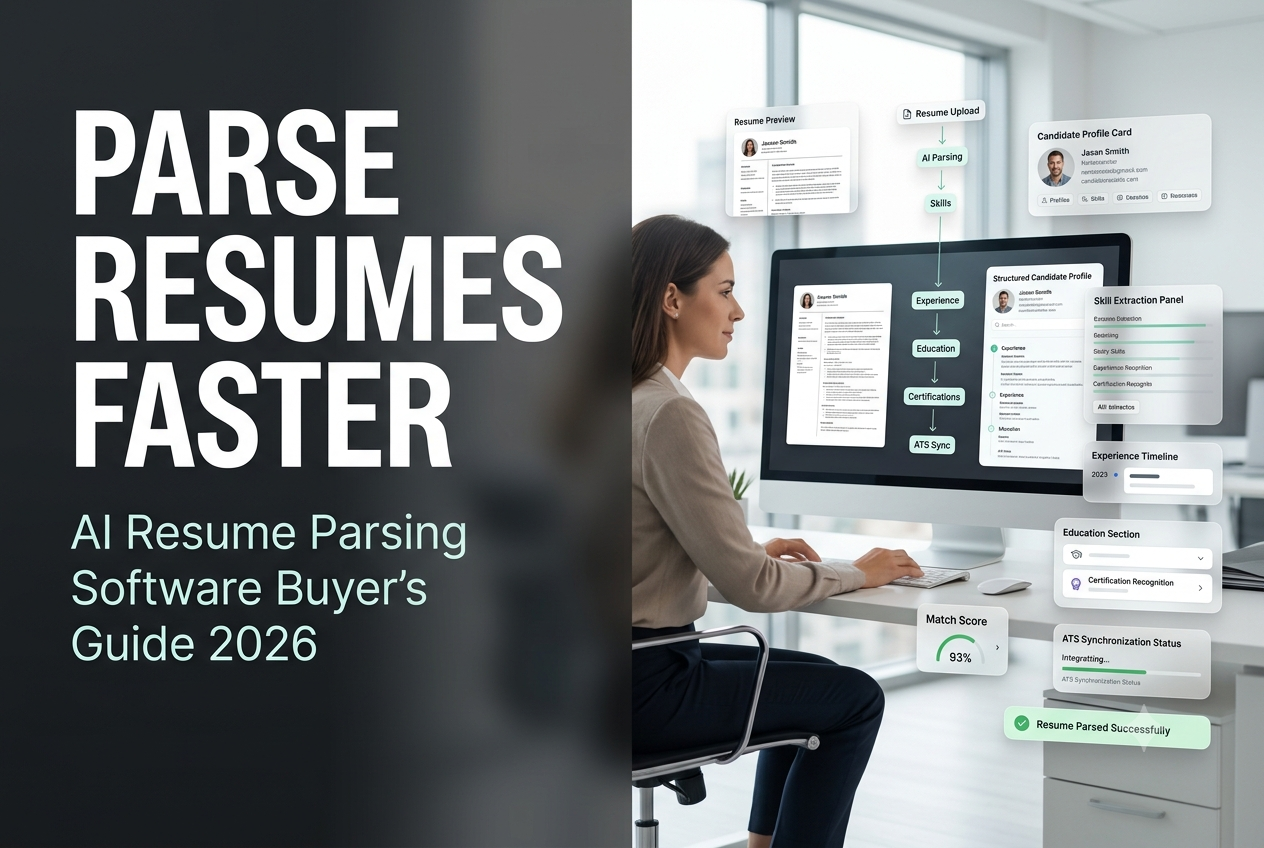
Every staffing agency has a resume data problem, even if nobody calls it that. Formats vary, fields go missing, and recruiters end up re-typing information that was already on the page. This guide covers how AI resume parsing software actually works, what it should extract, and what to check before it touches your ATS.
A resume is not data. It's a document, formatted however the candidate's word processor happened to lay it out, with dates written a dozen different ways and skills buried in prose instead of listed cleanly. For a recruiter working one submission, that's a minor annoyance. For an agency processing hundreds of resumes a week across multiple ATS platforms, it's a structural cost: manual entry, inconsistent records, and a candidate database that gets harder to search every month.
AI resume parsing software exists to turn that unstructured document into clean, structured, searchable data the moment it enters your system. This guide walks through what it does, how the technology actually works, and what separates a parser worth paying for from one that just adds another integration to manage.
What Is AI Resume Parsing Software?
AI resume parsing software reads unstructured resumes in any format and automatically extracts structured data, including contact details, job titles, employment dates, skills, education, and certifications, then organizes that data into a consistent candidate profile that syncs with an ATS or candidate database.
The word "AI" matters here because it distinguishes modern parsers from older, rule-based ones. A basic parser looks for keyword patterns and predictable formatting. An AI-driven parser uses natural language processing to understand context, so it can correctly identify that "Led a team of 12 across three product launches" describes a leadership role even without the word "manager" appearing anywhere on the page.
Why Resume Parsing Matters for Staffing Agencies
Staffing runs on volume, and volume punishes manual data entry. A recruiter who spends four minutes re-typing a resume into structured ATS fields isn't sourcing, screening, or calling candidates during that time. Multiply four minutes by a few hundred resumes a week, and the hours lost to data entry alone start to rival the hours spent on actual recruiting work.
There's a second, quieter cost: inconsistent data quality. When entry is manual, every recruiter formats things slightly differently. One person types "Sr. Software Engineer," another types "Senior Software Engineer," a third abbreviates it further. A candidate database full of these variations becomes difficult to search reliably, which undermines candidate matching and rediscovery even when the underlying talent is there.
Resume parsing fixes both problems at the source. Structured extraction happens the same way every time, so job titles, skills, and dates land in the same fields with the same formatting, regardless of who uploaded the resume or what format it arrived in.
How AI Resume Parsing Works
Parsing is a sequence of steps, not a single action. Understanding each step helps when evaluating vendors, since weaknesses often show up in one specific stage rather than across the board.
A resume arrives, often as a PDF, Word document, or scanned image. If it's a scanned document or image-based PDF, optical character recognition converts the pixels into raw text first. From there, text extraction pulls that raw text out of the file's formatting layer, stripping headers, footers, and layout artifacts.
Skill extraction and experience parsing are where natural language processing does the real work, identifying not just listed skills but skills implied by job descriptions, and correctly separating overlapping employment dates or concurrent roles. Education parsing handles degrees, institutions, and graduation dates, including the many ways candidates write these inconsistently. Resume standardization then normalizes all of it into consistent formatting, so "BS Computer Science" and "Bachelor of Science, Computer Science" resolve to the same structured value.
The result is a candidate profile that syncs to your ATS, feeding directly into candidate matching so recruiters can search by structured fields rather than hoping a keyword happens to appear somewhere in a resume.
Traditional Resume Parsing vs AI Resume Parsing
| Aspect | Traditional / OCR-Only Parsing | AI Resume Parsing |
|---|---|---|
| Method | Pattern matching and fixed templates | Natural language processing and machine learning |
| Context understanding | Limited, relies on exact keywords | Understands implied skills and context |
| Format flexibility | Struggles with non-standard layouts | Handles varied formats more consistently |
| Scanned documents | Requires separate OCR step, often manual | OCR built into the pipeline automatically |
| Data consistency | Variable, dependent on template match | Standardized output across resume formats |
| Maintenance | Requires manual rule updates over time | Improves through model training over time |
Traditional parsing still has a place, particularly for highly standardized documents like government forms. Resumes are the opposite of standardized, which is exactly why natural language processing outperforms fixed pattern matching in this specific use case.
Key Features
Resume Parsing Engine
The core natural language processing model that reads and interprets resume content beyond simple keyword matching.
OCR Support
Built-in handling for scanned resumes and image-based PDFs, so no separate conversion step is needed.
Resume Parsing API
A developer-accessible endpoint that lets your ATS or internal tools submit resumes and receive structured data directly.
Skill Extraction
Identification of both explicitly listed and contextually implied skills from job descriptions and project summaries.
Experience Parsing
Accurate separation of job titles, employers, dates, and responsibilities, including overlapping or concurrent roles.
Education Parsing
Extraction of degrees, institutions, and graduation dates, normalized despite inconsistent candidate formatting.
Certification Recognition
Identification of industry certifications and licenses, important for compliance-heavy sectors like healthcare and finance.
Resume Standardization
Normalization of extracted data into consistent formats so records are comparable across the entire database.
Candidate Profile
A structured, unified profile built from parsed data that feeds directly into search and matching.
ATS Synchronization
Two-way data flow that keeps parsed candidate records current in both the parsing tool and your ATS.
Duplicate Detection
Identification of resumes belonging to candidates already in the system, preventing fragmented duplicate records.
Analytics
Visibility into parsing accuracy, processing volume, and where manual review is still required.
Benefits
- Better ATS data quality: consistent, structured fields instead of variable manual entry.
- Faster recruiter workflows: candidates enter searchable, matchable profiles immediately on upload.
- Reduced manual data entry: recruiters spend time recruiting instead of re-typing resumes.
- Higher recruiter productivity: less administrative overhead per candidate processed.
- Improved candidate matching: clean structured data is what makes matching algorithms reliable.
- Lower operational costs: less time spent on correction and re-entry across the team.
- Better database search: standardized fields make search results consistent and trustworthy.
ATS Integrations
Resume parsing is only useful if the structured data actually lands where recruiters work, which means ATS synchronization is a core requirement, not an add-on. Agencies commonly run Bullhorn, CEIPAL, JobDiva, or Avionté, with Recruit CRM common among boutique firms and Greenhouse, Lever, Workday, Oracle HCM, or SAP SuccessFactors more typical in corporate and RPO environments.
| ATS | Typical Environment | Sync Note |
|---|---|---|
| Bullhorn | Mid-to-large staffing agencies | Well-supported native and marketplace integrations |
| CEIPAL | IT and healthcare staffing | API-based two-way sync for candidate records |
| JobDiva | High-volume contract staffing | Built-in resume database, verify parser compatibility |
| Avionté | Light industrial and clerical staffing | Payroll-linked data adds sync considerations |
| Recruit CRM | Boutique and executive search | Simpler data model, generally faster setup |
| Greenhouse / Lever | Corporate talent acquisition | Governed by internal data access policy |
| Workday / Oracle HCM / SAP SuccessFactors | Enterprise and RPO | Often requires IT involvement for API access |
A genuine two-way sync means parsed data flows into the ATS and status changes flow back, keeping one consistent record. A one-way import creates a second, slowly diverging copy of your candidate data, which recruiters learn to distrust quickly.
Industry Use Cases
IT Staffing
Technical resumes vary widely in format, and accurate skill extraction across programming languages and tools matters directly for match quality.
Healthcare
Certification and licensure recognition is essential, since compliance depends on correctly identifying credentials and expiration dates.
Engineering
Specialized terminology and project-based experience benefit from parsing that understands implied technical skills, not just listed ones.
Finance
Structured, auditable candidate records support compliance requirements common in regulated financial roles.
Manufacturing
High resume volume for recurring roles makes fast, accurate parsing a direct time saver at scale.
Executive Search
Long-form resumes and CVs benefit from parsing that correctly separates decades of overlapping board and advisory roles.
Contract Staffing
Frequent resubmission of the same candidates across assignments makes duplicate detection especially valuable.
AI Resume Parsing vs Related Processes
vs OCR
OCR converts an image into text. It does not understand what that text means. AI resume parsing typically includes OCR as one step, then applies natural language processing on top to structure the result.
vs Resume Screening
Resume screening evaluates whether a candidate fits a specific job, often using parsed data as an input. Parsing itself doesn't make a fit judgment, it just organizes the raw information that screening then uses.
vs Candidate Matching
Candidate matching ranks candidates against a job description. Parsing is the prerequisite step that makes matching possible, since matching algorithms depend on structured, standardized data rather than raw resume text.
vs Manual Data Entry
Manual entry is slower and less consistent, since every recruiter enters and formats data slightly differently. Parsing standardizes the process regardless of who uploads the resume.
vs ATS Import
A basic ATS import may store the resume file itself without extracting structured fields from it. Parsing is what turns that stored file into searchable, matchable data.
Implementation Best Practices
- Data quality: audit a sample of existing resumes before rollout to understand format variety in your database.
- Resume formatting: test parsing accuracy against your most common resume formats and templates, not just clean examples.
- Privacy: confirm how candidate data is stored, encrypted, and whether it's used to train shared models across other clients.
- Compliance: verify the vendor's approach to data retention and deletion aligns with relevant regional requirements.
- Testing: run a pilot batch of real resumes and manually review extracted fields before full deployment.
- Optimization: review parsing accuracy periodically, since resume formats and terminology shift over time.
How NinjaHire Uses AI Resume Parsing
NinjaHire's parsing engine reads incoming resumes the moment they enter the system, extracting skills, job history, education, and certifications, then standardizing that data before it syncs to your ATS. The goal is a candidate profile a recruiter can trust immediately, without needing to manually verify or re-enter the basics.
It connects with Bullhorn, CEIPAL, JobDiva, Avionté, and Recruit CRM through two-way synchronization, so parsed candidate data and any updates made in the ATS stay aligned in both directions. Parsing here isn't a standalone tool, it's the layer that makes candidate matching and rediscovery reliable, since both depend entirely on the quality of the structured data underneath them.
See parsing accuracy on your own resumes
Fifteen minutes, real resumes from your database, no migration required.
Book a Demo Start Free TrialFrequently Asked Questions
What is AI resume parsing software?
It's software that reads unstructured resumes and extracts structured data such as job titles, dates, skills, education, and certifications, then organizes that data into a consistent candidate profile that syncs with an ATS.
How does AI resume parsing work?
It moves through several steps: text extraction (with OCR first if the resume is scanned), skill and experience parsing using natural language processing, education parsing, standardization, and finally syncing the structured profile to your ATS.
How is AI resume parsing different from OCR?
OCR converts an image or scanned document into raw text. AI resume parsing goes further, using natural language processing to understand that text and organize it into structured, searchable fields.
Can resume parsing integrate with an ATS?
Yes, most modern parsing tools integrate with platforms like Bullhorn, CEIPAL, JobDiva, and Avionté through APIs, syncing parsed data directly into candidate records.
How accurate is AI resume parsing?
Accuracy varies by vendor and resume format, but standard fields like contact information, job titles, and dates are typically handled with high reliability, while unusual formatting may need manual review.
What data does resume parsing extract?
Common fields include contact details, job titles, employers, employment dates, skills, education, certifications, and sometimes soft skills implied by project descriptions.
Does resume parsing improve recruiter productivity?
Yes, by eliminating manual data entry, recruiters spend more time sourcing and engaging candidates rather than re-typing information already on the resume.
Which ATS platforms support resume parsing?
Bullhorn, CEIPAL, JobDiva, Avionté, and Recruit CRM are common in staffing, while Greenhouse, Lever, Workday, Oracle HCM, and SAP SuccessFactors are typical in corporate and enterprise environments.
What features matter most when evaluating a parser?
Accuracy of skill and experience extraction, OCR support for scanned documents, ATS synchronization depth, and duplicate detection tend to matter most in daily use.
How does resume parsing improve candidate matching?
Matching algorithms depend on clean, structured data. Parsing is what produces that structured data, so better parsing directly improves the reliability of matching results.
Does resume parsing work with scanned or image-based resumes?
Yes, most AI parsing tools include OCR as a built-in first step for scanned documents or image-based PDFs, converting them into text before parsing begins.
What is a resume parsing API?
It's a developer-accessible endpoint that lets internal tools or an ATS submit resumes directly and receive structured data back, without a manual upload step.
Is resume parsing accurate for non-English resumes?
Support varies significantly by vendor, so it's worth testing specifically against the languages common in your candidate pool before committing.
How does resume standardization work?
It normalizes extracted data into consistent formats, so variations like "BS Computer Science" and "Bachelor of Science, Computer Science" resolve to the same structured value.
Does resume parsing detect duplicate candidates?
Good parsing tools include duplicate detection, flagging when a new resume likely belongs to a candidate already in the database.
How is candidate data kept private during parsing?
This varies by vendor, so it's worth confirming encryption practices, data retention policies, and whether resumes are used to train shared models across other clients.
Can parsing handle unusual resume formats, like infographic-style resumes?
Highly visual or non-linear resume formats are typically the hardest case for any parser, so it's worth testing against your candidates' actual formats rather than assuming full compatibility.
Does resume parsing replace human review entirely?
No, most agencies keep a light human review step for edge cases, particularly for senior or highly specialized roles where nuance matters.
How long does it take to parse a resume?
Processing is typically near-instant per resume, with the larger time investment being initial setup, ATS integration, and testing accuracy on your specific resume formats.
What is the difference between resume parsing and resume screening?
Parsing extracts and organizes data from a resume. Screening evaluates whether that data fits a specific job, often using the parsed output as its input.
Does resume parsing help with compliance in regulated industries?
Yes, particularly through certification and licensure recognition, which supports compliance tracking in industries like healthcare and finance.
Can resume parsing extract implied skills, not just listed ones?
Modern AI-driven parsers using natural language processing can often infer skills from job descriptions and project summaries, not only from an explicit skills list.
What happens if a parser makes a mistake?
Most tools allow recruiters to manually correct parsed fields, and those corrections often feed back into improving accuracy over time.
How is NinjaHire's approach to resume parsing different?
NinjaHire parses resumes on upload, extracting skills, experience, education, and certifications, then syncs that standardized data two ways with ATS platforms like Bullhorn, CEIPAL, JobDiva, and Avionté, so the data stays reliable for matching and search.


Subscribe to our newsletter
Want to stay up to date with news and updates about our product? Subscribe.
© Copyright 2026