.png)
Why Recruiters Spend More Time Searching Their ATS Than Talking to Candidates

July 3, 2026
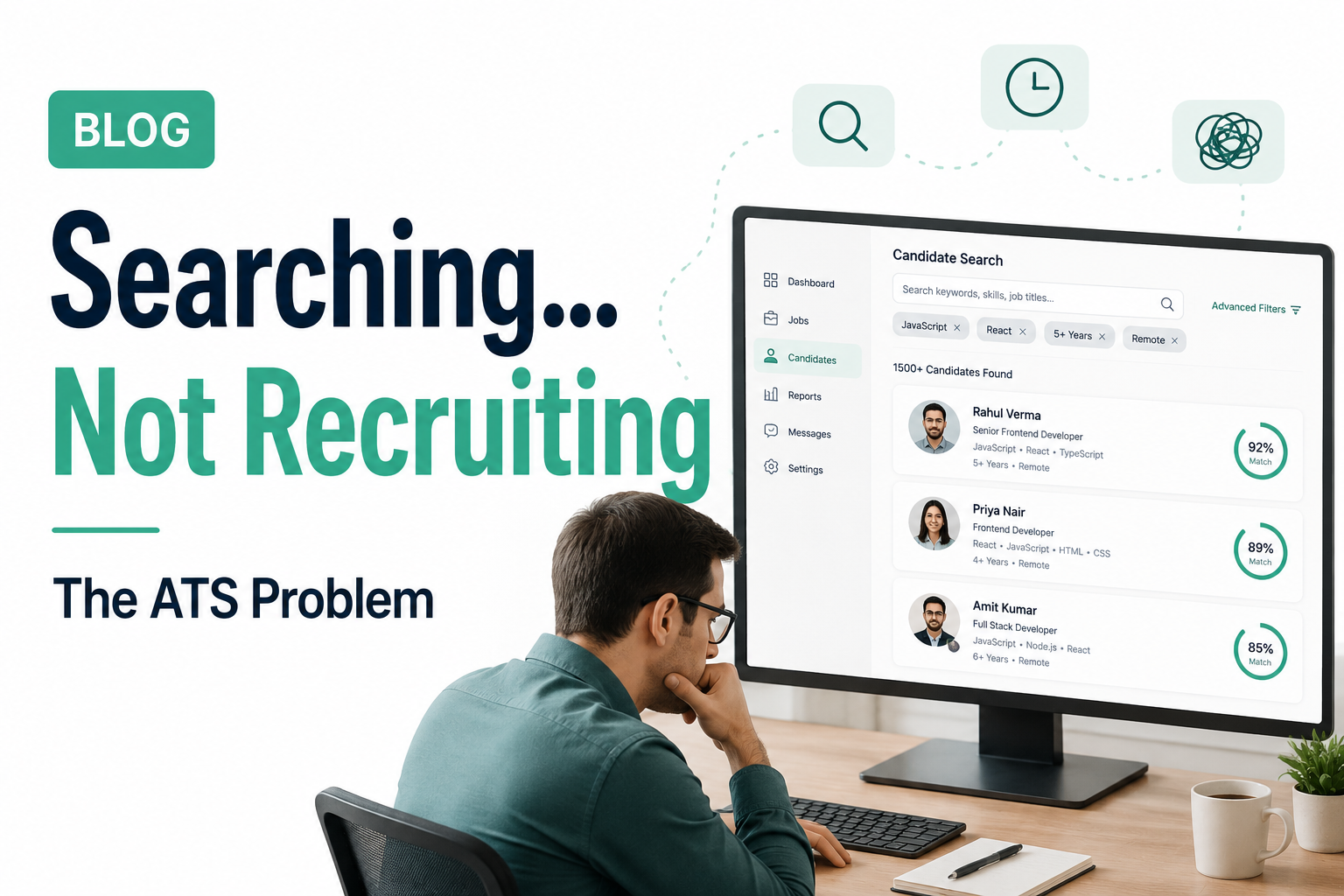
Enterprise recruitment organizations operate under a persistent, hidden operational drain. Sourcing leadership routinely attributes extended fill times and mounting cost-per-hire metrics to macro labor shortages or highly competitive talent pools. However, internal workflow audits reveal a far more systemic internal barrier: the absolute breakdown of the internal candidate data engine. Human sourcers are missing out on active placements not due to lack of market liquidity, but because they are spending their productive desk hours running complex, repetitive ATS candidate search queries across silent archives.
The core promise of a modern applicant tracking system is to serve as an accessible, high-yield talent network. Yet, as a staffing agency’s data asset expands over years of operation, traditional keyword indexers become slow and inefficient. Human teams find themselves locked in an administrative loop—scrolling through thousands of outdated files, wrestling with rigid Boolean strings, and filtering out identical duplicates. When searching the database becomes a frustrating administrative hurdle, recruiters stop trusting internal records and default to re-buying the exact same talent from expensive external portals.
To scale placement metrics safely and lower cost structures, workforce operations leaders must shift from manual text searching to proactive, intelligent candidate rediscovery. Liberating recruitment specialists from search constraints changes the foundational unit economics of a branch. This briefing breaks down why standard search tools fracture at scale and outlines a structured methodology to turn historical corporate databases into a distinct competitive asset.
Key Takeaways
- The Database Black Box: Traditional, keyword-reliant indexers require exact text strings, rendering up to 75% of a company’s historical records invisible to standard recruiter queries.
- Wasted Desk Capacity: Recruiters spend an average of four hours daily running database lookups, filtering duplicates, and validating basic files—time directly taken away from live interviews.
- Redundant Sourcing Reductions: Transitioning toward semantic search infrastructure allows agencies to fill mid-funnel contract requisitions internally, slashing redundant job board marketing budgets by more than half.
- The Sourcing Reflex Shift: Optimizing internal search tools converts the recruiting desk from a reactive administrative function into a fast-moving relationship engine.
What Is ATS Candidate Search?
ATS candidate search is the operational methodology and data query process used by recruiters to discover, isolate, and filter past applicant profiles stored inside an organization's central database repository.
Staffing firms rely on this functionality to surface pre-vetted talent records before allocating budget to external sourcing channels. In standard tracking environments, this lookup requires recruiters to manually design complex Boolean strings, filter records by localized category fields, and scan historical text profiles manually to locate matching capability.
Why ATS Search Gets Slower As Your Database Grows
The primary reason traditional database indexing methods break down over time is rooted in structural data decay. When a staffing firm expands from 10,000 to over 200,000 candidate profiles, the raw volume of unstructured information overwhelms simplistic text-matching systems. Because standard software applications treat resumes as flat, static text attachments, any increase in database size directly reduces search precision and extends processing times.
- The Constraints of Boolean String Search: Standard keyword queries require exact phrase matches to surface a profile. If a recruiter builds an outreach string around "Cloud Infrastructure Specialist," but a high-potential historical applicant has listed their title as "AWS Systems Architect," the system fails to bridge the context.
- Profile Duplication and Fragmented Records: When a candidate applies to three distinct contract assignments over a two-year timeline, unvetted software applications routinely fragment that data into separate profiles. This creates data silos that hide complete histories.
- Data Decay and Outdated Information: Resumes capture candidate backgrounds at a single moment in time. Without automated re-engagement tools, changes in mobile coordinates or newly acquired technical certifications are permanently lost.
| Data Indexing Factor | Legacy Search Database Vulnerability | Operational Pipeline Consequence |
|---|---|---|
| Query Processing | Requires manual construction of rigid text match formulas (AND/OR/NOT). | Sourcing specialists miss relevant candidate profiles due to alternate title variations. |
| Record Duplication | Splits multi-year candidate interactions across disjointed tracking files. | Recruiters waste time validating separate entries for the same applicant. |
| Profile Longevity | Resumes remain static files that freeze candidate skills profiles in time. | Valid talent appears unqualified on screen, forcing teams to rely on external search tools. |
How Much Time Recruiters Actually Spend Searching
The daily capacity drain associated with manual candidate database search work is substantial when quantified across an enterprise branch. When a recruiter is trapped scanning a long list of unsorted resumes to verify compliance or check baseline experience fields, that professional is missing the time required to speak directly with high-potential applicants. This operational delay directly drives up internal labor costs.
| Daily Operational Activity | Manual Workflow Model (Hours) | Intelligent Workflow Model (Hours) |
|---|---|---|
| Manual Query Filtering | 2.4 hours | 0.3 hours |
| Deduplication & Validation | 1.3 hours | 0.1 hours |
| Live Candidate Interviewing | 1.8 hours | 5.2 hours |
ATS Search vs. AI-Powered Candidate Search
Overcoming the limitations of traditional keyword lookups requires a permanent transition toward intelligent semantic parsing architectures. Standard applicant tracking software platforms treat data retrieval as a simple text matching problem. Modern AI-powered candidate search tools, by contrast, act as continuous contextual matching engines that understand adjacent proficiencies and historical progression paths.
| Technical Capability | Traditional ATS Candidate Search | AI-Powered Candidate Search |
|---|---|---|
| Query Interpretation | Requires rigid Boolean formula strings; strict text matching rules. | Natural language understanding that parses adjacent skills contextually. |
| Data Freshness | Resumes remain static files that slowly decay inside the system. | Continuous backend updates that enrich data from public networks. |
| Profile Organization | Delivers unsorted, chronological lists that demand manual screening. | Automated prioritized tiers scored directly against operational metrics. |
Is Your ATS Helping Recruiters—or Slowing Them Down?
Most staffing firms already have thousands of qualified candidates inside their ATS but struggle to find and re-engage them quickly. Take the ATS Talent Search Assessment to identify search bottlenecks, evaluate database health, and uncover opportunities to improve recruiter productivity.
Start Your ATS Talent Search AssessmentFrequently Asked Questions
What is ATS candidate search? +
Why is ATS search slow? +
How can AI improve ATS search? +
Conclusion
Transitioning from manual database filtering habits to high-velocity candidate discovery infrastructure is a foundational requirement to achieve sustainable growth in modern workforce recruitment. Recruitment teams create their most significant strategic value when they are engaging directly with human talent, conducting qualitative interviews, and advising client hiring managers—not when they are spending their productive desk capacity running manual searches across unorganized databases.
Deploying advanced platforms like NinjaHire transforms your internal data assets into an active, self-updating talent network. By compressing time-to-submit cycles down to hours, reducing redundant external data marketing costs, and maximizing recruiter placement outputs, our infrastructure provides the automated workflow tools required to unlock your database, protect your capital, and consistently connect your business with the right talent ahead of the competition.
Turn Your ATS Into a Competitive Advantage
See how NinjaHire helps staffing firms rediscover qualified candidates already inside their ATS, automate candidate search, improve recruiter productivity, and reduce time-to-submit.
Book a Demo