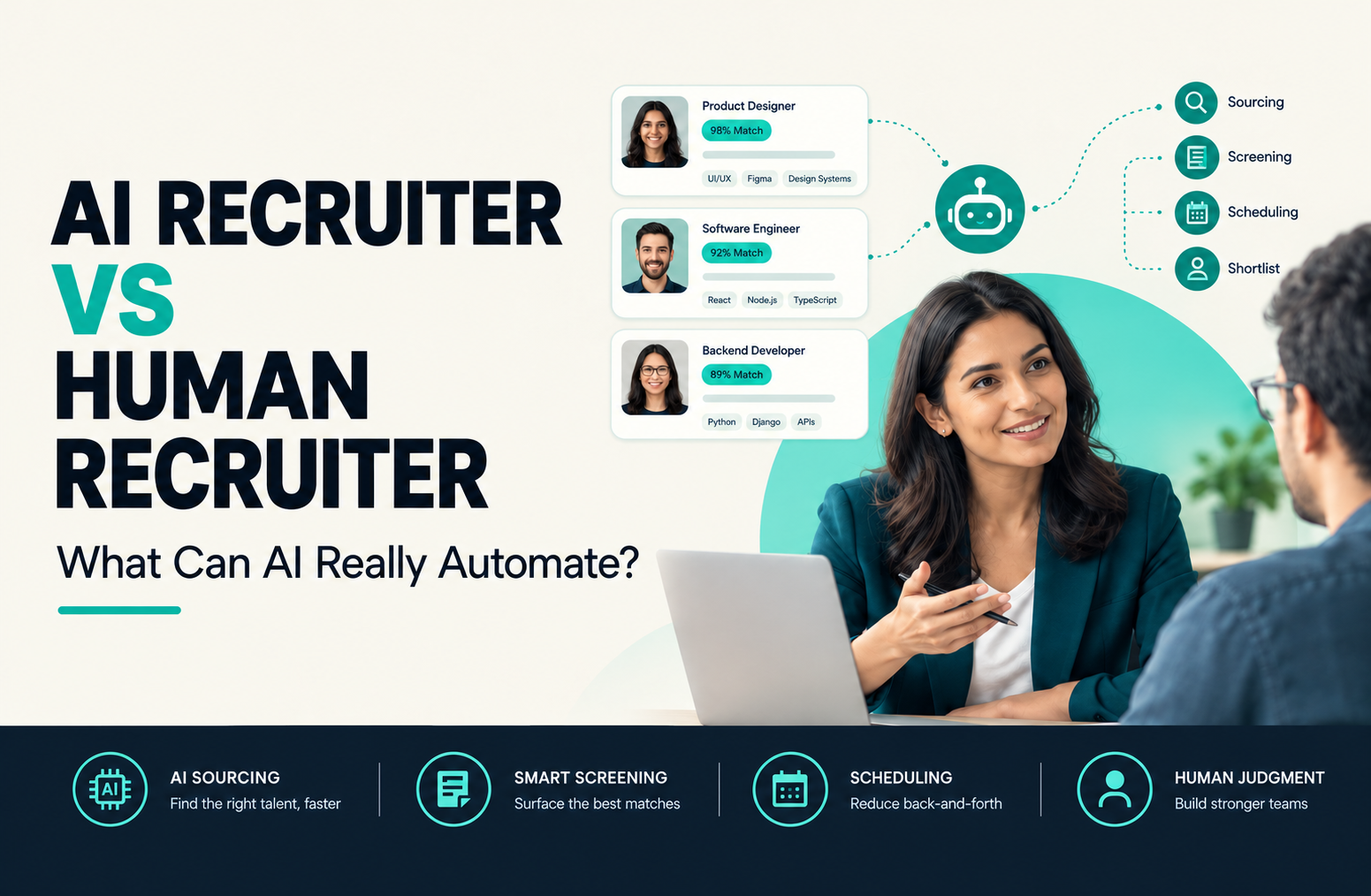
An autonomous AI recruiter is a software system designed to plan, coordinate, and execute multi-stage hiring activities, such as candidate rediscovery, outbound sourcing, multichannel engagement, structured screening, and interview scheduling, toward a defined hiring goal with limited continuous manual prompting, operating within explicitly configured permissions, guardrails, and human oversight.
Across the human capital technology landscape, the phrase is often applied inconsistently. Some platforms label simple email sequencing or keyword parsers as autonomous, while others deploy multi-agent architectures capable of dynamically adapting search criteria and coordinating handoffs. The critical distinction in modern recruitment operations is not whether software incorporates generative AI, but which specific actions the system is authorized to execute, how it evaluates context, what enterprise systems it can update, and when human approval remains mandatory.
Manual Recruiting vs Rule-Based Automation vs Agentic AI
Recruitment operations have evolved through three distinct operating models. While early market narratives suggested agentic AI would replace traditional workflows entirely, enterprise deployments demonstrate that high-performing talent systems blend all three: fixed deterministic rules for compliance, autonomous agents for multi-step execution, and human recruiters for critical assessment and relationship-building.
| Dimension |
Manual Recruiting |
Rule-Based Workflow Automation |
Agentic or Autonomous Recruiting |
| Task Initiation |
Manually triggered by a recruiter for every profile, email, note, and calendar invite. |
Triggered by rigid, predefined events, such as moving a candidate stage to trigger a fixed template. |
Goal-directed, initiated by requisition parameters or pipeline velocity thresholds, planning downstream execution sequences. |
| Next-Action Selection |
Recruiter decides on an ad-hoc basis based on memory, inbox pressure, and spreadsheets. |
Follows a hardcoded if-then tree; stops or fails if a candidate response or situation falls outside the branch. |
Dynamically selects the next permitted tool, such as re-sourcing, switching channels, initiating a phone screen, or escalating to human, based on context. |
| Contextual Decisioning |
High contextual understanding, but constrained by recruiter cognitive load and fatigue. |
Zero contextual reasoning; treats every candidate passing a filter identically, regardless of nuanced profile details. |
Reasons across multi-source context, including ATS history, resume trajectory, and interview transcripts, within established guardrails. |
| Response to New Data |
Slow; requires the recruiter to manually read updates, recalculate fit, and reprioritize their day. |
Inflexible; cannot adapt if a candidate provides an alternative phone number, answers ambiguously, or updates availability. |
Adaptive; updates candidate state, adjusts communication cadences, probes ambiguous screening responses, or flags anomalies. |
| Human Involvement |
Continuous, low-leverage administrative manual input across multiple disconnected screens. |
Periodic configuration and maintenance of workflow trees; ongoing manual handling of unrouted edge cases. |
Defined governance: human sets rubrics, defines escalation thresholds, reviews scored shortlists, and conducts final evaluation. |
| Typical Strengths |
Deep relationship building, high-touch empathy, nuanced candidate persuasion, and executive evaluation. |
Deterministic, highly predictable execution for high-volume, standardized administrative tasks. |
Compresses pipeline latency, eliminates multi-system coordination tax, and operates 24/7 across multiple time zones. |
| Common Limitations |
Severe pipeline latency, coordination tax, manual data entry errors, and candidate drop-off due to bandwidth limits. |
Brittle workflows that break on minor edge cases; robotic, impersonal candidate experiences when logic misfires. |
Requires strict governance, bias monitoring, and integration validation; risk of misaligned actions if guardrails are weak. |
| Appropriate Use Cases |
Executive search, passive partner-track headhunting, final offer negotiation, and culture evaluation. |
Standard auto-responders, simple status notifications, calendar link delivery, and compliance archiving. |
High-volume staffing, ATS candidate rediscovery, structured first-round phone or web screening, and round-the-clock candidate nurturing. |
How an Autonomous AI Recruiter Works: End-to-End Workflow
In an autonomous recruitment model, an authorized system coordinates candidate progression from requisition intake to qualified recruiter handoff. Below is a structured reference architecture showing how multi-agent coordination functions across a modern recruiting stack.
SOURCING AGENT
- ATS rediscovery search
- External job repository queries
- Waterfall contact enrichment
ENGAGEMENT AGENT
- Email and SMS delivery
- Adaptive cadence pacing
- Inbound intent classification
SCREENING AGENT
- Conversational phone calls
- Speech transcription
- Rubric-based fit scoring
HUMAN APPROVAL GATEWAY
Recruiter inspects scored call transcripts, verifies credentials, evaluates cultural alignment, and authorizes the client submission packet.
Stage 1: Job Intake and Requirement Interpretation
- Objective: Convert an unstructured job description or requisition brief into an actionable, bias-aware sourcing rubric and evaluation criteria.
- Information Needed: Required technical competencies, non-negotiable certifications, location and work authorization constraints, shift timings, target compensation band, and company profile.
- System Action: Extracts explicit criteria and adjacent skill profiles, recognizing, for instance, that an engineer skilled in FastAPI understands asynchronous Python programming.
- Failure Modes: Over-constraining queries with redundant buzzwords or ingesting unvetted, legally non-compliant criteria.
- Human Oversight: The recruiter reviews and signs off on the parsed rubric, verifies mandatory knockouts, and confirms lawful screening parameters.
Stage 2: ATS Rediscovery and Historical Record Review
- Objective: Surface already acquired, proprietary talent, such as past applicants, silver medalists, and former contractors, before spending money on third-party channels.
- Information Needed: ATS and CRM historical data, past interview notes, resumes, historical candidate dispositions, and contact records.
- System Action: Queries the ATS database using semantic matching to locate previously vetted profiles whose skills match the new opening.
- Failure Modes: Resurfacing do-not-contact records, out-of-date candidate contact data, or profiles rejected for clear compliance reasons.
- Human Oversight: Setting automated exclusion rules, like block-lists and recent rejections within 90 days, and validating rediscovery shortlists.
Stage 3: External Candidate Sourcing
- Objective: Discover active and passive profiles across authorized external networks and premium job repositories.
- Information Needed: Target industries, candidate geographies, validated job taxonomies, and vendor data entitlements.
- System Action: Deploys automated search strategies across platforms, expanding or narrowing criteria dynamically based on pool density.
- Failure Modes: Keyword hallucination, scraping restricted sources in violation of platform terms of service, or returning duplicate candidates.
- Human Oversight: Approval of target company lists, exclusion filters, and external sourcing caps.
Stage 4: Candidate Fit Evaluation Against Role-Specific Criteria
- Objective: Rank profiles against standardized job requirements without introducing demographic or arbitrary proxy bias.
- Information Needed: Anonymized candidate work histories, documented role accomplishments, education credentials, and clear job rubrics.
- System Action: Evaluates career trajectories, skill depth, and relevant industry experience against the approved rubric, assigning a structured relevance tier.
- Failure Modes: Penalizing non-linear career paths, employment gaps, or non-traditional educational backgrounds; algorithmic bias favoring specific demographic proxies.
- Human Oversight: Periodic sampling of rejected and top-ranked candidates to ensure fair and consistent scoring across candidate cohorts.
Stage 5: Contact Enrichment Where Permitted
- Objective: Identify verified, lawful communication channels, including work or personal email and phone numbers, for prioritized candidates.
- Information Needed: Candidate full name, employment history, geographic location, and verified data vendor waterfalls.
- System Action: Queries approved data enrichment providers to find deliverable contact points; checks numbers against internal opt-out tables and National Do Not Call registries where applicable.
- Failure Modes: Pulling unverified personal contact details, exceeding provider rate limits, or generating inaccurate contact matches.
- Human Oversight: Configuration of acceptable data sources, regulatory opt-out handling, and audit logging of enrichment provider calls.
Stage 6: Outreach Through Supported Channels
- Objective: Initiate personalized, relevant initial engagement across authorized channels, such as email, SMS, LinkedIn InMail, and voice.
- Information Needed: Candidate career context, verified role requirements, compensation ranges, approved message templates, and contact preferences.
- System Action: Generates tailored outreach referencing specific accomplishments, schedules delivery across approved cadences, and maintains communication throttles.
- Failure Modes: Generic automated phrasing, messaging multiple channels at inappropriate hours, or sending messages containing inaccurate job details.
- Human Oversight: Recruiters define and approve all messaging templates, escalation triggers, sender identities, and throttle volumes.
Stage 7: Candidate Responses and Follow-Up Management
- Objective: Classify candidate replies, answer standard role-related questions, and nurture interest toward screening.
- Information Needed: Inbound candidate responses, recruiter calendar availability, and role documentation covering benefits, location, and remote policies.
- System Action: Parses candidate intent, including interest, declination, requests for details, or unsubscribe demands, responds to basic factual queries from verified documents, and manages follow-ups.
- Failure Modes: Misinterpreting nuanced replies, failing to process opt-out requests immediately, or hallucinating company benefits.
- Human Oversight: Immediate escalation to a human recruiter whenever candidate questions exceed pre-approved reference material or when an opt-out is received.
Stage 8: Structured Screening via Voice, Video, or Web
- Objective: Validate basic qualifications, verify wage and schedule expectations, and assess structured competencies.
- Information Needed: Standardized screening script, objective scoring rubric, compliance disclosures, and candidate consent.
- System Action: Conducts structured interviews, such as automated voice calls or async web chats, asks clarifying follow-up questions within script parameters, and transcribes the conversation.
- Failure Modes: Speech-to-text transcription errors on technical terminology or regional accents, lack of statutory AI disclosures, or inappropriate follow-up questions.
- Human Oversight: Reviewing full transcripts and audio recordings; validating that knockouts reflect objective, job-related criteria.
Stage 9: Interview Scheduling and Calendar Coordination
- Objective: Seamlessly coordinate schedules between qualified candidates, recruiters, and hiring managers without back-and-forth email loops.
- Information Needed: Interviewer calendar availability, room or video link credentials, candidate availability, and interview loop structure.
- System Action: Sends dynamic self-scheduling links or coordinates calendar holds directly during phone screening calls, updates holds upon reschedule requests, and issues reminders.
- Failure Modes: Double-booking across shared calendars, scheduling outside designated interview windows, or timezone miscalculations.
- Human Oversight: Setting interview block rules, maximum interview loads per team member, and manual intervention when schedules conflict.
Stage 10: ATS Updates, Recruiter Handoff, and Submission
- Objective: Log every candidate interaction, synchronize scores and transcripts, and hand off fully pre-qualified profiles for final human evaluation and submission.
- Information Needed: Valid ATS profile schema, integration write permissions, and candidate status mapping.
- System Action: Writes interview transcripts, scoring summaries, and candidate consent records back to the core ATS; advances candidate pipeline stage; notifies the recruiter.
- Failure Modes: Incomplete API write-backs, duplicate candidate records, or incorrect status tagging in the primary system of record.
- Human Oversight: Mandatory human gate: A human recruiter evaluates the comprehensive candidate packet, conducts relationship-level vetting, and makes the definitive submittal or hiring decision.
Agent Responsibilities vs Recruiter Decision Rights
To protect candidate rights, ensure compliance with evolving employment laws, and prevent algorithmic runaway, organizations must establish clear operational boundaries between what an AI agent can execute and what requires explicit human review.
| Recruitment Activity |
System Autonomous Action |
Recruiter Decision Right and Approval Gate |
Key Safeguard and Regulatory Boundary |
| Parsing Job Requirements |
Automatically extracts skills, job levels, and rubrics from source documents. |
Recruiter Approval: Verifies parsed requirements and adjusts priorities before launch. |
Ensures job criteria do not incorporate unlawful, restrictive, or non-inclusive filters. |
| ATS and External Search |
Queries ATS databases and authorized talent pools using semantic parameters. |
Recruiter Review: Inspects discovery parameters and modifies search scope if needed. |
Source provenance tracking; compliance with platform API usage terms. |
| Match Scoring and Ranking |
Generates comparative relevance scores based strictly on objective rubric criteria. |
Recruiter Review: Periodically reviews ranked and unranked profiles for consistency. |
Annual independent bias audits, such as NYC Local Law 144, to evaluate disparate impact. |
| Contact Enrichment |
Searches verified provider waterfalls to identify deliverable email and phone data. |
System Automated: Operates within pre-set credit limits and vendor configurations. |
Adherence to data privacy laws, CCPA, and GDPR; suppression against internal opt-out lists. |
| Outreach Generation |
Generates tailored messages based on candidate and role context. |
Recruiter Approval: Approves initial campaign copy, messaging templates, and tone. |
Mandatory unsubscribe and opt-out mechanisms; clear identification that outreach is automated. |
| Initiating Phone Screens |
Places outbound calls or receives callbacks via conversational voice AI agents. |
Recruiter Configured: Sets approved calling hours, call scripts, and escalation points. |
Mandatory AI disclosure: System must explicitly inform candidate they are speaking with an AI. |
| Conducting Screening |
Asks standardized qualification questions, probes answers, and records transcripts. |
Recruiter Review: Reviews call transcripts, audio logs, and scored summaries. |
Standardized questions applied equally; complete audit logs kept for compliance verification. |
| Applying Knockouts |
Flags objective, legally verified disqualifiers, such as lack of mandatory certifications. |
Recruiter Gate: Human confirms any permanent candidate disqualification or rejection. |
Prevention of automated rejections on nuanced, non-objective criteria without human review. |
| Interview Scheduling |
Reconciles calendars, sends links, and books qualified candidates into team slots. |
Recruiter Controlled: Human defines working calendars, buffers, and interview capacities. |
Prevents scheduling loops; immediate manual escalation on candidate conflicts or booking errors. |
| ATS Record Syncing |
Writes notes, interview summaries, call audio links, and stage tags to the ATS or CRM. |
System Automated: Executes via configured bi-directional API connections. |
Data integrity checks, deduplication logic, and role-based access control. |
| Candidate Rejection |
Generates polite, structured disposition notices once authorized by human recruiter. |
Mandatory Human Approval: Recruiter authorizes candidate rejection status in the pipeline. |
Clear, defensible, documented business reasons; mitigation of automated disparate impact. |
| Final Hiring Decisions |
PROHIBITED: Autonomous systems must never make final hiring decisions. |
Sole Human Ownership: Hiring managers and recruiters make all employment and offer decisions. |
Compliance with EEOC Title VII guidance and EU AI Act Article 14 human agency mandates. |
Candidate Consent, Privacy, and International Compliance
Deploying agentic AI systems requires operational alignment with regional legal frameworks:
- United States (EEOC and Title VII): Employers are legally accountable for the selection procedures applied by third-party AI software. Selection criteria must be job-related and consistent with business necessity.
- Local AI Regulations, including NYC Local Law 144: Requires employers to conduct annual independent bias audits for automated employment decision tools that screen or score candidates, provide candidates 10 business days advance notice of tool usage, and provide an alternative selection process upon request.
- European Union (EU AI Act and GDPR): AI systems evaluating candidates or filtering job applications are designated High-Risk AI Systems under Annex III. Deployers must ensure continuous human oversight under Article 14, log traceability, transparency under Article 13, and adhere to Article 22 of the GDPR regarding automated individual decision-making. Emotion recognition in workplace environments is explicitly banned under Article 5.
The Coordination Tax: Where Recruiting Time Gets Lost
In traditional recruitment operations, hiring delays are rarely caused by an inability to find names. With modern search engines, databases, and talent repositories, candidate profiles are abundant. The primary bottleneck slowing down time-to-submit and time-to-hire is the Coordination Tax: the compounding administrative friction, context-switching, and queue time required to pass candidates between disconnected stages.
WHERE TIME IN RECRUITING GOES
Work Time: 15%
Active candidate interviewing and nuanced portfolio evaluation.
Handoff Time: 25%
Manual ATS data entry, copying notes, drafting emails, and calendar coordination.
Waiting Time: 60%
Idle candidate response lag, review backlogs, and scheduling delays.
To diagnose pipeline friction accurately, recruitment leaders must break overall latency into three distinct operational states:
- Active Work Time: The actual time human recruiters spend evaluating candidates, interviewing, and building client relationships, such as a 30-minute interview or 10 minutes reviewing a portfolio.
- Handoff Time: The administrative friction required to transfer context or trigger downstream actions, such as copying candidate notes into an ATS, creating calendar invites, drafting emails, and tagging team members.
- Waiting Time: The idle queue time where a candidate sits untouched waiting for the next step, like waiting 4 days for an application review, waiting 48 hours for an email reply, or sitting in interview scheduling limbo.
Total Stage Latency = Work Time + Handoff Time + Waiting Time
A Framework for Measuring Coordination Friction
- Timestamp State Transitions: Record exact timestamps when a candidate enters a stage, when contact is attempted, when candidate replies, when screening begins, and when results are posted.
- Isolate Active vs Queue Duration: Calculate the gap between candidate response and screening delivery. If an applicant responds to an outreach sequence at 8:00 PM on Friday, calculate how many hours elapse before first-round screening occurs.
- Track Recruiter Touchpoints: Count the number of manual clicks, browser tabs opened, and copy-paste operations required per submittal.
- Measure Pipeline Drop-Off Due to Latency: Correlate candidate withdrawal rates directly against queue durations between stages.
Autonomous AI recruiters compress pipeline latency primarily by targeting Handoff Time and Waiting Time, initiating outreach instantly upon discovery, handling callbacks 24/7, and immediately transcribing and scoring screens for human review.
The Technical Architecture Behind Autonomous Recruiting
The following conceptual reference architecture outlines the modular layers required for an enterprise-grade autonomous recruitment platform.
LAYER 1: POLICY & GOVERNANCE LAYER
Role-based access permissions, statutory AI disclosures, bias audit rules, rate limiting, recruiter approval gates, and candidate opt-out management.
LAYER 2: ORCHESTRATION & STATE MANAGEMENT
Workflow state machines, agent dispatching, and failure retry engines governing transitions between sourcing, engagement, and evaluation.
LAYER 3: TASK AGENTS
Sourcing Agent (semantic search, rediscovery, enrichment), Outreach Agent (multichannel intent routing), and Screening Agent (voice interviews, transcription, scoring).
LAYER 4: SYSTEM OF RECORD & INTEGRATIONS
Bi-directional ATS and CRM synchronization, calendar engines (Google Workspace, Microsoft 365), and immutable telemetry audit trails.
A. Orchestration Layer
The core engine coordinating system state. It manages workflows, tracks where each candidate sits in the pipeline, executes dependencies, such as only triggering a phone screen after consent is logged, and handles agent dispatching.
B. Recruiting Agents and Task Modules
- Sourcing Module: Executes semantic queries across proprietary graphs and external job platforms.
- Outreach Module: Manages message personalization, send cadences, follow-up pacing, and communication channels across email, SMS, and phone.
- Screening Module: Executes conversational voice or web-based screening against configured interview rubrics, generating transcripts and quantitative skill evaluations.
C. Data and Source Provenance
Maintains strict data lineage: where a candidate profile originated, when contact data was enriched, what candidate consent was gathered, and complete timestamp logs for every communication.
D. System-of-Record Integration Layer
Connects with existing enterprise infrastructure, including Applicant Tracking Systems, CRMs, and Vendor Management Systems. Requires robust bi-directional field mapping to sync candidates, statuses, interview notes, and activity records without creating duplicates.
E. Decision, Policy, and Safeguard Layer
Enforces compliance rules, approval gates, calling-hour windows, rate limits, and consent policies. Prevents agents from executing actions outside pre-authorized boundaries.
F. Observability, Logging, and Auditability
Maintains comprehensive immutable audit trails recording model inputs, outputs, scoring rationales, human interventions, and API transactions to support regulatory reporting and performance monitoring.
G. Exception Handling and Fallbacks
Determines failure routing: what occurs when candidate email bounces, phone numbers fail carrier validation, ATS webhooks drop, or candidate sentiment indicates confusion. Escalates edge cases to human recruiters instantly.
Three Illustrative Recruiting Workflows
The following workflows are realistic illustrative scenarios designed to demonstrate how autonomous recruiting agents interact with enterprise teams and external candidates. They do not represent specific customer case studies.
Scenario A: Time-Sensitive Technical Requisition in Staffing
- Context: A commercial staffing agency receives an urgent order from an enterprise client for three AWS Cloud Security Engineers with active Terraform certifications. Competitor agencies received the same requisition, making submission speed within 24 hours critical.
- Autonomous System Actions:
- The system ingests the requisition, extracts mandatory requirements for AWS Security Specialty, Terraform, and 4+ years of cloud infrastructure experience, and immediately searches the internal ATS to rediscover past applicants and silver medalists.
- Simultaneously, the Sourcing Agent expands into external candidate databases and talent repositories, scoring profiles against the technical rubric.
- Identified profiles are enriched with contact info, checked against internal suppression lists, and queued for engagement.
- Personalized multichannel outreach via SMS and email is dispatched referencing the candidates specific cloud projects.
- As candidates reply confirming interest, the Voice Screening Agent initiates a structured 12-minute phone screen validating mandatory certifications, compensation alignment, and shift availability, producing complete audio transcripts and scoring breakdowns.
- Human Approval Gates:
- Recruiter verifies the parsed search rubric prior to outreach execution.
- Recruiter reviews scored phone interview transcripts, conducts a brief culture conversation, and authorizes the client submittal packet.
- What to Request in a Demo: Observe live how the system handles candidates who provide updated phone numbers mid-chat, and inspect the exact scoring rubric generated for technical qualifications.
Anonymized Operational Trace: Job Intake to Qualified Shortlist
Below is an operational trace illustrating how a technical staffing requisition moves through an autonomous agent system with human approval checkpoints:
SYSTEM EXECUTION LOG • REQ-9402
COMPLETED
[Day 1 - 09:15 AM] REQUISITION INGESTED: Senior DevOps Engineer (Kubernetes, Terraform, AWS).
[Day 1 - 09:18 AM] HUMAN GATE 1 PASSED: Recruiter reviews and approves parsed rubric; validates compensation at $140k–$160k.
[Day 1 - 09:20 AM] DISCOVERY: 42 profiles matched from internal ATS rediscovery; 88 sourced externally via NinjaGraph.
[Day 1 - 09:45 AM] ENRICHMENT & SUPPRESSION: 112 valid email/phone records identified; 18 suppressed for recent outreach or DNC.
[Day 1 - 10:00 AM] ENGAGEMENT DISPATCH: Personalized multichannel outreach via Email and SMS deployed across staggered batches.
[Day 1 - 11:22 AM] CANDIDATE INTERACTION: First 14 candidate responses received. Intent parser categorizes: 8 Interested, 4 Declined, 2 Out-of-Scope Questions.
[Day 1 - 11:30 AM] HUMAN ESCALATION RESOLVED: 2 candidate questions regarding visa sponsorship routed to recruiter; answered via template.
[Day 1 - 12:15 PM] VOICE SCREENING TRIGGERED: Voice Agent initiates outbound calls to 8 interested candidates with mandatory AI disclosure.
[Day 1 - 02:40 PM] SCREENING COMPLETE: 6 screens completed with average duration of 8.5 min; 2 scheduled callbacks. Audio and transcripts generated.
[Day 1 - 03:00 PM] HUMAN GATE 2 FINAL SIGN-OFF: Recruiter reviews scored dossiers; approves top 3 candidates for client submittal packet.
[Day 1 - 03:15 PM] ATS WRITE-BACK: Stage updated to Submitted to Client; full audio recordings, transcripts, and evaluation rubrics attached.
Total elapsed time from job intake to client-ready submittal: 6 hours, 0 minutes, compared to a historical manual baseline of 48 to 72 hours.
Scenario B: High-Volume Specialized Corporate Hiring
- Context: An enterprise corporate talent acquisition team needs to hire 40 clinical laboratory technicians across five regional hospital locations. The corporate team must maintain Workday as their single source of truth and cannot risk candidate alienation or duplicate data creation.
- Autonomous System Actions:
- The autonomous layer connects to Workday via REST APIs, identifying previously archived applicants from related healthcare roles over the prior 12 months.
- The Outreach Agent sends re-engagement communications inviting past candidates to evaluate new local openings.
- Interested candidates are guided through structured asynchronous web screening or inbound conversational phone interviews to verify state licensure, shift preferences, and weekend rotation requirements.
- Candidates meeting hospital requirements are immediately scheduled directly into the regional hiring manager calendar via calendar integrations.
- The platform updates Workday candidate stages, appends interview summaries, and attaches transcripts.
- Human Approval Gates:
- Talent operations signs off on data retention, candidate privacy disclosures, and Workday API write-back field mapping.
- Regional hiring managers review candidate dossiers and conduct the formal competency interview.
- What to Request in a Demo: Inspect the ATS integration architecture to confirm whether status updates, candidate records, and interview notes write back cleanly without overwriting existing candidate history.
Scenario C: MSP and VMS Job Order Fulfillment
- Context: A national staffing provider receives a high-volume job broadcast via a Vendor Management System, such as Beeline or SAP Fieldglass, for contingent software quality analysts. Program rules mandate strict submittal limits and enforce financial penalties for candidate drop-offs.
- Autonomous System Actions:
- The supplier system ingests the VMS job notification, extracting rate caps, required start dates, and skill criteria.
- Sourcing agents identify pre-vetted contingent contractors within the agency internal bench and external pools.
- Automated outbound voice screens confirm availability for the required contract duration and verify that the candidate agrees to the designated bill rate.
- The platform compiles a ranked submittal packet containing validated right-to-represent confirmation, rates, and structured interview scores.
- Human Approval Gates:
- Critical Human Gate: The staffing account manager must explicitly review the candidate packet, verify rate calculations, confirm right-to-represent documentation, and physically authorize the final submittal into the client VMS portal.
- What to Request in a Demo: Review the exact mechanics of how candidate data is packaged for VMS workflows and clarify whether VMS submission is automated via verified APIs or requires manual recruiter submittal.
Common Failure Modes and Safeguards
Autonomy without strict guardrails introduces operational, legal, and brand risk. High-performing recruitment teams implement deterministic safeguards for every failure point:
| Failure Mode |
Operational Impact |
Practical Safeguard and Fallback Mechanism |
| Hallucinated Role Rubrics |
Inaccurate keyword generation causes the system to reject qualified talent or source irrelevant profiles. |
Mandatory Human Sign-off: Recruiter must validate parsed skills, required certifications, and knockout criteria before candidate outreach launches. |
| Outdated Contact Data |
High bounce rates damage email domain reputation; outreach reaches unintended individuals. |
Multi-Provider Verification: Waterfalled email and phone validation; automatic suppression of invalid or unverified records before sending. |
| Ignored Candidate Preferences |
Candidates receive outreach for junior roles or in formats they previously declined, damaging employer brand. |
Centralized Preference Tracking: Cross-system record reconciliation that reads historical notes, past rejections, and communication preferences. |
| Transcription and Speech Errors |
Technical jargon, acronyms, or non-native accents are misidentified, leading to skewed candidate scoring. |
Transcript and Audio Access: Recruiters are provided full audio recordings alongside transcripts; scores flag uncertainty thresholds for human verification. |
| Algorithmic Disparate Impact |
Screening rubrics inadvertently prioritize proxies for protected characteristics, excluding qualified cohorts. |
Independent Bias Audits: Regular statistical testing of selection ratios; elimination of subjective proxy scoring. |
| Integration Status Desync |
System takes action on candidates who were already hired, rejected, or contacted by another recruiter. |
Real-Time Polling: Systems verify live ATS status immediately before triggering outreach or screening calls. |
| Double-Booking Conflicts |
Interview slots conflict with recruiter or hiring manager commitments, frustrating candidates. |
Live Calendar Re-verification: Direct API synchronization with Google or Microsoft calendars that re-verifies availability seconds before sending confirmations. |
| Over-Automation Fatigue |
Unchecked message frequency annoys candidate communities, causing high unsubscribe and block rates. |
Strict Rate Throttles: Cap outreach volume per day, enforce minimum gaps between follow-ups, and provide one-click instant opt-outs. |
How to Evaluate an Autonomous AI Recruiter: 10-Point Buyer Checklist
When evaluating autonomous recruiting platforms, recruitment leaders should look beyond high-level vendor demonstrations and probe execution depth, system governance, and architectural resilience:
- Workflow Scope: Which recruiting stages are natively executed versus handed off to third-party tools?
Vendor Question: Can you demonstrate how a single requisition transitions from sourcing to outreach, screening, and calendar scheduling within your platform without third-party webhooks?
- Execution Depth vs Recommendation: Does the system autonomously perform actions, or does it merely generate suggestions that require manual recruiter execution?
Vendor Question: Show me the exact moment an agent sends an outreach sequence or dials a screening call, does it run on an automated trigger, or must a recruiter click approve on every profile?
- Adaptability and Exception Handling: How does the agent react when candidate responses are incomplete, ambiguous, or uncooperative?
Vendor Question: What happens when a candidate replies asking to be contacted in six months about remote opportunities?
- Human Decision Controls and Approval Gates: Can the organization define granular permission boundaries and mandatory human review checkpoints?
Vendor Question: Where in your interface can our team configure mandatory recruiter approvals before candidates are disqualified or submitted?
- Data Sourcing and Lineage Provenance: Where does external candidate data originate, and how is source provenance tracked?
Vendor Question: What specific job boards, databases, or data aggregators do your sourcing agents search, and how do you verify compliance with their terms of service?
- Candidate Experience and Privacy: How are opt-outs, consent, and communication preferences enforced across channels?
Vendor Question: If a candidate texts STOP, how does your system propagate that opt-out across email, phone, and ATS records across all active searches?
- Screening Fairness and Bias Governance: What independent audits exist to demonstrate that screening and scoring agents do not create disparate impact?
Vendor Question: Can you provide an independent bias audit report conducted under NYC Local Law 144 standards evaluating race and gender impact ratios?
- Integration Operations and Write-Back: Does the platform write structured data, including notes, transcripts, scores, and tags, back into our specific ATS or CRM?
Vendor Question: Can you demonstrate a live, bi-directional write-back to our ATS showing full candidate profile creation, transcript attachment, and pipeline status progression?
- Auditability and Observability: Can administrators review the exact logs, model prompts, and decision paths behind every candidate interaction?
Vendor Question: If a candidate disputes their screening score, can our team view the exact rubric, speech transcript, and scoring rationale used by the AI?
- Commercial and Implementation Transparency: What are the recurring software licensing costs, credit consumption rates for enrichment, phone minutes, and implementation time?
Vendor Question: What is the total cost of ownership including platform fees, sourcing data credits, and telephony minutes at our projected volume?
Where Ninjahire Fits, Verified Capabilities and Buyer Considerations
In the emerging ecosystem of autonomous recruiting technology, Ninjahire positions itself as a full-stack AI recruitment platform tailored primarily for staffing agencies, high-volume recruitment teams, and MSP staffing suppliers.
Product Walkthrough: Autonomous Phone Screening & ATS Sync in Action
Watch how NinjaHire conversational voice screening agent conducts candidate interviews, captures structured rubrics, and updates pipeline records in real time.
Watch the 4-Minute Interactive Demo →
Documented Production Capabilities
Based on Ninjahire official product documentation, the platform centers around specialized agent workflows:
- Sourcing and ATS Talent Rediscovery: The platform combines internal ATS candidate rediscovery with external sourcing across NinjaGraph and integrated job boards, including Monster, Dice, CareerBuilder, and ZipRecruiter. The sourcing engine uses semantic matching to identify past applicants and passive candidates, utilizing waterfalled data enrichment to locate contact details. Learn more about these discovery capabilities on the Ninjahire AI Sourcing overview.
- Multichannel Outreach Coordination: The Outreach Agent executes multi-touch engagement sequences across email, SMS, and voice, personalizing messages based on candidate profile data and role specifications. Read how autonomous engagement sequences operate via the Ninjahire AI Recruiter suite.
- Conversational Voice and Phone Screening: A core architectural component of the platform is its AI Phone Screening engine, capable of running parallel outbound calls and managing 24/7 inbound candidate callbacks. The agent conducts structured, conversational phone interviews, probes candidate responses against configured scripts, and delivers full transcripts, recordings, and scored rubrics.
- Interactive AI Interviewing and Video Screening: For asynchronous evaluation, teams can deploy specialized interview modules such as the AI Screening Agent, structured conversational sessions via the AI Interviewer, or automated one-way video assessments through the AI Video Interviewer.
- Pipeline Integrations: The platform documents connectivity with over 50 mainstream ATS platforms, synchronizing candidate records, call notes, and stage progressions. Review supported systems on the Ninjahire Integrations directory.
Operational Considerations for Buyers
While Ninjahire delivers deep execution across sourcing, multichannel engagement, and automated phone screening, prospective buyers should validate specific operational requirements during procurement:
- Integration Depth with Specific ATS Stacks: Verify which custom fields, tags, and stage triggers are supported natively for your ATS instance versus generic webhook connections.
- VMS Integration Workflows: Confirm whether submissions into specific enterprise VMS systems, such as SAP Fieldglass or Beeline, operate via direct write APIs or require human recruiter approval and manual handoff.
- Screening Governance Customization: Ensure your compliance and talent leaders review conversational screening rubrics and statutory AI disclosures to ensure alignment with local labor requirements.
Frequently Asked Questions
What is an autonomous AI recruiter?
An autonomous AI recruiter is a software system capable of coordinating and executing multiple recruiting tasks, including talent rediscovery, candidate sourcing, personalized outreach, conversational phone screening, and interview scheduling, toward a defined hiring objective with limited continuous human intervention, operating under strict permissions and human oversight.
How is agentic AI recruiting different from workflow automation?
Rule-based automation follows fixed if-then trees that execute identical actions on predefined triggers and break when unexpected data occurs. Agentic AI recruiting operates with contextual understanding and goal orientation: it evaluates unstructured candidate resumes, dynamically selects appropriate communication channels, conducts adaptive phone interviews, and refines sourcing parameters based on real-time campaign responses.
Can an autonomous AI recruiter replace a recruiter?
No. Autonomous AI recruiters are designed to eliminate the coordination tax, meaning repetitive data sourcing, contact enrichment, outreach chasing, phone screening logistics, and calendar coordination. Human recruiters retain critical relationship-building responsibilities, high-touch candidate closing, client consultation, nuance evaluation, and final hiring authority.
Can an autonomous AI recruiter work with an existing ATS?
Yes. Enterprise agentic recruiting platforms are designed to function as an intelligent execution and engagement layer that sits on top of your existing Applicant Tracking System. They read open requisitions, rediscover existing candidate records, and write back interview transcripts, scores, and status updates via bi-directional API integrations.
Can autonomous recruiting systems conduct phone screening?
Yes. Advanced systems incorporate conversational voice AI agents capable of placing outbound calls to interested applicants or fielding inbound callbacks 24/7. These agents identify themselves as AI recruiters, follow a structured interview script, ask contextual follow-up questions, record audio, generate transcripts, score candidates against objective rubrics, and coordinate interview scheduling.
What should a buyer verify before adopting an autonomous recruiting platform?
Buyers should evaluate: live ATS bi-directional field write-back; candidate consent, AI disclosure, and opt-out handling; independent bias audit reports, such as NYC Local Law 144 compliance; voice call quality and transcription accuracy; data sourcing provenance; and human approval controls over candidate disqualification and client submittals.
Conclusion and Next Steps
The shift from manual coordination to autonomous AI recruiting represents a fundamental transition in recruitment operations. By deploying goal-oriented agents to handle candidate rediscovery, multichannel outreach, voice screening, and scheduling, hiring teams can eliminate the coordination tax that stalls pipelines and frustrates candidates.
However, technology alone does not guarantee hiring success. The highest-performing staffing agencies and corporate talent teams treat AI agents as tireless execution partners, enforcing rigorous human decision rights, strict bias governance, and clear approval gates at every consequential stage.
Compress Your Hiring Latency with Autonomous Recruiting
Discover how NinjaHire coordinates candidate discovery, multichannel outreach, and 24/7 conversational phone screening to deliver verified shortlists directly to your recruiters.
Explore NinjaHire AI Recruiter →
.png)

.png)