.png)

The Recruiter Overload Nobody Talks About Honestly
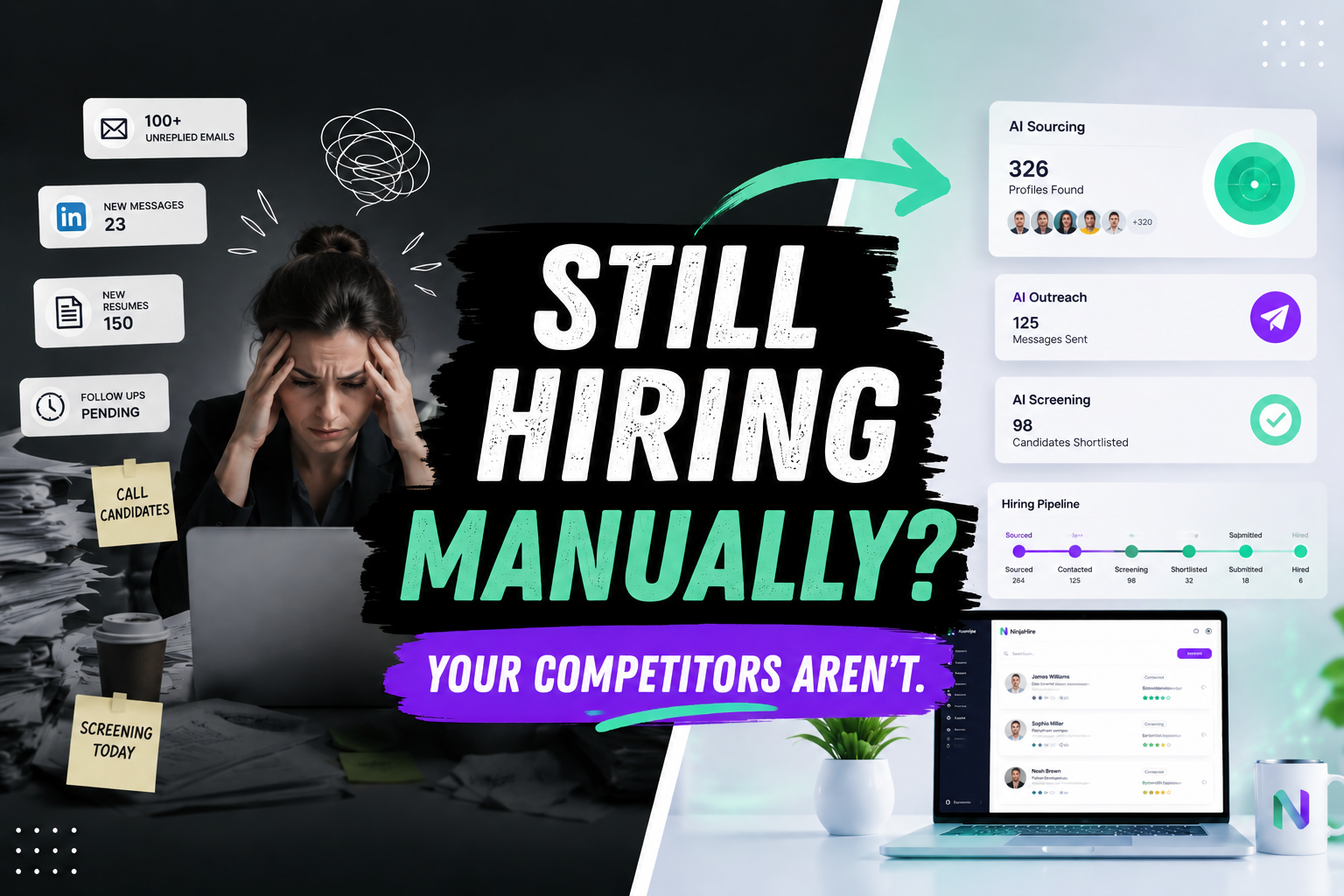
Here's what a typical day looks like for a high-volume recruiter in 2026: Log in. Check the job board. Filter 200 resumes. Send 40 outreach emails. Get 3 replies. Screen 2 candidates. Submit 1. Repeat.
That's not a recruiting process — that's a treadmill.
Staffing agencies scaling past 10, 20, or 50 open requisitions per recruiter hit a wall that more headcount doesn't solve. The bottleneck isn't effort. It's that human recruiters physically can't source, screen, outreach, and follow up fast enough to keep pace with client demand.
The math doesn't lie: Recruiters spend an average of 13 hours per week sourcing candidates for a single role. 75% of candidates never respond to a first outreach. The average time-to-submit at a staffing agency is 3–5 days per placement. Recruiter burnout is the #1 retention challenge for staffing firm owners.
The agencies winning right now aren't hiring more recruiters. They're building smarter workflows — ones where AI handles the top-of-funnel grind so recruiters can focus on relationships, negotiation, and closing.
What Is AI Recruitment Software?
AI recruitment software is a category of hiring technology that uses artificial intelligence to automate, accelerate, or augment the recruiting process — from sourcing and outreach to screening and scheduling. Unlike traditional ATS platforms (which are mostly databases with workflow management bolted on), AI recruiting tools are designed to do work — not just track it.
Depending on the platform, AI recruitment software can:
- Surface qualified candidates from multiple sources automatically
- Write and send personalized outreach sequences across email, LinkedIn, and SMS
- Screen resumes against job requirements using natural language processing
- Conduct AI-powered phone screens and parse responses
- Score and rank applicants by fit, availability, and engagement signals
- Generate recruiter productivity reports and bottleneck alerts
"AI doesn't replace the recruiter — it removes the parts of recruiting that never should have required a recruiter in the first place."
Why Traditional Recruiting Breaks at Scale
Manual Sourcing Hits a Ceiling Fast
LinkedIn Recruiter is a research tool, not a sourcing engine. Boolean searching, saving profiles, and building lists manually works fine when you have 5 open reqs. At 25? Your recruiters are spending entire mornings doing nothing but filtering profiles.
The problem: Sourcing is repeatable. It follows rules. Recruiters are valuable for judgment — not for executing the same search criteria across five job boards.
Outreach Becomes Copy-Paste Chaos
Response rates on generic recruiter outreach are abysmal — often under 15%. Personalized, context-aware outreach consistently performs 2–3x better. But manually personalizing at volume is physically impossible.
Resume Screening Is a Time Sink with No ROI
Reading 80 resumes to find 6 qualified candidates takes 2–3 hours — for every requisition. AI resume screening does the same pass in under 60 seconds, with configurable scoring criteria and automatic ranking. Most recruiters admit their manual screening is inconsistent anyway. AI doesn't have that problem.
Your ATS Isn't an AI Recruiting Tool
Bullhorn, JobDiva, Crelate — excellent at record keeping. Not recruiting. The gap between "we have an ATS" and "we have an AI recruiting workflow" is where most agencies are losing ground to competitors right now.
Key Features Staffing Teams Actually Need
Not all AI recruiting tools are built for staffing. Many are designed for corporate TA teams running 30 hires a year. Here's what actually matters for high-volume agencies.
AI Sourcing Automation
Multi-source candidate discovery from job boards, LinkedIn, and your ATS — with semantic matching that goes beyond keyword overlap.
AI Outreach Automation
Personalized, multi-touch sequences that run automatically based on candidate behavior — opens, clicks, replies — no manual follow-up needed.
AI Resume Screening
NLP-based scoring against your specific job requirements. Resumes ranked automatically before a recruiter opens a single one.
AI Phone Screening
Automated first-round qualification on availability, pay, commute, and role-specific criteria — before recruiter time is invested.
Recruiter Workflow Automation
Task queues, automated handoffs, pipeline triggers, and recruiter alerts that ensure nothing falls through the cracks.
Recruiting Analytics
Pipeline visibility, time-to-submit, outreach response rates, recruiter productivity by role and client.
AI Recruitment Software Comparison (2026)
How the leading platforms stack up — with a close eye on staffing-specific functionality versus corporate TA tools often misrepresented as staffing solutions.
| Platform | Staffing Focus | AI Sourcing | Outreach Auto. | AI Screening | Recruiter Workflows | Free Trial |
|---|---|---|---|---|---|---|
| 🥷 NinjaHire | ✅ Built for staffing | ✅ Multi-source | ✅ AI-generated | ✅ Resume + phone | ✅ Full automation | ✅ Yes |
| Gem | ⚠️ Enterprise TA | ✅ LinkedIn-first | ✅ Sequences | ⚠️ Basic | ⚠️ Limited | ❌ No |
| SeekOut | ⚠️ Corporate TA | ✅ Strong AI | ⚠️ Basic | ⚠️ Resume only | ❌ Minimal | ❌ No |
| Ashby | ❌ Internal only | ❌ None | ⚠️ Email only | ⚠️ Basic | ⚠️ Standard | ⚠️ Demo only |
| Manatal | ⚠️ SMB ATS | ⚠️ Extension | ❌ Manual | ✅ AI scoring | ⚠️ Basic | ✅ Yes |
| Fetcher | ⚠️ Corporate TA | ✅ Automated | ✅ Sequences | ⚠️ Limited | ⚠️ Limited | ⚠️ Demo only |
Key takeaway: Most AI recruiting tools are built for internal TA teams doing lower-volume, longer-cycle hiring. NinjaHire is designed from the ground up for the way staffing agencies actually work — high-volume, multi-client, speed-first.
Built for staffing. Not repurposed for it.
NinjaHire gives your recruiting team AI-powered sourcing, outreach, and screening — all designed around the staffing business model.
Recruiter Productivity: What AI Automation Actually Changes
When AI handles sourcing and outreach, recruiters can cover 3–4× more open requisitions without more hours, time-to-submit drops dramatically, and burnout falls because the soul-crushing volume work is automated.
Real Workflow Example: Light Industrial Staffing Firm
Before AI: 2 recruiters, ~8 open reqs each, 4 days average time-to-submit, 12% outreach response rate, ~20 placements/month.
After implementing AI sourcing and outreach automation:
- Each recruiter handles 12–15 reqs simultaneously
- Time-to-submit dropped from 4 days to 1.5 days
- Outreach response rate improved from 12% to 31%
- Monthly placement volume up 40% — same team, zero new hires
Industry Statistics: The AI Recruiting Landscape in 2026
- 67% of HR leaders say AI is helping them move faster on high-priority roles (LinkedIn Talent Trends 2025)
- Recruiters using AI sourcing tools report finding qualified candidates 58% faster than manual methods
- Automated outreach sequences outperform single-touch manual messages by 2.4× on response rate
- AI resume screening can reduce initial CV review time by up to 75% while improving consistency
- High-volume staffing firms using AI workflows report 30–50% improvement in recruiter output per desk
- 82% of candidates prefer personalized outreach — but only 23% report the messages they receive feel personalized
That last point is the most telling. Candidates want personalization. Recruiters don't have time to manually personalize at volume. AI closes that gap.
Use Case: AI Automation for High-Volume Light Industrial Hiring
Speed is everything in light industrial staffing. The recruiter who gets to a qualified forklift operator first wins the placement. With AI recruitment software, the workflow looks like this:
- Job order comes in from client
- AI immediately cross-references internal database + external sources for matching candidates
- Personalized outreach goes to 50+ candidates automatically — location, shift, pay rate, and specific requirements included
- Responses route to a unified inbox, sorted by engagement level
- Top responders get an AI phone screening call within minutes
- Recruiter reviews screened candidates and submits to client — often within hours
Use Case: AI Sourcing for Technical and Professional Roles
The misconception is that AI tools only work for commodity roles. For professional and technical hiring, the workflow is more nuanced — but sourcing, initial outreach, and first-pass screening still account for 60–70% of recruiter time. Automating those steps frees recruiters to invest their judgment where it matters most.
"The best AI tools aren't trying to replace recruiter intuition. They're trying to give recruiters more opportunities to use it."
For a deeper look at how leading agencies are structuring the balance between automation and human judgment in recruiting, see our breakdown of the AI-recruiter handoff.
ROI: What AI Recruiting Software Actually Costs vs. Delivers
The right question isn't "can we afford AI recruiting software?" It's "how much is the delay already costing us?"
Ready to see what your team's capacity actually looks like with AI?
NinjaHire is built for staffing firms serious about productivity, not just technology.
What to Look for When Evaluating AI Recruitment Software
Prioritize for staffing agencies:
- Multi-client, multi-req management — corporate TA tools assume single-employer use; staffing requires client segmentation
- Speed of implementation — you need ROI in weeks, not months; avoid 3-month onboarding timelines
- Outreach quality — read actual AI-generated messages before buying; generic sequences won't move the needle
- ATS compatibility — the tool should enhance your existing workflow, not replace your ATS
- Recruiter-level UX — if your recruiters won't use it daily, it delivers zero value
Red flags to watch for:
- Platforms positioning AI screening as full "replacement" for recruiter judgment
- Opaque pricing that only reveals itself after a long sales process
- Enterprise TA tools claiming to "also work for staffing" without staffing-specific features
- No free trial or meaningful demo environment
Frequently Asked Questions
The Gap Between Agencies That Automate and Those That Don't Is Widening
The staffing agencies winning in 2026 aren't necessarily the ones with the best recruiters. They're the ones with the best infrastructure supporting those recruiters.
AI recruiting automation won't fix bad client relationships, weak job orders, or misaligned recruiter incentives. But it will give your team the capacity to do more — more outreach, more sourcing, more qualified submissions — without working longer hours or adding headcount you can't support.
The question to ask: if your top competitor adopted AI recruiting automation this year, how would your operation look in comparison 12 months from now?
NinjaHire was built for staffing teams that are serious about productivity.
Start free. See results in your first week.