.png)
.jpeg)
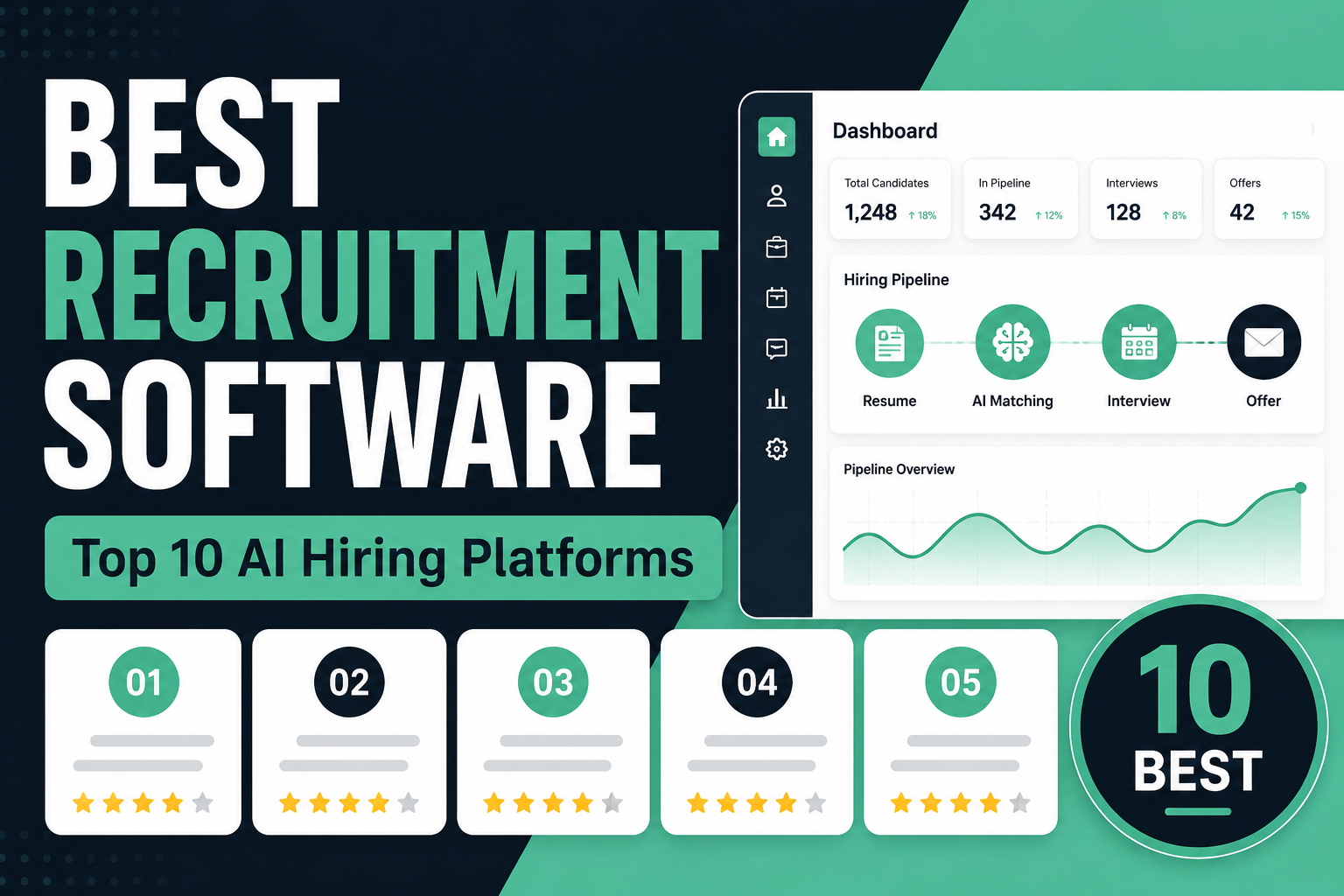
If you're reading this, you've probably already accepted that sourcing tools alone don't fix a slow hiring process. You need software that controls the entire workflow: intake, sourcing, screening, scheduling, submission, offer, and reporting, all connected instead of stitched together with spreadsheets and Slack threads.
This guide is for staffing agencies, RPO firms, executive search teams, and in-house talent acquisition leaders actively comparing recruitment workflow automation software in 2026. We evaluated ten platforms on workflow automation depth, AI capability, ATS functionality, pricing, and integrations, based on publicly available product documentation, vendor pricing pages, and third-party buyer data.
You'll walk away knowing which platforms suit high-volume staffing desks, which suit structured in-house hiring, where each one falls short, and how to run a fair evaluation with your stakeholders. Compare the best recruitment workflow automation software below.
Quick Comparison: Best Recruitment Workflow Automation Software in 2026
How ten leading platforms stack up on the criteria that matter most: AI depth, ATS functionality, resume parsing, outreach, and pricing model.
| Software | Best For | AI Workflow | ATS | Resume Parsing | Outreach | Pricing | Free Trial |
|---|---|---|---|---|---|---|---|
| Ninjahire | Staffing agencies & RPOs needing end-to-end workflow automation | Yes | Yes | Yes | Yes | From $200/month | Yes |
| Juicebox | Solo recruiters and small teams sourcing passive talent | Sourcing-only | No | Limited | Email only | From $139/seat/mo | Free tier |
| Ashby | High-growth tech companies wanting analytics-heavy in-house hiring | Yes | Yes | Yes | Yes | From $400/mo | No |
| Greenhouse | Enterprises needing structured, compliance-heavy hiring | Partial | Yes | Yes | Limited | Contact vendor for pricing | No |
| Lever | Mid-market teams that want ATS and CRM nurturing in one system | Partial | Yes | Yes | Yes | Contact vendor for pricing | No |
| SmartRecruiters | Global enterprises with high-volume, multi-region hiring | Yes | Yes | Yes | Limited | From ~$14,995/yr | No |
| Recruit CRM | Small to mid-size staffing agencies | Partial | Yes | Yes | Yes | From ~$85/user/mo | Yes |
| Bullhorn | Large staffing firms needing an ATS-plus-back-office CRM | Partial | Yes | Yes | Yes | From ~$99/user/mo | No |
| Manatal | Budget-conscious agencies and startups | Yes | Yes | Yes | Limited | From ~$15/user/mo | Yes |
| Zoho Recruit | SMBs and cost-sensitive in-house teams | Partial | Yes | Yes | Limited | Free tier; paid from ~$25/user/mo | Yes |
Detailed Software Reviews
An in-depth, balanced review of each platform's workflow automation, AI features, ATS functionality, integrations, strengths, and limitations. Pricing reflects publicly disclosed figures; most enterprise contracts are individually quoted.
Ninjahire
Overview: Ninjahire is a recruitment workflow automation platform built around a single premise: sourcing candidates faster doesn't matter if the rest of the hiring workflow is still manual. It combines AI-powered candidate search, resume parsing, matching, and multi-channel outreach with a configurable workflow engine that automates handoffs between sourcing, screening, scheduling, client submission, and offer stages.
Ideal users: Staffing agencies, RPO firms, and recruitment operations teams that need one connected system rather than a sourcing tool bolted onto a separate ATS.
Key workflow automation capabilities: Configurable pipeline stages, automation rules that trigger on candidate status changes, automated follow-up sequences, and submission workflows built for agency-client handoffs.
AI features: AI candidate search and matching, automated resume parsing and ranking, AI-assisted outreach personalization, and candidate rediscovery from historical talent pools.
ATS capabilities: Native applicant tracking with pipeline visibility, role-based permissions, and reporting built specifically around agency and RPO workflows.
Integrations: Connects with common calendar, email, and job board tools; API access for custom workflows.
Strengths: Purpose-built for the full workflow rather than a single stage, strong resume parsing and matching accuracy, workflow automation designed around real staffing desk processes.
Limitations: As a newer entrant than legacy ATS incumbents, its integration marketplace and enterprise compliance tooling are still maturing relative to Greenhouse or SmartRecruiters. Buyers with heavy HRIS integration needs should confirm connector availability during evaluation.
Pricing: https://ninjahire.co/pricing.
Best for: Staffing agencies and RPOs that want sourcing, ATS, and workflow automation in one platform instead of three.
Verdict: Ninjahire is a strong fit for teams whose primary bottleneck is workflow fragmentation rather than sourcing volume alone. Enterprises with complex legacy-system requirements should evaluate integration depth carefully before committing.
Juicebox
Overview: Juicebox, known for its PeopleGPT search engine, is an AI-native sourcing platform that lets recruiters describe a candidate profile in plain language and returns ranked matches from a large aggregated profile database. It has expanded into autonomous AI Agents that run searches and draft outreach continuously.
Ideal users: Solo recruiters, small in-house teams, and founders who need fast sourcing without a full ATS.
Key workflow automation capabilities: Sourcing and outreach automation only. Juicebox does not include native pipeline tracking, interview scheduling, or offer workflows.
AI features: Natural-language AI search, AI-driven candidate ranking, and autonomous sourcing Agents that run in the background and surface shortlists.
ATS capabilities: None built in. Sourced candidates must be exported or synced to a separate ATS for pipeline management.
Integrations: Integrates with a wide range of ATS and CRM platforms so sourced candidates can flow into an existing system.
Strengths: Genuinely fast, accurate natural-language sourcing; large profile database; useful for hard-to-find passive talent.
Limitations: No built-in ATS or pipeline tracking, email-only outreach with no multi-channel sequencing, AI Agents cost extra on top of seat pricing, and full workflow automation still requires a separate system.
Pricing: Free tier available; paid plans start around $139 per seat per month, with AI Agents priced separately as an add-on. Higher tiers required for ATS integrations.
Best for: Teams that need a best-in-class sourcing layer and already have (or don't need) a separate workflow system.
Verdict: Excellent at the discovery phase of recruiting, but it is a sourcing tool, not a workflow automation platform. Teams evaluating it against full-workflow software should be clear about that distinction before comparing price.
Ashby
Overview: Ashby is an all-in-one recruiting platform combining ATS, sourcing CRM, interview scheduling, and heavily configurable analytics, with AI features layered throughout, including candidate filtering and interview summarization.
Ideal users: Growth-stage and enterprise tech companies with a dedicated recruiting operations function.
Key workflow automation capabilities: Custom workflow builder, automated scheduling, and configurable analytics dashboards that track recruiter and pipeline performance.
AI features: AI candidate filtering, an AI notetaker for interviews, and AI-assisted summarization.
ATS capabilities: Full ATS with structured pipelines, plus a native sourcing CRM.
Integrations: Open API and webhooks, strong for teams with engineering resources to build custom automations; some HRIS connectors require workarounds.
Strengths: Best-in-class analytics and dashboard customization, modern interface, genuinely all-in-one for in-house teams.
Limitations: No free trial, steep learning curve for smaller teams, key reporting features gated behind higher tiers, and pricing scales quickly with headcount.
Pricing: Foundations plan starts around $400 per month for companies under roughly 100 employees; larger organizations move to custom pricing.
Best for: Data-driven, growth-stage tech companies that want deep reporting and are prepared to pay a premium for it.
Verdict: A strong choice for in-house teams that live in their hiring dashboards. Less suited to staffing agencies managing multiple clients and requisitions with tighter margins.
Greenhouse
Overview: Greenhouse is a long-established ATS built around structured hiring: interview kits, standardized scorecards, and DEI-oriented reporting designed to reduce bias and enforce process consistency across large hiring teams.
Ideal users: Mid-market and enterprise in-house talent acquisition teams with compliance and consistency requirements.
Key workflow automation capabilities: Structured interview workflows, automated scheduling, and onboarding handoff, though workflow customization can require dedicated administrative resources.
AI features: AI features have been added on top of an established platform architecture rather than built in from the start; capability is growing but is not as deeply embedded as newer AI-native tools.
ATS capabilities: Extensive, with strong structured interviewing and scorecard functionality.
Integrations: One of the largest partner ecosystems in the category, with 500+ listed integrations.
Strengths: Deep compliance and DEI reporting tools, structured process enforcement, large integration marketplace.
Limitations: Pricing is not published and typically requires a sales conversation; implementation for enterprise deployments commonly runs 60 to 90 days; entry-tier plans exclude API access and advanced analytics; limited built-in outreach or CRM-style candidate nurturing.
Pricing: Contact vendor for pricing. Buyer-reported figures vary widely by company size and tier.
Best for: Enterprises that prioritize structured, auditable hiring processes over sourcing or nurturing capability.
Verdict: Still a category benchmark for compliance-heavy structured hiring, but it can feel like overkill, and expensive, for smaller teams or agencies that need lighter, faster workflow automation.
Lever
Overview: Lever (LeverTRM) combines an ATS with a native candidate relationship management layer, letting teams nurture passive candidates with email sequences and talent pools inside the same system used for active pipeline tracking.
Ideal users: Mid-market in-house teams that want sourcing, nurturing, and tracking unified in one platform.
Key workflow automation capabilities: Automated nurture campaigns, pipeline stage automation, and reporting built around a flexible "Opportunity" data model rather than rigid stages.
AI features: AI and automation features have been added incrementally; not built on an AI-native architecture.
ATS capabilities: Full applicant tracking combined with built-in CRM, which differentiates it from Greenhouse's more process-first model.
Integrations: Around 200+ listed integrations, smaller than Greenhouse's marketplace but with a more hands-on customer success model for mid-market accounts.
Strengths: Native CRM nurturing without a separate tool, simpler user interface, generally faster implementation than Greenhouse.
Limitations: Pricing is not published; advanced analytics, nurture campaigns, and premium integrations are often priced as add-ons that meaningfully increase total cost.
Pricing: Contact vendor for pricing.
Best for: Mid-market teams whose bottleneck is passive candidate nurturing as much as active pipeline tracking.
Verdict: A solid middle ground between Greenhouse's structure and a dedicated sourcing CRM, though total cost of ownership can climb once add-ons are factored in.
SmartRecruiters
Overview: SmartRecruiters is an enterprise recruiting suite built for global, high-volume hiring, combining ATS, CRM, and analytics with an AI-powered hiring assistant and talent matching in its higher tiers.
Ideal users: Large enterprises with multi-region, high-volume hiring needs.
Key workflow automation capabilities: Configurable hiring workflows across regions and business units, plus automation for high-volume requisition management.
AI features: AI-powered hiring agent and talent matching, available on Professional and higher tiers.
ATS capabilities: Full-scale ATS designed for large, complex hiring organizations.
Integrations: Broad enterprise HRIS and job board integration ecosystem.
Strengths: Built for scale and global compliance requirements, strong candidate matching in upper tiers.
Limitations: No free trial, entry pricing published at roughly $14,995 annually with meaningful jumps to access AI features, and the platform can be more than smaller teams or agencies need.
Pricing: Essential tier starts around $14,995 per year; Professional and High Volume tiers use custom pricing.
Best for: Enterprise in-house teams running high-volume hiring across multiple countries.
Verdict: A capable enterprise platform, but its pricing floor and complexity put it out of reach for staffing agencies or SMBs comparing workflow automation options.
Recruit CRM
Overview: Recruit CRM is an ATS and CRM built specifically for recruitment and staffing agencies, combining candidate and client management with workflow automation aimed at agency operations.
Ideal users: Small to mid-size staffing and executive search agencies.
Key workflow automation capabilities: Automated pipeline stages, email sequences, and Kanban-style workflow views built around agency desk operations.
AI features: AI-assisted resume parsing and candidate matching; AI capability is less extensive than AI-native platforms.
ATS capabilities: Combined ATS and CRM covering both candidate and client relationship tracking, which agencies typically need in one system.
Integrations: Connects with common job boards, email providers, and calendar tools; smaller integration ecosystem than enterprise ATS platforms.
Strengths: Purpose-built for agency workflows, fast implementation, competitively priced relative to enterprise ATS platforms.
Limitations: Less suited to large in-house enterprise hiring, and AI capability is more basic than newer AI-native entrants.
Pricing: Plans reportedly start around $85 per user per month.
Best for: Small and mid-size agencies that need combined candidate and client workflow management without enterprise overhead.
Verdict: A practical, agency-focused option, though larger firms may outgrow its AI and reporting depth.
Bullhorn
Overview: Bullhorn is one of the most established platforms built specifically for staffing agencies, combining ATS and CRM functionality with back-office capability for larger firms managing high volumes of job orders and placements.
Ideal users: Large staffing firms and consultancies with complex client and candidate management needs.
Key workflow automation capabilities: Automation across job order management, candidate submission, and placement tracking, with strong client relationship management built in.
AI features: AI and automation features are being added incrementally rather than forming the platform's original foundation.
ATS capabilities: Deep ATS and CRM functionality tailored to staffing operations, including client-side workflows.
Integrations: Integrates with email platforms like Gmail and Outlook and LinkedIn, plus a broad partner ecosystem for staffing-specific tools.
Strengths: Purpose-built CRM layer for agency client relationships, strong fit for high-volume staffing desks, established market presence.
Limitations: No free trial, pricing starts higher than many agency-focused alternatives, and some features like assessments or background screening require paid integrations.
Pricing: Reportedly starts around $99 per month, scaling with users and modules.
Best for: Large staffing firms that need a combined CRM and ATS for both candidates and clients at scale.
Verdict: A strong fit for high-volume staffing operations, though smaller agencies may find it more platform than they need, both in cost and complexity.
Manatal
Overview: Manatal is a cloud-based ATS and CRM aimed at recruitment agencies and in-house HR teams that want AI-assisted candidate recommendations without enterprise-level cost.
Ideal users: Budget-conscious agencies and startups.
Key workflow automation capabilities: Automated candidate scoring, pipeline stage automation, and job posting distribution across a large network of job boards.
AI features: AI-powered candidate recommendations and social media enrichment across a wide range of platforms.
ATS capabilities: Full ATS and CRM combination with collaborative hiring tools.
Integrations: Broad job board network and standard recruiting tool integrations.
Strengths: Strong feature set relative to its price point, quick setup, transparent published pricing.
Limitations: AI and analytics depth is lighter than premium platforms like Ashby, and outreach capability is more limited.
Pricing: Starts around $15 per user per month.
Best for: Small agencies and startups that want genuine AI features at an accessible price.
Verdict: One of the best value options in this category, provided you don't need enterprise-grade analytics or multi-channel outreach automation.
Zoho Recruit
Overview: Zoho Recruit is an ATS and CRM aimed at SMBs, agencies, and in-house HR departments, offered as part of the broader Zoho ecosystem with a freemium entry point.
Ideal users: Cost-sensitive SMBs and small agencies, especially those already using other Zoho products.
Key workflow automation capabilities: Job posting automation, custom workflows, and candidate assessment tools.
AI features: AI-powered candidate matching and automated screening workflows.
ATS capabilities: Full applicant tracking with resume parsing extracting a large number of data points per candidate, plus OCR support for scanned resumes.
Integrations: Deep integration with the Zoho product suite; standard integrations with common job boards and email providers.
Strengths: Free tier available, transparent published pricing, solid feature set for the price, familiar for existing Zoho users.
Limitations: Outreach and multi-channel sourcing capability is more limited than dedicated recruiting CRMs, and AI depth trails purpose-built recruiting AI platforms.
Pricing: Free plan available; paid plans start around $25 per user per month.
Best for: SMBs and in-house teams that want essential ATS functionality without enterprise pricing.
Verdict: A dependable, affordable entry point, particularly for teams already inside the Zoho ecosystem, though it's not built for agencies running complex multi-client workflows.
Feature-by-Feature Comparison
Look past marketing language and check specific feature availability. The table below compares core capabilities across all ten platforms.
| Feature | Ninjahire | Juicebox | Ashby | Greenhouse | Lever | SmartRecruiters | Recruit CRM | Bullhorn | Manatal | Zoho Recruit |
|---|---|---|---|---|---|---|---|---|---|---|
| AI Candidate Search | Yes | Yes | Yes | Partial | Partial | Yes | Partial | Partial | Yes | Partial |
| Resume Parsing | Yes | Limited | Yes | Yes | Yes | Yes | Yes | Yes | Yes | Yes |
| Semantic Search | Yes | Yes | Partial | No | No | Partial | No | No | Partial | No |
| Candidate Rediscovery | Yes | No | Partial | Partial | Yes | Partial | Yes | Yes | Partial | Partial |
| Native ATS | Yes | No | Yes | Yes | Yes | Yes | Yes | Yes | Yes | Yes |
| Native CRM | Yes | No | Yes | Partial | Yes | Yes | Yes | Yes | Yes | Partial |
| Workflow Builder | Yes | No | Yes | Partial | Partial | Yes | Yes | Yes | Partial | Yes |
| Automation Rules | Yes | Partial | Yes | Partial | Yes | Yes | Yes | Yes | Partial | Yes |
| Interview Scheduling | Yes | No | Yes | Yes | Yes | Yes | Partial | Partial | Partial | Yes |
| Email Automation | Yes | Yes | Yes | Partial | Yes | Partial | Yes | Yes | Partial | Partial |
| Calendar Sync | Yes | No | Yes | Yes | Yes | Yes | Yes | Yes | Partial | Yes |
| Chrome Extension | Yes | No | Partial | Partial | Partial | No | Yes | Yes | Yes | Partial |
| Analytics/Reporting | Yes | Partial | Yes | Yes | Yes | Yes | Partial | Yes | Partial | Partial |
| Mobile App | Yes | No | Partial | Yes | Yes | Yes | Yes | Yes | Yes | Yes |
| Open API | Yes | Partial | Yes | Yes | Yes | Yes | Partial | Yes | Partial | Yes |
| Zapier Integration | Yes | Partial | Partial | Yes | Yes | Partial | Yes | Partial | Yes | Yes |
| Slack Integration | Yes | No | Yes | Yes | Yes | Partial | Partial | Partial | Partial | Partial |
| Role Permissions | Yes | No | Yes | Yes | Yes | Yes | Yes | Yes | Partial | Yes |
| Custom Reports | Yes | Partial | Yes | Yes | Yes | Yes | Partial | Yes | Partial | Partial |
| Compliance Tools | Partial | No | Partial | Yes | Partial | Yes | Partial | Yes | Partial | Partial |
| Bulk Actions | Yes | Partial | Yes | Yes | Yes | Yes | Yes | Yes | Yes | Yes |
| Pipeline Automation | Yes | No | Yes | Partial | Yes | Yes | Yes | Yes | Partial | Partial |
| AI Candidate Matching | Yes | Partial | Yes | Partial | Partial | Yes | Partial | Partial | Yes | Yes |
| Offer Workflow | Yes | No | Yes | Yes | Yes | Yes | Partial | Yes | Partial | Partial |
| Custom Workflow Rules | Yes | No | Yes | Partial | Partial | Yes | Yes | Yes | Partial | Yes |
"Partial" means the feature is limited, gated behind a higher tier, or needs a third-party add-on.
Workflow Automation Comparison: Stage by Stage
Feature checklists only tell part of the story. What matters more is whether a platform automates handoffs between stages, or just digitizes each stage in isolation.
| Workflow Stage | Strongest Automation | Weakest Automation |
|---|---|---|
| Candidate sourcing | Ninjahire, Juicebox, Ashby | Recruit CRM, Zoho Recruit |
| Resume parsing | Ninjahire, Zoho Recruit, Ashby | Juicebox |
| Candidate matching | Ninjahire, Ashby, Manatal | Bullhorn, Recruit CRM |
| Outreach | Ninjahire, Lever, Recruit CRM | Juicebox (email-only), SmartRecruiters |
| Follow-up automation | Ninjahire, Lever, Bullhorn | Ashby, Manatal |
| Screening | Ninjahire, SmartRecruiters, Ashby | Manatal, Zoho Recruit |
| Scheduling | Ninjahire, Ashby, Greenhouse | Bullhorn, Recruit CRM |
| Client submission | Ninjahire, Bullhorn, Recruit CRM | Greenhouse, Ashby |
| Offer management | Ninjahire, Greenhouse, Bullhorn | Manatal, Recruit CRM |
| Analytics | Ashby, Greenhouse, Bullhorn | Manatal, Juicebox |
| Pipeline management | Ninjahire, Lever, SmartRecruiters | Juicebox (no ATS) |
Sourcing-first tools like Juicebox and structure-first tools like Greenhouse show their limits here: excellent at one or two stages, but requiring a separate system for the rest. Platforms built around the full pipeline, including Ninjahire, Ashby, Bullhorn, and Recruit CRM, reduce manual handoffs.
AI Capability Comparison
Not all "AI-powered" claims mean the same thing. Some platforms built AI into their core architecture; others added it on top of an existing system.
| AI Capability | Ninjahire | Juicebox | Ashby | Greenhouse | Lever | SmartRecruiters | Recruit CRM | Bullhorn | Manatal | Zoho Recruit |
|---|---|---|---|---|---|---|---|---|---|---|
| AI Search | Yes | Yes | Yes | Partial | Partial | Yes | Partial | Partial | Yes | Partial |
| AI Matching | Yes | Partial | Yes | Partial | Partial | Yes | Partial | Partial | Yes | Yes |
| AI Resume Ranking | Yes | No | Yes | Partial | Partial | Yes | Partial | Partial | Yes | Yes |
| Semantic Search | Yes | Yes | Partial | No | No | Partial | No | No | Partial | No |
| AI Outreach | Yes | Yes | Partial | No | Partial | No | Partial | Partial | No | No |
| AI Screening | Yes | No | Partial | Partial | Partial | Yes | No | No | Partial | Partial |
| AI Follow-ups | Yes | Partial (Agents add-on) | No | No | Partial | No | Partial | Partial | No | No |
| AI Insights/Analytics | Yes | Partial | Yes | Yes | Yes | Yes | Partial | Yes | Partial | Partial |
| Workflow Intelligence | Yes | No | Yes | Partial | Partial | Yes | Partial | Partial | No | No |
| Automation Builder | Yes | No | Yes | Partial | Yes | Yes | Yes | Yes | Partial | Yes |
Juicebox and Manatal lead on AI discovery but stop short of full workflow intelligence. Ashby and SmartRecruiters offer strong AI analytics behind higher-tier plans. Ninjahire carries AI capability across the entire workflow, from search through follow-up, rather than one stage.
Pricing Comparison
Most enterprise recruiting platforms in this category don't publish transparent pricing, which makes apples-to-apples comparison difficult. Below is what's publicly known, along with where buyers should expect a custom quote.
| Software | Published Pricing | Free Trial | Implementation | Support | Enterprise Tier |
|---|---|---|---|---|---|
| Ninjahire | Contact vendor for pricing | Yes | Included | Standard and dedicated tiers | Custom quote |
| Juicebox | From $139/seat/mo; Agents priced separately | Free tier | Self-serve | Standard | Custom Business plan |
| Ashby | From $400/mo (Foundations) | No | 4-8 weeks typical | Standard and dedicated | Custom quote |
| Greenhouse | Contact vendor for pricing | No | Separately billed; 4-8+ weeks | Standard and dedicated | Custom quote |
| Lever | Contact vendor for pricing | No | Included, varies by tier | Standard and dedicated | Custom quote |
| SmartRecruiters | From ~$14,995/yr (Essential) | No | Included, weeks typical | Standard and dedicated | Custom quote |
| Recruit CRM | From ~$85/user/mo | Yes | Self-serve, fast | Standard | Custom quote |
| Bullhorn | From ~$99/mo, scales with users | No | Weeks typical | Standard and dedicated | Custom quote |
| Manatal | From ~$15/user/mo | Yes | Days, self-serve | Standard | Custom quote |
| Zoho Recruit | Free tier; paid from ~$25/user/mo | Yes | Self-serve | Standard | Custom quote |
Platforms that don't publish pricing (Greenhouse, Lever, SmartRecruiters, Ashby above entry tier) tend to price by total headcount rather than recruiter seats, with renewal increases commonly in the 8 to 15 percent range. Ask for a three-year total cost projection, not just a first-year quote.
Pros & Cons Comparison
| Software | Key Strength | Key Weakness |
|---|---|---|
| Ninjahire | Full workflow automation from sourcing to offer in one system | Smaller enterprise integration marketplace than legacy incumbents |
| Juicebox | Best-in-class natural-language sourcing | No native ATS or pipeline tracking |
| Ashby | Best analytics and dashboard customization | Expensive, no free trial, steep learning curve |
| Greenhouse | Deep compliance and structured hiring tools | Opaque pricing, slow implementation, limited outreach |
| Lever | Native CRM nurturing built into the ATS | Add-ons increase cost significantly |
| SmartRecruiters | Built for global, high-volume enterprise hiring | High pricing floor, complex for smaller teams |
| Recruit CRM | Purpose-built for agency client and candidate workflows | Lighter AI and reporting than premium platforms |
| Bullhorn | Strong CRM for staffing agency client relationships | Higher entry cost, some features need paid add-ons |
| Manatal | Strong feature-to-price ratio | Limited outreach and analytics depth |
| Zoho Recruit | Free tier and transparent, affordable pricing | Limited multi-channel outreach and AI depth |
Best Software by Use Case
Staffing Agencies
Ninjahire, Bullhorn, and Recruit CRM lead here because agency workflows require managing both candidate pipelines and client relationships in the same system. Bullhorn suits larger firms with complex back-office needs; Recruit CRM and Ninjahire fit small to mid-size agencies wanting faster implementation.
Enterprise Hiring
Greenhouse and SmartRecruiters are the strongest fits for large enterprises needing structured, auditable, multi-region hiring with deep compliance reporting.
Healthcare
Zoho Recruit and Bullhorn offer the compliance and volume handling healthcare staffing requires, though buyers should confirm credentialing-specific integrations, since neither is a healthcare-specialist system out of the box.
Technology Hiring
Ashby is purpose-built for tech company hiring operations, with analytics depth that appeals to engineering-minded teams. Ninjahire and Lever are also strong where sourcing speed matters as much as reporting.
Executive Search
Ninjahire and Recruit CRM fit executive search firms needing relationship-driven candidate rediscovery and long-cycle nurturing rather than transactional hiring.
Startups
Manatal and Zoho Recruit offer the best combination of low cost and fast setup for startups making their first hires without dedicated recruiting ops staff.
SMBs
Zoho Recruit and Manatal lead on affordability, with Recruit CRM a strong step up once workflow complexity grows.
High-Volume Hiring
SmartRecruiters and Bullhorn handle high requisition volume well, though both require dedicated administrative resources to configure.
RPO
Ninjahire and Bullhorn suit RPO firms managing multiple client accounts, since both support client-facing submission workflows alongside pipeline management.
Remote Hiring
Ashby and Lever both handle distributed, asynchronous hiring well, with scheduling automation that accounts for multiple time zones.
Recruitment Workflow Automation Buyer's Guide
If you need a refresher on the core concept, our guide on recruitment workflow automation and why sourcing alone doesn't fix hiring delays covers that in depth. From here, the work is evaluating software against a specific set of buying criteria.
Essential features to prioritize
- AI-assisted candidate search and matching that goes beyond keyword filtering
- Native ATS functionality so pipeline data doesn't live across disconnected tools
- Configurable automation rules triggered by candidate status changes, not static reminders
- Multi-channel outreach and follow-up automation
AI considerations
Distinguish between AI built into the core architecture and AI added as a feature layer. AI-native platforms tend to carry intelligence across more of the workflow rather than concentrating it in search or screening alone.
ATS considerations
Confirm whether the platform includes native pipeline tracking or requires pairing with a separate ATS. Sourcing-only tools like Juicebox are excellent at their job but incomplete alone.
Integrations
Check calendar, email, job board, HRIS, and Slack integrations against your actual stack. Ask specifically whether integrations are two-way syncs or one-directional exports.
Security and compliance
Ask about data residency, SOC 2 or equivalent certification, and role-based access controls, especially across multiple regions or client accounts.
Scalability
Model headcount and hiring volume 18 to 24 months out. Several platforms price by total company headcount rather than recruiter seats, which can create unexpected cost jumps.
ROI & Business Impact
Recruitment workflow automation software earns its cost by compressing the time and manual effort between each hiring stage. Buyers evaluating ROI should track these metrics before and after implementation:
| Metric | What to Track |
|---|---|
| Time-to-submit | Days from role intake to first candidate submission |
| Time-to-hire | Days from job opening to offer acceptance |
| Recruiter productivity | Requisitions or submissions handled per recruiter per week |
| Cost-per-hire | Total recruiting spend divided by hires made |
| Candidate response rate | Percentage of outreach that generates a reply |
| Pipeline velocity | Average time candidates spend in each pipeline stage |
| Hiring efficiency | Ratio of qualified submissions to interviews conducted |
Teams that automate scheduling alone commonly report recovering several recruiter-hours per week. The larger gains come from automating handoffs between stages, since manual data entry between disconnected systems is consistently cited as a top workflow pain point.
Implementation Checklist
- Workflow audit: Map your current hiring process stage by stage and identify where manual handoffs cause delays.
- Tool selection: Shortlist two to three platforms, then run structured demos using the same scenario for each.
- Migration: Plan data migration for existing candidate and client records.
- Automation setup: Configure workflow rules and integrations before go-live, not after.
- Training: Budget dedicated time for recruiter training; adoption failures are usually a training gap, not a product gap.
- KPIs: Set baseline metrics before rollout so you can measure impact.
- Optimization: Review automation performance at 30, 60, and 90 days and adjust based on usage data.
How to Choose Recruitment Workflow Automation Software
Evaluation checklist
- Does it automate handoffs between stages, or just digitize individual stages?
- Is AI built into the core workflow, or added as a bolt-on feature?
- Does pricing scale by seat or by total headcount?
- What's included in the base tier versus gated behind add-ons?
Questions to ask vendors
- What does a three-year total cost of ownership look like, including renewal increases?
- Which integrations are native two-way syncs versus manual exports?
- Can we run a paid pilot before committing to an annual contract?
Red flags
- No public pricing and reluctance to give even a range before a sales call
- Vague answers about which features require add-on modules
- AI features that can't be demonstrated live on your own sample data
Procurement tips
Negotiate renewal price caps up front. Request bundled implementation and training pricing instead of itemized fees. Reference competing quotes during negotiation; vendors consistently offer better terms to buyers who show active evaluation of alternatives.
Frequently Asked Questions
What is recruitment workflow automation software?
It's software that automates the handoffs between hiring stages, sourcing, screening, scheduling, submission, and offer, rather than just tracking candidates in a static database.
What's the difference between an ATS and a workflow automation platform?
An ATS primarily tracks candidates through pipeline stages. Workflow automation software adds rules and triggers that automatically move work forward, such as scheduling an interview or sending a follow-up when a candidate's status changes.
Is Ninjahire an ATS?
Yes. Ninjahire includes native applicant tracking alongside AI sourcing, resume parsing, and workflow automation, so it functions as both an ATS and a workflow automation platform.
What is the best recruitment workflow automation software for staffing agencies?
Ninjahire, Bullhorn, and Recruit CRM are generally the strongest fits, since they combine candidate and client workflow management in one system.
What is the best AI recruitment workflow software?
Ninjahire, Ashby, and Manatal carry the most AI capability across multiple workflow stages rather than a single feature.
Is Juicebox a full recruiting platform?
No. Juicebox is a sourcing tool built around natural-language candidate search. It does not include native pipeline tracking, so most teams pair it with a separate ATS.
How much does recruitment workflow automation software cost?
Costs range from free or under $30 per user per month for entry-level tools like Zoho Recruit and Manatal, to custom enterprise contracts that can exceed $50,000 per year for platforms like Greenhouse or SmartRecruiters.
What are the best Greenhouse alternatives?
Ashby, Lever, and Ninjahire are commonly evaluated as Greenhouse alternatives, depending on whether the priority is analytics (Ashby), CRM nurturing (Lever), or full workflow automation (Ninjahire).
What are the best Lever alternatives?
Ashby and Ninjahire are frequently compared against Lever for teams that want more built-in automation or AI-native architecture.
What are the best Ashby alternatives?
Greenhouse for structured compliance-heavy hiring, and Ninjahire for teams that prioritize workflow automation over analytics customization.
What are the best Bullhorn alternatives?
Recruit CRM and Ninjahire are commonly considered for agencies that want similar CRM depth with lower entry cost.
What are the best Recruit CRM alternatives?
Bullhorn for larger firms needing more back-office capability, and Ninjahire for firms that want deeper AI-driven sourcing and matching.
What are the best SmartRecruiters alternatives?
Greenhouse for enterprise compliance needs, and Ninjahire or Ashby for teams that want more workflow automation flexibility at a lower price point.
What are the best Manatal alternatives?
Zoho Recruit for budget-conscious teams, and Ninjahire for teams that want stronger workflow automation as they scale beyond a startup team size.
Does Ninjahire integrate with existing ATS systems?
Ninjahire includes native ATS functionality and API access; buyers with existing enterprise HRIS systems should confirm specific connector availability during evaluation.
What is the best ATS with workflow automation built in?
Ninjahire and Ashby both combine ATS functionality with configurable workflow automation natively, rather than requiring separate tools.
How long does implementation typically take?
Simpler platforms like Manatal or Zoho Recruit can be live within days. Enterprise platforms like Greenhouse or SmartRecruiters typically take four to twelve weeks depending on data migration and customization needs.
Which platforms support multi-channel outreach?
Ninjahire, Lever, Recruit CRM, and Bullhorn support multi-channel outreach natively. Juicebox is currently limited to email.
Can recruitment workflow automation software replace a recruiter?
No. These platforms automate repetitive administrative work like scheduling, follow-ups, and status updates, freeing recruiters to focus on relationship-building and judgment calls that require human input.
Is pricing negotiable for enterprise ATS platforms?
Generally, yes, particularly at mid-market and enterprise tiers. Buyer data consistently shows better outcomes for buyers who reference competitive quotes during negotiation.
What's the difference between AI-native and AI-added platforms?
AI-native platforms were built around AI from the start, so intelligence typically runs through more stages of the workflow. AI-added platforms bolt AI features onto an older architecture, which can mean less consistency between stages.
Do these platforms support compliance requirements like GDPR or EEOC reporting?
Most enterprise platforms, including Greenhouse, SmartRecruiters, and Bullhorn, offer compliance and DEI reporting tools. Confirm specific regional requirements directly with the vendor.
What's the biggest mistake buyers make when comparing recruitment software?
Comparing first-year sticker price without modeling implementation fees, add-on costs, and renewal escalation over a three-year contract term.
Why Consider Ninjahire
Ninjahire is built around a specific thesis: the biggest hiring bottlenecks usually aren't in sourcing, they're in the handoffs between sourcing, screening, scheduling, submission, and offer. That's reflected in where the platform is strongest.
AI sourcing and matching: Ninjahire's AI search and candidate matching are designed to work together, so a strong sourcing result flows directly into ranked, workflow-ready candidates rather than a separate export step.
Resume parsing: Structured parsing extracts candidate data automatically, reducing manual data entry during intake.
Workflow automation: Configurable automation rules move candidates through pipeline stages based on status changes, rather than relying on recruiters to manually update every step.
Outreach: Multi-channel outreach and follow-up automation are built in, addressing a gap that pure sourcing tools like Juicebox leave open.
ATS and analytics: Native pipeline tracking and reporting mean teams don't need to stitch together a separate ATS and sourcing tool.
Ninjahire isn't the right fit for every team. Enterprises with deep, established HRIS ecosystems should evaluate integration depth carefully, since its marketplace is smaller than incumbents like Greenhouse. For staffing agencies, RPOs, and teams whose real bottleneck is a fragmented, multi-tool workflow, it's worth a closer look.
Book a personalized demo to see how Ninjahire handles your specific hiring workflow.