.png)

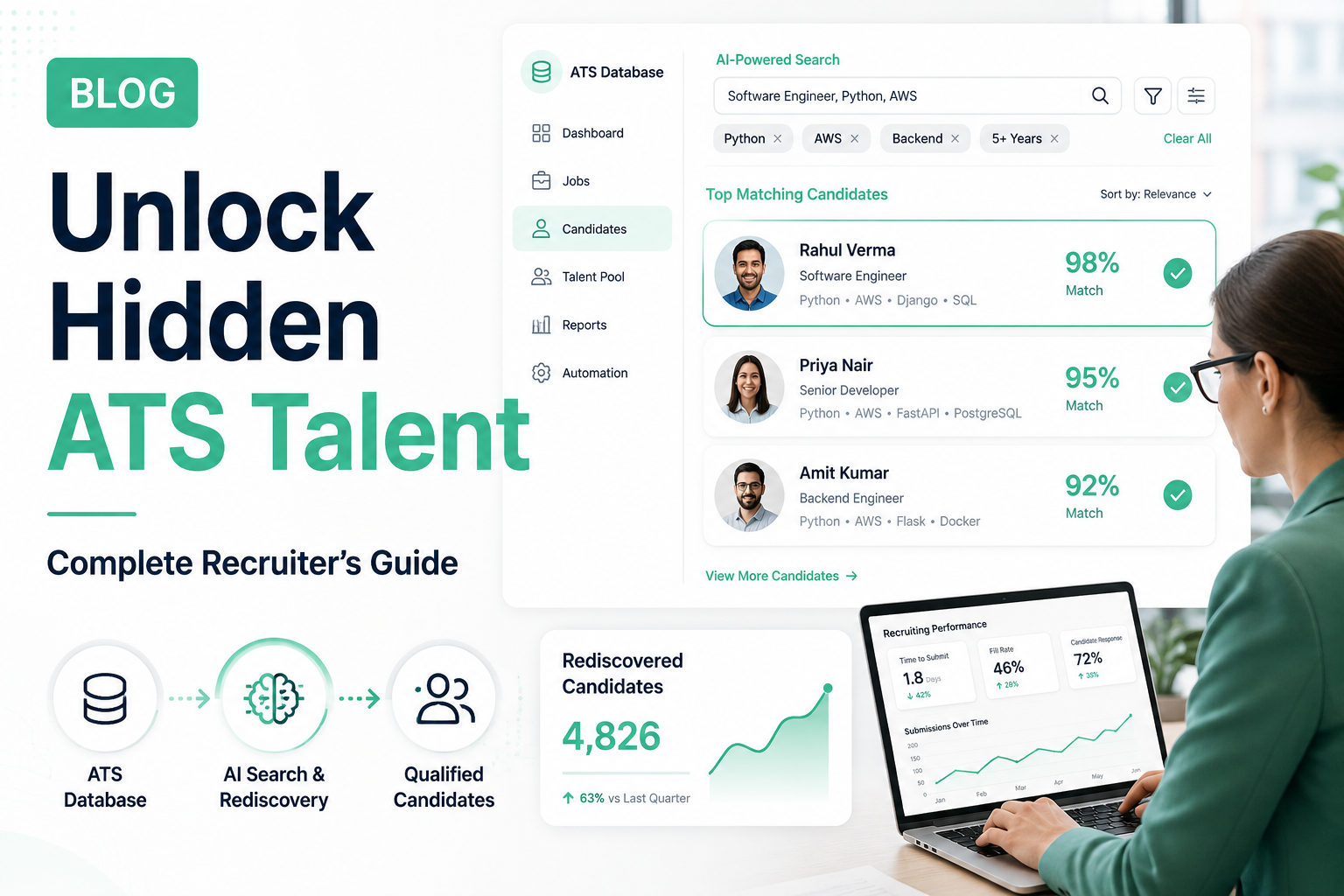
Candidate rediscovery software helps recruiters search an organisation’s existing ATS or CRM records for past applicants, previously sourced candidates, and finalists who may fit a new opening. Depending on the product, it may add semantic matching, candidate ranking, data enrichment, or re-engagement workflows to the search capabilities already available in the applicant tracking system (ATS).
A common deployment is a search or intelligence layer connected to the ATS/CRM. The exact architecture varies: some products are overlays, while others combine rediscovery with a recruiting CRM or broader talent acquisition suite. Confirm which records the product reads, which fields it can write, and which actions require recruiter approval.
The core purpose of this software is to surface qualified, familiar talent before an organization commits budget to external job boards, paid advertisements, or third-party agency fees. However, capabilities vary significantly across vendors. Some tools function as lightweight search overlays, while others operate as full-scale recruitment CRMs or AI talent orchestration engines.
Before procuring a dedicated solution, recruitment operations leaders must determine whether their current ATS search is genuinely insufficient, or whether poor internal data hygiene, missing skills taxonomy, or untrained Boolean operators are the true bottlenecks.
What Buyers Should Evaluate Before Choosing Candidate Rediscovery Software
Start by identifying the bottleneck. A separate platform is not automatically the answer to a weak rediscovery process.
- Search limitation: Recruiters cannot reliably find relevant past candidates using the ATS’s existing keyword, Boolean, and filter tools.
- Data-quality limitation: Candidate records are incomplete, duplicated, stale, or missing useful history. Better matching alone will not fix these issues.
- Workflow limitation: Recruiters find suitable people but cannot safely coordinate re-engagement, suppress ineligible contacts, or record activity back in the ATS.
- Business case: There is enough recurring hiring volume or avoidable external sourcing spend to justify the software, integration, training, and ongoing administration.
Before demos, document a baseline: how often recruiters search old records, how many relevant candidates they find, how long the search takes, how many are contactable, and how many progress to a qualified conversation. Use the same baseline for every vendor pilot.
The Problem Buyers Are Trying to Solve
Many talent acquisition teams build sizeable candidate databases over years of hiring. Yet recruiters may still turn to job boards or external sourcing when historical records are difficult to search or trust. Common friction points include:
- Inflexible Database Search: Standard ATS search often relies on strict, exact-match keyword matching. If a candidate lists "Kubernetes" on their resume but the recruiter searches for "K8s" or "Container Orchestration", that candidate may be omitted from results.
- Overlooked Past Applicants and Finalists: Strong runners-up from past requisitions frequently sit dormant in ATS archives because recruiters lack automated alerts when a similar vacancy opens.
- Data Decay: Candidates change employers, gain new certifications, relocate, or update phone numbers and email addresses. A profile submitted three years ago rarely reflects that professional's current seniority or contact details.
- Duplicate Profile Proliferation: Candidates who apply to multiple roles under slightly different names, personal email addresses, or phone numbers create fragmented records, splitting application history across disconnected entries.
- Lack of Contextual Transparency: When a candidate is rejected at an early stage for one role, standard ATS archives rarely show at a glance whether that rejection was due to skill mismatch, timing, compensation, or location, leading recruiters to bypass viable candidates.
- Synchronization Breakdowns: When sourcing teams use standalone external tools or spreadsheets to rediscover past candidates, notes, outreach attempts, and opt-outs often fail to write back to the ATS, risking duplicate outreach.
Core Capabilities Buyers Should Compare
Evaluating candidate rediscovery software requires looking past marketing demonstrations and testing how the system processes messy, real-world recruitment data.
A. Semantic Matching and Relevance
ATS search capabilities vary by product and configuration. Some rely heavily on keywords and structured filters; semantic matching may use language models, taxonomies, or other methods to relate skills, industries, job titles, and career experience. Ask the vendor to explain its method and test it against your own records.
A candidate whose resume mentions "B2B SaaS Demand Generation" should theoretically be recognized as relevant to a search for "Performance Marketing Manager", even if the exact string does not appear. However, semantic matching is not universally accurate. Systems can introduce false positives by inferring competencies a candidate does not have, or fail on non-linear career paths.
Procurement Test: Provide the vendor with a challenging requisition and three real, de-identified resumes from your database: one ideal match, one adjacent match with a different title, and one superficially similar resume that is actually unqualified. Check whether the platform accurately separates them and clearly justifies the ranking.
B. Match Explainability and Recruiter Control
A match score is only useful if recruiters can interpret and challenge it. Ask the vendor to show:
- Exactly which required skills were identified and where they appeared in the candidate's work history.
- Which requirements were marked missing or indeterminate.
- Why a candidate was ranked above another.
- Clear controls allowing the recruiter to override the algorithm, weight specific criteria higher, or exclude specific pools (such as recent rejections or active employees).
C. Deduplication and Candidate Identity Resolution
Duplicates can arise from multiple applications, agency submissions, imports, or changed contact details. Test both false merges (two people combined incorrectly) and missed matches (one person left as several records). Ask which identifiers are used, how conflicting evidence is handled, whether the system distinguishes a strong match from a suggestion, whether a merge can be reversed, and how application history, source attribution, permissions, and audit logs are preserved.
D. Data Refresh and Source Provenance
When a vendor offers refresh or enrichment, ask which fields it can change, where each value comes from, and whether the original value is retained. Distinguish at least these timestamps:
- Record Created Date: When the candidate originally entered your ATS.
- Last Observed Date: When the software last detected public activity or profile updates on the web.
- Field Update Date: When a specific attribute was modified in your database.
- Contact Verification Date: When an email address was confirmed active via deliverability checks.
E. Consent, Suppression, and Regulatory Compliance
Separate four questions during procurement: whether you may retain and process the candidate data; whether a proposed contact channel and message are permitted; whether the recruiter is authorised to access the record; and whether the candidate must be suppressed because of an unsubscribe, do-not-contact request, active process, or other internal rule. Applicable requirements depend on jurisdiction, data type, channel, and use case. NYC Local Law 144 concerns certain automated employment decision tools, not a universal consent rule for candidate outreach. Ask your privacy or legal team to assess the relevant obligations. Test suppression propagation and define what happens if a sync fails.
F. Contact Quality and Reachability
Do not treat contact coverage as proof that a candidate can be reached. Measure separate stages: contact detail present, detail enriched, address or number checked, message successfully delivered, response received, and qualified interest expressed. Ask what each vendor’s verification status means, when it was last checked, which source supplied the value, and how false positives and hard bounces are handled.
G. ATS Write-Back and Synchronization
A rediscovery tool that does not write back clean, structured activity to the primary ATS creates data silos and recruiter friction. Investigate supported write-back objects (applications, stages, tags, notes), synchronization latency, error-handling workflows, and API rate limits. For broader architectural context, read our guide on building an AI recruiting stack without replacing your ATS.
Procurement Comparison: Architectural Approaches
| Dimension | Native ATS Search & Filters | Dedicated Rediscovery Layer | Broad Talent Acquisition Suite |
|---|---|---|---|
| Primary Role | Core system of record and compliance tracking. | Specialized intelligence and search overlay. | End-to-end recruitment lifecycle platform. |
| Search Mechanism | Keyword, Boolean operators, structured filter tags. | May add semantic matching, skill normalization, or ranking; methods vary by product. | May combine search with CRM, talent pools, and workflow modules. |
| Candidate History | History available within the ATS, subject to its data model and configuration. | Ingested via API; depth depends on field mapping. | Potentially tighter native data integration; verify module and permission boundaries. |
| Data Freshness | Freshness depends on candidate updates, integrations, and available enrichment. | Varies; may offer automated third-party enrichment. | May include enrichment or talent-community updates; confirm data sources and permissions. |
| Integration Overhead | Usually lower incremental integration effort, but search configuration and data quality still need work. | Connector setup and field mapping may be required; effort varies by ATS and workflow. | May require broader configuration or migration, depending on the suite and existing stack. |
| Core Buyer Question | "Can we solve our problem by training recruiters on Boolean?" | "Can this overlay cleanly connect and deliver measurable ROI?" | "Are we prepared to endure a complete system replacement?" |
Named Vendor Procurement Matrix
For a fair comparison, give every shortlisted vendor the same de-identified requisition and test records. Score matching quality, explainability, deduplication, data provenance, suppression, recruiter controls, integration effort, and total cost against one shared rubric.
Evidence standard: The linked pages are vendor-authored starting points, not independent validation of every capability in this table. Ask each vendor to identify the relevant documentation, package dependency, and limitations in writing. Mark each requirement as documented, demonstrated in your environment, or not confirmed.
| Vendor / product family | Positioning to investigate | Public starting point | Must be confirmed in procurement |
|---|---|---|---|
| Gem Talent CRM / rediscovery | Evaluate how candidate rediscovery fits with its CRM, talent pools, and existing recruiting workflows. | Gem product information | Supported ATS and package; which historical records are indexed; visibility and permission behavior; available read/write fields; suppression timing; enrichment sources and field history. |
| Workday HiredScore | Evaluate fit where the organisation already uses an enterprise recruiting ecosystem and wants AI-assisted talent intelligence. | Workday product information | Product availability for your environment; supported ATS scope; how match explanations are generated; configuration and implementation requirements; exact write-back behavior and auditability. |
| hireEZ | Evaluate its sourcing and talent intelligence capabilities, including whether the required rediscovery workflow is included for your setup. | hireEZ product information | Exact rediscovery module and plan; supported ATS and objects; permitted data sources; field-level freshness and provenance; contact verification method; campaign and ATS synchronization behavior. |
| Ninjahire | Evaluate the specific candidate search, matching, and rediscovery workflow offered for your ATS and use case. | Ninjahire product information | Confirm supported connector and subscription; which ATS records are read; exact fields or activities written back; source-by-source data access rights; freshness and enrichment methodology; suppression and error-handling controls. |
These products are not identical categories, and public product pages do not establish that every feature is available in every plan or ATS configuration. Use the matrix to structure a shortlist, not as a substitute for a product demo or written confirmation.
Questions to Ask During a Vendor Product Demonstration
- "Can you open three specific candidates surfaced by your algorithm and show me the exact text or data points that triggered their match score?"
- "How does your matching engine handle non-standard job titles or career pivots?"
- "Can our recruiters manually weight specific hard requirements as mandatory pass/fail criteria before semantic scoring is applied?"
- "Show me the field-level history for an enriched candidate. How do we know when the phone number or job title was last confirmed accurate?"
- "If a candidate is currently in our ATS with a verified personal email address, can your enrichment engine accidentally overwrite it with an unverified corporate address?"
- "How does your identity resolution engine decide that two records belong to the same person? What happens if they share a common name but have different LinkedIn profiles?"
- "If a candidate replies 'Unsubscribe' or is marked 'Do Not Contact' in our ATS, how quickly does that suppression flag sync to your platform?"
- "Can you show me a live ATS record before and after a rediscovery sequence is launched? Exactly which fields, tags, and notes were created in the ATS?"
- "What happens if our ATS API endpoint experiences downtime or throttling during a mass rediscovery campaign?"
- "Can we run a two-week pilot using a subset of our own archived requisitions and candidate records before signing an annual contract?"
- "Can we score the same de-identified requisition and test candidates across all vendors using the same mandatory criteria and evaluation rubric?"
- "Can you show the original value, enriched value, source, last checked date, and confidence or verification status for each changed field?"
- "What is the documented behavior when a sync fails, and can we review retries, reconciliation reports, audit logs, and rollback options?"
Record the result for every test: Pass, fail, or not tested, with a screenshot or export where permitted. Agree on acceptance criteria before the demo so the vendor cannot redefine success afterwards.
Pre-Purchase Technical Integration Checklist
For complete technical implementation procedures and webhook configuration steps, refer to our dedicated guide on implementing candidate rediscovery software.
- Verify ATS/CRM API Access: Confirm your subscription tier includes read/write REST API access and webhook event listeners.
- Inventory Core Data Fields: Document all custom fields, candidate tags, rejection reasons, and pipeline stages that must be mapped.
- Define Data Ownership: Formally establish which system serves as the single source of truth for candidate status, contact preferences, and compliance flags.
- Map Confidential Profiles: Confirm executive searches and confidential roles can be excluded from broad rediscovery search indexing via role-based access controls.
- Test Real-Time Event Sync: Verify that updates to candidate records in the ATS reflect in the rediscovery platform within an acceptable operational timeframe.
- Simulate Conflict Resolution: Modify a field simultaneously in both systems to confirm the integration follows defined precedence rules.
- Validate Suppression Mechanics: Tag a profile with a test "Do Not Contact" flag to ensure outreach sequences hard-stop automatically.
- Apply Least-Privilege Access: Grant only the record and field permissions required for the use case, and test role-based visibility for confidential or restricted candidates.
- Define Failure and Recovery: Document retry behavior, alerts, reconciliation, rollback, and how recruiters should proceed when a connector is unavailable.
- Set Audit Ownership: Name the owner responsible for reviewing sync errors, data corrections, suppression incidents, and periodic access checks.
- Confirm Field-Level Write Rules: Define which system wins when values conflict, which fields are never overwritten automatically, and how a correction is reversed.
Evaluating Candidate Rediscovery ROI
Financial safeguard: Time capacity released is not automatically cash saved. Count it as financial value only when the method is explicit and defensible. Do not count the same avoided agency fee, job-board cost, recruiter hours, or hiring outcome twice. The break-even hours calculation uses the total monthly cost less verified external spend avoided, divided by recruiter count and loaded hourly cost.
- R: Number of recruiters actively using the tool.
- H: Measured hours saved per recruiter per month, established in a pilot.
- C: Fully loaded hourly cost of a recruiter.
- S: Direct external sourcing spend demonstrably avoided, such as a job-board or agency cost that would otherwise have occurred.
- T: Monthly software subscription and licence fees.
- I: Monthly equivalent of implementation, integration, maintenance, training, and administration costs.
Formula: Monthly net benefit = (R × H × C) + S − T − I. Estimated monthly ROI = (monthly net benefit ÷ (T + I)) × 100, where total monthly cost is greater than zero.
Enter estimates in the same currency. The calculator displays amounts in USD. Leave unknown values at zero until you can measure them.
Estimated monthly time value: $0.00
Estimated monthly net benefit: $0.00
Estimated monthly ROI: Not calculable until costs are entered
Break-even hours saved per recruiter / month: Not calculable until recruiter count and hourly cost are entered
Use your own pilot results and cost inputs. Do not substitute industry averages for measured values, and do not count the same benefit twice.
Decision Framework: When to Buy vs. When to Optimize Your ATS
To evaluate how internal rediscovery fits alongside outbound talent acquisition, read our guide to AI sourcing tools and platforms.
Make the decision using observed search failure, relevant-candidate yield, recruiter time, contactability, downstream outcomes, integration feasibility, and total cost of ownership, not a universal candidate-record threshold.
- A pilot shows that relevant candidates are being missed by the existing search workflow.
- Semantic matching, cross-pool search, deduplication, or controlled re-engagement addresses a demonstrated problem.
- External sourcing or agency spend could be avoided in measurable cases without double-counting benefits.
- The vendor can meet your ATS permissions, privacy, suppression, audit, and write-back requirements.
Consider a dedicated rediscovery platform when:
- Recruiters have not tested the native search, Boolean operators, filters, tags, saved searches, and candidate-pool features available in your current system.
- The main constraint is incomplete, inconsistent, or poorly governed data rather than search capability.
- Search volume is manageable and recruiters can find suitable historical candidates with a documented, repeatable workflow.
- The potential benefit does not yet justify subscription, implementation, maintenance, training, and administration costs.
Optimize your existing ATS first when:
Common Failure Modes to Watch For
- High match scores, weak evidence: A model ranks candidates based on inferred skills that are not supported by the resume or ATS history. Require evidence for each material match and test false positives.
- Stale or untraceable data: Enriched fields have no source, verification date, or confidence indicator. Preserve original values and require field-level provenance.
- Incorrect duplicate merges: Similar names or shared contact details cause two people to be merged. Use multi-signal identity checks, reversible actions, and audit trails.
- Suppression that arrives too late: An unsubscribe or do-not-contact flag does not propagate before another message is sent. Test event delays, outages, retries, and fail-safe behavior.
- ATS data overwritten without control: Enrichment replaces a trusted value with an unverified one. Define field ownership, precedence, and approval rules before enabling write-back.
- Integration appears connected but is incomplete: Search works, but notes, status changes, or campaign outcomes do not sync. Test every required object and failure path, not just the initial connection.
- Low recruiter adoption: Results are difficult to explain, irrelevant, or disconnected from daily workflow. Measure recruiter acceptance and time to review, not only the number of profiles returned.
- ROI inflated by double-counting: Time saved, avoided sourcing costs, and hiring value are all counted for the same outcome. Agree on a finance-approved measurement method before the pilot.
Use these failure modes as pilot test cases and record pass, fail, or not tested for each vendor.
Frequently Asked Questions
What is candidate rediscovery software?
Candidate rediscovery software is a specialized recruitment technology layer that searches and matches past applicants, archived resumes, and dormant talent records inside an organization's ATS or CRM against new job requisitions. It uses semantic matching, deduplication algorithms, and contact verification to help recruiters re-engage existing talent before spending budget on external sourcing channels.
How does candidate rediscovery differ from standard ATS search?
ATS search varies by product and configuration and may combine keywords, Boolean logic, structured fields, and semantic features. A separate rediscovery platform may add broader matching, ranking, enrichment, or re-engagement workflows, but buyers should test whether those additions solve a measured gap in their existing system.
Does candidate rediscovery software automatically update candidate records?
Not all platforms update records automatically, and the depth of enrichment varies widely. Some platforms refresh candidate details by matching public professional footprints against third-party data providers, while others merely index existing ATS text. Buyers must inspect field-level timestamps, data provenance, and verification methods to ensure internal records are not overwritten with unverified information.
How does rediscovery software prevent duplicate outreach?
Duplicate-outreach prevention depends on identity resolution, ATS synchronization, suppression rules, and timing. Ask the vendor to demonstrate how it handles active applications, interview stages, unsubscribe requests, do-not-contact flags, conflicting records, and sync failures. Do not assume every platform enforces the same rules automatically.
Does candidate rediscovery software replace an ATS?
Usually, rediscovery is added to an existing ATS or CRM rather than replacing it. However, product architecture varies, and some talent acquisition suites combine several functions. Confirm which system remains authoritative for applications, stages, contact preferences, audit history, and hiring decisions, and test the actual integration behavior.
Evaluating Next Steps
Selecting the right candidate rediscovery platform requires balancing search intelligence with architectural stability. High match scores mean little if the underlying software creates duplicate profile clutter, violates data retention mandates, or fails to write candidate interactions back to your core ATS.
Begin with a baseline of current search performance, candidate data quality, external sourcing costs, and integration constraints. Shortlist vendors against a shared test set, verify source provenance and recruiter controls, and run a time-boxed pilot with de-identified records. Agree on success criteria and total cost of ownership before committing to a longer contract.