.png)

Recruiting Operations
Most staffing firms do not have a recruiting problem. They have a predictability problem. Output fluctuates. Some months are strong; others fall short. The team is working hard, but the results are inconsistent. Founders and operations leaders feel it but struggle to diagnose exactly where things break down.
The firms that scale past the growth ceiling are not necessarily the ones with the best recruiters. They are the ones that have built a system, encoding what top performers do naturally into repeatable workflows every recruiter can follow. This transforms recruiting from an individual performance sport into an operational function that can be measured, improved, and scaled without starting over every time a key person leaves. This article is a practical guide for staffing leaders ready to move from inconsistent growth to genuine operational control.
Section 01
Why Recruiting Performance Becomes Unpredictable
Staffing agencies hit predictability walls for reasons that rarely get diagnosed correctly. The conversation usually lands on recruiter skill or candidate market conditions. Both matter, but neither explains why two recruiters with similar experience and access to the same jobs produce dramatically different outputs. The real answer is almost always operational.
Reactive Recruiting
The default mode in most staffing operations is reactive. A requisition opens. Recruiters scramble to source. If the pipeline is thin, they start over from scratch. There is no standing inventory of pre-qualified candidates segmented by skill, availability, and fit. Every new req triggers the same manual search cycle. This creates a throughput ceiling that no amount of recruiter hustle can fully overcome because the bottleneck is structural, not motivational.
Process Inconsistency
When ten recruiters run ten different versions of the same process, results vary wildly. One recruiter does thorough intake calls and submits fewer but higher-quality candidates. Another submits high volumes with minimal vetting. A third ghosts candidates after the first call. Without standardized workflows, quality and speed become a function of individual style rather than a reliable property of the operation itself.
According to Staffing Industry Analysts, firms with documented, standardized recruiting workflows report 31% higher fill rates than those that rely on ad hoc recruiter processes. Consistency is not about limiting creativity. It is about making the outcome predictable regardless of who is running the process.
Tool Fragmentation
The average enterprise recruiting team operates across 7 to 12 separate platforms: an ATS for tracking, a LinkedIn seat for sourcing, an email tool for outreach, a scheduling app, an assessment platform, a reporting dashboard. Each transition between tools is a point of friction, data loss, and delay. Recruiters spend more time managing tools than working candidates.
Recruiter Dependency Risk
When institutional knowledge lives in individual recruiters rather than in systems, every departure is a setback. Relationships, candidate lists, market intelligence, the tacit knowledge of how to work a particular client's preferences: none of it transfers automatically. The firm effectively loses an operational asset every time a key person walks out.
Section 02
The Four Biggest Recruiting Bottlenecks in Staffing Agencies
Understanding where output breaks down is the first step toward fixing it. Across staffing operations, there are four bottlenecks that appear consistently, regardless of firm size or specialty. Each one creates measurable drag on placement velocity and recruiter productivity.
| Bottleneck | Root Cause | Business Impact | Severity |
|---|---|---|---|
| Candidate Sourcing | Manual searches, no talent pipeline, over-reliance on inbound | Slow time to slate, thin pipelines, missed SLAs | High |
| Screening and Qualification | No structured criteria, inconsistent scoring, recruiter subjectivity | Poor submission quality, client dissatisfaction, rework | High |
| Candidate Engagement | Manual follow-up, delayed responses, no outreach sequences | Candidate drop-off, lost placements, poor candidate experience | High |
| Reporting and Visibility | No pipeline metrics, manual reporting, lagging dashboards | No early warning system, reactive management, poor forecasting | Medium-High |
Candidate Sourcing Bottlenecks
Most staffing firms depend on job board postings and LinkedIn searches as their primary sourcing channels. Both require significant time investment and produce diminishing returns in competitive skill categories. Cloud engineers, data scientists, cybersecurity professionals, and senior finance talent are not actively browsing job boards. Reaching them requires proactive outreach to passive candidates, which requires time and consistency that manual processes cannot sustain at volume.
The deeper problem is that most firms are sitting on thousands of pre-qualified candidates in their existing ATS and have no mechanism to re-engage them against new requirements. According to Gartner (2025), the average enterprise ATS re-engagement rate sits at just 12 to 17%. The talent is there. The operational process to surface and activate it is not.
Screening Bottlenecks
When screening criteria are not standardized, every recruiter develops their own version of what "qualified" means. This creates inconsistent submission quality across the team, forces clients to do qualification work that should have happened internally, and generates rework that consumes hours that could have gone toward new placements. According to SHRM (2025), poor screening processes account for an estimated 35% of placement delays in staffing firms.
Candidate Engagement Bottlenecks
Studies from LinkedIn Talent Solutions (2025) show that 68% of candidates report feeling ignored during the hiring process. For staffing firms competing on speed and candidate experience, that number represents a direct threat to placement rates. Candidates who do not hear back quickly accept offers from other firms. Candidates who feel unvalued stop responding. Each dropped conversation is a lost placement opportunity.
"The firms that win the talent competition are not the ones with the best job descriptions. They are the ones that respond fastest, communicate most consistently, and make candidates feel like they actually matter."
NinjaHire Research, 2025Reporting Bottlenecks
You cannot manage what you cannot see. Most staffing firms operate with reporting that is either manual, lagging by days or weeks, or limited to lagging indicators like placements made. They lack real-time visibility into pipeline health, submission-to-interview conversion rates, and time-to-fill trajectories. Without early warning signals, operational problems compound before they are caught.
Section 03
What Predictable Recruiting Operations Actually Look Like
Predictable recruiting operations are a standardized, data-driven approach to talent acquisition in which a staffing agency can consistently forecast sourcing output, submission volumes, and placement rates based on repeatable, documented workflows, rather than depending on individual recruiter skill or effort variability.
In practical terms, this means opening a dashboard Monday morning with a high-confidence view of where every requisition stands, how many qualified candidates are in each pipeline, and where the risks are. It means a new recruiter can onboard through a structured process rather than six months of tribal knowledge absorption. It means the operation does not grind to a halt when your top performer takes two weeks off.
This is not about removing human judgment from recruiting. Senior recruiters add enormous value through relationships, market knowledge, and advisory capacity. Predictable operations create the conditions for that judgment to be applied consistently, rather than being diluted by hours of administrative work.
Documented Processes
Every stage of the recruiting lifecycle has a defined process, entry criteria, and exit criteria that any recruiter can follow.
Real-Time Visibility
Leadership has current data on pipeline health, recruiter activity, and conversion metrics across every active requisition.
Consistent Execution
Candidate engagement, follow-up sequences, and qualification standards are applied uniformly across the team, not dependent on individual style.
Scalable Infrastructure
Adding a new recruiter or a new client account does not require rebuilding the process from scratch. The system absorbs growth.
Outcome Forecasting
Historical performance data enables accurate fill rate and time-to-fill projections that support client commitments and internal planning.
Continuous Improvement
Performance data feeds back into process refinement. The operation improves iteratively rather than requiring periodic overhauls.
Section 04 · NinjaHire Framework
The Five Pillars of Predictable Recruiting Operations
Building a recruiting operation that performs consistently requires more than adopting new software. It requires rethinking the architecture of how work gets done. The following five pillars represent the foundational elements of operationally mature staffing agencies.
Every stage of the recruiting lifecycle, from req intake to placement, has a documented process with clear entry and exit criteria. Recruiters follow the same steps regardless of the role or client. Intake calls use consistent qualification frameworks. Submission packages meet defined quality standards. Stage transitions require specific actions, not individual judgment calls about when to move a candidate forward.
Candidate data from every source, job boards, LinkedIn, referrals, previous placements, and inbound applications, flows into a unified record that recruiters can search and action. Past candidates are re-evaluated against new requirements automatically. Market intelligence about compensation ranges, availability windows, and skill distributions is accessible to the full team rather than siloed in individual knowledge.
Outreach sequences, follow-up communications, interview confirmations, and status updates are handled by automated workflows that maintain consistent touchpoints without requiring recruiter time. Candidates experience responsive, personalized communication. Recruiters are freed from the volume work of maintaining touchpoints across dozens of simultaneous pipelines.
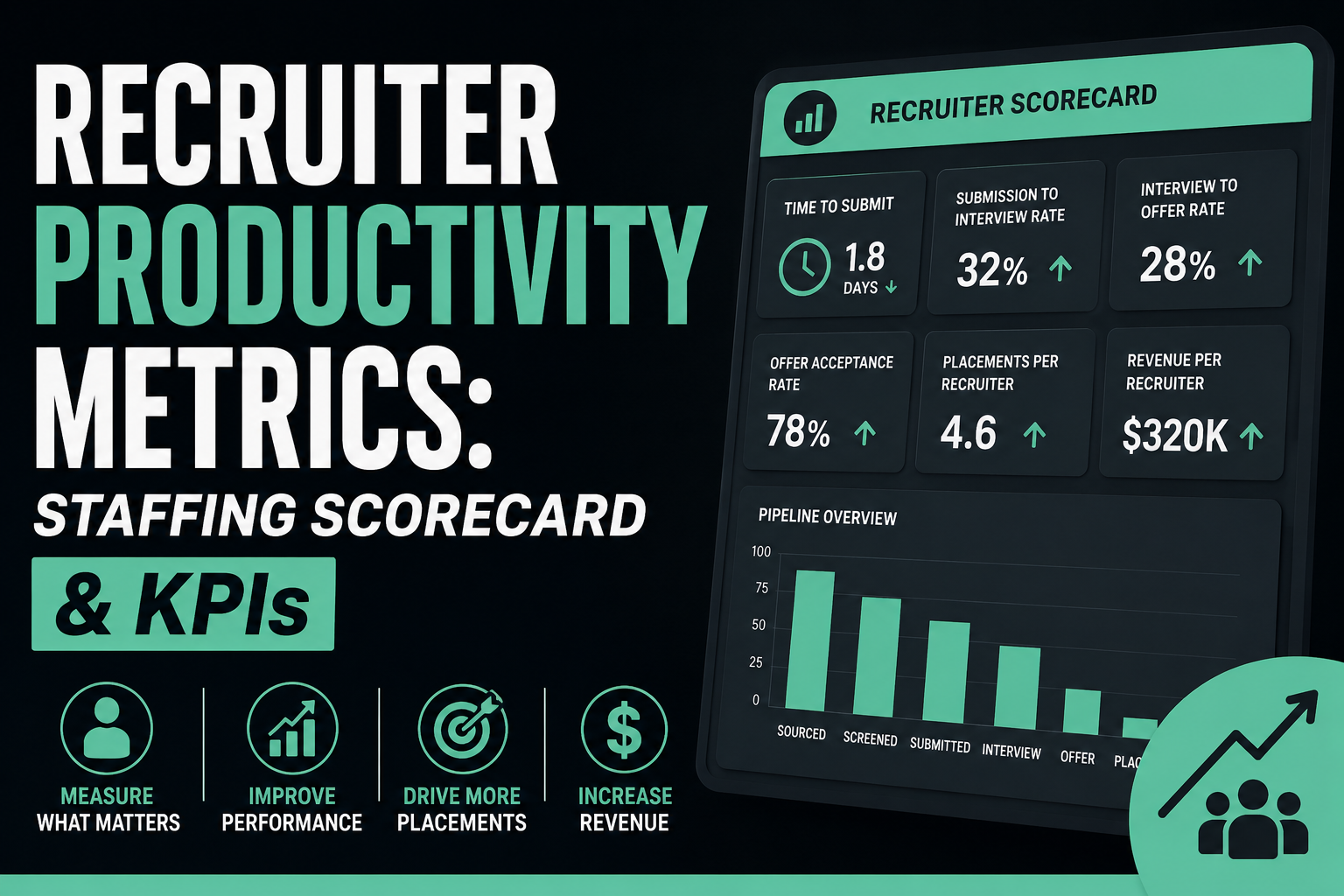
Key performance metrics are tracked in real time and surfaced in dashboards accessible to recruiters, managers, and leadership. Time to submit, submission-to-interview ratio, offer acceptance rate, and placements per recruiter are not compiled manually at the end of the month. They are live, accurate, and actionable. Operational problems are caught when they are small, not after they have compounded into missed client SLAs.
The infrastructure supports growth without requiring proportional headcount increases. Adding a new client account or onboarding a new recruiter does not break the system. Workflows are designed to handle higher volumes because the execution layer is powered by automation and AI assistance rather than relying solely on human bandwidth.
Key Insight: The five pillars are cumulative. Standardized workflows create the foundation for meaningful analytics. Analytics create the feedback loop for continuous optimization. Automation delivers the scalability. Each pillar builds on the prior one. Firms that try to implement analytics before standardizing workflows end up measuring chaos rather than performance.
Section 05
Metrics Every Staffing Agency Should Track
Operational visibility starts with measuring the right things. The table below outlines the core recruiting KPIs every staffing agency should monitor, along with industry benchmark ranges and the operational insight each metric provides.
| Metric | What It Measures | Benchmark Range | Red Flag Threshold |
|---|---|---|---|
| Time to Submit | Hours from req opening to first qualified submission | 24 to 48 hours | Over 72 hours |
| Time to Fill | Days from req opening to placement | 18 to 35 days (varies by role) | Over 45 days |
| Submission to Interview Ratio | Percentage of submissions that convert to client interviews | 35% to 55% | Under 25% |
| Interview to Offer Ratio | Percentage of interviews that result in an offer | 50% to 70% | Under 35% |
| Offer Acceptance Rate | Percentage of offers accepted by candidates | 80% to 92% | Under 70% |
| Placements per Recruiter (Monthly) | Productive output per recruiter | 3 to 8 (varies by role complexity) | Under 2 |
| Candidate Response Rate | Percentage of outreach that receives a response | 20% to 35% | Under 12% |
| Pipeline Coverage Ratio | Number of qualified candidates per open requisition | 3:1 to 5:1 | Under 2:1 |
| ATS Re-engagement Rate | Percentage of existing database activated for new roles | 25% to 45% (agentic) | Under 15% |
| Client Satisfaction Score | Client retention and satisfaction with placements | 4.0 to 4.8 out of 5.0 | Under 3.5 |
Benchmark ranges compiled from SHRM, Staffing Industry Analysts, Josh Bersin Research, and NinjaHire platform data, 2024-2025. Ranges vary by industry vertical, role type, and market conditions.
According to Josh Bersin (2025), staffing firms that actively track submission-to-interview ratios and use that data to refine screening criteria see a 22 to 28% improvement in client satisfaction scores within six months. The metric creates a direct feedback loop between recruiter behavior and client outcomes.
Section 06
Why Operational Scalability Matters More Than Recruiter Headcount
The instinctive response to a capacity problem in most staffing firms is to hire more recruiters. It is understandable. More recruiters means more calls, more submissions, more placements. The problem is that this logic only holds if each incremental recruiter operates independently of systems. In reality, every new recruiter added to a poorly structured operation absorbs management time, introduces new process variability, and adds coordination overhead that diminishes the productivity of the existing team.
The firms that scale efficiently have figured out a different equation. They invest in operational infrastructure first, so that each recruiter operates with significantly more leverage than in a tool-light environment. When sourcing is assisted by AI agents, when outreach sequences run automatically, when scheduling is handled by workflow automation, a single recruiter can manage three to four times the pipeline that a recruiter without that infrastructure could handle.
Consider two IT staffing firms, each with 20 recruiters. Firm A runs on a standard ATS with manual sourcing. Each recruiter handles 15 to 20 requisitions and submits 12 to 18 candidates per month. Firm B has invested in automated sourcing and AI-assisted qualification. Each recruiter handles 35 to 50 requisitions and submits 40 to 60 qualified candidates per month. Firm B is not more talented. It is more leveraged.
Section 07
How Automation Creates Predictability
The word "automation" has developed an unfortunate reputation in recruiting. For many practitioners, it conjures images of mass blast emails, impersonal chatbots, and candidates treated like database entries rather than people. That version of automation does exist and it performs poorly. But it is not what operational automation in a well-designed staffing system actually looks like.
Done correctly, automation creates consistency, not impersonality. Every candidate receives timely communication, no follow-up falls through the cracks, and recruiter attention is directed to work requiring genuine human judgment.
Automated Sourcing
AI-assisted sourcing tools scan multiple platforms simultaneously, identify matching candidates, enrich profiles with verified contact data, and surface them for review. According to LinkedIn Talent Solutions (2025), recruiters using AI-assisted sourcing spend 65% less time on search and identification, reallocating that time to candidate relationship development.
Automated Screening
Structured screening workflows evaluate candidate fit across skills alignment, compensation, availability, and work authorization. This does not replace the recruiter's final judgment. It ensures candidates who reach the recruiter have already cleared consistent threshold criteria, reducing wasted conversations on misaligned profiles.
Automated Follow-Up and Engagement
Candidate drop-off is one of the most costly and preventable problems in staffing operations. A candidate who expressed strong interest on Monday but has not heard back by Wednesday is already taking calls from other firms. Automated follow-up sequences, tailored to each stage of the pipeline, ensure that every candidate receives timely, relevant communication without requiring the recruiter to manually track 40 simultaneous conversations.
Data from SIA (2025) shows that staffing firms using automated multi-touch engagement sequences see candidate response rates 2.8 to 3.5 times higher than firms relying on manual outreach alone. The difference is not the message quality. It is the consistency of delivery.
Automated Scheduling
According to McKinsey (2025), interview scheduling consumes an average of 4.2 hours per placement when handled manually. Automated scheduling eliminates this overhead, giving candidates and hiring managers a friction-free experience while freeing recruiter hours for higher-value work.
Workflow Automation
Beyond individual tasks, workflow automation governs the logic of how candidates and requisitions move through the recruiting process. When a candidate reaches a qualification threshold, they are automatically routed to the next stage. When a submission has not received a client response after 48 hours, an automated alert triggers a recruiter follow-up. When a contract placement is approaching its end date, the system initiates a redeployment workflow. These are not glamorous capabilities. They are the operational connective tissue that turns individual actions into a coherent, predictable system.
Section 08
The Rise of Agentic Recruiting Operations
The evolution of recruiting infrastructure has passed through several distinct phases. Understanding where we are in that progression is essential for any staffing leader making technology investment decisions in 2026.
| Capability | Traditional Recruiting | Recruiting Automation | Agentic Recruiting |
|---|---|---|---|
| Sourcing | Manual Boolean searches, job board posts | Semi-automated job distribution, basic AI matching | Autonomous multi-source discovery, real-time enrichment |
| Qualification | Recruiter reviews all resumes manually | Rule-based keyword filtering | Multi-dimensional AI scoring with reasoning attached |
| Candidate Engagement | Manual email and phone outreach | Templated drip sequences | Dynamic, context-aware personalized communication |
| Scheduling | Manual coordination by email | Calendar link tools | Fully automated across all parties and time zones |
| Pipeline Management | ATS status updates, manual tracking | Trigger-based stage routing | Goal-directed agent loops with autonomous escalation |
| Reporting | Manual compilation, lagging | Scheduled automated reports | Real-time dashboards with predictive modeling |
| Re-engagement | Manual list pulls from ATS | Periodic email campaigns | Proactive, role-matched outreach to past candidates |
| Recruiter Role | Full executor of every step | Guided by automation triggers | Judgment partner, advisor, and relationship lead |
Agentic recruiting is a category of autonomous talent acquisition in which AI agents independently perceive the state of the hiring environment, set intermediate goals, execute multi-step workflows, and adapt to new information without requiring step-by-step human instruction. Recruiters are engaged at the moments that require human judgment, relationship, or negotiation skills, not at every administrative step.
The key distinction is adaptability. Automation follows rules. Agentic systems pursue goals. An automated system sends a follow-up email after three days because the rule says to. An agentic system evaluates the candidate's response signals, the urgency of the requisition, and determines the optimal next action, which may be a call, an immediate submission, or a hold for a better-matched opportunity.
This is not science fiction. Staffing agencies operating on agentic infrastructure today are reporting recruiter-to-submission ratios of 1:40 to 1:60 monthly, compared to the industry average of 1:12 to 1:18 on traditional models. The operational gap between firms that have adopted this infrastructure and those that have not will widen materially through 2026 and 2027.
Section 09
How High-Growth Staffing Firms Are Building Recruiting Operations in 2026
The most operationally mature staffing firms share five common investments. These are not necessarily the firms spending the most on technology. They are the firms that have made deliberate decisions about what kind of operation they want to run and have built the infrastructure to support it.
Operational Visibility First
Before optimizing anything, high-growth firms establish visibility. They deploy real-time dashboards covering pipeline health, submission activity, and conversion performance, and treat data quality as a genuine operational priority. Without accurate data, every subsequent improvement is built on a shaky foundation.
Talent Intelligence as a Competitive Asset
The best firms treat their candidate database as an asset that appreciates over time. They build structured re-engagement programs, segment talent pools by skill and availability, and encode institutional knowledge about candidate-client fit into their screening frameworks.
According to Staffing Industry Analysts (2025), 62% of staffing firm leaders report that speed of submission is now their primary competitive differentiator with clients. Firms that have built proactive talent pipelines can submit qualified candidates within hours of a req opening, rather than starting the sourcing process from scratch.
Workflow Orchestration Across the Full Lifecycle
High-growth firms think about the full candidate journey from first contact to placement and map workflows to that journey. Every transition, from sourcing to qualification to submission to offer, has defined triggers, actions, and handoffs. The recruiter enters the workflow at the points where judgment adds the most value.
Recruiter Enablement Rather Than Recruiter Replacement
There is an important distinction between using technology to replace recruiters and using it to enable them. When recruiters are freed from data entry, sourcing, and scheduling, they can focus on relationship and advisory work that they find meaningful and that clients value. Better recruiter experience leads to better retention, leads to stronger candidate relationships, leads to better placement outcomes.
AI-Assisted Execution at Scale
The final characteristic of high-growth firms is the willingness to let AI systems handle execution at scale. This means trusting AI-generated outreach to represent the firm well, allowing autonomous qualification agents to make first-pass decisions, and using agentic workflows to orchestrate candidate pipelines without requiring a recruiter to manually move every piece. The recruiter remains the decision-maker on submissions, offers, and client strategy. But the groundwork is laid by systems, not by hand.
Section 10 · Framework
Building a Recruiting Engine That Scales: A Five-Step Framework
Transforming a reactive recruiting operation into a predictable one does not happen in a single technology purchase or a one-week process overhaul. It is a deliberate progression. The following five-step framework is designed for staffing leaders who want to move systematically from their current state to operational maturity.
Assess
Map your current state. Document every step in your recruiting workflow. Identify where work gets stuck, where data gets lost, and which metrics you cannot currently answer. If you cannot pull time-to-submit, submission-to-interview ratio, and ATS re-engagement rate in under five minutes, you have a visibility problem that must be resolved before anything else.
Standardize
Before automating anything, standardize the processes worth automating. Define qualification criteria, document your intake call framework, establish submission quality standards, and create outreach templates. Automation applied to an inconsistent process produces consistent chaos.
Automate
Once core workflows are standardized, automate the execution layer. Start with the highest-volume, lowest-judgment tasks: follow-up sequences, scheduling, status updates, ATS data hygiene. Then move to sourcing assistance and AI-aided qualification. Build toward a state where recruiter time is spent on judgment work, not administrative execution.
Measure
Instrument your operation with the KPIs from Section 5. Build dashboards that are live, not weekly compilations. Assign ownership for each metric to a specific role or team. Create threshold alerts that trigger action when metrics fall below acceptable ranges. The goal is to catch operational problems when they are small, not when they have already created client-facing failures.
Optimize
Use performance data to drive continuous improvement. Test different sourcing channel mixes. Refine qualification criteria based on placement success rates. Adjust outreach sequences based on response data. Run structured experiments on key variables and use results to update your standard operating procedures. The operation should get measurably better every quarter.
Operational Maturity Model for Staffing Agencies
Where most staffing firms are today: The majority of staffing agencies operate at Stage 2 to 3. Progressive firms are moving to Stage 3 to 4. The firms building structural competitive advantage in 2026 are targeting Stage 4 to 5, where operational leverage compounds and the gap between them and their competitors widens with every passing quarter.
Frequently Asked Questions
Predictable Recruiting Operations: Common Questions
What are predictable recruiting operations?
How do staffing agencies improve recruiter productivity?
What causes recruiting bottlenecks in staffing agencies?
How do staffing agencies scale recruiting operations?
What is recruiting operations management?
Conclusion
The Operational Imperative for Staffing Agencies
The staffing industry is in a period of structural change. Gross margins are compressed. Candidate supply in high-demand categories is constrained. MSP clients are evaluating vendors on technology performance metrics alongside relationship history. The firms that will thrive are not necessarily the ones with the most experienced recruiters or the best client relationships. Those things matter, but they are not sufficient.
The most successful staffing agencies of the next decade will be defined by operational excellence. They will have recruiting engines that source proactively, qualify consistently, engage candidates with the personalization that builds trust, and give leadership real-time visibility into performance at every stage. They will not be dependent on any single recruiter's institutional knowledge. They will have built systems that distribute that knowledge across the operation and make it available to every person on the team.
Building that kind of operation follows a clear progression: assess your current state honestly, standardize your core workflows, automate where human judgment is not required, measure what matters in real time, and improve continuously. If you cannot open a dashboard Monday morning and know exactly where your operation stands, that is where the work begins.
"The most successful staffing agencies of the next decade will not be defined by recruiter headcount. They will be defined by operational excellence: the systems, data, and infrastructure that make every recruiter more effective and every placement more predictable."
NinjaHire Research Team, 2026