.png)
Pre-employment testing vs AI interviews: which predicts job performance better?

March 15, 2026
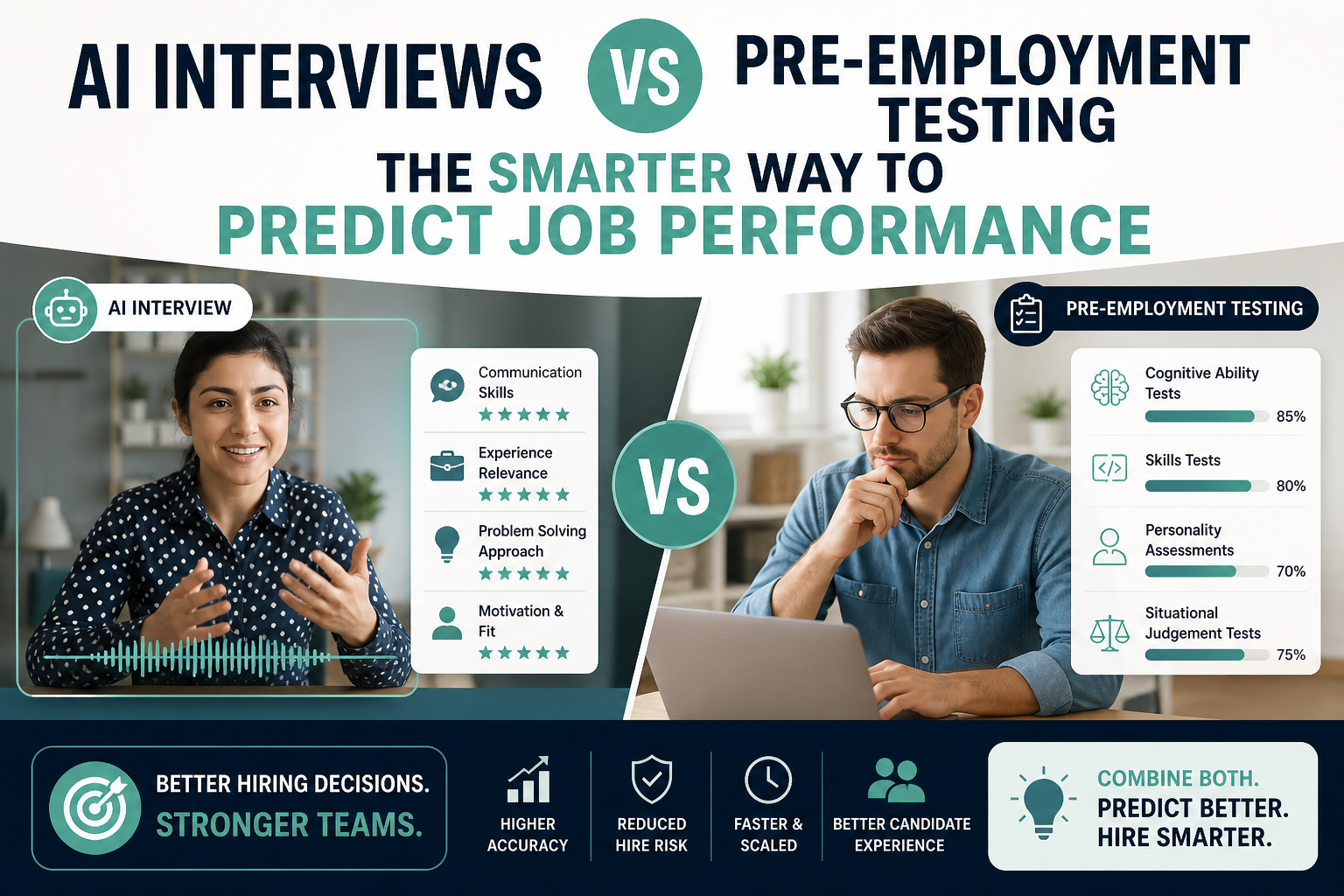
Every hiring manager has faced the same problem: two candidates look identical on paper, interview well, and then diverge dramatically in performance after six months on the job. The question isn't just how to screen faster — it's how to screen smarter. That's where the debate between pre-employment testing and AI interviews gets genuinely interesting.
Both methods claim to predict job performance. Both have research behind them. And both are being adopted at scale by companies trying to escape the unreliability of unstructured interviews. But they measure fundamentally different things, fail in different ways, and work best under different conditions.
This article breaks down the science and the practice — so you can make the right call for your hiring process.
What Actually Predicts Job Performance?
Before comparing methods, it's worth anchoring the discussion in the science. Predictive validity is the statistical measure of how well a hiring tool forecasts actual on-the-job performance. It's expressed as a correlation coefficient (r), where 1.0 is a perfect predictor and 0 means no relationship at all.
The landmark meta-analysis by Schmidt and Hunter (1998), published in Psychological Bulletin, reviewed over 85 years of research and remains the gold standard reference in personnel selection. Its core finding: most hiring methods have far lower predictive validity than hiring managers believe.
Predictive Validity Benchmarks (Schmidt & Hunter meta-analysis):
📊 Work sample tests — r = 0.54
📊 General cognitive ability (GCA) tests — r = 0.51
📊 Structured interviews — r = 0.51
📊 Personality tests (conscientiousness) — r = 0.31
📊 Unstructured interviews — r = 0.38
📊 Years of experience — r = 0.18
📊 Reference checks — r = 0.26
The takeaway: no single method is a silver bullet. The highest predictive accuracy comes from combining cognitive ability testing with structured interviews — something both traditional testing firms and AI-powered platforms are now trying to replicate at scale.
Pre-Employment Testing: What It Measures and How
Pre-employment testing refers to standardised assessments administered before or during the hiring process to evaluate a candidate's suitability for a role. The category is broad, covering everything from 10-minute cognitive puzzles to 90-minute personality inventories. Understanding what each type measures — and what it doesn't — is essential before deciding where to invest.
Cognitive Ability Tests
Cognitive tests measure general mental ability: numerical reasoning, verbal comprehension, abstract thinking, and working memory. They are among the most robustly validated hiring tools in existence. A candidate who scores well on a cognitive test tends to learn faster, handle complexity better, and adapt to changing environments more readily.
Tests like the Wonderlic, Hogan HPI, or Criteria's CCAT are widely used in professional hiring. They work particularly well for roles that require fast onboarding, pattern recognition, or technical problem-solving — software engineers, analysts, management consultants, traders.
The limitation is narrow scope. Cognitive tests say nothing about how a person interacts with teammates, handles pressure, or behaves when no one is watching. And depending on administration, they can introduce adverse impact — meaning statistically lower pass rates for certain demographic groups — which creates legal and equity risks.
Personality Tests
Personality assessments, most commonly based on the Big Five model (OCEAN: Openness, Conscientiousness, Extraversion, Agreeableness, Neuroticism), measure stable behavioural dispositions. Conscientiousness — the tendency to be organised, diligent, and goal-oriented — has the strongest correlation with job performance across virtually all role types.
Well-validated instruments include the NEO-PI-R, Hogan Personality Inventory, and the 16PF. They're particularly useful in sales, customer service, and management roles where interpersonal consistency matters.
The risk with personality testing is fakeability. Candidates who understand what traits are being measured can — and do — distort their responses. Forced-choice formats reduce this, but don't eliminate it. Also, personality tests used in isolation have relatively modest predictive validity and are better used as secondary filters or team-fit signals.
Skills Tests
Skills-based assessments test specific technical or functional competencies: coding ability (e.g. HackerRank), writing samples, Excel proficiency, language fluency, or domain-specific knowledge. These are work sample tests by another name, and as the Schmidt-Hunter data shows, they sit at the top of the predictive validity hierarchy.
The advantage: direct relevance. If you need a Python developer, testing Python ability is more predictive than asking how confident someone feels about their coding. The limitation: skills tests require investment in design and calibration, and they're less applicable to generalist or leadership roles where no single skill dominates performance.
Situational Judgement Tests (SJTs)
SJTs present candidates with realistic workplace scenarios and ask them to choose or rank the best response. They measure judgment, decision-making, and role-specific competencies in a format that's harder to game than straightforward personality measures.
SJTs are particularly effective for roles involving customer interaction, people management, or ethical decision-making. Research shows they add incremental validity when combined with cognitive tests — meaning they predict performance over and above what the cognitive test alone captures. Their main drawback is development cost and the effort required to validate scenarios against actual role performance.
AI Interviews: How the Technology Actually Works
AI-powered interviews represent a newer category of hiring assessment method. At their core, they use artificial intelligence — typically natural language processing, audio analysis, and sometimes video analysis — to evaluate candidate responses during an interview that may be asynchronous (pre-recorded) or live with an AI interviewer.
Contrary to what early hype suggested, well-designed AI interviews aren't just about facial expression detection or tone scoring. The better platforms focus on structured data extraction from what candidates actually say. Here's what the best AI interview tools evaluate:
Communication Clarity and Structure
AI models trained on role-relevant transcripts can assess how clearly a candidate explains their reasoning, whether they use structured frameworks (like STAR — Situation, Task, Action, Result), how concise or rambling their answers are, and whether their vocabulary aligns with the role's complexity level. This is especially useful for customer-facing roles and management positions where communication quality is a core performance driver.
Experience Validation
Unlike a test, an AI interview can ask follow-up questions. When a candidate claims to have led a cross-functional project, a well-designed AI system can probe for specifics — team size, outcome metrics, tools used, challenges navigated — and flag vague or inconsistent responses. This transforms a screening interview from a checkbox exercise into a genuine signal extraction process.
Behavioural Pattern Analysis
AI interviews scored against competency frameworks can identify whether a candidate consistently demonstrates certain behaviours across multiple questions. Resilience, ownership, learning orientation, and adaptability can all be scored from behavioural interview responses — not through pseudo-science body language analysis, but through structured NLP scoring of what's said and how it's organised.
Motivation and Role Fit Signals
One underrated advantage of AI interviews is the ability to probe motivation at scale. Questions about why a candidate wants the role, what they're optimising for in their next position, and what environments they've thrived or struggled in yield rich signal about cultural fit — something that's expensive to evaluate through human interviewer time alone.
Direct Comparison: Pre-Employment Testing vs AI Interviews
| Dimension | Pre-Employment Testing | AI Interviews |
|---|---|---|
| What it measures | Cognitive ability, personality, specific skills, judgment | Communication, experience depth, behavioural competencies, motivation |
| Predictive validity | High for cognitive (r≈0.51), moderate for personality (r≈0.31) | Comparable to structured interviews (r≈0.40–0.51 depending on design) |
| Candidate experience | Can feel impersonal; test anxiety is real | More conversational; closer to actual job simulation |
| Scalability | Very high — automated scoring, instant results | High — async interviews handle volume with no scheduling overhead |
| Fakeability | Moderate — especially personality tests | Lower — contextual follow-ups harder to prepare for |
| Fairness and bias risk | Cognitive tests can introduce adverse impact | AI scoring bias risk if training data is not carefully audited |
| Role coverage | Best for structured, technical, or volume roles | Broad — especially strong for soft-skill and management roles |
| Cost to implement | Moderate — licensing fees per assessment | Moderate to low — cost per interview often lower at scale |
| Legal defensibility | High if validated assessments used correctly | Evolving — requires documentation of scoring criteria and fairness audits |
| Time to result | Immediate (automated scoring) | Near-immediate for async; requires brief processing time |
Predictive Validity: A Closer Look
The question "which predicts job performance better?" doesn't have a clean universal answer — because predictive validity varies by role type, seniority level, and what combination of methods you're using.
Here's what the research literature suggests:
| Method | Estimated Predictive Validity (r) | Strongest Use Case |
|---|---|---|
| Cognitive ability test | 0.51 | Complex analytical roles |
| Work sample / skills test | 0.54 | Technical, measurable output roles |
| Structured interview (human) | 0.51 | All roles with defined competencies |
| AI structured interview | 0.40–0.51* | Volume hiring, communication roles |
| Personality test (conscientiousness) | 0.31 | Customer service, sales, management |
| SJT | 0.34 | Judgment-heavy and people roles |
| Unstructured interview | 0.38 | Not recommended as primary method |
*AI interview validity estimates are based on platforms using structured, competency-anchored scoring. Platforms relying on facial expression or tone analysis alone have far lower and more contested validity.
The critical insight from the research: combination beats any single method. A cognitive test plus a structured interview delivers r ≈ 0.63 — meaningfully higher than either alone. This is the core argument for building multi-signal hiring pipelines rather than picking one approach.
Where Pre-Employment Tests Fall Short
Pre-employment testing has genuine weaknesses that are often glossed over by vendors and HR professionals who've invested in particular platforms.
Adverse impact. Cognitive ability tests — the most predictive category — consistently show statistically lower average scores for Black and Hispanic candidates compared to white candidates in US research. This creates legal risk under disparate impact doctrine and genuine equity concerns. Organisations using cognitive tests need to carefully document validation studies, use role-specific cut scores, and ideally combine them with other methods to reduce over-reliance on any single signal.
Test anxiety and access inequality. Some candidates who would be excellent employees perform poorly under timed, formal test conditions. This is especially true for candidates from non-traditional educational backgrounds or those returning from career breaks.
Narrow bandwidth. Most tests, by design, measure a limited construct. A high cognitive test score says little about how someone handles ambiguity, navigates politics, or energises a team. Personality tests add breadth but at the cost of reduced validity and higher fakeability.
Context blindness. Tests have no awareness of the candidate's actual career context. A candidate who built a product in a chaotic startup environment and one who followed well-defined processes at a large enterprise might score identically on a cognitive test — but perform very differently in your specific role.
Where AI Interviews Fall Short
AI interviews are not a magic upgrade over traditional assessments, and their hype has sometimes outrun their evidence base.
Training data bias. AI models learn from historical data. If that data reflects past hiring decisions that encoded bias — preferring candidates who speak a certain way, use particular vocabulary, or demonstrate communication patterns associated with specific educational backgrounds — the model will perpetuate those patterns. Without rigorous bias auditing, AI interviews can appear objective while encoding structural unfairness.
Candidate acceptance varies widely. Research by the Society for Human Resource Management (SHRM) shows that candidates over 40 and from certain cultural backgrounds are significantly less comfortable with AI-only interview processes. In competitive talent markets, over-reliance on AI screening can reduce your applicant pool among experienced candidates.
Surface performance beats substance. Articulate candidates who've been coached on behavioural interview frameworks can produce polished, well-structured responses that score well without necessarily reflecting deep competence. AI systems that score on structure and vocabulary may reward rehearsed performance over authentic capability.
Limited construct validity for complex roles. For highly specialised roles — quantitative finance, medical research, systems architecture — an AI interview's ability to meaningfully evaluate technical depth is constrained by the limits of natural language analysis. Domain-specific expertise often shows up in what you build, not just how you talk about it.
The Combined Approach: Why AI + Testing Outperforms Both Alone
The strongest hiring assessment strategy isn't choosing between pre-employment testing and AI interviews — it's sequencing them to extract different types of signal from the same candidate pool.
Here's the logic: tests measure what candidates can do (ability, skills) and stable traits (personality). AI interviews measure how candidates think, communicate, and contextualise their experience. Together, they cover a broader construct space than either method alone — which is precisely why combination models consistently outperform single-method approaches in predictive validity research.
A well-designed combined pipeline looks like this:
- Stage 1 — Skills or cognitive screening: A short, role-relevant test filters for minimum capability thresholds. This is fast, scalable, and removes clearly unqualified applicants without human time investment.
- Stage 2 — AI interview: Candidates who pass the test threshold complete an asynchronous AI interview focused on behavioural competencies and experience validation. This surfaces contextual signal the test can't capture.
- Stage 3 — Human interview (shortlist only): Only candidates who pass both stages reach a human interviewer. This stage can be structured around the gaps or inconsistencies flagged by the AI — making human interview time dramatically more efficient.
- Stage 4 — Personality or SJT (optional): For management or people-heavy roles, a personality or situational judgement test adds a final layer of behavioural prediction before offer stage.
This pipeline achieves four things simultaneously: it scales screening without proportional headcount cost; it reduces unstructured interview time (the lowest-validity stage); it generates auditable hiring data for compliance; and it improves candidate experience by making early stages faster and more transparent.
Platforms that integrate both modalities — like AI-powered applicant tracking systems that combine assessment scoring with interview evaluation — are rapidly becoming the standard for companies hiring more than 50 people per year.
Cost vs Efficiency: What the Numbers Look Like
| Method | Cost Per Candidate | Time to Screen 100 Candidates | Human Hours Required |
|---|---|---|---|
| Unstructured phone screen | $30–80 (recruiter time) | ~50 hours | High |
| Cognitive / skills test only | $5–25 | ~2 hours (admin) | Very low |
| AI interview only | $8–30 | ~3 hours (review) | Low |
| Combined test + AI interview | $15–45 | ~4 hours (review) | Low |
| Full human structured interview | $100–300+ | ~80–120 hours | Very high |
The combined approach delivers the strongest predictive signal at roughly one-third the cost of full human structured interviews — and screens 100 candidates in the time it would take a recruiter to run 5–8 phone screens manually.
The ROI compounds over time: better prediction means lower attrition, faster ramp times, and fewer costly mis-hires. Research by the Society for Human Resource Management estimates the cost of a single bad hire at 50–200% of annual salary. Even marginal improvements in predictive accuracy pay for the assessment infrastructure many times over.
Decision Framework: Which Method Should You Use?
The right choice depends on role type, hiring volume, and what aspects of performance matter most. Use this framework to decide:
- High-volume, entry-level roles (e.g. customer service, retail, operations): Start with a short cognitive or SJT screen, follow with AI interview for communication and motivation signals. Human review at final stage only. Cost and speed are your primary constraints — the combined AI approach delivers the best ROI here.
- Technical roles (e.g. software engineering, data science, finance): Skills tests are non-negotiable — they directly simulate the work. Supplement with a structured AI interview to assess problem-solving communication and past project depth. Personality tests optional unless team dynamics are a stated risk.
- Management and leadership roles: Cognitive testing plus personality assessment (especially conscientiousness and emotional stability) plus a structured AI interview covering leadership scenarios and decision-making. Human interview focuses on strategic thinking and stakeholder navigation.
- Niche specialist roles (e.g. clinical research, legal, engineering): Domain knowledge tests or case studies take precedence. AI interviews add value for communication and cultural fit. Test vendors with validated instruments for the specific domain are worth the additional cost.
- Culture-critical roles (e.g. founding team hires, exec search): Assessment methods alone are insufficient. SJTs and personality inventories provide useful baseline data, but human judgment — backed by structured interview frameworks — must carry more weight at this level.
Real-World Hiring Scenarios
Scenario A: E-commerce company scaling a 200-person customer support team
Challenge: 800 applications per month, 3-person HR team, 4-week time-to-hire target.
Solution: 15-minute SJT + short cognitive test filters to top 30%. AI interview (asynchronous, 4 questions) screens communication quality and motivation. Human review limited to final 15 candidates per cohort.
Result: Time-to-hire reduced from 28 days to 11 days. 90-day attrition dropped 22% after 6 months. HR team reclaimed ~120 hours per month of screening time.
Scenario B: Series B fintech hiring senior product managers
Challenge: 12 PM roles per year, each requiring deep domain knowledge and leadership capability. Hiring managers overwhelmed by weak shortlists from generic recruiters.
Solution: Tailored product sense test (case-based) plus structured AI interview covering product decisions, stakeholder management, and growth examples. Only candidates passing both stages reach VP of Product.
Result: Interview-to-offer ratio improved from 8:1 to 3:1. Hiring managers reported significantly higher shortlist quality. Average time-to-hire reduced by 40%.
Are AI Interviews Reliable? A Direct Answer
This is one of the most common questions from HR leaders evaluating new hiring tools.
The honest answer: it depends on how the AI interview is designed. AI interviews that rely primarily on facial expression or vocal tone analysis have weak and contested validity — and introduce significant fairness risks, particularly for neurodiverse candidates and those using non-native languages. Regulatory scrutiny of these approaches has increased in jurisdictions including the EU, Illinois, and New York City.
AI interviews built on structured natural language processing of spoken or written responses — scored against validated, role-specific competency frameworks — perform significantly better. When designed with the same rigour as a structured human interview (standardised questions, defined scoring rubrics, calibrated against performance outcomes), AI interviews can achieve predictive validity comparable to well-run structured interviews at a fraction of the cost.
The key due diligence questions to ask any AI interview vendor: Has the scoring model been validated against actual performance data? Has it been audited for adverse impact across demographic groups? What are the defined competencies and how are they operationalised? Can you see how individual candidate responses map to scores?
Should Companies Use Both Pre-Employment Tests and AI Interviews?
For most organisations hiring more than a handful of people per year, yes — with design and sequencing that matter.
The research case is clear: multi-method pipelines outperform single-method approaches on predictive validity. The practical case is equally clear: tests and AI interviews measure different things, and those different things both matter for job performance.
What to avoid: piling up multiple assessments with no sequencing logic, or using methods that measure the same construct twice (e.g., two different personality tests). Every stage should add incremental signal — information that isn't captured by what came before it.
What to prioritise: a pipeline where tests establish baseline capability thresholds, AI interviews add contextual and behavioural depth, and human interviews are reserved for the shortlist where their time and judgment create genuine value.
Frequently Asked Questions
Which predicts job performance better — pre-employment tests or AI interviews?
Neither method definitively outperforms the other across all contexts. Cognitive ability and work sample tests have the strongest individual predictive validity (r ≈ 0.51–0.54). AI interviews, when built on structured competency scoring rather than facial or tone analysis, achieve validity comparable to structured human interviews. The strongest predictor is a combination of cognitive testing plus structured interviewing — and AI interviews can efficiently deliver the structured interview component at scale.
Are AI interviews reliable for hiring?
AI interviews built on structured NLP scoring against validated competency frameworks are reliable and show predictive validity comparable to structured human interviews. AI interviews that score based on facial expressions, vocal tone, or eye contact alone have weak validity and introduce fairness risks. When evaluating AI interview platforms, ask specifically how scoring is calibrated, what constructs are measured, and whether adverse impact audits have been conducted.
What is the best way to assess candidates for high-volume roles?
For high-volume roles, the most effective approach is a short cognitive or situational judgement test followed by an asynchronous AI interview. This combination screens large applicant pools quickly, produces auditable hiring data, and generates substantially higher predictive validity than unstructured phone screens alone. Human interviewer time is then focused on the final shortlist, dramatically improving cost efficiency without sacrificing quality.
Do pre-employment tests disadvantage certain candidates?
Cognitive ability tests in particular show adverse impact in research — meaning statistically lower average pass rates for certain demographic groups. This creates both legal risk and equity concerns. To mitigate this, organisations should use validated, role-specific assessments, set defensible cut scores, and avoid over-relying on any single test type. Combining cognitive tests with other methods (AI interviews, SJTs, skills tests) reduces the weight placed on the cognitive test alone and improves both fairness and predictive accuracy.
How do structured interviews compare to AI interviews?
Well-designed structured interviews — where all candidates answer the same questions, scored against defined rubrics — have predictive validity of r ≈ 0.51, on par with cognitive tests. AI interviews, when structured in the same way, can achieve comparable validity while scaling to hundreds of candidates simultaneously. The key distinction is "structured": an unstructured AI interview is no more valid than an unstructured human one. The quality of the question design and scoring framework determines the predictive value.
Can small companies benefit from AI hiring assessment methods?
Yes. Modern AI interview platforms have made structured assessment accessible to companies hiring as few as 10–20 people per year. The per-candidate cost is typically lower than a single recruiter phone screen. For small companies where every hire has a disproportionate impact, improving predictive accuracy through structured assessment — whether tests, AI interviews, or both — pays off significantly in reduced attrition and faster onboarding.
The Bottom Line
Pre-employment testing and AI interviews are not competing technologies — they're complementary tools that measure different dimensions of candidate suitability. Tests establish cognitive and skills baselines with strong statistical validity. AI interviews add behavioural depth, experience context, and communication quality at a scale no human interviewing process can match.
The companies hiring best today aren't choosing between these methods. They're designing pipelines that use each method where it adds the most signal, in a sequence that's fast for candidates and efficient for recruiters.
If your current process still relies primarily on CV screening and unstructured interviews, either method alone would be a meaningful upgrade. But if you're building for the next five years of hiring — at any volume — the combined approach is where the evidence points.
See how AI-powered hiring assessment works in practice. Screen smarter, hire faster, and build teams that actually perform.
Try for free