.png)
AI Recruiting CRM vs ATS: What's the Difference?
.jpeg)
August 6, 2026
Recruiting Technology · Executive Guide
A working guide for talent acquisition leaders on how candidate relationship management and applicant tracking software differ, how they work together, and how artificial intelligence is changing both.
Executive Summary
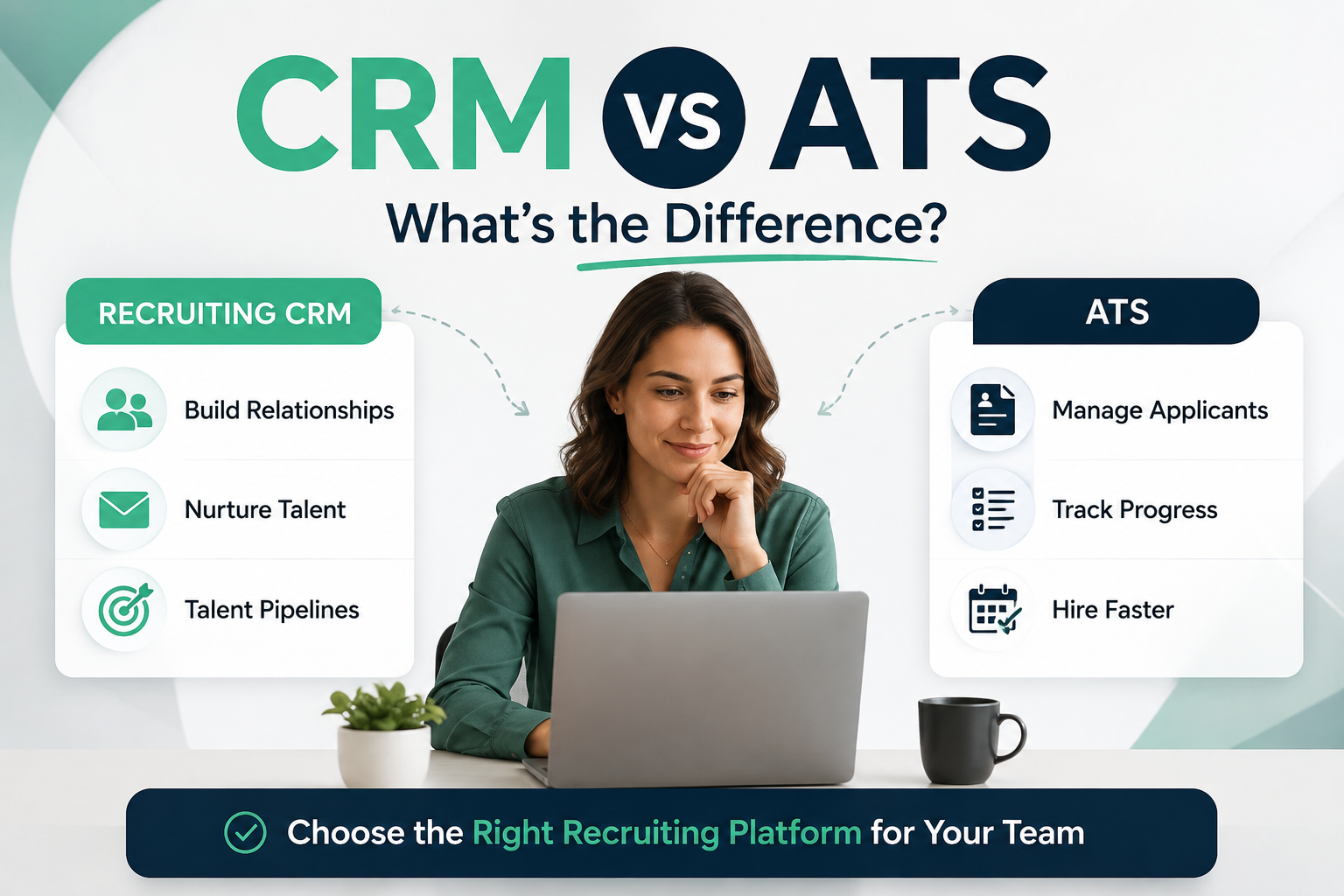
Recruiting technology is often discussed as a single category, but it is built on two distinct disciplines. A recruiting CRM manages relationships with people before they formally apply — sourcing, nurturing, and re-engaging both active and passive candidates over time. An ATS manages the structured process that begins once a candidate applies to a specific job — screening, interviewing, compliance documentation, and offer management.
Neither system replaces the other. Organizations with high hiring volume, competitive talent markets, or long sourcing cycles typically need both, and increasingly, an AI recruiting CRM capable of sourcing, matching, and rediscovering candidates at scale. This guide explains what each system does, how they interact across the recruiting lifecycle, and how to decide what your organization actually needs.
Chapter 1: What is an ATS?
Definition and purpose
An ATS exists to make the formal hiring process auditable and repeatable. Once a requisition opens and candidates apply, the ATS becomes the operational backbone: it stores applications, routes resumes to hiring managers, schedules interviews, tracks approvals, and generates the documentation that compliance and legal teams require, particularly in regulated industries and government-adjacent hiring.
A brief history
Early applicant tracking systems emerged in the 1990s as digital filing cabinets for paper resumes. As online job boards grew, ATS platforms evolved into workflow engines that could parse resumes, track requisition status, and produce compliance reports for equal employment opportunity requirements. Most enterprise ATS platforms available today, including Greenhouse, Lever, Workday Recruiting, and iCIMS, are built around this requisition-centric model.
Core architecture
An ATS is typically organized around three objects: the requisition (an open role), the candidate record (an applicant tied to that requisition), and the pipeline stage (where the candidate sits in the process). Reporting, approvals, and compliance data are all attached to these three objects.
Advantages
- Creates a defensible, auditable hiring record
- Standardizes interview and approval workflows
- Centralizes compliance and EEO reporting
- Integrates with HRIS for onboarding
Limitations
- Weak at engaging candidates before they apply
- Passive candidates are largely invisible to it
- Limited long-term relationship or nurture tracking
- Reporting favors process, not talent pipeline health
Chapter 2: What is a Recruiting CRM?
Definition and purpose
Candidate Relationship Management applies the logic of sales and marketing CRM to recruiting. Instead of tracking deals through a sales funnel, a recruiting CRM tracks people through a talent funnel: identified, contacted, engaged, nurtured, and eventually converted into an applicant. Its unit of work is the person, not the requisition.
Talent pools and segmentation
A CRM organizes candidates into talent pools by skill, function, location, or seniority, independent of any specific open role. This allows recruiters to build pipelines for roles that do not yet exist and reduce time-to-fill when a requisition eventually opens.
Engagement and rediscovery
A defining CRM capability is candidate rediscovery — surfacing past applicants or sourced candidates who are a strong fit for a new opening, rather than starting sourcing from zero every time. This is especially valuable for organizations that receive high application volume but historically let most candidate data go cold after a role closes.
Advantages
- Builds pipeline ahead of hiring need
- Engages passive candidates over months or years
- Reduces reliance on paid sourcing per requisition
- Improves employer branding through consistent contact
Limitations
- Not built for compliance-grade process tracking
- Limited structured interview and approval workflows
- Requires disciplined data hygiene to stay useful
- Value compounds slowly, not immediately
Chapter 3: CRM vs ATS — Detailed Comparison
| Dimension | Recruiting CRM | Applicant Tracking System |
|---|---|---|
| Primary purpose | Build and nurture candidate relationships | Manage the formal hiring process |
| Primary users | Sourcers, recruiters, employer branding teams | Recruiters, hiring managers, HR, compliance |
| Candidate type | Active and passive candidates | Primarily active applicants |
| Core workflow | Source → nurture → convert | Apply → screen → interview → hire |
| Data ownership | Long-term relationship history | Requisition-specific application record |
| Automation focus | Outreach sequences, campaigns, drip nurture | Stage transitions, approvals, scheduling |
| Reporting emphasis | Pipeline health, source of hire, engagement | Time-to-fill, compliance, funnel conversion |
| Typical integrations | Email, LinkedIn, sourcing tools, career sites | HRIS, background checks, e-signature, assessments |
| Communication style | Personalized, sequenced, marketing-influenced | Transactional, process-driven |
| AI capabilities | Sourcing, matching, personalized outreach, rediscovery | Resume screening, scheduling assistance, ranking |
| Key strength | Pipeline depth before a role opens | Process consistency and auditability |
| Key weakness | Weak compliance and approval structure | Poor visibility into passive talent |
| Ideal use case | High-volume sourcing, staffing, employer branding | Structured hiring, regulated industries |
| Representative KPI | Talent pool growth, engagement rate | Time-to-fill, offer acceptance rate |
| Pricing consideration | Often priced per seat plus contact volume | Often priced per seat plus requisition volume |
Which comes first?
Can CRM replace ATS?
Chapter 4: The Recruiting Lifecycle
CRM
CRM
CRM
CRM
CRM
ATS
ATS
ATS
ATS
ATS
CRM
CRM
This handoff pattern explains why many recruiting organizations run both systems in parallel, connected by integration or, increasingly, by a unified AI-powered platform that removes the manual handoff between them.
Chapter 5: AI Recruiting CRM vs Traditional CRM
How AI improves CRM
Traditional CRMs depend on recruiters manually tagging, segmenting, and messaging candidates. AI capabilities change the economics of that work. Sourcing agents can identify and enrich candidate profiles from multiple sources. Matching models can rank existing talent pool members against a new requisition in minutes rather than days. Predictive analytics can flag which passive candidates are statistically more likely to respond to outreach, based on prior engagement patterns.
How AI improves ATS
Within the ATS, AI is most useful for reducing administrative load: parsing and structuring resumes, generating interview summaries, ranking applicants against role requirements, and assisting with scheduling logistics. The compliance and approval backbone of the ATS remains rule-based and auditable by design.
Recruiter copilots and agentic AI
A growing category of tools acts as a recruiter copilot — drafting outreach messages, summarizing candidate history, and suggesting next actions. Some platforms extend this into agentic workflows, where an AI agent can autonomously execute multi-step sourcing or nurture sequences within guardrails set by the recruiter. Modern recruiting platforms such as NinjaHire illustrate this direction, combining AI-assisted candidate rediscovery, CRM-style talent pools, and ATS-style workflow tracking with a human-in-the-loop approval layer, rather than fully autonomous decision-making.
Human-in-the-loop and governance
Responsible deployment of AI in recruiting keeps a human reviewer in the loop for consequential decisions — particularly screening and rejection — and maintains documentation of how AI-assisted recommendations were used. This aligns with guidance from frameworks such as the NIST AI Risk Management Framework and the OECD AI Principles, both of which emphasize human oversight, transparency, and accountability in automated decision systems.
Chapter 6: CRM and ATS by Organization Type
Startup
ATS-first; CRM value emerges once hiring volume or brand recognition grows.
SMB
Lightweight combined tool or ATS with basic pipeline tagging is often sufficient.
Mid-Market
Dedicated CRM becomes valuable as recruiter headcount and requisition volume rise.
Enterprise
Both systems required; integration and reporting consistency become critical.
Staffing Agency
CRM is often the primary system; ATS supports client-facing compliance.
Executive Search
CRM-centric; relationship depth over years matters more than transaction speed.
Healthcare
ATS-heavy due to licensure and compliance; CRM aids chronic shortage roles.
IT Staffing
Both, with CRM emphasis on skills-based talent pools and rapid rediscovery.
Manufacturing / Retail
High-volume, seasonal hiring favors ATS efficiency with CRM-driven rehire pools.
Chapter 7: Should You Buy CRM, ATS, or Both?
Decision framework
- High hiring volume with recurring role types favors CRM investment
- Regulated or compliance-heavy hiring requires a capable ATS regardless of size
- More than 3–5 recruiters typically justifies dedicated CRM tooling
- Long sourcing cycles for scarce skills favor early CRM adoption
- Limited integration capacity favors a combined AI-powered platform
- Low recruiting maturity favors starting with ATS before adding CRM complexity
Do startups need CRM? Generally not immediately. Early-stage companies benefit more from a clean, simple ATS until hiring volume or employer brand development justifies dedicated relationship management.
Should enterprises use both? Yes, in nearly all cases. Enterprise hiring volume, compliance obligations, and the value of long-term talent pools make a combined CRM and ATS approach the practical default.
Chapter 8: The Modern Recruiting Tech Stack
Integration quality between these layers matters more than the feature depth of any single tool. Duplicate candidate records, inconsistent status data, and manual re-entry between CRM and ATS are the most common sources of recruiting operations friction in mid-market and enterprise teams.
Chapter 9: How AI Is Reshaping CRM and ATS
Emerging capabilities
- Knowledge graphs connecting candidates, roles, and skills
- Skills intelligence that maps capability, not just job titles
- Autonomous, guardrailed candidate engagement sequences
- Decision intelligence surfacing pipeline risk before it becomes a vacancy crisis
Governance priorities
- Documented human review of AI-influenced screening decisions
- Bias testing on matching and ranking models
- Transparency with candidates about AI use in the process
- Clear escalation paths from AI agent to human recruiter
Organizations such as SHRM and LinkedIn Talent Solutions have both published guidance emphasizing that AI adoption in recruiting should augment recruiter judgment rather than replace it, particularly at the screening and decision stages where fairness and legal exposure are highest.
Chapter 10: Choosing the Right Platform
Executive buying checklist
- Does the platform unify CRM and ATS data, or require manual syncing?
- Can AI-assisted matching and rediscovery be explained and audited?
- Does reporting cover both pipeline health and process compliance?
- What is the actual data security and access control model?
- How is human review enforced at consequential decision points?
- What is the realistic recruiter adoption curve, based on reference customers?
- Does pricing scale predictably with hiring volume and seats?
- What integrations exist with your current HRIS and interview tools?
Organizations evaluating AI-powered recruiting solutions should treat this checklist as a starting point for vendor conversations rather than a final scorecard — the right weighting depends on hiring volume, industry, and recruiting maturity established earlier in this guide.
Frequently Asked Questions
What is a Recruiting CRM?
A recruiting CRM is software for building and nurturing relationships with candidates, including passive talent, before they formally apply to a role.
What is an ATS?
An applicant tracking system manages the formal hiring process once a candidate applies, including screening, interviews, and offer workflows.
What is the difference between CRM and ATS?
CRM manages relationships before and between applications; ATS manages the structured process after someone applies to a specific role.
Which comes first, CRM or ATS?
CRM engagement typically happens first, since sourcing and nurturing precede a formal application, which then moves into the ATS.
Can CRM replace ATS?
No. CRM lacks the compliance-grade approval and documentation workflows required for formal hiring processes.
Can ATS replace CRM?
Not effectively. ATS platforms are weak at long-term relationship nurturing and largely blind to passive candidates.
Should staffing agencies use both?
Most staffing agencies rely heavily on CRM for talent pools, with a lighter ATS layer for client-facing compliance needs.
Should enterprises use both CRM and ATS?
Yes. Enterprise hiring volume and compliance obligations typically require both systems working together.
Can AI replace a CRM entirely?
No. AI enhances CRM capabilities like sourcing and matching, but relationship strategy still requires human recruiter judgment.
How does AI improve CRM?
AI improves CRM through automated sourcing, candidate-job matching, personalized outreach, and rediscovery of past candidates.
How does AI improve ATS?
AI improves ATS efficiency through resume parsing, applicant ranking, and administrative automation around scheduling.
Which is better for passive candidates, CRM or ATS?
CRM is built specifically for engaging and nurturing passive candidates; ATS has little visibility into this population.
Which is better for active applicants?
ATS is designed for managing active applicants through a structured, auditable hiring process.
Do startups need a CRM?
Usually not immediately. Startups often start with an ATS and add CRM capability as hiring volume grows.
What is Candidate Relationship Management?
Candidate Relationship Management is the practice of tracking and nurturing candidate relationships over time, independent of a specific job opening.
What is a Talent CRM?
A talent CRM is another term for a recruiting CRM, describing software focused on candidate relationships rather than job applications.
How do AI recruiting platforms combine CRM and ATS?
They unify candidate and applicant data into one system, applying AI to sourcing, matching, and rediscovery while keeping ATS-style workflow tracking.
What should buyers evaluate before purchasing recruiting software?
Buyers should evaluate integration depth, AI maturity, reporting quality, compliance support, and realistic recruiter adoption.
What is a talent pipeline?
A talent pipeline is an organized group of candidates being tracked for current or future hiring needs.
What is candidate rediscovery?
Candidate rediscovery is the practice of resurfacing past applicants or sourced candidates who fit a new open role.
What is recruiting automation?
Recruiting automation refers to software-driven tasks such as scheduling, outreach sequencing, and status updates that reduce manual recruiter work.
What is recruiting operations?
Recruiting operations is the discipline of managing recruiting process, tooling, data, and metrics across a talent acquisition function.
What is a hiring workflow?
A hiring workflow is the defined sequence of steps a candidate moves through, from application to offer, usually managed in an ATS.
What is skills intelligence?
Skills intelligence is the use of data and AI to map candidate and employee capabilities beyond job titles.
What is an HRIS and how does it relate to ATS?
An HRIS manages employee records after hire; the ATS typically hands off hired-candidate data to the HRIS for onboarding.
What is recruiting intelligence?
Recruiting intelligence refers to analytics and insights derived from recruiting data to guide sourcing and process decisions.
What is agentic AI in recruiting?
Agentic AI refers to AI systems that can autonomously execute multi-step recruiting tasks within defined guardrails and human oversight.
What does human-in-the-loop mean in recruiting AI?
It means a human recruiter reviews and approves AI-influenced decisions, particularly around screening and rejection.
Is a recruiting CRM the same as a sales CRM?
No. Recruiting CRMs are purpose-built for candidate engagement and talent pools, distinct from sales-focused customer CRMs.
How much does a recruiting CRM cost?
Pricing varies widely by vendor and is typically based on seats and contact or candidate volume; buyers should request current vendor pricing.
How much does an ATS cost?
ATS pricing typically scales with seats and requisition volume, and varies significantly between SMB and enterprise vendors.
Do I need separate CRM and ATS tools or one combined platform?
This depends on integration capacity and recruiting maturity; combined AI-powered platforms reduce handoff friction for many teams.
What KPIs matter most for CRM performance?
Talent pool growth, candidate engagement rate, and pipeline-to-hire conversion are common CRM performance indicators.
What KPIs matter most for ATS performance?
Time-to-fill, offer acceptance rate, and pipeline conversion by stage are common ATS performance indicators.
Does CRM help with employer branding?
Yes. Consistent, relevant candidate engagement over time reinforces employer brand perception among both active and passive talent.
What industries rely most heavily on CRM?
Staffing, executive search, and industries with chronic skill shortages, such as healthcare and technology, rely heavily on CRM.
What industries rely most heavily on ATS?
Regulated industries such as healthcare, finance, and government contracting rely heavily on ATS compliance features.
Can small businesses skip both CRM and ATS?
Very small, low-volume hiring teams sometimes manage with spreadsheets initially, but this rarely scales past a handful of hires.
What is the biggest risk of AI in recruiting?
The biggest risk is unreviewed AI-influenced decisions introducing bias or compliance exposure without adequate human oversight.
How should organizations govern AI use in hiring?
Organizations should document human review points, test for bias, and maintain transparency with candidates, consistent with frameworks like NIST's AI Risk Management Framework.


Subscribe to our newsletter
Want to stay up to date with news and updates about our product? Subscribe.
© Copyright 2026