.png)
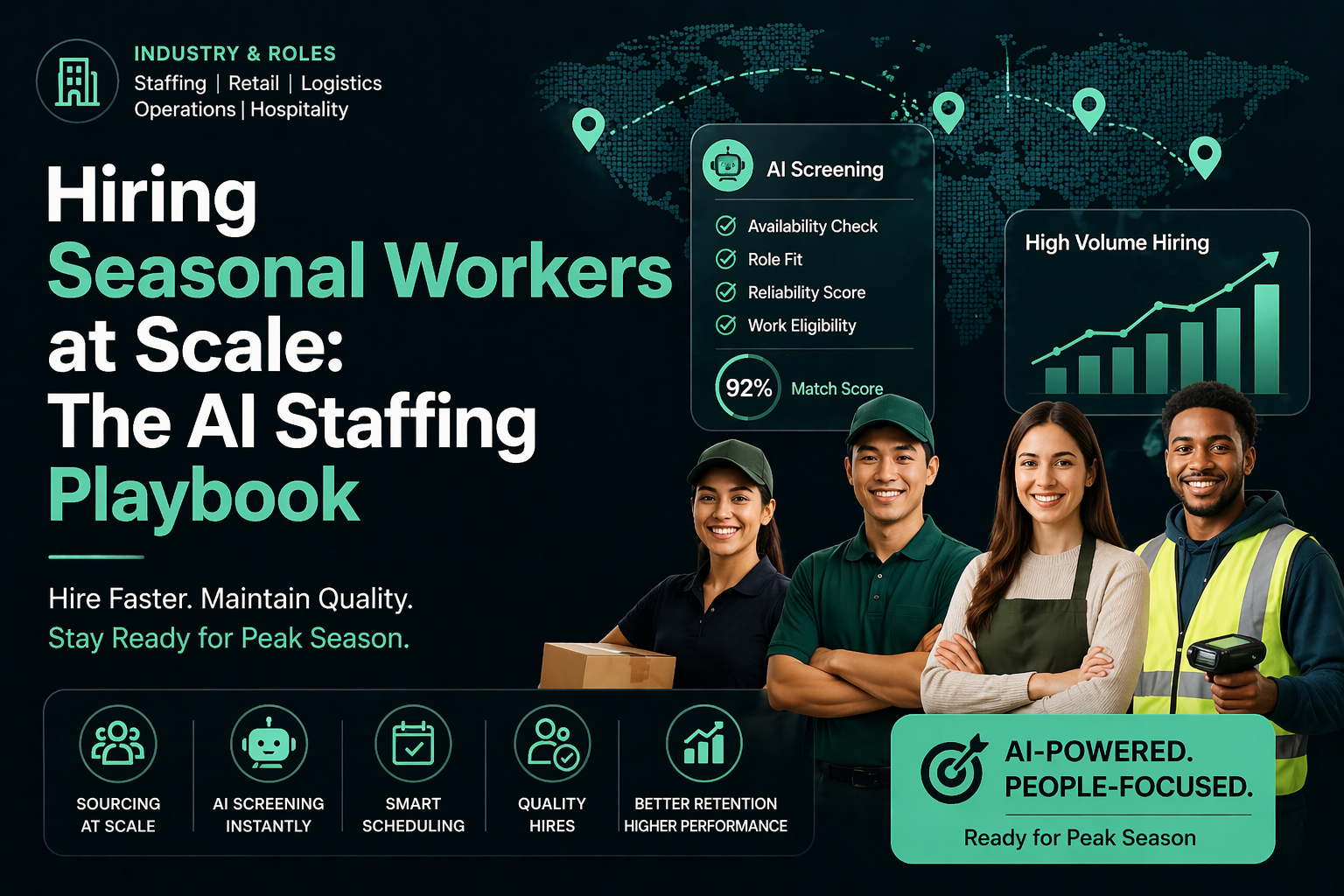
Hiring seasonal workers at scale: the AI staffing playbook

March 15, 2026
What Is Seasonal Hiring at Scale
Seasonal hiring at scale is the process of recruiting, screening, and onboarding large volumes of temporary or short-term workers within a compressed timeframe, typically to meet predictable demand spikes in retail, logistics, hospitality, and agriculture. It differs from standard hiring in that speed, volume, and process repeatability matter more than long-term cultural fit, and failure to fill roles on time has direct operational and revenue consequences.
Companies running seasonal hiring operations are not dealing with the same hiring problem as those filling a handful of permanent roles. They might need to hire 200 warehouse workers before a peak shipping season or staff an additional 80 retail associates for the holiday quarter. The challenge is not finding candidates, applications typically pour in. The challenge is moving them through a process fast enough to have people ready on day one of the peak period.
That is where the traditional hiring playbook breaks down, and where AI-powered high volume hiring workflows have become the practical standard for teams that need to execute this reliably year after year.
Why Seasonal Hiring Is Operationally Difficult
Anyone who has managed a seasonal hiring push from the inside knows that it looks simple from a distance and chaotic up close. The applications are there. The roles are defined. The start dates are fixed. And yet, most organizations fumble through it every single year, repeating the same operational mistakes at volume.
Time pressure is unforgiving. In seasonal hiring, the start date is not flexible. A retailer opening additional registers for the holiday rush cannot push that date back because hiring ran slow. A logistics provider contracted to meet December delivery volumes cannot negotiate an extension because onboarding took longer than expected. Every day of delay in the hiring process directly reduces the number of trained workers available when they are most needed. The pressure is binary in a way that most other business hiring is not.
Volume spikes overwhelm standard processes. Most recruiting operations are built for a steady flow of applications, perhaps ten to thirty per open role, managed by a recruiter who can give each application meaningful attention. Seasonal hiring inverts this entirely. A single job posting for a warehouse role can attract five hundred applications in 48 hours. The same recruiter who handles five roles in a normal month is now expected to process hundreds of candidates across dozens of identical positions, simultaneously, without dropping quality.
Recruiter bandwidth is the real bottleneck. Hiring teams rarely scale proportionally to seasonal demand. Most companies add one or two temporary recruiters and expect them to cover what would realistically require a team three times the size. The result is triage hiring, recruiters making fast decisions based on thin information, skipping steps that feel optional, and hoping that enough of the people they put through convert into reliable workers. The hope-based approach rarely delivers the retention rates companies need to cover their seasonal operational commitments.
The Speed vs Quality Tradeoff in Seasonal Hiring
There is a persistent myth in seasonal hiring that speed and quality are fundamentally in tension, that to hire fast, you have to accept lower screening standards, and that thorough screening necessarily means slower hiring. This framing leads organizations to make a choice they should not have to make, and it usually resolves in favor of speed because the deadline pressure is immediate and the quality consequences are delayed.
The cost of a bad seasonal hire is real, but it shows up slowly. A seasonal worker who does not show up reliably, underperforms in a physical role, or leaves after two weeks is not just a cost in replacement hiring time. In a logistics operation, one unreliable worker in a fulfillment line can slow throughput for an entire shift. In retail, undertrained seasonal staff create service failures during the highest-revenue weeks of the year. The operational damage from poor seasonal hiring is significant, it just does not appear on a recruiter's dashboard in real time.
No-shows are the most visible form of seasonal hiring failure. Hiring someone who never shows up is the clearest signal that the screening process did not do its job. No-show rates of 20 to 35 percent are common in seasonal hiring operations that rely on speed alone. That means for every 100 people hired, 20 to 35 slots that someone planned for in their shift roster are empty on day one. The organization then scrambles to backfill, which is even more expensive and more rushed than the original hiring round.
The cost of poor screening compounds. When you add up no-shows, early attrition in the first two weeks, performance failures in physical roles, and the recruiter time spent re-hiring throughout the season, the cost of under-screening a seasonal hire is routinely three to five times higher than the cost of adding structured screening to the original process. The problem is that most finance teams only see the salary line, not the downstream operational cost, which is why the investment in better screening rarely gets made proactively.
How AI Solves High Volume Hiring
AI-powered hiring tools do not solve the speed vs quality tradeoff by choosing one side. They dissolve the tradeoff by removing the bottleneck that created it. That bottleneck is human time. When every screening interaction requires a recruiter to be on a call, the total number of candidates that can be evaluated is limited by the number of recruiter hours available. AI removes that ceiling entirely.
Automation of screening at volume. An AI screening system can evaluate 500 candidates in the same time it takes a recruiter to complete 15 phone screens. It does this by deploying structured async interview interactions, voice or text based, that candidates complete on their own schedule, at any hour, from any location. The AI evaluates each response against a defined rubric, scores the candidate across relevant dimensions, and surfaces a ranked shortlist for the recruiter to act on. The recruiter's job shifts from conducting individual screenings to reviewing AI-generated summaries and making decisions on the top candidates.
Structured evaluation removes inconsistency. One of the underappreciated problems in high volume hiring is that human screenings become inconsistent at scale. A recruiter conducting their fifteenth phone screen of the day is not evaluating that candidate the same way they evaluated the first. Fatigue, familiarity bias, and cognitive shortcut-taking all degrade screening quality over time. AI screening applies the same rubric to every candidate regardless of the order they are processed, the time of day, or how many have already been reviewed. That consistency produces more reliable shortlists than manual screening at volume.
Faster decision making through summarization. AI screening systems do not just evaluate candidates, they summarize them. A recruiter reviewing 200 applications manually would need to read each resume, take notes, recall context across days of reviewing, and try to maintain comparative judgments across a large set. An AI system returns a structured profile for each candidate: key strengths, availability match, relevant experience, and any flags. The recruiter can make a decision in 60 seconds per candidate rather than 8 to 12 minutes. That compression of decision time, multiplied across hundreds of candidates, is where the operational leverage comes from.
- Recruiter reviews each resume manually
- Phone screens booked one at a time
- Inconsistent evaluation across candidates
- 8–12 min decision time per candidate
- Bottleneck scales linearly with volume
- High no-show and drop-off rates
- AI screens all applicants simultaneously
- Candidates complete async at any time
- Consistent rubric applied to every candidate
- 60-second review of AI-generated summary
- Scales to 10x volume without extra headcount
- Structured availability matching reduces no-shows
Planning Your Hiring Funnel Before Peak Season
The organizations that execute seasonal hiring well are not doing anything extraordinary during the peak period. They are executing a process they designed and tested six weeks before demand arrived. The ones that struggle are the ones who treat peak season as the time to start thinking about hiring. By then, you are already behind.
The six-week preparation rule is the principle that every configuration decision, screening criteria, job description, AI setup, and workflow test should be completed at least six weeks before your first required start date. This gives you time to post roles and begin building pipeline while there is still slack in the system, run a test batch of candidates through your screening setup and catch any calibration issues before they affect real hiring decisions, identify any integration gaps between your AI screening tool and your ATS, and train anyone on the team who will be reviewing shortlists on what the AI outputs mean and how to act on them.
Configuration before demand means making all your screening design decisions when you have time to think, not when you are under pressure to fill roles. What availability patterns does this role actually require? What physical demands are non-negotiable? What signals in a candidate's history predict reliability for a 6-week contract? These questions have considered answers when you work through them in advance, and rushed guesses when you try to answer them in the middle of a hiring sprint.
Testing your workflow before the real volume hits is the step most teams skip and most regret. Run 20 to 30 real candidates through your full screening process before you need the results to count. Review the AI outputs. Check whether the scoring aligns with your intuition when you look at the underlying responses. Look for any questions that seem to be producing confusing or inconsistent answers. A one-week test run with a small candidate batch is the best insurance policy against discovering a process problem when you have 400 people in your funnel and three weeks to hire.
Companies that begin seasonal hiring setup six or more weeks before their peak start date consistently report 40 to 55 percent lower time-to-hire and significantly higher show rates on day one compared to companies that begin setup two weeks before their deadline. Preparation is not a nice-to-have in seasonal hiring, it is the primary performance variable.
Designing Screening Criteria for Seasonal Roles
The quality of your AI screening output is directly determined by the quality of your screening criteria. Generic questions produce generic signal. Seasonal roles have specific, practical requirements, and your screening design should surface those requirements clearly and early, so only genuinely qualified candidates progress through the funnel.
Availability Matching
Seasonal roles typically have non-negotiable availability requirements, specific shift patterns, weekend availability, holiday working, or early morning logistics start times. These requirements should appear in screening before any other evaluation happens. There is no point running a candidate through a full skills or behavioral screening if they are unavailable for the shifts the role requires. Ask directly and early: are you available to work the hours this role requires? Structure the response so there is no ambiguity, not a free-text field, but a direct confirmation with the actual shift times stated. Candidates who cannot meet the availability requirement should be exited politely and quickly.
Physical Requirements
For roles in logistics, warehousing, manufacturing, or event operations, physical capability is a genuine requirement. Your screening should ask about this explicitly and honestly, framed as a practical question rather than a compliance checkbox. Candidates who are given a clear picture of the physical demands of a role before accepting it are significantly less likely to leave in the first week because the role was not what they expected. Transparency in screening reduces early attrition more reliably than any retention bonus.
Reliability Indicators
Reliability is the hardest thing to screen for and the most important outcome in seasonal hiring. The behavioral signals that predict reliability in a short-term role include previous experience completing seasonal or temporary contracts, consistent employment history without unexplained gaps in available periods, proximity to the work location, access to reliable transport, and explicit acknowledgment of the contract duration and end date. Candidates who are clear about why they want a time-limited role, saving for a specific goal, covering a gap between longer-term positions, returning to a company they worked for previously, tend to show up and complete their contracts at higher rates than candidates for whom the role is a last resort.
Handling 10x Application Volume Without Burnout
The volume math in seasonal hiring is brutal. A company hiring 150 seasonal workers with a 10 percent offer acceptance rate and typical funnel drop-off needs to start with 800 to 1,200 applications to end up with the people they need. A two-person recruiting team cannot manually process 1,200 applications in any reasonable timeframe, let alone while simultaneously managing interviews, references, and onboarding administration. Something has to give, and without AI, what gives is usually quality.
| Application Volume | Recommended Approach |
|---|---|
| Under 200 | Manual review with structured scorecard is manageable. Use async AI screening to save phone screen time but human review of all applications is feasible. |
| 200 – 500 | AI screening is necessary. Set minimum availability and availability threshold filters to auto-advance qualifying candidates. Recruiter reviews AI shortlist only. |
| 500 – 1,500 | Full AI-first funnel required. AI handles screening, scoring, and initial scheduling. Recruiters review top 20–25% of ranked candidates. Human interview only for final-stage candidates. |
| 1,500+ | AI screening with automated advance and decline communication. Batch hiring events for top candidates. Recruiter involvement begins only at offer stage. ATS integration essential for tracking. |
The scaling logic here is straightforward: the recruiter's attention is a finite resource, and it should be reserved for decisions that genuinely require human judgment. Those decisions happen at the later stages of the funnel, not at the top, where the work is primarily sorting, filtering, and communicating. AI handles the sorting and filtering at any volume. The recruiter focuses on the final 20 percent of candidates who have already been validated as meeting baseline criteria.
Recruiter burnout in high volume hiring seasons is real and it has a cost. Burnt-out recruiters make worse decisions, disengage from candidate experience, miss important signals in later-stage interviews, and often leave after the season, taking institutional knowledge about what good seasonal hiring looks like with them. Protecting recruiter capacity by automating everything that can be automated is not just an efficiency measure, it is a retention strategy for your own team.
Re-engaging Previous Seasonal Workers
The best seasonal hire you can make is the one you already made. Previous seasonal workers who performed well represent the highest-value segment of your candidate pool, and most companies dramatically underinvest in maintaining and activating that pool between seasons.
Talent reuse is the fastest path to filled roles. A returning seasonal worker already knows your systems, understands your operational culture, and has demonstrated that they show up reliably and complete their contract. Re-hiring them costs a fraction of the time and resource of hiring a new candidate, and the no-show and attrition risk is dramatically lower. If you track previous seasonal workers systematically and reach out to them six to eight weeks before your next peak period, before competitors do, you can fill a meaningful portion of your seasonal headcount needs from this single pool.
Faster onboarding is a compounding advantage. When you re-hire returning seasonal workers, your onboarding process is shorter because they already have baseline familiarity with your environment. That means they become productive faster, which means they generate more value during the contracted period. In a six-week seasonal role, even two days of faster onboarding represents a meaningful improvement in productivity ROI per hire.
Reduced attrition benefits the whole operation. Attrition during a seasonal period creates a different kind of problem than attrition in permanent hiring, you cannot simply restart the process and wait for the next candidate. You need someone performing that role now, and a mid-season replacement hire is more expensive, more rushed, and lower quality than a well-screened original hire. Every returning worker who stays through their contract because they already know what to expect is one less mid-season crisis to manage.
Predicting Retention Using AI Screening
Retention prediction in seasonal hiring is not about psychological profiling or complex modeling. It is about using the information a candidate provides during screening to identify the practical factors that are most strongly associated with completing a short-term contract reliably. AI screening makes this faster and more consistent, but the underlying logic is straightforward human pattern recognition applied at scale.
Behavioral signals in screening responses. The way a candidate answers questions about previous short-term or seasonal work tells you a great deal about how they will approach this one. Candidates who describe previous seasonal roles with specificity, what they did, what they liked, why the period ended naturally, are more likely to be genuinely comfortable with the seasonal employment model. Candidates who express ambivalence about the time-limited nature of the role, or who frame it primarily as a stopgap while looking for something else, carry higher mid-contract exit risk.
Availability consistency matters more than availability breadth. A candidate who says they are available any time, any shift, any day is not necessarily more reliable than a candidate with clear, specific availability. Consistent specific availability, I am available Monday to Saturday, 6am to 2pm, every week of the contract period, is more predictive of reliable attendance than open-ended availability that turns out to have unstated constraints. AI screening can be configured to assess the specificity and consistency of availability responses and flag candidates whose stated availability is vague or self-contradictory.
Previous seasonal experience is the single strongest predictor. Candidates who have completed multiple seasonal contracts in similar roles or industries are demonstrably lower-risk than candidates for whom this would be their first temporary role. They understand what the work looks like, they have made the psychological adjustment to time-limited employment, and they are less likely to leave mid-contract because reality did not match expectation. AI screening should weight this factor explicitly and surface it clearly in candidate summaries.
Metrics That Matter in Seasonal Hiring
Most seasonal hiring teams track the wrong metrics, usually hire count against target, with time to fill as a secondary concern. These metrics tell you whether you got people in the door, not whether the hiring process actually worked. The metrics that reveal true seasonal hiring performance are the ones that measure what happened after hire.
| Metric | What It Measures | Why It Matters |
|---|---|---|
| Time to Hire | Days from application to accepted offer | Directly affects whether roles are filled before the peak period starts |
| Day-One Show Rate | Percentage of hires who appear on their first scheduled shift | The clearest signal of screening quality, low rates mean your process is not qualifying the right people |
| Contract Completion Rate | Percentage of seasonal hires who work through the full contracted period | Measures actual retention performance, the real output of the hiring process |
| No-Show Rate by Source | No-shows broken down by application channel or screening path | Identifies which sourcing channels produce the least reliable candidates |
| Time to Productivity | Days from start date to independent performance | Reflects onboarding efficiency and candidate quality, returning workers score significantly better here |
| Mid-Season Attrition Rate | Exits before contract end date, by week | Pinpoints when and why workers leave, enabling targeted process fixes for subsequent seasons |
If you track these metrics consistently across two or three seasonal cycles, patterns emerge that are impossible to see in a single season. You start to understand which sourcing channels produce the most reliable workers, which screening criteria are genuinely predictive versus just surface-level, and which parts of your onboarding process drive the most early exits. That accumulated understanding is what separates organizations that get meaningfully better at seasonal hiring every year from those that repeat the same mistakes with slightly different role titles.
Tools for Seasonal Hiring with AI
The right tool stack for seasonal hiring does not need to be complicated. It needs to cover the specific operational gaps that manual processes cannot fill at volume, which primarily means screening, scheduling, and tracking. Here is how to think about each category and what to look for when evaluating options.
AI Screening Platforms
This is the highest-leverage tool category for seasonal hiring. An AI screening platform replaces or supplements the phone screen stage with structured async interactions that candidates complete on their own time. The platform evaluates responses against your defined rubric, scores candidates, and returns a ranked shortlist. For seasonal hiring specifically, look for platforms that support high volume throughput without degrading in speed or quality, allow you to configure availability-matching questions as hard filters, produce candidate summaries that are readable and actionable in under 60 seconds, and can send automated communications to candidates throughout the process. NinjaHire is built for exactly this use case, async AI screening at volume with the configuration depth that seasonal hiring requires.
Applicant Tracking Systems
Your ATS is the operational backbone of the hiring process, it tracks every candidate, records every interaction, and ensures nothing falls through the gaps at volume. For seasonal hiring, your ATS needs to handle bulk import and export, support mass communication across candidate segments, integrate cleanly with your AI screening platform so candidate data flows without manual re-entry, and provide reporting that breaks down funnel performance by stage. ATS platforms with native high-volume hiring features or strong integration ecosystems, Greenhouse, Lever, Workable, and similar, work well. Avoid any setup that requires manual data transfer between systems at volume, because that manual step becomes a chokepoint under pressure.
Scheduling Tools
For any live interview stage that remains in your seasonal process, and there should be at most one, you need scheduling automation. A tool that allows candidates to self-book from a curated availability window, confirms the booking automatically in their local time, and sends reminders at 24 hours and 1 hour before the session will meaningfully reduce no-shows at the interview stage. This is not a glamorous tool category, but the operational impact of eliminating manual scheduling at volume is significant, especially when your recruiter team is already stretched across a hundred other tasks.
Common Mistakes in Seasonal Hiring
Seasonal hiring mistakes are frustratingly predictable. The same patterns appear across industries and organization sizes, usually because the lessons from one season do not get documented and applied to the next. Here are the ones that show up most consistently.
Reactive setup. Starting the hiring process two to three weeks before your peak need is the most common and most costly mistake in seasonal hiring. At that point, you are hiring in competition with every other organization running the same late realization, your best candidates have already accepted other offers, and you have no time to test or iterate on your screening setup. The fix is structural: build a seasonal hiring calendar that shows your setup deadline, your go-live date, and your first required start date for every seasonal period you run, and enforce the setup deadline with the same seriousness as the final deadline.
Poor screening calibration. Deploying AI screening with generic questions that were not designed for your specific seasonal role produces generic output. If your AI screening is asking behavioral questions calibrated for permanent professional roles, the results will not tell you what you actually need to know for a six-week warehouse position. Screening criteria should be designed from scratch for each role type, reviewed by someone who has actually managed that role operationally, and tested on a small batch of candidates before full deployment. Generic setups are better than no screening, but they leave significant performance on the table.
Ignoring retention signals post-hire. Most seasonal hiring teams measure their own performance by how quickly they fill roles. Very few track what happens after the hire. If 30 percent of your seasonal workers leave in the first two weeks every season, that is not an operations problem, that is a hiring problem. The signal is in your post-hire attrition data, and using it to improve your screening criteria for the following season is one of the highest-ROI improvements any seasonal hiring team can make. The teams that do this consistently get better at seasonal hiring every cycle. The teams that do not keep starting from zero.
Key Takeaway
Seasonal hiring success is determined before the peak period starts, not during it. The teams that consistently fill their seasonal roles on time with workers who actually show up and stay have one thing in common: they treat hiring setup as an operational deliverable with its own deadline, not a process that begins when the pressure does. AI screening removes the volume bottleneck. Good criteria design removes the quality gap. Early preparation removes the time pressure. When all three are in place, seasonal hiring becomes a repeatable, predictable operation rather than a recurring crisis.
Hire Seasonal Workers Faster, Without the Chaos
NinjaHire gives your team AI-powered async screening built for high volume hiring, with the configuration depth to match your exact seasonal role requirements.
Try for FreeFrequently Asked Questions
The fastest path to quality seasonal hires is async AI screening deployed before your peak demand arrives. By replacing manual phone screens with AI-evaluated async interactions, you can process hundreds of candidates simultaneously, surface a qualified shortlist within 24 to 48 hours of posting, and reserve human recruiter time for final-stage decisions rather than top-of-funnel sorting. The speed comes from parallelization, every candidate screens at the same time rather than waiting in a queue for a recruiter to call them.
Bulk hiring, sometimes called mass hiring or high volume recruitment, is the process of filling a large number of similar roles within a compressed timeframe. It differs from standard recruiting in that volume and speed take priority over the extended evaluation processes used for permanent or senior roles, and the process needs to be designed for repeatability and throughput rather than deep individual assessment. The screening criteria are more standardized, the evaluation is more structured, and the decision timeline is much shorter, typically days rather than weeks.
AI helps seasonal hiring by removing the human time bottleneck from the screening stage. In practice, this means deploying async AI interviews that candidates complete on their own schedule, having those responses automatically evaluated against your defined criteria, and receiving a ranked, summarized shortlist rather than a pile of unreviewed applications. AI also enables consistent evaluation across hundreds of candidates, something human recruiters cannot sustain at volume, and can be configured to match availability requirements as a hard filter before any behavioral evaluation takes place.
The core tool stack for high volume seasonal hiring includes an AI screening platform for async candidate evaluation, an ATS for tracking and communication at volume, and a scheduling tool for any live interview stages that remain. The AI screening platform is the highest-leverage tool, it is where you recover the most time and maintain the most quality at scale. Platforms built specifically for high volume use cases, like NinjaHire, offer the configuration depth that seasonal roles require: availability matching, role-specific criteria, and bulk candidate communication built into the workflow.
Reducing seasonal attrition starts in the screening process, not in the onboarding process. The primary cause of early exits in seasonal roles is expectation mismatch, the worker did not fully understand the physical demands, the shift patterns, or the exact contract duration before accepting. Screening that surfaces these realities explicitly and requires candidates to acknowledge them before progressing reduces early attrition significantly. Beyond that, re-hiring previous seasonal workers who have already demonstrated contract completion is the single highest-reliability strategy, their attrition risk is structurally lower than new hires.
The practical answer is six to eight weeks before your first required start date. That window gives you time to configure your screening setup, test it on a small candidate batch, go live with job postings while there is still slack in the pipeline, and iterate on any issues before they affect real hiring outcomes. Companies that start two to three weeks out routinely find themselves hiring under pressure, making compromised decisions, and dealing with higher no-show and attrition rates as a result. The setup investment at six weeks is minimal compared to the operational cost of a poorly executed peak hiring season.