.png)
The Staffing Agency Tech Stack Is Breaking: Recruiters Now Use 8+ Tools To Fill One Job

July 3, 2026
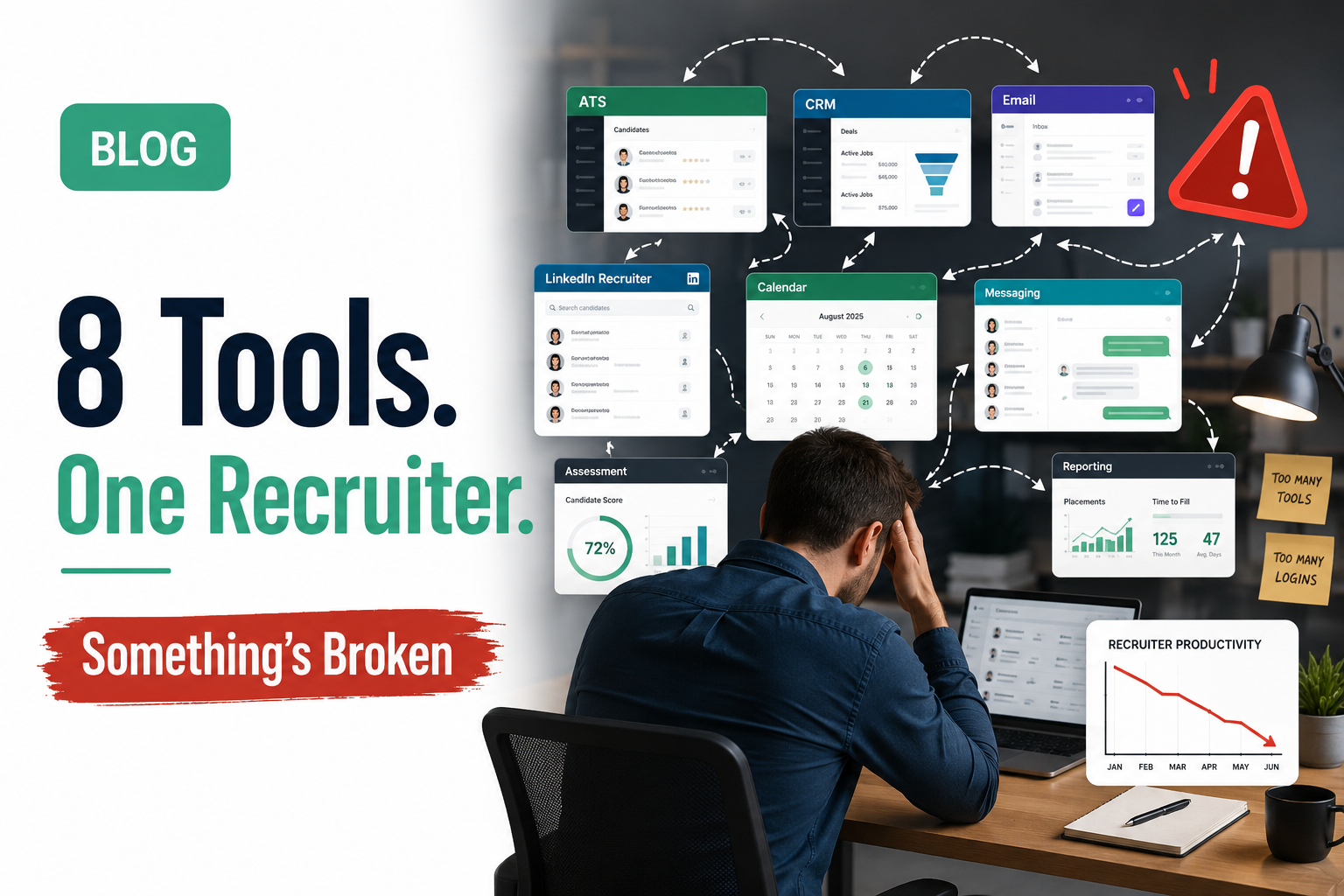
The delivery engine of the modern workforce solutions firm is suffering from a hidden form of friction. Sourcing leadership routinely attributes margin compression and extended submission windows to tight candidate pools or shifting client expectations. However, comprehensive diagnostic reviews across active branches reveal a far more structural challenge: technology sprawl. Sourcing teams are not struggling due to a lack of options; they are overwhelmed by the sheer number of applications they must navigate to execute a single hiring decision.
Over the past decade, the rapid expansion of niche SaaS applications promised to streamline distinct elements of the talent acquisition lifecycle. Agencies quickly adopted specialized software point solutions—one for text-based outreach, another for automated scheduling, a standalone tool for assessment grading, and independent chrome extensions for external profile data collection. This reactive accumulation has led to a fragmented state where the primary asset of a firm—its candidate database—is scattered across disconnected software applications, requiring constant manual updates and data entries.
The operational consequence is severe. Recruiters are no longer acting as relationship-driven human capital advisors; they have been re-allocated as data-entry coordinators, manually synchronizing data fields across eight or more separate software platforms. This systemic fragmentation slows down submittal turnaround speeds, lowers recruiter output per desk, and degrades the candidate experience. To restore delivery margins, staffing operations leaders must move away from point-solution proliferation and build a simplified, highly consolidated technology stack.
Executive Summary & Key Takeaways
- The Points-Solution Paradox: Technology sprawl has converted the recruiter’s workflow into an administrative coordination loop, heavily limiting true candidate engagement time.
- The Hidden Cost of Context Switching: Jumping across fragmented systems creates a significant drop in cognitive focus, directly slowing down pipeline delivery speeds.
- Database Underutilization: Disconnected point applications isolate data pools, driving recruiters to bypass internal ATS records and re-buy matching talent from expensive external portals.
- Consolidation Strategy: Modern, high-performing agencies are replacing loose tool collections with unified platforms that integrate screening, messaging, and candidate rediscovery natively.
What Is Staffing Agency Software?
Staffing agency software represents the core system of record and pipeline management infrastructure utilized by recruitment firms to discover, screen, engage, track, and deploy contingent or permanent talent across corporate client accounts.
Historically centered around a foundational Applicant Tracking System (ATS) or Customer Relationship Management (CRM) core, modern staffing agency software solutions have expanded to govern the end-to-end recruitment delivery chain. This includes advanced capabilities such as automated candidate screening, real-time interactive text messaging, automated panel scheduling alignment, compliance credential tracking, and predictive data forecasting. When designed correctly, it integrates all applicant touchpoints into a unified intelligence layer, enabling delivery teams to identify high-potential talent and execute client presentations in hours rather than days.
Why Modern Staffing Firms Depend on 8+ Recruiting Tools
The transition from a clean, single-system recruitment workflow to an overly complicated patchwork of eight or more tools was rarely an intentional strategy. Instead, it occurred through gradual technical debt. As legacy database architectures struggled to handle modern communication styles and high-speed delivery demands, staffing leaders reacted by adding specialized standalone tools to patch immediate workflow gaps.
In a typical unoptimized branch today, a standard recruiter's daily tech application setup looks remarkably like this:
- The Central ATS of Record: Used to host candidate profiles, store historical applications, and execute baseline compliance entries.
- A Standalone Staffing CRM: Managed by account executives to map out business prospects, handle client contracts, and log sales communications.
- External Sourcing Networks (LinkedIn Recruiter/Job Boards): Where sourcers spend their premium credits to discover fresh candidate leads outside their internal systems.
- An Isolated SMS Platform: Used to run broadcast text blasts, which are rarely synchronized with the central applicant file notes.
- A Disconnected Scheduling Application: Managed through external link generation to coordinate available interview times across multiple team calendars.
- A Separate Skills Assessment Module: Where coding challenges, nursing credential checks, or behavioral tests are issued and scored.
- An AI Note-Taking Assistant: Added to record interview audio and generate written summaries, which must then be manually copy-pasted into the system.
- A Patchwork of Chrome Extensions: Utilized to extract contact details, check social profiles, and bridge missing data fields manually.
Every single tool on this list was adopted with the best intentions—to solve a specific operational bottleneck. However, because these applications function as independent data islands, the net result is a highly fragmented environment that drains recruiter capacity and creates immense data chaos.
The Hidden Cost of Technology Sprawl
The financial consequences of running an unvetted staffing agency software ecosystem extend far beyond the visible line items on software procurement invoices. The true, more damaging drain on resources occurs inside the daily recruitment workflow, where manual entry steps and tracking delays systematically degrade recruiter performance and slow down pipeline velocity.
| Identified Tech Sprawl Friction | Immediate Recruiter Workflow Reality | Downstream Corporate Business Consequence |
|---|---|---|
| Manual Data Synchronization | Recruiters manually copy and paste details like contact logs and skill assessments across systems. | Significant capacity loss; teams lose up to three hours daily on basic data updates. |
| Data Profiling Silos | Candidate interaction details and compliance history are split across disconnected systems. | Recruiters bypass existing ATS profiles and re-buy matching talent from expensive external portals. |
| Broken Tracking Links | Applicants must bounce between separate portals to upload documents, schedule calls, and take tests. | Elevated mid-funnel drop-off rates; damage to corporate employer brand equity. |
| Opaque Operational Metrics | Delivery heads must manually compile reports across variable system dashboards to evaluate pipelines. | Complete lack of true time-to-submit visibility; highly volatile margin forecasting. |
The Real Cost of Context Switching
When a recruitment professional is forced to constantly jump between eight disconnected software interfaces to process a single candidate, their daily output drops significantly. Cognitive research across complex operational environments shows that context switching—the habit of stopping one task to handle an unaligned process on another platform—can waste up to 40% of an individual's productive capacity. Every time a recruiter leaves their candidate screen to generate a scheduling link, verify a licensing database, or update an external tracking document, their cognitive focus is completely broken.
This continuous fragmentation creates deep operational delays. Recruiters lose hours every day simply re-orienting themselves within their workflows, checking multiple systems for data entry errors, and waiting on slow system lookups. This mental fatigue directly extends the agency's time-to-client-submittal. In fast-moving contract talent pipelines, a delay of just a few hours allows more technically integrated competitors to deliver pre-screened talent first, leaving the slower firm with empty pipelines and unfulfilled client assignments.
How High-Performing Staffing Firms Build Simpler Tech Stacks
Forward-thinking workforce solution providers are breaking away from point-solution fragmentation by adopting a strategy of workflow consolidation. Instead of continually adding more software components to their infrastructure, operations directors are auditing their processes to build single, highly integrated talent networks. The objective is clear: increase recruiter leverage by ensuring all essential candidate tracking, validation, and outreach tasks occur within a unified workspace.
Consolidating your delivery lifecycles directly improves your data tracking precision. By removing external data gaps and syncing communication histories, high-volume sourcing teams gain absolute clarity over their internal pipelines. Recruiters can instantly leverage advanced candidate rediscovery tools to search their existing ATS warehouse, automatically surfacing pre-screened historical talent and initiating multi-channel outreach in seconds—all from a single, centralized workspace.
Essential Categories Every Staffing Firm Needs
Building a highly scalable, predictable talent acquisition operation requires a tech stack designed for automated execution. Rather than managing loose tool collections, organizations should focus on four foundational infrastructure modules connected through a single system core:
1. The Core Sourcing & Database Layer (ATS/CRM)
The central heart of the enterprise, responsible for storing candidate histories, maintaining client contracts, and tracking compliance compliance. This database layer must operate as an active data asset rather than a stale filing archive.
2. Contextual Screening & Candidate Rediscovery
Advanced machine learning matching layers that contextually interpret candidate skills and backgrounds across your internal database, instantly prioritizing top-tier profiles and completely removing manual document review tasks from the recruiting schedule.
3. Automated Multi-Channel Engagement
Continuous, automated text and email tracks that manage early outreach steps, handle interactive compliance follow-ups, and coordinate interview calendars automatically to eliminate manual chaser work.
4. Integrated Pipeline Intelligence
Real-time KPI metric scorecards that provide delivery heads with clear visibility over submission velocities, channel success rates, and recruiter output metrics to ensure total process optimization.
Modern Staffing Technology Stack Architecture
Staffing operations leaders can review this comparison matrix to plan their transition away from point-solution sprawl toward an integrated talent infrastructure model.
| Recruiting Lifecycle Phase | Traditional Sprawl Stack (8+ Tools) | Modern Consolidated Stack (Single Platform) |
|---|---|---|
| Top-of-Funnel Sourcing | Manual Boolean search across external job boards + separate data extraction extensions. | Automated candidate rediscovery software mining the existing database contextually. |
| Applicant Evaluation | Recruiters manually open files + separate assessment links sent via loose emails. | High-volume AI candidate screening providing instant suitability rankings at entry. |
| Communication Delivery | Manual phone dialing + isolated SMS blast engines + standalone scheduling links. | Natively integrated mobile messaging paths with automated self-booking triggers. |
| Process Governance | Manual tracking spreadsheets + retrospective performance calculations. | Real-time operational dashboards tracking active submittal deadlines programmatically. |
Can AI Replace Multiple Recruiting Tools?
The strategic impact of artificial intelligence in corporate recruitment is frequently obscured by excessive marketing hype. Realistically, AI is not a complete replacement for human recruiters; it serves as a powerful operational leverage layer that automates repetitive, data-intensive tasks. True automation focuses entirely on removing manual administrative data entry from your delivery pipelines.
An intelligent system should handle the administrative heavy lifting: contextually scanning massive resume databases, calculating suitability scores relative to job requirements, and running automated communication loops to verify availability. This shifts the recruiter's daily schedule away from administrative tracking, allowing professionals to dedicate their focus to high-value relationship tasks: conducting deep qualitative screens, checking corporate cultural alignment, and closing premier talent.
Mini Case Study: Overhauling Delivery Infrastructure
A fast-growing North American professional services and technical staffing firm was facing severe pipeline friction. Operating with forty full-time recruiters, the company utilized eleven separate software applications to process candidate profiles. Sourcing teams spent their days copy-pasting notes between their ATS, standalone texting tools, separate assessment platforms, and personal scheduling links. This fragmented workflow pushed their average time-to-client-submittal to over four business days, resulting in missed contract openings across highly competitive corporate accounts.
To stabilize their margins, the organization initiated an operational overhaul, replacing their disjointed point solutions with a consolidated workspace strategy. They automated top-of-funnel document reviews, implemented integrated mobile messaging loops, and launched automated internal candidate rediscovery tracks to leverage their existing data assets first.
The performance results achieved within ninety days of consolidation were immediate:
- Submission Speeds Compressed by 85%: Average time-to-submit dropped from 4.2 business days down to under 12 hours total.
- External Sourcing Spend Lowered by 61%: Sourcing teams successfully filled open requisitions internally by reactivating dormant ATS files automatically.
- Recruiter Placements per Desk Scaled by 55%: Net billing volumes grew significantly due to the total removal of manual scheduling tasks and administrative coordination loops.
Staffing Technology Stack Checklist
Workforce solutions owners and heads of delivery can utilize this practical diagnostic checklist to identify software redundancies across their current operating structures.
Frequently Asked Questions
What is staffing agency software? +
Why do staffing firms use multiple recruiting tools? +
How many recruiting tools should a staffing agency use? +
Can AI replace recruiting software? +
How do staffing firms simplify recruiting operations? +
Should ATS and CRM be separate? +
What technology should every staffing agency have? +
How do staffing firms reduce technology complexity? +
Conclusion
Achieving long-term human capital delivery efficiency requires a transition away from point-solution proliferation and a move toward workflow consolidation. As competitive submission windows tighten and tracking regulations become more complex, global staffing firms can no longer afford to run unvetted, fragmented software ecosystems.
The future of staffing success is not determined by continuously adding new single-purpose applications to your recruiting infrastructure. True operational excellence is achieved by building deeply connected, highly integrated talent networks that maximize the value of your existing data asset while liberating recruiters from administrative burdens.
Implementing comprehensive platforms like NinjaHire transforms your recruitment tech stack into a scalable business asset. By combining high-volume text screening, real-time candidate identity checks, automated mobile communication channels, and internal candidate rediscovery workflows within a unified workspace, our platform removes tool sprawl completely, expands individual recruiter productivity, and ensures your agency is positioned to fill critical assignments ahead of the competition.
Simplify Your Staffing Technology Stack
See how NinjaHire helps staffing firms reduce tool sprawl by combining AI-powered candidate search, candidate rediscovery, workflow automation, recruiter productivity tools, and recruiting intelligence in one platform.
Start Your Free 30-Day Trial