.png)

There is a conversation that happens in almost every staffing agency leadership meeting. Revenue is behind. Fill rates are slipping. A few recruiters are burning out. The instinct is always the same: hire more people, buy more job board credits, push harder on sourcing. The diagnosis is almost always wrong.
The constraint is rarely sourcing. The constraint is the volume of work that sits between sourcing and placement, and that work is almost entirely coordination.
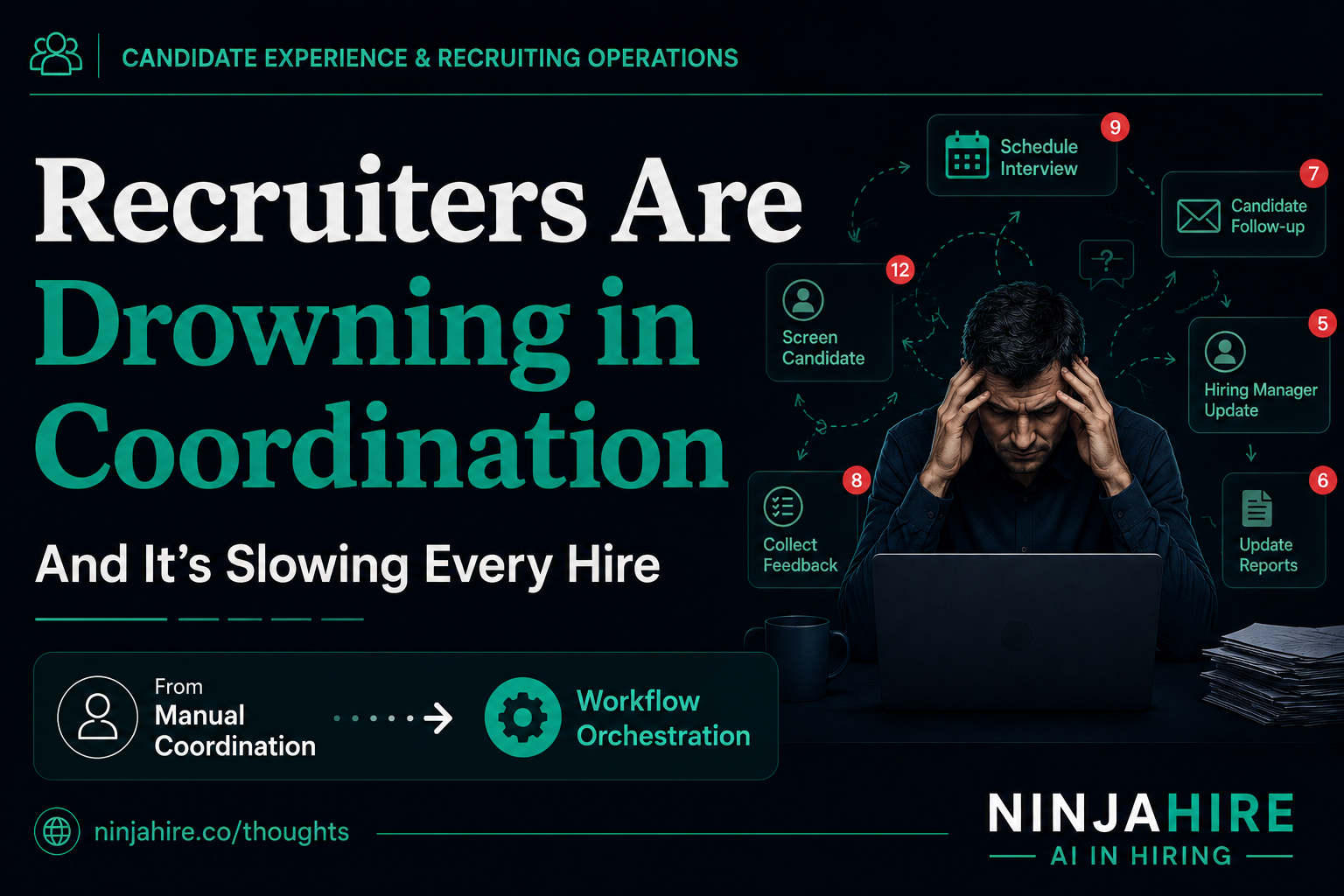
Every recruiter on your team carries an invisible second job. Not recruiting: managing the logistics of recruiting. Chasing hiring managers for feedback, manually scheduling interviews, sending follow-up reminders, updating spreadsheets, reformatting reports, fielding status requests. This is operational drag, and it compounds quietly.
Operational drag is the accumulated weight of manual coordination tasks that slow a recruiting team's capacity to place candidates and grow revenue.
A recruiter spending two hours daily on coordination loses ten hours per week, over five hundred annually, on work that rarely requires their expertise. Multiply that across ten recruiters and you have lost five thousand hours of recruiting capacity to administrative overhead. That is the difference between scaling and stagnating.
What Is Manual Recruiting Coordination?
Manual recruiting coordination is the set of administrative, communication, and logistical tasks that a recruiter performs by hand to move candidates, hiring managers, and stakeholders through the hiring process. This includes interview scheduling, status follow-ups, candidate communications, approval routing, reporting, and pipeline tracking. These tasks do not require recruiting expertise but consume a significant portion of every recruiter's working day.
It is worth drawing a clear line between recruiting and coordinating recruiting. Recruiting is the skilled work: identifying talent, evaluating fit, building relationships, negotiating offers. These activities create value and require judgment.
Coordinating recruiting is everything else. The operational scaffolding surrounding the skilled work. In a well-designed operation, coordination is handled by systems and automation. In most staffing agencies today, it is handled manually by the same people doing the skilled work.
Consider a single placement cycle. A recruiter sources a qualified candidate. From that moment they will draft outreach, follow up when there is no response, schedule an intake call, update the ATS, reformat the resume for submission, wait for client feedback, chase the hiring manager when feedback is delayed, schedule an interview, send confirmations, send reminders, debrief, and collect feedback from both sides. Each step done manually creates a new opportunity for delay, miscommunication, or error. That is not a workflow. It is a series of individual decisions repeated endlessly across every open role on the desk.
Where Recruiting Teams Lose the Most Time
Research from LinkedIn Talent Solutions and SHRM consistently shows that fewer than half of a recruiter's working hours are spent on activities requiring their skills: sourcing, interviewing, advising candidates and clients, closing offers. The rest is coordination.
| Activity | Hrs/Week Manual | Hrs/Week Automated | Time Recovered |
|---|---|---|---|
| Interview scheduling | 4 to 6 hrs | 0.5 to 1 hr | 3 to 5 hrs |
| Candidate follow-ups | 3 to 5 hrs | 0.25 to 0.5 hrs | 2.5 to 4.5 hrs |
| Hiring manager comms | 3 to 4 hrs | 1 to 1.5 hrs | 1.5 to 2.5 hrs |
| ATS and data entry | 3 to 5 hrs | 0.5 to 1 hr | 2.5 to 4 hrs |
| Pipeline and reporting | 3 to 5 hrs | 0.5 to 1 hr | 2.5 to 4 hrs |
| Leadership status requests | 2 to 3 hrs | Near zero | 2 to 3 hrs |
| Total coordination | 18 to 28 hrs | 3 to 5 hrs | 15 to 23 hrs recovered |
For a firm with ten recruiters, recovering fifteen to twenty-three hours per person weekly is the equivalent of adding four to six full-time recruiting capacity without a single new hire.
How Manual Coordination Creates Recruiting Bottlenecks
A bottleneck is any point where work slows, stops, or degrades because a manual handoff has not happened yet. Most recruiting bottlenecks are coordination failures, not sourcing failures.
Communication Gaps
When a recruiter submits a candidate and waits for client feedback with no visibility into timing, the gap becomes invisible until it is too late. The candidate may have accepted another offer while the recruiter waited for a response that was never sent.
Process Inconsistency
In most staffing operations, the workflow depends on which recruiter is handling the role. One follows up within 24 hours. Another waits for the client. This inconsistency means the client and candidate experience varies by recruiter rather than being driven by a consistent operational standard.
Approval Delays
In environments with compliance requirements or client-specific onboarding steps, manual approval routing creates predictable delays. An email to the wrong person or a document buried in an inbox can hold up a placement for days. These delays are entirely avoidable with automated routing and escalation logic.
Staffing Industry Analysts data indicates that top-performing staffing agencies submit qualified candidates 30% to 50% faster than average performers. The primary differentiator is not sourcing speed. It is workflow efficiency: how quickly a recruiter moves from identification to submission without manual coordination creating friction at each step.
Context Switching
McKinsey research found it takes an average of 23 minutes to regain full focus after an interruption. For recruiters managing coordination manually, interruptions are constant. Each one fragments capacity for the deep, high-value work that actually drives placements.
The Productivity Tax on Staffing Agencies
Manual coordination creates a measurable productivity tax across the entire business. Gartner research on talent acquisition found that organizations with high manual process dependency consistently show lower placements per recruiter, longer time-to-fill cycles, and higher cost-per-hire than peers who have invested in workflow standardization and automation.
| Metric | Manual Ops | Optimized Ops | Improvement |
|---|---|---|---|
| Placements per recruiter (monthly) | 3 to 5 | 7 to 12 | 2x to 3x increase |
| Time to submit (days) | 5 to 9 days | 1 to 2 days | 70%+ reduction |
| Time to fill (days) | 28 to 45 days | 14 to 22 days | 35% to 50% faster |
| Recruiter skilled work hrs/week | 18 to 22 hrs | 32 to 38 hrs | 60%+ more capacity |
| Recruiter annual turnover | 35% to 45% | 15% to 22% | 50%+ retention gain |
The Candidate Experience Impact
Candidates in an active job search are evaluating multiple opportunities simultaneously. Their decision to stay engaged depends heavily on communication quality, responsiveness, and process professionalism. When recruiting runs on manual coordination, the candidate experience becomes unpredictable.
A candidate does not experience your ATS or internal workflow. They experience your response time, your follow-through, and your ability to keep them informed. That experience is entirely shaped by how well your coordination infrastructure works.
SHRM data indicates that 58% of candidates have declined an offer or disengaged from a process due to poor communication. CareerBuilder research shows that 78% of candidates say the recruiting experience signals how a company values its people, and by extension, the agencies that represent them.
LinkedIn Global Talent Trends research shows candidate expectations for response time have compressed significantly. In 2019, candidates expected a response within one week. By 2023, the expectation shifted to 48 to 72 hours. In high-demand technical and contract staffing markets, the expectation is often same-day. Manual coordination workflows are structurally incapable of meeting these expectations consistently at scale.
What High-Performing Recruiting Teams Do Differently
The most productive staffing agencies share a consistent operational pattern: standardized workflows that remove ambiguity, centralized communication that reduces tool switching, real-time pipeline visibility that surfaces problems before they become delays, and automated execution of coordination tasks that previously lived in individual inboxes.
Most staffing agencies operate between Stage 1 and Stage 2. The transition from Stage 2 to Stage 3, where coordination tasks are systematically automated rather than delegated to individual recruiters, is where significant productivity gains begin. Agencies at Stage 4 and Stage 5 have built a recruiting infrastructure layer that coordinates all moving pieces of the hiring process without requiring recruiters to manage the logistics.
The Shift From Coordination to Orchestration
Manual coordination puts the operational burden on the recruiter. Every follow-up, scheduling action, and status update requires a human decision and a human action. Workflow automation removes some of that burden through predefined triggers. Recruiting orchestration is a different category entirely: the entire operation is coordinated as an intelligent system where workflows adapt, priorities surface automatically, and execution happens without requiring recruiter attention at every step.
| Dimension | Manual Coordination | Workflow Automation | Recruiting Orchestration |
|---|---|---|---|
| Ownership | Individual recruiter | Rules engine | Intelligent system layer |
| Visibility | Low; fragmented | Medium; stage-based | Full real-time view |
| Speed | Dependent on human response | Faster for defined triggers | Near-instant across all stages |
| Candidate Experience | Inconsistent by recruiter | Consistent for templated steps | Personalized and adaptive |
| Scalability | Linear: more volume needs more headcount | Partial: automates volume, not complexity | Non-linear: scales without proportional headcount |
| Recruiter Productivity | Low: majority on coordination | Medium: some coordination removed | High: recruiters on skilled work only |
| Operational Cost | High: coordination is the dominant cost | Medium: partial reduction | Low: coordination cost largely eliminated |
The Rise of Agentic Recruiting Coordination
The most significant shift currently emerging across high-performing staffing organizations is what industry analysts are beginning to describe as agentic recruiting coordination.
Traditional Recruiting
Fully manual coordination. Recruiters manage all scheduling, follow-ups, reporting, and communication by hand. High operational overhead per placement.
Workflow Automation Current Majority
Rule-based triggers automate defined steps. Reduces some coordination burden but cannot adapt to context or exceptions.
Recruiting Orchestration
Unified workflow layer that coordinates all hiring stages as a connected system. Real-time visibility, adaptive sequencing, and centralized execution.
Agentic Recruiting Emerging
AI agents autonomously execute follow-ups, scheduling, engagement sequences, and process management. Recruiters focus entirely on relationships and hiring outcomes.
Agentic recruiting coordination uses AI agents to autonomously execute follow-ups, scheduling, candidate engagement, workflow actions, reminders, and recruiting process management. Rather than triggering predefined rules, agentic systems understand context, adapt to changing conditions, and take initiative on coordination tasks while keeping recruiters informed and in control of decisions requiring human judgment.
Modern staffing agencies are increasingly moving beyond workflow tracking tools and adopting recruiting infrastructure that can coordinate sourcing, engagement, scheduling, intelligence, and workflow execution from a single operational layer. This shift is creating a new category of recruiting operations platforms focused on orchestration rather than administration. The agencies that invest early in this infrastructure are building compounding operational advantages that become harder to replicate over time.
Building a Coordination-Free Recruiting Operation
Eliminating manual coordination overhead is a staged improvement process. Meaningful gains are achievable at each stage, even before a firm reaches full orchestration maturity.
Have each recruiter track time over two weeks, categorizing activities as skilled work versus coordination work. Convert total coordination hours to an annual cost using average recruiter compensation. This number becomes the financial anchor for every workflow investment decision that follows.
Identify the five to ten most common placement scenarios. For each, map the ideal workflow from intake to placement including every communication touchpoint. These become the templates from which automated workflows are built. Standardization is the prerequisite for automation.
Manual coordination is often a symptom of fragmented tooling. When candidate communication lives in personal email, schedules in individual calendars, and pipeline data in spreadsheets, coordination requires constant manual reconciliation. Centralizing these streams into a unified platform enables automation and visibility.
Begin where the volume and time cost is highest: interview scheduling, follow-up sequences, post-submission status pings, and interview reminder communications. Even basic automation in these areas can recover three to five hours per recruiter weekly within the first month.
Once workflows are automated and pipeline data is centralized, you gain reliable operational data. Measure time-to-submit by role and client. Track where candidates disengage most frequently. Use this intelligence to tighten SLAs and build toward the orchestration model where the system surfaces problems before they become losses.
| Maturity Stage | Coordination Model | Key Indicators | Strategic Priority |
|---|---|---|---|
| Level 1: Reactive | Fully manual; ad hoc | High burnout; no pipeline visibility; inconsistent candidate experience | Standardize core workflows immediately |
| Level 2: Structured | Process-defined; manually executed | Some consistency; still high coordination hours | Begin automating highest-volume tasks |
| Level 3: Automated | Rule-based automation for defined steps | Reduced scheduling overhead; better data quality | Centralize communication; integrate workflow layers |
| Level 4: Orchestrated | Unified workflow execution | High productivity; real-time visibility; strong candidate experience | Add intelligence layer; evaluate agentic capabilities |
| Level 5: Agentic | AI agents coordinate autonomously | Maximum recruiter capacity on skilled work; compounding operational advantage | Scale agentic capabilities; build proprietary workflow intelligence |
The Most Expensive Part of Recruiting Is Not Sourcing
Every recruiting leader eventually has a version of the same realization. The firm is working hard. Recruiters are busy. The pipeline is active. But revenue is not growing the way the headcount and effort would suggest. The missing variable, almost invariably, is operational leverage.
The most expensive part of your recruiting operation is not job board subscriptions or sourcing technology. It is the hours of recruiter capacity consumed daily by coordination tasks that do not require recruiting expertise. It is the candidates who disengage while your team waits on manual feedback loops. It is the placements delayed by scheduling friction that an automated system would have resolved in seconds.
The staffing agencies that win in the next decade will not be the ones with the most recruiters. They will be the ones with the most operational leverage: the ability to move candidates, clients, and processes faster, with less friction, at greater scale per person.
Reducing coordination overhead, increasing workflow visibility, and building toward intelligent orchestration are strategic bets on your firm's ability to scale without proportionally scaling costs. The firms making that bet now are building the operational infrastructure that turns a good recruiting team into a compounding business advantage.