.png)
Time-to-fill vs time-to-hire: what AI actually moves the needle on

March 15, 2026
Recruiting is caught in a measurement trap where speed is often mistaken for efficiency. Most talent acquisition leaders look at the dashboard and see a single number representing how long it takes to hire someone but that number is a lie. It obscures the friction between different departments and the reality of the candidate experience. If you want to actually fix your hiring engine you have to stop treating time as a single metric. You have to understand the specific mechanical differences between time to fill and time to hire because they tell two very different stories about your organization.
Most teams are currently drowning in applications while simultaneously complaining about a talent shortage. This paradox exists because the tools we use to measure success are outdated. We are using 2010 metrics to solve 2026 problems. AI is marketed as a silver bullet for speed but if you apply it to the wrong part of the process you are just failing faster. True optimization requires a surgical understanding of where the clock actually stops and starts and where human intervention is actually a bottleneck versus a necessity.
What is time to fill vs time to hire
The distinction between these two metrics is the difference between measuring the health of your business operations and the health of your recruiting team.
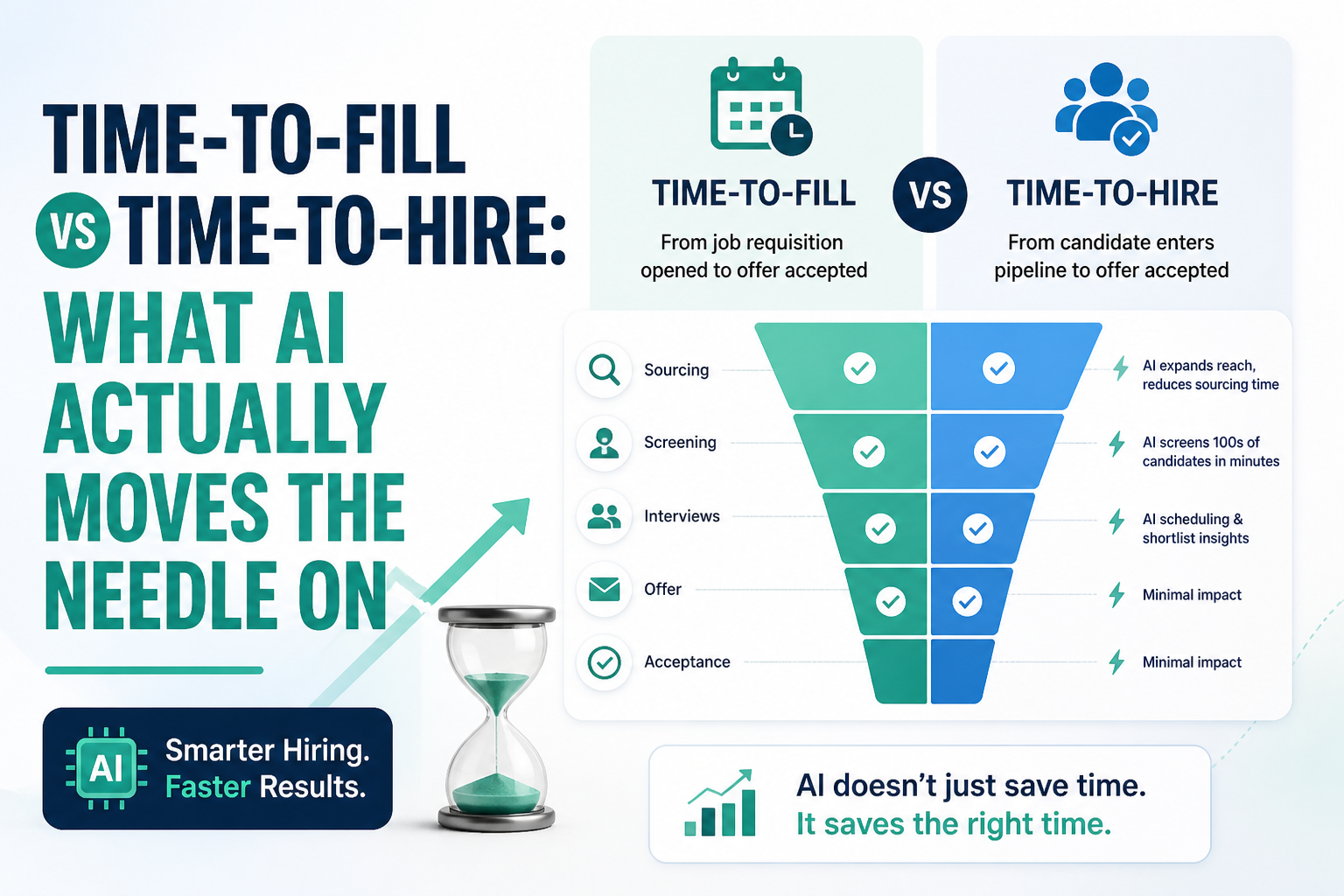
What is time to fill in recruitment → Time to fill is the number of calendar days from the moment a job requisition is approved until a candidate signs the offer letter. It measures the entire vacancy period including budget discussions and internal logistics.
What is time to hire → Time to hire is the number of days from when a candidate enters your pipeline to the day they accept the offer. It tracks the efficiency of your selection process and the speed at which you move talent through the funnel.
Why most teams confuse these metrics
The confusion starts in the Applicant Tracking System. Most ATS platforms are not configured to distinguish between when a role is "open" and when a recruiter starts "working" the role. This leads to a massive data integrity problem. If a finance team takes three weeks to approve a budget but the ATS marks the start date as the day the manager first mentioned the role your time to fill looks disastrously high even if the recruiter found a candidate in four days.
Inconsistent definitions are the primary culprit. Some companies define the end of the clock as the day the offer is extended while others wait until the background check is cleared. This lack of standardization makes industry benchmarking nearly impossible. Vendors often capitalize on this confusion by promising to reduce hiring time by 80 percent without clarifying which metric they are targeting. If an AI tool speeds up sourcing it might lower your time to hire but it won't touch the three weeks of bureaucratic delay that bloats your time to fill.
Where the time actually goes
To improve your speed you have to map the journey of a single requisition. The vast majority of time is not spent interviewing. It is spent waiting for decisions. We call this the white space in the funnel.
In the United States the average time to fill is roughly 42 days but in highly specialized sectors like engineering it often stretches past 60 days. In India the challenge is the notice period which can be as long as 90 days. This means that even if your time to hire is fast your time to fill is artificially inflated by local market norms. In the UK the focus is often on the quality of the vetting process which can add a week to the final stage of the funnel.
Where AI actually moves the needle
Not all AI is created equal and not every stage of the funnel benefits from automation. If you try to automate the final interview you will lose the candidate. But if you don't automate the initial screening you will lose the market.
Screening and the biggest impact
This is where AI provides the most significant return on investment. Traditional screening involves a recruiter looking at a PDF and trying to match keywords to a job description. This is slow and prone to bias. Modern AI uses vector embeddings to understand the semantic meaning of a resume. It knows that a candidate who managed a high-volume retail team has transferable skills for a junior project management role even if the keywords don't match.
The needle moves here because AI can process 5000 applications in the time it takes a human to drink a cup of coffee. This reduces the screening phase from weeks to minutes. This is the primary way to reduce time to hire using AI.
Automated Scheduling
The most underrated use of AI is the elimination of calendar tag. In a manual world a recruiter spends 20 percent of their week just trying to find a time that works for three different interviewers and one candidate. AI agents can now interface directly with calendars and handle the rescheduling and the follow-ups without any human intervention. This removes about 48 to 72 hours of dead time from every single round of interviews.
The Intelligence Gap in Sourcing
Sourcing is often where time to fill is high because the initial search was too narrow. Recruiter-led sourcing relies on the individual's ability to write a Boolean string. AI-driven sourcing looks at historical data to find people who are "likely to move" based on their career patterns and company health. It expands the pool of candidates instantly which prevents the role from sitting vacant for months while you search for a purple squirrel.
Industry benchmarks
The following table outlines the impact of AI across different sectors. These numbers reflect the shift from manual workflows to AI-augmented processes.
In the US tech market the reduction is primarily in the middle of the funnel where technical assessments and initial screens are automated. In India the biggest gain is in the retail and staffing sectors where the volume of candidates is so high that manual screening is physically impossible.
Why optimizing speed alone is dangerous
There is a point where speed becomes a liability. If you move too fast you stop assessing for cultural alignment and start hiring for availability. This leads to the "revolving door" problem where your time to hire is low but your turnover rate is high.
Bad hires are the most expensive mistake a company can make. In the UK for example the cost of a bad hire is estimated at over 30000 pounds when you factor in lost productivity and the cost of re-recruiting. If AI helps you hire a person who isn't a fit in 5 days you haven't saved the company time you have created a six-month problem.
Candidate experience also suffers when the process feels too robotic. Candidates want to know that a human is making the final decision. If they receive an automated rejection letter three seconds after they hit apply they feel like they weren't given a fair chance. A healthy process uses AI to remove the administrative burden so that the recruiter has more time to actually talk to the candidates who matter.
Metrics you should track together
A single metric is a data point but a dashboard is a story. You need to look at these numbers in tandem to understand where the friction lies.
- Time to fill: Measures the business impact of vacancies.
- Time to hire: Measures the agility of your recruiting team.
- Screen pass rate: Measures the accuracy of your AI or recruiter vetting.
- Offer acceptance rate: Measures the competitiveness of your brand and comp.
- Candidate NPS: Measures how the process felt for the applicant.
If your time to hire is decreasing but your screen pass rate is also dropping it means your AI is being too aggressive or too lenient. You are moving faster but you are losing quality. The goal is to see a decrease in time to hire while maintaining or increasing your offer acceptance rate.
How to actually reduce hiring time
To move the needle you have to address the root causes of delay. Start by auditing your internal approval process. If it takes more than 48 hours to get a budget approved your time to fill will always be high regardless of your tech stack.
Next you should implement AI-first screening. This doesn't mean removing humans but rather giving them a ranked list of the top 10 percent of candidates so they don't waste time on the bottom 90 percent. This creates a massive surge in efficiency at the top of the funnel.
Finally you must fix the interview loop. Most companies have too many interviews. Every additional round adds roughly 5 to 7 days to the time to hire. Use AI to document the interviews and share the insights across the team so that you can make a decision in three rounds instead of six. Recruiter workflow optimization is about giving the team the tools to focus on the human side of the job while the machine handles the data.
FAQ
Final takeaway
The difference between time to fill and time to hire is the difference between a business problem and a process problem. AI is the only way to scale the process without losing the quality. By focusing on where the time actually goes and removing the white space in your funnel you can create a competitive advantage that goes beyond just filling seats. You can build a talent engine that is both fast and precise.