.png)
When NOT to use AI in recruiting and what to do instead
.jpeg)
March 15, 2026
.jpg)
The Rise of AI in Hiring
Hiring didn’t suddenly become complicated. It became unmanageable at scale.
As companies started growing faster—especially in tech, SaaS, and GCC setups—the volume of applications increased sharply. Recruiters weren’t struggling because they lacked capability. They were struggling because the hiring process wasn’t designed to handle that kind of volume efficiently.
This is where AI in recruiting started gaining traction.
Automating resume screening, scheduling interviews, and handling initial candidate interactions helped teams move faster without immediately increasing hiring bandwidth. For roles with clearly defined requirements and high application volume, this worked well. It reduced manual effort and brought consistency into early-stage screening.
And that’s exactly why adoption picked up so quickly.
However, the shift also introduced a subtle change in how hiring teams started thinking. The focus gradually moved from decision quality to process speed. Instead of evaluating whether they were hiring the right people, teams began optimising for how quickly they could move candidates through the funnel.
That distinction matters more than it seems.
Hiring is not just an operational workflow that needs efficiency. It is a series of decisions made under uncertainty. While AI performs well in environments where data is structured and patterns are repeatable, hiring rarely fits that model completely.
Strong candidates don’t always look obvious on paper. Some of the best hires come from unconventional backgrounds, adjacent industries, or non-linear career paths. These profiles often don’t match predefined patterns, which makes them harder for automated systems to recognise.
This is where the limitation starts becoming visible.
AI is effective at identifying what aligns with existing data. Good hiring, on the other hand, often involves recognising potential that doesn’t perfectly match historical patterns. When overused, AI can unintentionally filter out candidates who don’t fit neatly into the system’s logic but may still be high-impact hires.
That doesn’t make AI in hiring ineffective. It simply highlights that its strength lies in improving efficiency, not replacing judgment.
And when that distinction is ignored, teams may end up moving faster—but not necessarily making better hiring decisions.
The Problem Nobody Talks About
Most teams don’t fail because they use AI in recruiting. They fail because they stop questioning where it should stop.
On the surface, everything looks like it’s working. Roles are getting closed faster. Recruiters are handling more positions. Dashboards show better turnaround time. From the outside, it feels like hiring has finally become efficient.
But if you look a little closer, a different pattern starts to appear.
Shortlists begin to look identical. Profiles feel “safe.” There’s less variation in the kind of candidates being considered. And over time, hiring starts becoming predictable in a way that isn’t always good.
This is the part that rarely gets discussed.
AI doesn’t just speed up hiring. It quietly standardises it.
Most systems are trained on past data previous hires, existing team structures, historical success patterns. The assumption is that what worked before will work again. In stable, repeatable roles, that logic holds.
But hiring isn’t always about repeating the past.
Sometimes, the role itself is evolving. Sometimes, the team needs a different kind of thinking. Sometimes, the best hire is the one who doesn’t resemble anyone already in the company.
When hiring becomes too pattern-driven, those candidates don’t even make it into consideration.
And because the process feels efficient, this loss is almost invisible.
Another issue is over-reliance. Once AI tools are in place, teams gradually stop challenging their output. If a candidate is filtered out early, it’s rarely revisited. If a system ranks profiles a certain way, it’s often accepted without question.
Not because recruiters don’t know better, but because the system creates a sense of confidence.
It feels objective. Data-backed. Consistent.
But consistency isn’t always accuracy.
In some cases, it just means the same kind of mistake is repeated at scale.
This is where hiring automation starts becoming risky. Not because AI is flawed, but because it’s being trusted in areas that require context, judgment, and sometimes even instinct.
The problem isn’t that companies are using AI. The problem is that they’re using it everywhere.
And hiring doesn’t reward that approach.
7 Situations Where You Should NOT Use AI in Recruiting
AI works well when the problem is structured and repeatable. Hiring is not always that kind of problem. There are clear situations where relying too much on AI in recruiting starts working against you, even if the process looks efficient on the surface.
The issue is not obvious in the beginning. It shows up later—through poor fit, early attrition, or teams that don’t quite work the way they should.
Here are the situations where AI hiring tools tend to fall short.
1. Leadership and Executive Hiring
Senior roles are rarely about matching skills on a job description. They are about judgment, influence, and the ability to operate in ambiguity. Two candidates with similar experience can perform very differently depending on context.
AI can screen for experience and keywords, but it cannot evaluate how someone makes decisions under pressure or how they align with the leadership style of the organisation. These are things you understand through conversation, not data.
2. Early-Stage or Evolving Roles
In early-stage companies, roles are not fixed. The person you hire often ends up shaping the role itself. Job descriptions change, priorities shift, and expectations evolve quickly.
AI struggles in these environments because it depends on clarity and structure. When the role itself is still being defined, past patterns don’t offer much value. Human judgment becomes far more important here.
3. Niche or Specialized Positions
For highly specialised roles, especially in emerging technologies or cross-functional areas, the talent pool is limited and often unconventional. The right candidate may not use standard keywords or may come from an adjacent domain.
AI systems tend to prioritise exact matches. That makes it easy to miss candidates who are capable but don’t fit the expected pattern perfectly.
4. Culture-Critical Hiring
Some hires have a disproportionate impact on team culture. These are people who influence how teams collaborate, communicate, and solve problems.
Culture fit is not something that can be reliably measured through resumes or structured data. It requires context, observation, and interaction. Over-reliance on AI in such cases can lead to hires who look right on paper but don’t integrate well into the team.
5. Passive Candidate Hiring
The best candidates are often not actively applying. They need to be engaged, convinced, and guided through the process.
AI tools are not built for this. They don’t build trust or relationships. They don’t adapt conversations based on subtle signals. This is where experienced recruiters create the most value, and automation adds very little.
6. When Data is Limited or Biased
AI systems are only as good as the data they are trained on. If past hiring data is biased or limited, the system will reflect those same biases.
This is one of the biggest risks of AI hiring. It can reinforce existing patterns without anyone actively intending to. In such cases, relying on AI can reduce diversity instead of improving it.
7. High-Stakes Hiring Decisions
Some roles carry a higher impact on business outcomes. A wrong hire in these positions is expensive—not just financially, but operationally.
In such scenarios, decisions need to go beyond scoring models or rankings. They require deeper evaluation, multiple perspectives, and careful judgment. AI can support the process, but it should not be driving the decision.
Why AI Fails in These Scenarios
The limitation isn’t that AI in recruiting is ineffective. It’s that it’s built for a different kind of problem than the one hiring often presents.
Most AI hiring tools are designed to identify patterns in data and apply those patterns consistently. That works well when the environment is stable and the definition of a “good candidate” doesn’t change much. But in many hiring situations, especially the ones that matter most, those conditions don’t hold.
One of the biggest gaps is context.
AI evaluates what is visible and measurable—job titles, skills, tenure, keywords. What it doesn’t fully understand is why those things matter in a specific situation. A candidate may have a shorter tenure at multiple companies for valid reasons, or may have shifted industries in a way that actually adds value. Without context, those signals are often interpreted negatively.
Another issue is the absence of judgment.
Hiring decisions are rarely binary. They involve trade-offs. A candidate might lack one skill but bring strong problem-solving ability. Another might look perfect on paper but struggle in unstructured environments. These are decisions that require interpretation, not just evaluation. AI can rank candidates, but it cannot weigh nuanced trade-offs in the same way an experienced recruiter or hiring manager can.
Bias is also a structural concern.
AI systems learn from historical data. If past hiring decisions had patterns—intentional or not—the system will replicate them. Over time, this can reinforce narrow hiring criteria instead of expanding them. The process feels objective, but it is still shaped by past inputs.
There is also a dependency on patterns that limits adaptability.
AI works best when it sees something it has seen before. When a candidate or role falls outside those patterns, the system has less confidence. In hiring, however, those outliers are often the people who bring new thinking or help teams evolve.
Finally, there is no real understanding of human dynamics.
Hiring is not just about capability. It is about how someone collaborates, communicates, handles conflict, and adapts to a team. These are not easily captured through structured inputs. They emerge through interaction, conversation, and observation over time.
This is where the gap becomes clear.
AI can process information faster than any recruiter. It can organise, filter, and prioritise at scale. But it does not understand people in the way hiring decisions often require.
That’s why in complex or high-impact roles, relying entirely on AI tends to create a false sense of confidence. The process feels more precise, but the underlying decision may still lack depth.
And in hiring, that difference shows up later—when the person is already part of the team.
AI vs Human Recruiters
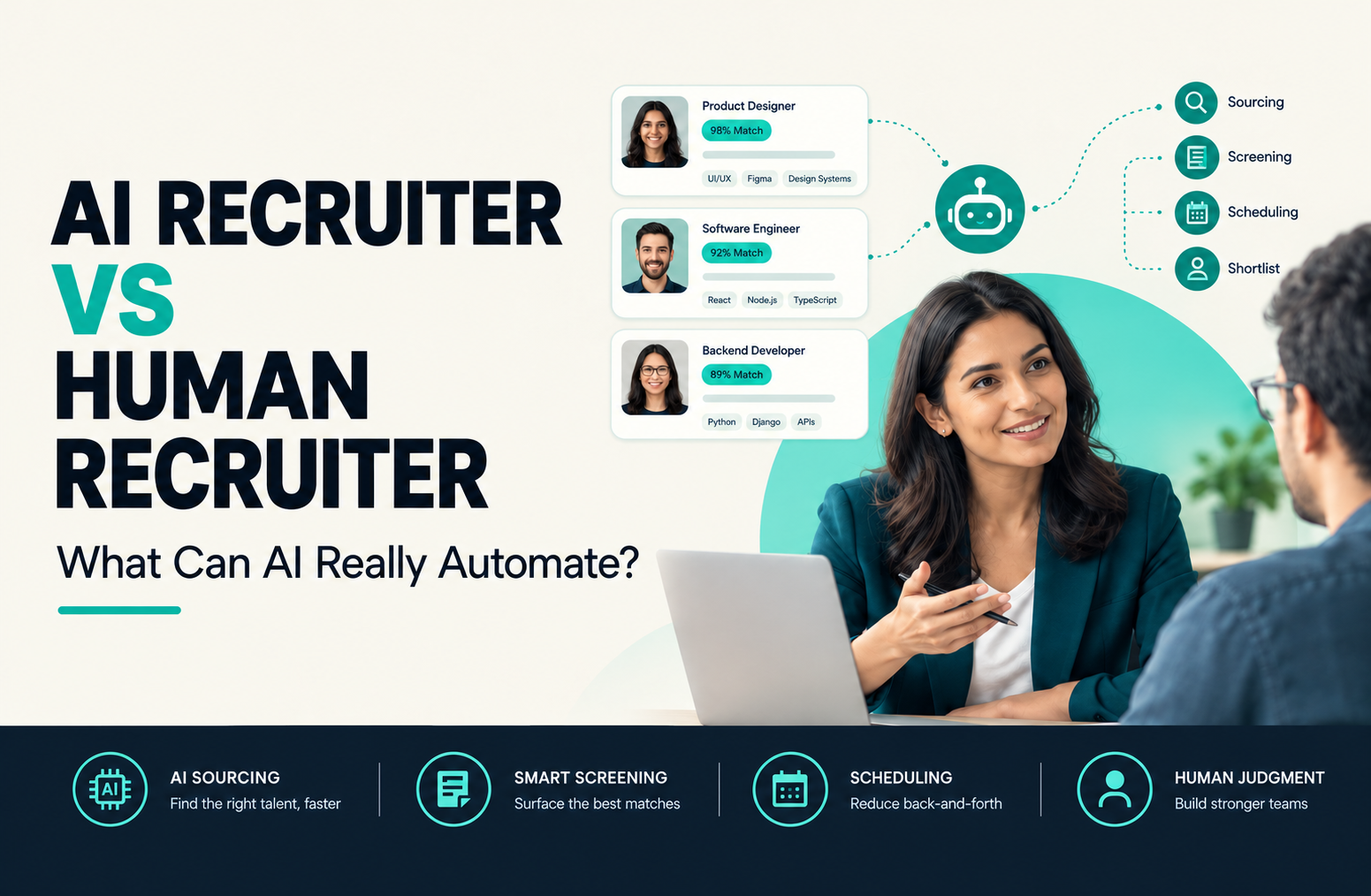
The conversation is often framed as a comparison—AI vs human recruiters—as if one is meant to replace the other. In reality, they operate very differently, and the gap becomes more visible in complex hiring situations.
AI brings speed and consistency. It can process large volumes of applications, apply the same criteria across candidates, and reduce manual workload. For early-stage screening, this is useful. It ensures that obvious mismatches are filtered out quickly and that recruiters can focus their time elsewhere.
But beyond that stage, the nature of the work changes.
Human recruiters don’t just evaluate profiles. They interpret them.
Two candidates with similar resumes can have very different stories behind them. A role change might signal instability in one case and growth in another. A career break might be a red flag in a system but completely irrelevant once you understand the context. These are not decisions that can be made purely on structured data.
There is also the element of interaction.
Good recruiters pick up on signals that are not explicitly stated—how a candidate thinks through a problem, how they communicate, how they respond when something is unclear. These insights come from conversation, not from data points. They evolve during the process, not before it.
Relationship-building is another clear difference.
Hiring, especially for mid to senior roles, is not just about selection. It involves influencing decisions, managing expectations, and building trust. Passive candidates, in particular, don’t respond to automated workflows. They respond to people who understand their motivations and can position the opportunity in a way that makes sense to them.
This is where AI has very limited capability.
It can initiate interaction, but it cannot sustain meaningful engagement. It cannot adjust based on subtle cues or shift the conversation when needed. It follows a structure, while human interaction adapts in real time.
Decision-making also works differently.
AI ranks candidates based on predefined criteria. Human recruiters evaluate trade-offs. They consider what is missing, what can be developed, and what matters most for a specific team at a specific time. These decisions are rarely straightforward, and they often involve factors that are not easily measurable.
So the difference is not just in capability. It is in how the problem itself is approached.
AI is effective when the goal is to process and filter.
Human recruiters are essential when the goal is to decide and close.
Treating both as interchangeable leads to poor outcomes. Understanding where each adds value is what makes the hiring process stronger.
What to Do Instead
The answer isn’t to step away from AI in recruiting. That would be unrealistic, and in many cases, unnecessary. The real shift is in how it is used.
Most hiring problems don’t come from lack of tools. They come from using the same tool across every stage of the process.
AI works best when the task is operational and repeatable. Early-stage screening, interview scheduling, basic candidate communication—these are areas where automation reduces friction without affecting decision quality. It allows recruiters to focus on work that actually requires judgment.
The problem starts when AI moves beyond support and begins influencing decisions.
This is where a clear separation helps.
Use AI to handle volume. Let it filter out obvious mismatches, organise applications, and create structure in the early stages. It does this faster and more consistently than any manual process.
But once you move closer to decision-making, the approach needs to change.
Shortlisting should not rely only on system rankings. Profiles need to be reviewed with context. A candidate who doesn’t perfectly match the criteria might still be worth a conversation. This is where experienced recruiters add value—by knowing when to go beyond the system.
Interviews, especially for mid to senior roles, should remain human-led. This is where you assess thinking, adaptability, and alignment with the team. No automated system can replace the depth of a real conversation in these cases.
The same applies to candidate engagement.
Strong candidates often have multiple options. They are not just evaluating the role; they are evaluating the people and the organisation. This part of the process requires trust and clarity, which can’t be built through automated interactions alone.
A more effective approach is to treat AI as infrastructure, not as a decision-maker.
It should make the process smoother, not replace the thinking behind it.
Teams that get this right don’t necessarily hire slower. They just introduce the right level of human involvement at the points where it matters most. The process remains efficient, but the decisions become more deliberate.
That balance is what most hiring systems miss.
The Hybrid Hiring Model
Most hiring teams don’t need more tools. They need clearer boundaries.
The real shift is not about choosing between AI and humans. It’s about deciding where each should step in and where they shouldn’t.
A simple way to think about it is this: use AI to manage the process, and rely on humans to make the decisions.
At the start of the funnel, volume is the problem. This is where AI adds the most value. It can organise applications, remove obvious mismatches, and keep the process moving without delays. Used well, it reduces noise and gives recruiters a cleaner starting point.
But as soon as the problem shifts from volume to judgment, the approach needs to change.
Shortlisting is not just about matching criteria. It’s about recognising potential, spotting inconsistencies, and sometimes taking a calculated risk on a profile that doesn’t look perfect on paper. This requires context, not just data.
The same applies to interviews. The goal is not only to validate skills but to understand how someone thinks, how they approach problems, and how they fit into a team. These are not things that can be reliably assessed through automated scoring or structured responses alone.
Candidate experience is another area where the hybrid model matters.
Strong candidates don’t just go through a process; they evaluate it. The way conversations are handled, how feedback is shared, how decisions are communicated—all of this influences their perception of the company. Automation can support communication, but it cannot replace thoughtful interaction.
In a hybrid model, AI supports consistency and speed, while humans provide interpretation and direction.
When this balance is clear, the process becomes more stable. Teams don’t get overwhelmed by volume, and they don’t lose depth in decision-making. Each part of the system does what it is best suited for.
The challenge is that this boundary is rarely defined explicitly. Over time, AI starts taking on more responsibility simply because it is available, not because it is appropriate.
Teams that perform well in hiring tend to be more deliberate. They decide upfront where automation helps and where it stops. That clarity prevents the process from drifting into over-reliance.
In the end, the goal is not to make hiring faster at any cost. It is to make better decisions without slowing down unnecessarily.
A hybrid approach is what makes that possible.
AI in Hiring for GCCs and Global Teams
This is where things become more nuanced.
In domestic hiring, patterns are easier to define. The talent pool is familiar, expectations are relatively aligned, and past data has some level of relevance. AI performs reasonably well in these environments because the variables are limited.
But once hiring becomes global—especially in GCC setups—the complexity increases.
You’re no longer just evaluating skills. You’re evaluating context.
A candidate’s experience in one market doesn’t always translate directly to another. Communication styles differ. Decision-making approaches vary. Even the definition of ownership or initiative can change depending on cultural and organisational background.
These are not obvious on a resume. And this is where AI hiring systems start to struggle.
Most tools are trained on standardised datasets. They look for consistency in roles, titles, and progression paths. But global hiring rarely follows a clean structure. Strong candidates may come from unconventional backgrounds or operate differently than expected, especially in cross-border teams.
In India, for example, the talent pool is deep but highly diverse. Two candidates with similar experience on paper can have very different exposure depending on the companies they’ve worked in, the scale they’ve operated at, and the kind of problems they’ve solved.
AI systems don’t always capture that nuance.
There’s also the challenge of offshore hiring risks.
When companies are building GCCs or remote teams, alignment matters more than ever. Misalignment in expectations, communication, or work style doesn’t show up immediately—it shows up after the person joins. By then, the cost of a wrong hire is already high.
Relying too heavily on AI in these scenarios can create a false sense of standardisation. The process feels structured, but the underlying evaluation may miss important context.
Another layer to this is candidate engagement.
Global hiring often involves candidates who are evaluating multiple international opportunities. They are not just comparing roles; they are comparing teams, leadership, and long-term growth. This requires conversations that go beyond scripted interactions.
AI can support outreach, but it cannot build conviction.
That still depends on how well the opportunity is positioned, how questions are handled, and how trust is built during the process.
In GCC hiring especially, the margin for error is smaller.
You’re not just hiring for a role. You’re building a team that needs to operate across geographies, often with high ownership and limited supervision. Getting that wrong slows down more than just hiring—it affects delivery, culture, and long-term scalability.
This is why a more cautious approach to AI in global hiring makes sense.
Use it to bring structure where needed. But don’t rely on it to interpret complexity.
Because in cross-border hiring, context is not a small detail. It’s the difference between a hire that works and one that doesn’t.