.png)
Candidate Management Software for Fast-Growing Staffing Firms

May 28, 2026
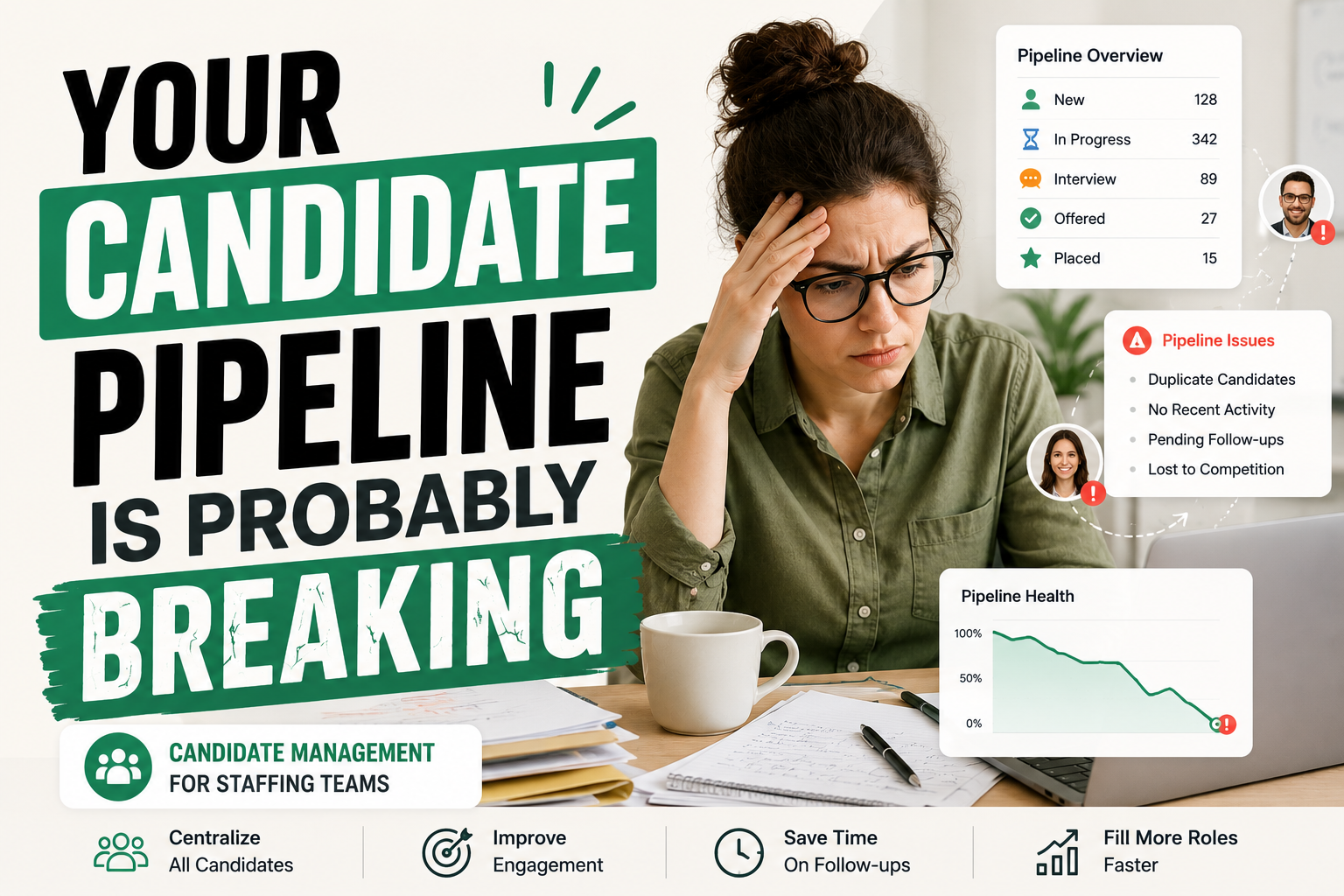
When your recruiting operation scales past a handful of recruiters, candidate pipelines get messy fast. Here's how high-performance staffing firms keep them under control — and where most fall apart.
The Pipeline Problem Nobody Talks About
You've hired three new recruiters in six months. You've doubled your open requisitions. You've brought on two new clients and you're managing delivery across four accounts simultaneously. And yet somehow, your candidate pipeline feels less organized than it did when you were a team of two.
This isn't a recruiting skills problem. It's a pipeline infrastructure problem — the single most common reason fast-growing staffing firms hit a wall on delivery capacity right when they should be scaling confidently.
When candidate pipelines live across disconnected spreadsheets, individual recruiter notes, ATS records with no standardized workflow, and Slack threads that go cold — the firm doesn't lose candidates because of poor sourcing. It loses them because no one can see what's happening where, who owns which candidate, which follow-up is overdue, or which silver-medal candidate from last quarter is a perfect fit for a role that opened this morning.
Why Fast-Growing Staffing Firms Struggle With Candidate Pipelines
Recruiter Coordination Breaks Down First
When two recruiters work independently on similar requisitions, they often source the same candidates and never sync on status. The candidate gets two outreach messages within 24 hours from the same firm. The candidate opts out. The firm loses a strong prospect because of internal coordination failure.
Pipeline Visibility Deteriorates With Volume
A recruiter managing 8 open reqs can hold candidate status in their head. A recruiter managing 18 can't. When pipeline visibility depends on individual memory rather than shared systems, delivery managers have no reliable view of where candidates stand or where bottlenecks are forming in real time.
Follow-Ups Become Inconsistent
The difference between a 48-hour and 96-hour follow-up can mean losing a candidate to a competitor. When follow-up timing depends on recruiter bandwidth rather than automated triggers, the most in-demand candidates are the most likely to disappear before you reconnect.
ATS Records Go Stale and Unused
Most staffing firms have years of candidate data sitting in their ATS — partially filled profiles, old application records, notes from prior searches. When that data isn't structured for rediscovery, it's effectively invisible. Recruiters keep sourcing new candidates for roles their existing database could fill in half the time.
What Is Candidate Management Software?
What separates genuinely useful candidate management software from a more expensive database is the degree to which it reduces coordination overhead. Every hour a recruiter spends updating records, chasing submission status, or re-sourcing candidates their ATS already contains is an hour not spent on placements.
Candidate Tracking
Centralized status tracking across every stage, every recruiter, every open req — with shared visibility and no status falling through the cracks.
Pipeline Management
Structured pipeline stages with clear ownership, escalation rules, and automated movement based on candidate actions and recruiter inputs.
Recruiter Collaboration
Shared candidate records, internal notes, submission history, and coordination tools that prevent duplicates and keep teams aligned.
Workflow Automation
Automated follow-ups, status triggers, rediscovery alerts, and engagement sequences that run while recruiters focus on conversations.
Where Recruiting Pipelines Break Down
| Recruiting Stage | Common Bottleneck | Operational Impact | Automation Opportunity |
|---|---|---|---|
| Candidate Discovery | Re-sourcing ATS candidates; duplicate outreach | Wasted budget; candidate fatigue | AI rediscovery matching |
| Initial Screening | Manual scheduling; inconsistent qualification criteria | Slow time-to-screen; poor experience | AI pre-screening + scheduling |
| Candidate Tracking | Status in recruiter notes or memory | No delivery visibility | Pipeline stage automation |
| Recruiter Coordination | No deduplication; competing submissions | Duplicate submissions; client damage | Shared records + submission locks |
| Follow-Ups | Dependent on recruiter bandwidth | Candidate dropout | Automated follow-up sequences |
| Candidate Re-engagement | Silver-medal candidates never re-contacted | Higher sourcing spend; longer fill | Rediscovery automation |
| Engagement & Nurturing | Passive candidates go cold | Talent pool erosion | CRM-based nurture sequences |
| Pipeline Reporting | Manual reporting; no real-time view | Managers decide without current data | Live pipeline dashboards |
The Candidate Management Workflows Staffing Teams Should Automate
Automation in recruiting isn't about replacing recruiters — it's about removing coordination overhead so good recruiters can focus on what they're actually good at: building relationships and closing placements.
Candidate Pipeline Tracking
Pipeline stages change based on recruiter actions but those changes rarely make it back into the ATS in real time. Delivery managers are perpetually flying blind.
Trigger-based stage progression that moves candidates forward automatically when predefined events occur. No manual record update required.
AI Candidate Rediscovery
Every new req triggers a sourcing cycle when the answer may already be in the database. A candidate strong for a role 90 days ago is never surfaced when a similar role opens.
AI-powered matching that scans existing records when a new req is created and surfaces candidates with relevant skills before the recruiter opens a job board.
Candidate Engagement Automation
Engagement depends entirely on recruiter bandwidth. A recruiter managing 15 open reqs can't maintain consistent touchpoints with every active and passive candidate.
Engagement sequences that trigger based on candidate stage or inactivity. A candidate not contacted in 10 days automatically gets a check-in — without the recruiter initiating it.
Recruiter Collaboration Workflows
Without a shared coordination system, duplicate outreach is almost inevitable. Two recruiters contact the same candidate for different roles on the same day.
Shared candidate records with outreach logs, deduplication flags, and submission locks. Internal handoff workflows keep the team aligned without daily status meetings.
Candidate Follow-Up Automation
Candidates expect follow-up within 48 hours. When staffing firms take 4–5 days because recruiters are stretched thin, the candidate has often accepted something else.
Time-triggered sequences that send at preset intervals after pipeline events. The recruiter personalizes; the system ensures nothing ages past its follow-up window.
Pipeline Visibility Dashboards
Delivery managers handling 8–12 recruiters across dozens of reqs have no real-time view into pipeline health. Resource decisions happen after delivery problems develop.
Live dashboards showing candidate volume by stage, recruiter activity, aging candidates, and fill rate trends. Decision makers spot thin pipelines before they become delivery misses.
How Candidate Management Software Improves Recruiting Efficiency
| Metric | Manual Recruiting | With Candidate Management Software |
|---|---|---|
| Pipeline visibility | Estimated; dependent on recruiter updates | Live; automatic stage tracking |
| Follow-up consistency | ~40–55% within 48 hrs | ~85–95% with automated sequences |
| Candidate rediscovery rate | <10% of ATS candidates re-engaged | 30–50% of roles filled from existing database |
| Duplicate submissions | 4–8% in teams of 5+ | <1% with deduplication |
| Time-to-first-contact | 12–36 hours average | Under 4 hours with automated outreach |
| Recruiter req capacity | 8–12 active reqs per recruiter | 15–22 reqs with automation support |
| Status meeting time | 4–6 hrs/week | Under 2 hrs with shared dashboards |
| Staffing scalability | Delivery scales 1:1 with headcount | Delivery scales 1.5–2× headcount growth |
The scalability row is the most meaningful one for growing firms. Manual processes scale linearly. Automated pipeline management breaks that relationship — each recruiter carries more req load without sacrificing delivery quality, which means the firm can grow revenue ahead of headcount.
Candidate Management for Staffing Agencies and Enterprise Teams
High-Volume Staffing Operations
A team of 10 recruiters each managing 20 reqs with 15 active candidates per req is coordinating 3,000 candidate relationships simultaneously. No spreadsheet handles that. Automated stage triggers, calendar integration, and bulk action capabilities are non-negotiable at this volume.
MSP Recruiting and Multi-Client Delivery
MSP staffing requires client-segmented pipelines, program-level reporting, and submission controls that enforce client-specific rules automatically. Candidate management software built for MSP environments handles this without requiring the recruiter to manually enforce every rule on every submission.
Enterprise Talent Communities
Enterprise teams increasingly maintain talent communities — pools of candidates who applied in prior cycles or were sourced but not yet engaged. These require CRM-quality relationship tracking: interaction history across channels, engagement scoring, and automated keep-warm sequences that maintain candidate interest through long hiring cycles.
Staffing operations insight: The most consistent complaint from recruiting managers is not about sourcing — it's about visibility. "I can't see where anything is" is the most common pipeline problem at scale. Solving visibility is the highest-leverage thing candidate management software does.
How Candidate Rediscovery Improves Recruiting Pipelines
The average staffing firm with three-plus years of operation has an ATS containing thousands of screened candidates. The majority are functionally unused after the original search closed — because searching the existing database is too slow, too manual, and returns too many irrelevant results without proper infrastructure.
What Good Rediscovery Actually Looks Like
- When a new req is created, the system surfaces top-matched candidates from the existing database before the recruiter opens a job board
- Silver-medal candidates from similar past roles are flagged automatically with their prior interaction history
- Passive candidates who have gone quiet receive automated re-engagement sequences when their skills match an active opening
- Rediscovery results include recency signals — candidates active 90 days ago get higher priority than those active three years ago
- Recruiter notes and screening assessments from prior searches surface alongside the match, giving context without requiring a repeat screen
Teams running structured rediscovery workflows consistently fill 30–40% of their roles from existing pipeline before external sourcing is required.
Candidate Engagement, Recruiting CRM, and AI Hiring Software
Recruiting CRM capabilities are underutilized in most staffing operations because ATS platforms treat the candidate as a transaction rather than a relationship. Candidate engagement software changes the operating model — instead of managing discrete applications, recruiters manage an ongoing relationship with a talent pool.
- Stage-triggered follow-ups: Automated messages when a candidate hits a pipeline milestone — screen complete, interview scheduled, offer extended
- Inactivity sequences: Re-engagement outreach when a candidate hasn't been contacted past a defined threshold
- Nurture campaigns: Periodic, low-touch check-ins with candidates in long-term hold not attached to an active req
- Post-placement engagement: Check-in sequences for placed candidates — a retention tool and a relationship-building mechanism for future searches
For AI-powered recruiting, the features that move the needle are candidate matching that scores database records against req requirements, automated screening at scale, predictive pipeline analytics that flag at-risk reqs, and workflow orchestration that routes candidates automatically. NinjaHire's guide to AI hiring workflows and recruiting automation systems covers implementation considerations in depth. For how AI screening affects candidate experience, see NinjaHire's AI screening and candidate experience benchmarks.
Candidate Management Software Comparison
| Platform | Pipeline Automation | Rediscovery | Collaboration | CRM | AI Matching | Best For |
|---|---|---|---|---|---|---|
| NinjaHire | ✓ Strong | ✓ AI-powered | ✓ Shared records | ✓ Built-in | ✓ Yes | Fast-growing staffing, AI-first ops |
| Bullhorn | ✓ Configurable | ◐ Basic | ✓ Yes | ✓ Strong | ◐ Add-on | Large enterprise staffing, MSP |
| Vincere | ✓ Good | ◐ Limited | ✓ Yes | ✓ Yes | ◐ Developing | Mid-market agencies, exec search |
| Recruit CRM | ◐ Moderate | ◐ Basic | ◐ Basic | ✓ Yes | ✗ Limited | Small agencies, early-stage ops |
| Zoho Recruit | ◐ Moderate | ✗ Minimal | ◐ Basic | ◐ Basic | ◐ Zia (limited) | Budget-conscious, simple workflows |
| Avionté | ✓ Good | ◐ Moderate | ✓ Yes | ◐ Basic | ◐ Developing | Light industrial, high-volume hourly |
Evaluation tip: When demoing any platform, run your three most common pipeline failure scenarios — duplicate candidate prevention, follow-up for a candidate quiet for 7 days, and rediscovery for a new req similar to one that closed 90 days ago. If the platform can't demonstrate those three clearly, it's not built for operational staffing.
Frequently Asked Questions
What is candidate management software?
How do staffing firms manage candidate pipelines effectively?
What is candidate rediscovery?
How does candidate management software improve recruiter productivity?
How do recruiters organize candidate pipelines?
Can candidate management software integrate with ATS systems?
What recruiting workflows should be automated first?
How does candidate pipeline automation work?
Why do recruiting pipelines break down at scale?
What is the best candidate management software for staffing agencies?
How do staffing firms improve candidate engagement?
How do recruiters manage passive candidates?
How much does candidate management software cost?
How do recruiting operations leaders measure pipeline health?
What should I look for when evaluating candidate management software?
Managing Candidate Pipelines at Scale
Recruiting pipeline management isn't a technology problem at its core — it's a coordination and visibility problem that technology solves. When staffing firms grow, the informal systems that once kept pipelines organized stop working, not because the team isn't capable, but because manual coordination doesn't scale.
The firms that scale delivery capacity ahead of headcount growth share consistent traits: shared real-time pipeline visibility; automated follow-up and engagement independent of individual bandwidth; structured rediscovery workflows that reduce sourcing spend; and a candidate data layer that supports collaboration rather than siloing information by recruiter.
NinjaHire is built specifically for staffing operations teams outgrowing the tools that got them here — firms that need pipeline automation, AI-powered rediscovery, and recruiter collaboration infrastructure designed for the coordination complexity of high-volume, multi-recruiter staffing delivery.


Subscribe to our newsletter
Want to stay up to date with news and updates about our product? Subscribe.
© Copyright 2026