.png)

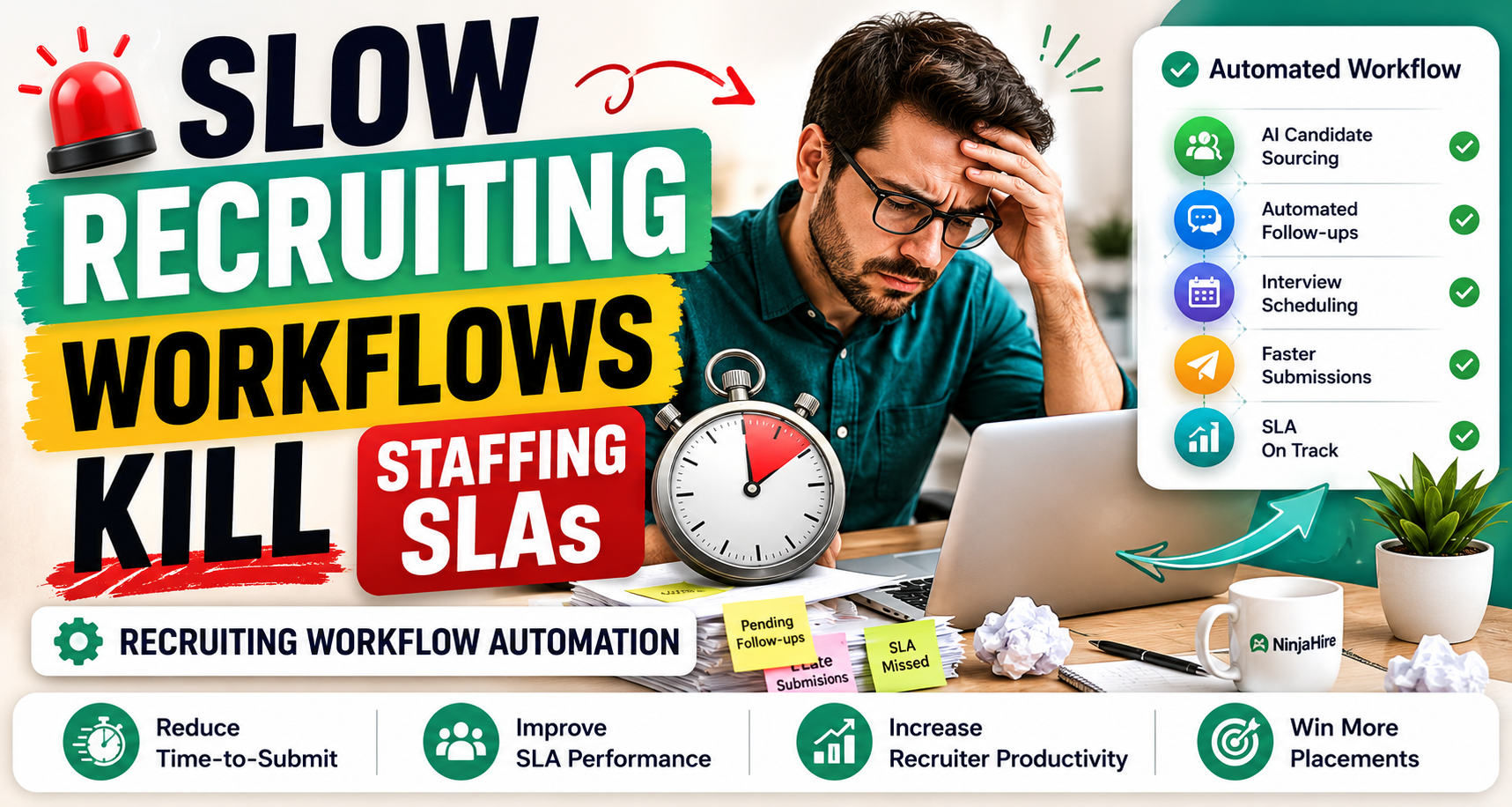
Most staffing firms don't lose client confidence because they can't find candidates. They lose it because too much time passes between finding a candidate and getting them in front of the client. That gap, the submission lag, is where delivery breaks down.
Recruiters are working. They're sourcing, screening, messaging. But in high-req environments, coordination overhead quietly eats the hours that should be going toward submissions. A recruiter carrying 20 open reqs isn't slow, they're stretched across too many manual handoffs, status updates, follow-up reminders, and scheduling chains that should never require human attention in the first place.
In VMS-driven programs, this pressure is even sharper. Response windows are narrow. Submission slots fill fast. The staffing firm that submits three qualified candidates at 9 a.m. wins the interview slots. The one that submits four excellent candidates at 2 p.m. often gets nothing, not because of quality, but because of timing.
This is a recruiting operations problem, and it has a practical solution. Workflow automation removes the coordination friction that delays submissions without replacing the recruiter judgment that makes them good.
What Is Time-to-Submit in Staffing?
Time-to-submit is the elapsed time between when a staffing firm receives a job requisition and when it submits its first qualified candidate to the client or into a VMS. It is a core staffing SLA metric reflecting recruiting team speed, workflow efficiency, and delivery capacity. Most enterprise clients expect first submissions within 24–48 hours of req release. High-performing staffing operations target under 24 hours.
Time-to-submit covers the entire internal delivery cycle: req intake and parsing, sourcing qualified candidates, recruiter review and screening, candidate communication, availability confirmation, and formal submission into a client ATS or VMS portal.
Each of those steps involves handoffs, and each handoff is a potential delay point, especially when managed manually across email, spreadsheets, or disconnected recruiting tools.
In VMS-managed staffing programs, time-to-submit is often the single most visible performance metric. MSP managers track submission speed alongside fill rate and quality. Firms that consistently submit late see their req access reduced. Firms that submit fast, and submit well, get preferred supplier positioning.
Why time-to-submit benchmarks matter
- Enterprise MSP programs often have submission windows as short as 12–24 hours
- First-submitted candidates receive interview consideration at a disproportionately higher rate
- Consistently slow submission creates permanent tier-down risk in VMS supplier rankings
- Faster submission = faster req turnover = higher recruiter throughput
Why Staffing Firms Struggle With Time-to-Submit
Staffing firms struggle with time-to-submit because recruiting workflows are built around recruiter effort rather than workflow structure. When sourcing, screening, scheduling, follow-up, and submission preparation all depend on individual recruiter action, delays accumulate at every step. The result is a delivery process that runs as fast as its slowest human handoff, not as fast as the system could support.
The honest reason most staffing firms are slower than they should be is not recruiter quality. It's workflow design. When a recruiter receives a new req, they typically:
- Parse the req manually and identify key skills and must-haves
- Search the ATS and job boards separately, cross-referencing results by hand
- Begin outreach via email or phone, with no automated follow-up behind it
- Wait for candidate replies before scheduling a screen
- Manually coordinate availability between the candidate and an internal calendar
- Conduct the screen and then format the submission write-up
- Manually enter submission details into the client ATS or VMS field by field
Every one of those steps has a wait built into it. And when a recruiter is managing 15–25 open reqs, those waits compound. A follow-up that doesn't go out for 18 hours because the recruiter was on calls. A scheduling back-and-forth that takes three days. A submission that sits ready but hasn't been entered yet because the VMS requires manual data entry for every field.
The fastest staffing firms are not necessarily sourcing more candidates. They are removing workflow delays.Staffing delivery operations insight
Where Recruiting Workflows Slow Staffing Delivery
Every stage of the recruiting funnel carries a delay risk. The table below maps the most common bottlenecks and where automation has the highest operational impact.
| Recruiting Stage | Workflow Bottleneck | Operational Impact | Automation Opportunity |
|---|---|---|---|
| Req Intake | Manual req parsing, ad hoc priority assignment | Recruiters start sourcing without clear criteria | Automated req parsing, priority tagging, recruiter routing |
| Candidate Sourcing | ATS + job board search run separately | Slow pipeline build, duplicated effort | AI candidate matching across integrated channels |
| Candidate Rediscovery | Warm ATS candidates go uncontacted | Recruiters source cold when fits already exist | Automated rediscovery by req criteria |
| Screening | Every screen is a live call, even for basics | Screening throughput limited by calendar | AI-assisted pre-screening via SMS/email |
| Interview Scheduling | Manual back-and-forth: 4–6 messages per booking | 2–4 day scheduling lag kills momentum | Self-service scheduling links + automated reminders |
| Follow-Up | Inconsistent when recruiter bandwidth drops | Warm candidates go cold | Trigger-based follow-up sequences by candidate status |
| Submission Prep | Manual write-up formatting per client template | Bottleneck even after candidate is ready | Auto-populated submission summaries from ATS data |
| Candidate Engagement | No systematic engagement during submission lag | Candidates accept competing offers | Automated touchpoints keeping candidates warm |
The Recruiting Workflows Staffing Teams Should Automate
Not every recruiting task should be automated. Recruiter judgment, the read on a candidate's communication style, the instinct that a resume undersells someone, the relationship built during a real conversation, that's not replaceable. What is replaceable is every repetitive coordination task that sits between recruiter judgment and candidate submission.
AI Candidate Sourcing
The bottleneck: Recruiters manually searching multiple platforms, ATS, LinkedIn, job boards, and cross-referencing results by hand. On a 20-req load, this sourcing cycle alone can consume half the day.
The automation opportunity: AI sourcing tools that ingest req criteria and surface ranked candidate matches across integrated channels simultaneously. Instead of a recruiter spending 90 minutes building a candidate list, they review a pre-ranked shortlist in 15 minutes.
Operational impact: Sourcing time per req reduced from 1–3 hours to under 30 minutes. Req capacity per recruiter increases materially without adding headcount.
Candidate Rediscovery
The bottleneck: ATS databases that hold thousands of past candidates but surface them poorly. Most recruiters source externally by default because internal search is too slow or unreliable.
The automation opportunity: Automated rediscovery workflows that match new reqs against the existing candidate database and surface warm candidates who have already been screened or placed. These candidates submit faster because the relationship already exists.
Staffing SLA impact: Rediscovered candidates can move from contact to submission in hours rather than days, the fastest path to a qualified submission in a high-req environment.
Screening Automation
The bottleneck: Every candidate requires a live screening call before submission, even for basic availability, compensation, and work authorization checks. When recruiters are running high req volumes, screening becomes the scheduling bottleneck that delays everything downstream.
The automation opportunity: Structured pre-screening via automated SMS, email, or chatbot sequences that collect qualification data before the recruiter engages. Candidates who don't match are filtered early, saving recruiter time for candidates worth pursuing.
Recruiter productivity impact: Pre-screening automation can handle 60–80% of initial qualification questions without recruiter involvement.
Interview Scheduling Automation
The bottleneck: Scheduling a 30-minute screen requires an average of 4–6 message exchanges when done manually. In high-volume staffing, this overhead accumulates into days of lost time per recruiter per week.
The automation opportunity: Self-service scheduling links that allow candidates to book directly into the recruiter's available calendar. Automated confirmation and reminder sequences ensure show rates stay high without recruiter follow-up.
Staffing SLA impact: Scheduling cycle reduced from 2–4 days to same-day or next-day.
Recruiter Follow-Up Automation
The bottleneck: Recruiter follow-up is inconsistent under high req load. Candidates who don't respond to first outreach go uncontacted for days, or indefinitely, because the recruiter has moved on to more immediately responsive candidates.
The automation opportunity: Trigger-based follow-up sequences that continue outreach automatically when a candidate hasn't responded. Sequences run on configurable timelines, 24 hours, 48 hours, 72 hours, and stop automatically when the candidate engages.
Submission Workflow Automation
The bottleneck: After a candidate is qualified, the submission still requires manual work: writing the summary, formatting to the client template, and entering data into the VMS field by field. For firms with multiple clients and VMS systems, this adds 20–45 minutes of admin time after the recruiter's actual work is done.
The automation opportunity: Auto-populated submission templates that pull candidate data from the ATS and format it to client requirements. One-click submission workflows eliminate manual VMS data entry for structured fields.
Candidate Engagement Automation
The bottleneck: The window between a candidate being qualified and a formal submission decision, often 24–72 hours, is the highest-risk period for candidate dropoff. Without active engagement, candidates accept competing offers.
The automation opportunity: Automated engagement sequences that keep qualified candidates warm and informed during the submission and interview process, without requiring recruiter time.
Recruiting Pipeline Visibility
The bottleneck: Delivery managers can't see pipeline status across their team in real time. Req coverage gaps aren't visible until an SLA deadline has already passed.
The automation opportunity: Real-time pipeline dashboards showing req status, candidate progress, submission count, and team activity. Automated alerts when reqs approach SLA deadlines without candidates in pipeline.
How Recruiting Automation Improves Staffing Delivery Efficiency
The operational impact of workflow automation in staffing isn't theoretical. These benchmarks reflect what high-performing staffing operations observe when systematic automation replaces manual coordination.
| Delivery Metric | Manual Recruiting | Automated Workflows | Improvement |
|---|---|---|---|
| Time-to-Submit (first candidate) | 48–72+ hours | 12–24 hours | 50–70% faster |
| Recruiter Response Time | 4–12 hours | Under 30 min (automated) | Consistent, 24/7 |
| Follow-Up Consistency | 40–60% of candidates | 95–100% automated | Near-complete coverage |
| Recruiter Req Capacity | 12–18 active reqs | 22–32 active reqs | 40–75% more reqs handled |
| Candidate Response Rate | 35–50% (email only) | 55–75% (multi-channel) | Meaningful improvement |
| Scheduling Cycle Time | 2–4 days | Same-day to next-day | 70–80% faster |
| Staffing SLA Compliance | 65–75% on-time | 85–95% on-time | ~20–30pt improvement |
| Submission Dropoff Rate | 20–35% dropout | 8–15% dropout | 50–60% reduction |
These figures reflect operational benchmarks from staffing environments running structured automation across sourcing, follow-up, scheduling, and submission workflows, not point solutions for a single step in the process.
Recruiting Automation Software for Staffing Agencies
Staffing agency recruiting has a different operational profile than in-house talent acquisition. A recruiter in an agency isn't trying to hire one role, they're trying to fill 15 roles for different clients simultaneously, with submission windows sometimes measured in hours, not days.
For high-volume staffing, the most critical automation capabilities aren't sourcing AI or employer branding tools. They are:
- Rapid req intake and recruiter assignment new reqs routed to the right recruiter with context automatically, not through a manager email chain
- ATS candidate rediscovery at scalesurfacing qualified prior candidates faster than any external source for common role types
- Multi-channel automated outreachSMS, email, and in-app touchpoints running in parallel so candidates hear from the firm across the channels they actually respond to
- Submission workflow streamliningreducing per-submission administrative overhead so recruiters can submit more candidates without extending their hours
In VMS staffing environments specifically, automation that supports faster submission without sacrificing quality is the primary competitive differentiator. A staffing firm that can submit eight qualified candidates in 12 hours consistently, without burning out their recruiting team, wins market share over time.
Ready to reduce your time-to-submit?
See how NinjaHire's workflow automation reduces submission lag and improves staffing SLA performance.
Recruiting Automation for Enterprise Staffing Teams
Enterprise staffing teams face a compounded version of the same problems. They have more reqs, more clients, more recruiters, and more coordination overhead as a result. The workflows that cause delays in a 10-recruiter shop cause proportionally larger delays in a 100-recruiter operation, because the surface area for coordination failures is much larger.
At the enterprise level, automation has to create operational coherence across a team with distributed req coverage, variable recruiter specializations, and multi-location delivery.
Candidate ownership visibility. When multiple recruiters source across overlapping req types, duplication is inevitable without a clear system. Automated candidate ownership tracking prevents different recruiters from contacting the same candidate from the same firm.
Cross-team pipeline visibility. Delivery managers need to see req coverage across the team in real time, not through status meetings or weekly spreadsheets. Automated pipeline dashboards give managers the visibility to intervene on at-risk reqs before SLA deadlines pass.
Recruiter workload distribution. Req assignment based on recruiter current load, not manual manager judgment, keeps capacity balanced and prevents individual recruiters from becoming bottlenecks when req volume spikes.
Recruiting analytics with operational depth. Time-to-submit by recruiter, by client, by role type. Follow-up coverage rates. Submission-to-interview conversion. Without automation, this data is nearly impossible to generate consistently.
How Automation Improves Staffing SLA Performance
Recruiting automation improves staffing SLA performance by eliminating the manual coordination steps that create submission delays. Automated follow-up, scheduling, and submission workflows ensure candidates move through the pipeline on a consistent timeline rather than at the pace of recruiter availability, directly improving SLA scores in VMS and MSP programs.
SLA compliance in staffing is ultimately a workflow execution problem. A staffing firm can have excellent recruiters and still miss SLAs consistently if the workflow between req intake and submission has too many manual dependencies.
Automated SLA deadline tracking. If a req has no candidates in active pipeline 12 hours before the submission deadline, the system alerts the recruiter and delivery manager automatically.
Follow-up automation that doesn't drop candidates. Automated sequences continue outreach across multiple channels and multiple days without recruiter intervention, capturing candidates who would otherwise have been abandoned after one unanswered email.
Submission pipeline visibility. Delivery managers who can see exactly where every candidate is in every req's pipeline can make better prioritization decisions before something goes wrong, not after.
Seasonal Hiring and Staffing Workflow Automation
Seasonal hiring amplifies every delivery challenge that staffing operations deal with year-round. Volume spikes sharply, recruiter capacity doesn't, and submission windows get shorter because clients need positions filled on a fixed timeline before the peak begins.
Staffing firms handling seasonal programs, retail, logistics, industrial, hospitality, often need to make more submissions in a four-week window than they'd normally process in a quarter. That's not a sourcing problem. It's a workflow problem. Sourcing can be scaled. Coordination overhead, without automation, cannot.
This is where seasonal hiring automation has the most visible operational impact. Automated intake, bulk outreach sequences, self-service scheduling for high-volume candidate pools, and streamlined submission workflows allow teams to process the volume seasonal programs demand without proportional headcount increases. For staffing operations already exploring AI seasonal staffing workflows the workflow layer is where efficiency compounds fastest.
Recruiting Automation Software Comparison
Here's how the major platforms compare on the workflow capabilities that affect staffing delivery speed most directly.
| Platform | Workflow Automation | Submission Workflows | SLA Visibility | Candidate Engagement | Staffing-Specific |
|---|---|---|---|---|---|
| NinjaHire | Full | Built-in | Real-time | Multi-channel | Yes |
| Bullhorn Automation | Partial | Manual + add-on | Reporting add-on | Email-focused | Yes |
| Recruit CRM | Basic sequences | Manual | Limited | Partial | |
| Vincere | Moderate | Some automation | Dashboard | Email/SMS | Yes |
| Avionté | Workflow rules | VMS integration | Reporting | Limited | Yes |
| Sense | Strong | Not primary focus | Engagement-focused | AI-driven | Yes |
What separates platforms that actually accelerate staffing delivery from those that add automation features on top of a manual workflow: the former are built around the submission pipeline as the operational unit. The latter often automate communication well but leave the submission workflow itself largely manual.
The Future of Staffing Workflow Automation
The direction workflow automation is heading in staffing isn't toward replacing recruiters. It's toward removing every operational task that doesn't require a recruiter's judgment, which turns out to be a lot of what currently occupies their time.
AI workflow orchestration. Next-generation platforms will orchestrate the entire workflow, routing candidates through different sequences based on their profile, behavior, and req match, without requiring manual configuration at each stage.
Predictive staffing workflows. Systems that flag reqs likely to miss submission windows before they miss them, based on current pipeline depth, recruiter workload, and historical submission velocity.
Recruiter workflow intelligence. Recommendations surfaced within the recruiter's normal workflow: which candidates to contact next based on response probability, which reqs to prioritize based on submission window proximity.
Automated candidate coordination. The end state is a system where candidates move through the process, screened, scheduled, engaged, and kept informed, without every touchpoint requiring recruiter initiation. The recruiter's role becomes focused on interactions that require human judgment.
Conclusion: The Delivery Gap Is a Workflow Problem
Staffing firms that consistently win on time-to-submit aren't doing it through heroic recruiter effort. They've built workflows where the administrative and coordination overhead that usually slows delivery has been removed from the recruiter's daily path.
The gap between req intake and first submission is, in most staffing operations, filled with tasks that don't require a recruiter's expertise: message follow-up, scheduling coordination, data entry, status tracking, template formatting. Automating those tasks doesn't change what recruiters do when they find a strong candidate. It changes how much of their day they spend doing that versus everything else.
That's the practical argument for recruiting automation in staffing operations, not technology for its own sake, but workflow improvement that shows up in submission timing, fill rates, and client delivery scores.
NinjaHire is built for exactly this: staffing delivery teams that need to move faster without adding headcount or burning out their recruiters. If your submission velocity isn't where it needs to be, the workflow starts here.
Start reducing your time-to-submit today
NinjaHire's recruiting workflow automation is built for staffing delivery teams handling high req volume and demanding SLAs.