What human-in-the-loop means in hiring
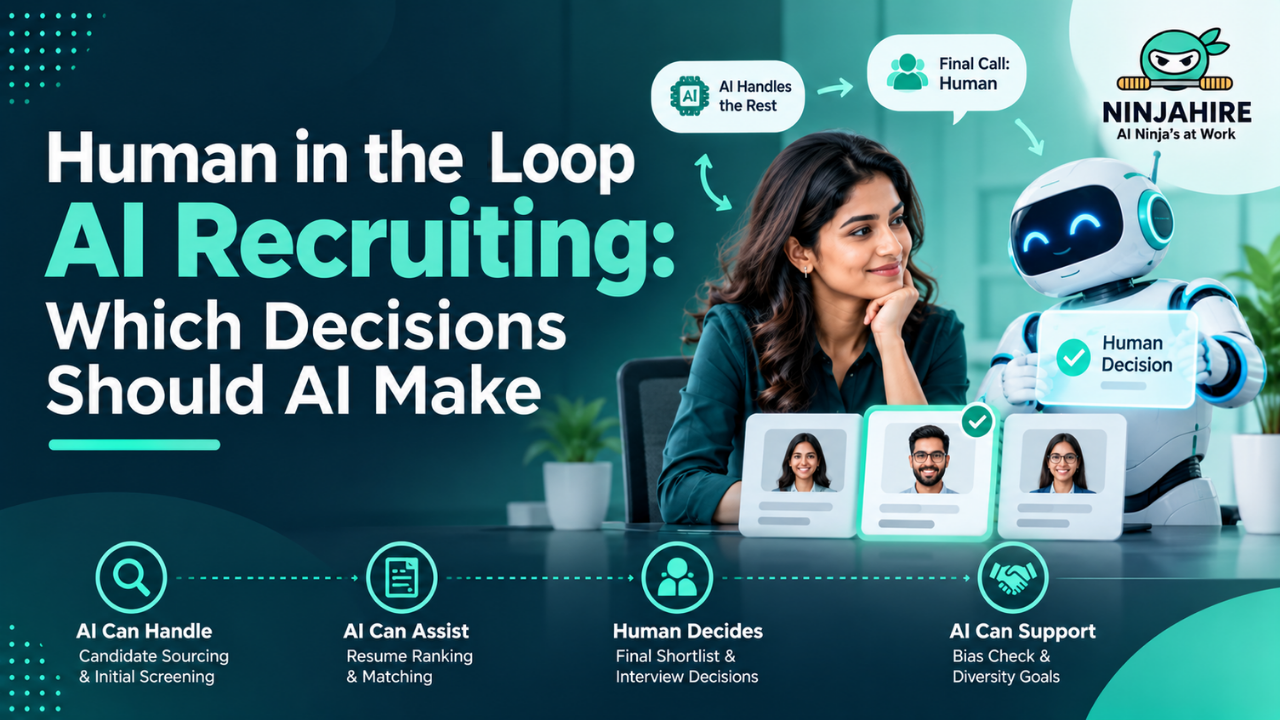
Three arrangements get confused. Fully automated: the system acts and nobody reviews the outcome. Human-on-the-loop: a person monitors results in aggregate and intervenes when something looks wrong. Human-in-the-loop: a person reviews a specific recommendation before it takes effect.
Consequential hiring decisions usually warrant the third. A weaker version is common: a recruiter opens a ranked shortlist, approves the top five, and never opens a transcript. A signature was added, not judgment.
Meaningful review has three features:
- The reviewer knows the job-related criteria before seeing the AI's recommendation or score.
- The reviewer can inspect the evidence behind it: the transcript passage, the resume section, the score components.
- The reviewer can override the recommendation, and the override is recorded with a reason.
Automation bias is the failure mode to design against. Under volume pressure, people defer to confident-looking numbers: a score of 88 reads as a measurement even when it rests on an ambiguous answer.
Recruiting tasks AI can reasonably support
Some recruiting work is repeatable, governed by explicit criteria, and produces checkable output. That is where AI assistance is most defensible:
- Organizing and deduplicating applications across job boards and the ATS.
- Matching resumes against written requirements such as a licence or a named technology.
- Sourcing profiles from permitted sources.
- Drafting outreach messages for a recruiter to edit and send.
- Scheduling interviews and reminders.
- Running structured first-round screens with transcripts.
- Summarizing interview responses against a defined rubric.
- Flagging missing information such as unstated work authorization.
These are general category capabilities, not a description of any single platform. Each still needs accuracy checks: summaries drop context, matching can reward keyword overlap over demonstrated capability, and transcription errors change meaning. AI output is evidence to verify, not a finding to act on.
Decisions that need meaningful human review
The precise boundary depends on risk, jurisdiction, and deployment design, so no single list fits every agency. These situations consistently warrant a person:
- Final selection and rejection. Both change a candidate's standing and can be challenged later.
- Ambiguous or conflicting evidence. The resume says one thing and the screen says another.
- Exceptions to screening rules. A candidate misses a requirement but offers a credible equivalent.
- Accommodation requests. A request to screen differently is a legal matter, not a workflow exception.
- Low confidence or poor data. Short answers, failed audio, and sparse profiles give unreliable scores.
- Context the system cannot see. An explained career gap, or a contractor placed before.
This does not mean a person must perform every administrative step; manual scheduling reminders add effort without accountability. Concentrate oversight where decisions are consequential and hard to reverse.
A decision matrix for AI-assisted recruiting
Below, assist means AI produces input, recommend means AI proposes an outcome, and approve means a person decides and owns it.
| Recruiting task | Appropriate AI role | Human responsibility | Recommended control |
|---|---|---|---|
| Sourcing | Assist: surface and rank matches | Define criteria and permitted sources | Sample who is surfaced and missed |
| Criteria-based screening | Assist: apply job-related criteria | Set and justify every requirement | Record tying each knockout rule to the job |
| Outreach | Draft: prepare personalized messages | Approve tone, accuracy, role claims | Recruiter approval before first contact |
| Interview summaries | Assist: summarize against a rubric | Verify against the transcript | Weekly spot-check of a fixed share |
| Shortlist | Recommend: rank and explain | Review evidence before advancing | Criteria shown before score; overrides logged |
| Rejection | Flag only: note unmet requirements | Decide and own the rejection | No auto-rejection without recorded approval |
| Accommodation requests | None | Receive, assess, respond | Route out of the automated path |
| Final selection and submittal | Recommend at most | Decide and document the rationale | Named approver recorded on the decision |
How a human-in-the-loop workflow runs
Step seven is where most companies fall short. The number of reviews does not help assess the success of reviewing processes. Staffing firms need to measure a set of key metrics to detect any screening issues, inconsistencies, or even bias.
Stage-based success rates: Measure the success rate in moving applicants from one stage to another (from sourcing to screening, from screening to interviewing, from interviews to shortlisting, from shortlisting to hiring). Examine any unexpected declines in the success rate, especially if you see qualified candidates being eliminated from the selection process.
Override rates: Monitor how often recruiters override recommendations provided by the AI, pass candidates who have been flagged by the system, or change any decision made during screening. Analyze any unusually high or low override rates.
Candidate groups and outcomes: Compare screening success rates, interview success rates, rejection rates, and placement results among various demographic groups for which data gathering is legal. Look into significant or persistent differences that are not justifiable.
Rates of false positives and false negatives: Select a sample of those who were either accepted or rejected from the system to see if there were candidates who qualified but were not selected and vice versa. Give special emphasis to the candidates who were knocked out using knockout criteria.
Quality of the data and confidence levels: Watch out for incomplete profile information, transcription errors, failed interviews, and low confidence scores. Send those cases to manual review.
The review process should start when there is a significant change in pass rates, unexplained disparities between groups of candidates, frequent overrides regarding the same criterion, an unexpected increase in rejection rates, or information indicating that the qualified candidates are erroneously screened. The agencies should also look into complaints, accommodations and frequent data quality problems.
In case any trigger is encountered, the automated decision-making process should be stopped or limited if necessary, evaluate the evidence, ensure that the criteria used are still job-related, and document these actions. The owner of the problem should be assigned and continuous monitoring should take place until the issue is corrected. These actions will facilitate the oversight of the AI recruiting process.
A staffing agency example
The following is hypothetical, illustrating the workflow rather than reporting a client result.
A light industrial agency receives 400 applications for 15 warehouse roles requiring forklift certification. AI organizes them, runs structured first-round screens, and returns a ranked shortlist with transcripts.
The recruiter does not start at the top. She reviews the criteria first, then works through the evidence for the top 40. Three scored low because audio failed mid-call, so she reschedules them. One was flagged for a missing certification but says in the transcript that renewal is in progress, so she verifies it directly. Another asked for a written screen instead of a call; that request left the automated path for the agency's accommodation process. She submits 12 candidates and logs why four flagged candidates advanced.
Benefits and limitations
The realistic gains are consistency, capacity, and documentation. Every candidate gets the same job-related questions, recruiters spend less time on first-round calls, and transcripts beat a handwritten note.
The limitations deserve equal weight. Historical data carries historical patterns, so a model tuned on past placements can reproduce past exclusions. Summaries and transcripts contain errors invisible to a reviewer who never opens the source. Scores invite false precision; the gap between 74 and 78 is rarely meaningful, yet shortlists get cut on it.
Human review does not automatically remove bias. A reviewer can approve a biased recommendation or add their own. Oversight makes decisions traceable and correctable, not correct.
Responsible implementation checklist
- Write down each screening criterion and the reason it is job-related.
- Check that screens measure job skills rather than reflecting an impairment. Department of Justice guidance on algorithms, AI, and disability discrimination in hiring notes that employers stay responsible even when the technology belongs to another company, and that applicants should be told what is used and how they will be evaluated.
- Keep an obvious route for accommodation requests, and ensure asking costs the candidate nothing.
- Tell candidates when AI is used in screening. New York City requires a bias audit within one year of using an automated employment decision tool, a public summary of results, and notice at least 10 business days beforehand.
- Keep records of criteria, scores, evidence, reviewers, and override reasons.
- Train reviewers on what a score does and does not measure.
- Review outcomes by stage and by group, investigate gaps, and name one accountable owner.
- Anchor the program to a recognized reference such as the voluntary NIST AI Risk Management Framework, organized around govern, map, measure, and manage.
Obligations depend on the tool, the use case, and the jurisdiction, and US requirements have shifted at federal and state level. One point matters here: the New York City rule covers employment agencies as well as employers, so an agency screening for a client can be the covered party. General information, not legal advice.
Evaluating an AI recruiting platform
- What evidence sits behind each recommendation, and which criteria drove the score?
- Are criteria, rubrics, and knockout rules configurable by the agency?
- Which actions can be gated behind approval, and what happens when confidence is low?
- What records are kept, for how long, and can they be exported?
- How is candidate data stored and used, and are screening formats accessible?
- Does it integrate with the ATS or VMS in use, and what monitoring does the vendor document?
Where Ninjahire fits
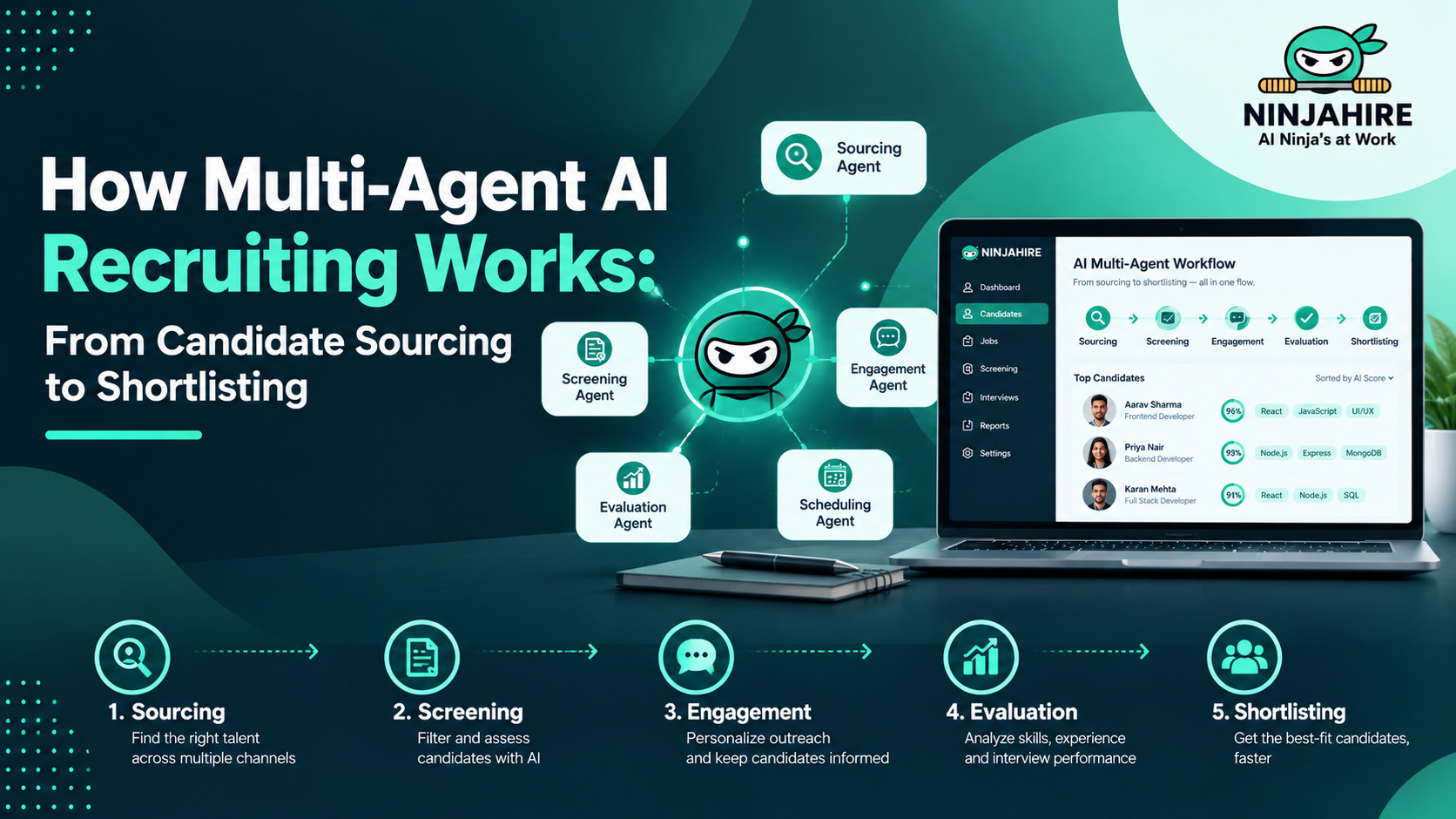
The description of Ninjahire’s agents published by the company mentions three agents responsible for sourcing, outreach, and screening. The AI screening agent by Ninjahire performs structured interviews via phone, video, or online. It uses configurable scoring rubrics and knockout criteria for the screening process. It creates ranked results, transcripts, evaluations summaries, and shareable reports that could be synchronized with ATS records. The recruiters could evaluate candidates on the basis of evidence and not on scores only. As per the AI interview notice by Ninjahire, the AI agent makes recommendations and summaries. But, the final decision is left to human recruiting managers.
Still, one cannot get clear information from the live product pages whether recruiters could manually override individual recommendations and whether approval from the recruiters is necessary before using knockout criteria. It is necessary to check before deployment whether there are any options of overrides, and whether recruiters could change screening recommendations for the particular candidate, and whether flagged candidates could be reviewed before being knocked out or moving ahead. It is also important to see if recruiters could review transcripts and scoring evidence, change knockout criteria, and document reasons for overrides.
Conclusion
AI belongs in recruiting with a bounded role: defined tasks, checkable output, and a clear stop before any decision that changes a candidate's standing. The agencies handling this well are not the ones automating least. They are the ones that can say which criteria applied, what evidence supported the decision, and who reviewed it.
Frequently Asked Questions
What does human-in-the-loop mean in AI recruiting?
A named person reviews a specific AI recommendation before it takes effect, with access to the evidence behind it and the ability to override it. Monitoring results after the fact is weaker oversight.
Can AI reject a job candidate?
Technically yes: many systems can be configured to eliminate candidates automatically against knockout criteria. Whether they should is a separate question. Rejection is consequential and reviewable, and the legal exposure sits with the employer or agency rather than the vendor, so recorded approval is safer.
Which recruiting tasks are best suited to AI assistance?
Tasks with explicit criteria and verifiable output: organizing applications, matching against written requirements, drafting outreach, scheduling, running structured screens, and summarizing responses.
How can staffing agencies monitor AI hiring bias?
Compare advance rates at each stage and across candidate groups, sample candidates the system filtered out, track override rates, and keep records supporting an independent audit.
Does human review make an AI hiring process fair?
No. Review creates accountability and a correction path, but a reviewer can approve a biased recommendation. Fairness also depends on job-related criteria, validated tools, accessible formats, and monitoring.