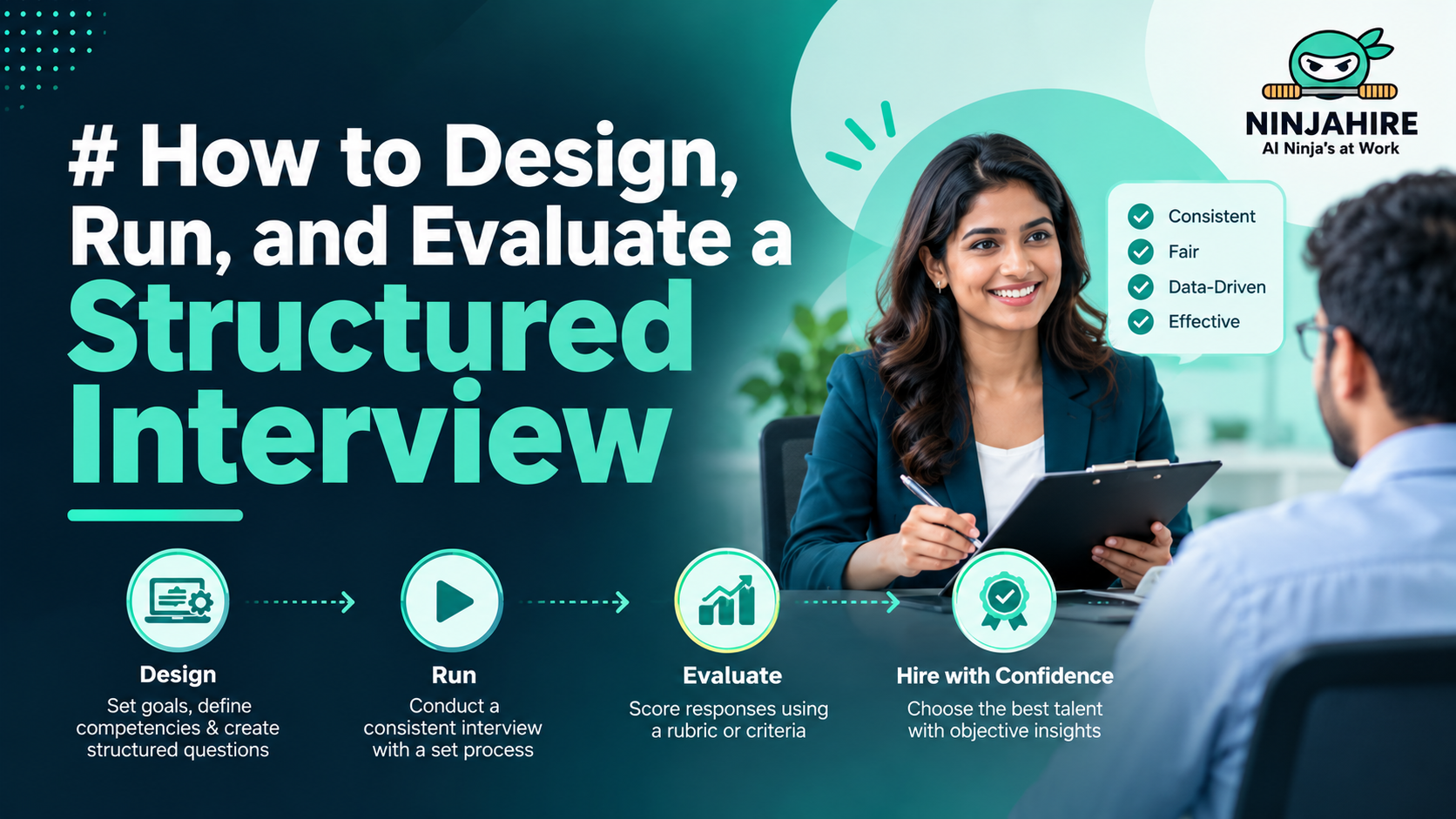
A structured interview is a job interview in which every candidate for a role answers the same predetermined, job-related questions and is scored on the same defined rating scale. The questions come from an analysis of what the job actually requires. The scale describes what a weak, adequate and strong answer looks like, so two interviewers mean the same thing by a score of 4. The US Office of Personnel Management reports that interviews with higher degrees of structure show higher validity, higher rater reliability and agreement, and less adverse impact than loosely run conversations. This guide covers how to build one and how to check that it works.
TL;DR
- Structure means three things together: the same job-related questions, the same anchored scoring scale, and independent scoring before any group discussion. Drop the scale and it is just a question list.
- However, a new statistical analysis in 2022 has challenged the existing estimates of the validity of selection procedures, showing that previous studies had actually exaggerated their reliability. The new study showed that structured interviews ranked highest among all the selection techniques reviewed.
- Structure supports fair, job-related evaluation. It does not guarantee it, and it does not by itself make a process lawful.
- A structured process is measurable. Interviewer agreement, scorecard completion and selection rates by group will tell a hiring team within a quarter whether the design is holding.
What is a structured interview?
Structure is a spectrum, not a switch. OPM describes interviews as varying by how much is constrained: at the low end nothing constrains the questions and the interviewer forms an overall impression; at the high end every candidate receives the same lead questions and the same planned follow-up probes, scored against written benchmarks of proficiency.
Three formats sit along that spectrum.
| Unstructured | Semi-structured | Structured | |
|---|---|---|---|
| Questions | Improvised, different for each candidate | Fixed core set, planned probes | Identical lead questions, identical order |
| Scoring | Overall impression, formed at the end | Rubric, with notes on probe responses | Anchored rubric, scored per question |
| When scores are recorded | Often during the debrief | Independently, then discussed | Independently, then discussed |
| Content source | Interviewer's judgement | Job analysis, with room to explore | Job analysis only |
| Main risk | Decisions reflect rapport | Probes drift away from the rubric | Feels mechanical if the anchors are thin |
| Reasonable use | Rarely defensible for selection | Senior, ambiguous or low-volume roles | Most roles, especially at volume |
A note on terminology
"Semi-structured interview" means something different in academic research, where it describes a qualitative data-collection technique. This guide uses the hiring sense: a fixed core question set with planned follow-ups, scored on a shared rubric.
The three parts that make it structured
- Job-related questions. OPM reports that questions based on competencies identified through job analysis as critical to success show high validity, rater reliability and rater agreement. Consistency applied to irrelevant questions buys nothing.
- An anchored rating scale. Each score level is described in terms of observable behaviour, so interviewers are not quietly applying private standards.
- Independent scoring. OPM describes the usual panel method: each member rates responses individually, then the panel meets to resolve significant discrepancies. Scoring after the discussion lets the most confident voice set the anchor for everyone else.
Why structure works, and what the evidence actually says
Two sources are worth reading directly before quoting anything about structured interviews.
OPM's assessment method comparison rates structured interviews High on validity, High on face validity, Low on subgroup differences, and Moderate on both development and administration cost. These are OPM's own qualitative rankings across thirteen methods, not scores. Work samples and job knowledge tests also rate High on validity, so this is not a claim that interviews outperform everything else.
The quantitative picture changed in 2022. For two decades most hiring content cited a 1998 meta-analysis that put structured interviews at .51 and unstructured at .38. Sackett, Zhang, Berry and Lievens, writing in the Journal of Applied Psychology, showed that the range-restriction corrections behind those figures systematically overstated validity. Their revised estimates fall by roughly .10 to .20 points across procedures. Most methods that ranked high still rank high, and structured interviews emerged as the top-ranked selection procedure examined. SIOP covered the finding for practitioners.
What a validity coefficient means, and what it does not
Validity coefficient shows the connection between the test scores and the relevant criteria like job performance of individuals. It is always represented as a correlation coefficient and ranges from –1 to +1. The greater the value of the validity coefficient the more connected the test score is to the job performance of the subjects analyzed. It is not the percentage, measure of accuracy or chance to hire a good candidate.
Validity differs from reliability. In terms of validity, we talk about what the test predicts and what it measures whereas in terms of reliability we talk about the consistency of the result received from the test. For instance, interviewers may give candidates similar scores showing reliability but these scores may poorly correlate with their future job performance. A structured interview should possess both properties.
That is why the validity coefficient does not indicate any percentage of successful hires. Comparing two validity coefficients we cannot draw a conclusion that the first method is several times more accurate than the second one. The claims about structured interviews being "twice as accurate" or "reducing bias by 40%" cannot be supported using validity coefficients only.
The limitations worth stating
- Structure reduces discretion; it does not remove bias. OPM reports generally little or no difference in performance between men and women or between applicants of different races, but also notes that differences in interviewer ratings have been found by race, depending on the race of candidate and interviewer, job complexity and the type of questions asked.
- Validity varies. The 2022 authors note that structured interview validities are variable, which means a poorly built structured interview is not automatically a good one.
- People often prefer the looser version. OPM notes that interviewers and applicants tend to favour less structured formats, even though interviews generally produce more favourable candidate reactions than other selection methods. Expect internal resistance and plan for it.
- One honest upside. OPM reports that faking occurs less often in structured interviews than in paper-and-pencil inventories measuring the same competencies.
How to design and run a structured interview
Seven steps. The first four happen before any candidate is contacted.
- Analyse the job. List what the person will actually do in the first 90 days. Talk to the manager and a strong current performer. This is the source of everything downstream.
- Pick four to six competencies. Choose the ones that separate strong performers from adequate ones. More than six and interviewers rush or inflate.
- Write one or two questions per competency. Each question targets exactly one competency, in behavioural or situational form.
- Write the rating scale before anyone interviews. Describe what each score level looks like in observable terms, for every level, not just the top one.
- Set the rules of delivery. Same questions, same order, same planned probes. Agree in advance which follow-ups are permitted so one candidate does not get three chances to improve an answer while another gets none.
- Score independently, then debrief. Every interviewer commits a score against the rubric before hearing anyone else's. Disagreements are resolved by pointing at what the candidate said, not by seniority.
- Document the job-related reasons. Keep the evidence notes and scores with the application record.
Interview planning template
One row per question. Fill the left-hand columns before the role opens; the right-hand ones during and after.
| Field | Example entry |
|---|---|
| Role | Warehouse Shift Supervisor |
| Competency | Handling a staffing shortfall mid-shift |
| Question type | Behavioural |
| Question | (see the examples below) |
| Evidence indicators | Names the constraint, describes the reallocation made, states the outcome and what changed afterwards |
| Scoring scale | 1–5, anchors defined per level |
| Permitted probes | "What were the constraints?" / "What happened next?" |
| Interviewer | Assigned owner for this competency |
| Score and evidence | Recorded independently, before the debrief |
| Decision note | Job-related reason for the final call |
How to Use Resume-Personalised Follow-Up Questions Without Losing Consistency?
A resume-based follow-up can help the interviewer to understand the experience of the candidate better, but such a follow-up must not substitute the core standardized question. Every candidate should get the same core questions and evaluated according to the same rubric of scoring specific competencies.
For instance, after giving the candidates an opportunity to discuss a situation in which they managed a shortage in staffing, the interviewer can give a follow-up question to one of the candidates who talks about warehouse operations asking him/her how he/she reallocated the staff. Similarly, another candidate who talks about his/her experience in retail operations can also be questioned on how he/she reallocated the responsibilities in that situation.
In order to maintain comparability:
- Use identical key questions: Ask all candidates the same rated questions.
- Specify allowable probing questions beforehand: Determine the questions that can help clarify individual responsibilities, actions, logic and results.
- Use the same rating criteria: Assess the evidence based on the same competency-specific criteria, regardless of the candidate's profile.
- Document the evidence independently from the score: Describe what the candidate said and how this relates to the specific rating scale.
- Provide equal opportunities to candidates: Do not give a certain candidate additional help to improve an answer he or she provides.
Resumes customization must not alter the nature of evidence but only make it more clear. When a new question provides an opportunity to prove a new competency or allows a candidate to show a new competence, the subsequent ratings can no longer be compared. In case of high-stakes selection, maintain consistency of key questions, rating scales and probing rules.
Where structured interviews go wrong
Rating errors structure does not fix on its own
- Halo and horns. One strong or weak answer colours every other score. Scoring question by question, immediately after each answer, limits it.
- Similarity bias. Shared background reads as competence. Anchors tied to observable behaviour give interviewers something else to point at.
- Confirmation bias. A resume impression drives which probes get asked. Fixing the permitted probes in advance is the control.
- Recency bias. The last candidate of the day sets the standard. Scores recorded against written anchors, not against the previous candidate, reduce drift.
- Leading questions. Supplying the answer inside the question destroys comparability.
- Unstructured debriefs. The most senior voice anchors the room. Independent scores first, discussion second.
Fairness, accessibility and the legal position (United States)
A standardised process is easier to explain than an improvised one. It is not automatically lawful. The EEOC's guidance on employment tests and selection procedures sets out the standard: a neutral selection procedure can still violate Title VII if it disproportionately excludes a protected group and the employer cannot show it is job-related and consistent with business necessity. If an equally effective alternative with less adverse impact exists, it should be adopted.
Four practical obligations follow.
- Define competencies that trace to real job requirements, and be able to say why each question is job-related.
- Offer and provide reasonable accommodations. The ADA requires that tests be administered so results reflect the skill being measured rather than a candidate's impairment.
- Keep the evidence notes and scores, so a decision can be explained later.
- Review outcomes for adverse impact rather than assuming consistency produced it. Running a bias audit is a separate exercise from designing the rubric.
This is United States guidance and it does not have the force of law; it is technical assistance. Requirements differ by jurisdiction, and several states and cities now regulate automated hiring tools specifically — see AI hiring laws by state. Employment counsel should review any selection process before rollout.
If part of the screen is automated
AI-assisted screening can deliver the consistency a structured design asks for: the same questions, the same rubric, every candidate. It also introduces obligations that do not disappear because a vendor supplied the tool. The EEOC states plainly that while a vendor's validity documentation may be helpful, the employer remains responsible for ensuring its selection procedures are valid under the Uniform Guidelines.
In practice that means reviewing how the tool scores, whether candidates are told what is happening and offered an alternative, whether the format is accessible, what data is retained, and whether a human reviews the output before anyone is rejected. Screening accuracy and candidate notice are both worth settling before the first automated screen goes out.
How to tell whether it is working
Most guides stop at the debrief. A structured process is measurable, and these six signals will show within a quarter whether the design is holding.
| Signal | What it tells you | How to read it |
|---|---|---|
| Interviewer agreement | Whether the anchors mean the same thing to everyone | Compare independent scores on the same candidate. Divergence above one point on a 1–5 scale means the anchor needs rewriting, not that an interviewer is wrong |
| Scorecard completion rate | Whether the process survives contact with a busy week | Scores recorded before the debrief, with evidence notes attached. A falling rate is the earliest warning sign |
| Selection rates by group | Whether the process is producing adverse impact | Requires enough volume and usually specialist input. A difference is a prompt to examine the questions and anchors, not proof of discrimination |
| Candidate experience | Whether structure is reading as rigidity | Ask about clarity and fairness, not satisfaction with the outcome |
| Time to decision | Whether the design is practical | Rising time usually means too many competencies or too many interviewers |
| Later job performance | Whether the competencies predicted anything | Compare scores against performance at 90 days once there is a reasonable sample. Drop competencies that predict nothing |
None of these means much in isolation, and small samples mislead. Review them together, and treat a surprising number as a reason to look at the design rather than as a verdict. Recruiter productivity metrics covers the operational side of the same question.
Running structured screening across many roles at once
The design work above is per role. Staffing agencies, MSP programmes and RPO teams run dozens of roles at once across multiple clients, which is where consistency usually breaks: the rubric exists, but the first-round screen gets done by whoever is free, in whatever form the day allows.
First-round screening is the natural place to standardise first, because it is the highest-volume stage and the one most exposed to improvisation. Ninjahire's AI screening agent conducts first-round interviews by phone, video or web chat against a scoring rubric and knockout criteria the hiring team defines, and returns transcripts, scores and a ranked shortlist. Recruiters then work a pre-qualified list rather than a raw applicant pool.
One design point is worth being explicit about. The agent personalises questions to each candidate's resume, which is a departure from strict standardisation. The defensible approach is the semi-structured one described earlier: keep the scored core question set and the rubric identical for everyone considered for a role, and confine personalisation to planned probes. Human review before any rejection stays in place either way — Ninjahire's own documentation states the agent is not designed to replace recruiters at the decision point.
Frequently asked questions
How many questions does a structured interview need?
Four to six competencies with one or two questions each puts most interviews at five to eight scored questions. Fewer leaves important predictors unmeasured. More tends to produce rushed scoring and ratings clustered in the middle, because interviewers run out of attention before they run out of questions.
Can a structured interview still feel conversational?
Yes. Rigidity comes from thin anchors and a script read aloud, not from standardisation itself. A semi-structured design keeps the core questions and rubric fixed while allowing planned probes, which gives the candidate a real exchange and still produces comparable scores.
Should every panel member ask the same questions?
No. Each interviewer should own different competencies so the loop does not repeat itself. What must stay identical is the set of questions each candidate receives across the whole loop, and the rubric every interviewer scores against.
How long does it take to build one?
For a single role, a job analysis conversation, a competency list, five to eight questions and a written rating scale is realistically a day's work spread over a week. It is reusable for every candidate in that role and for the next opening at the same level, which is where the time comes back.
Do structured interviews work for high-volume hiring?
They suit it particularly well, because the design cost is paid once and then amortised across hundreds of candidates. The constraint at volume is interviewer capacity rather than question design, which is why first-round screening is usually where high-volume teams standardise first.
What is the difference between a structured and an unstructured interview?
In a structured interview, questions are designed ahead of time and are directly related to the job being offered, and the same rubric is applied to score each candidate. In an unstructured interview, the interviewer has more discretion to pose questions and rate their responses.
How do you score a structured interview?
With the help of a predetermined set of criteria with specific behavioral anchors attached to each score point. The interviewers will be expected to record observations from each response, score independently and compare notes on the important discrepancies after scoring.
Can structured interviews include resume-personalised questions?
Absolutely. Interviews can make use of resume-specific follow up questions in order to verify experience, while still maintaining the core questions and scoring criteria constant. Allowed questions should be geared towards obtaining equivalent information for the same competency without providing different levels of help to the interviewes.