.png)
How Staffing Teams Automate Hiring Without Increasing Recruiter Burnout

June 4, 2026
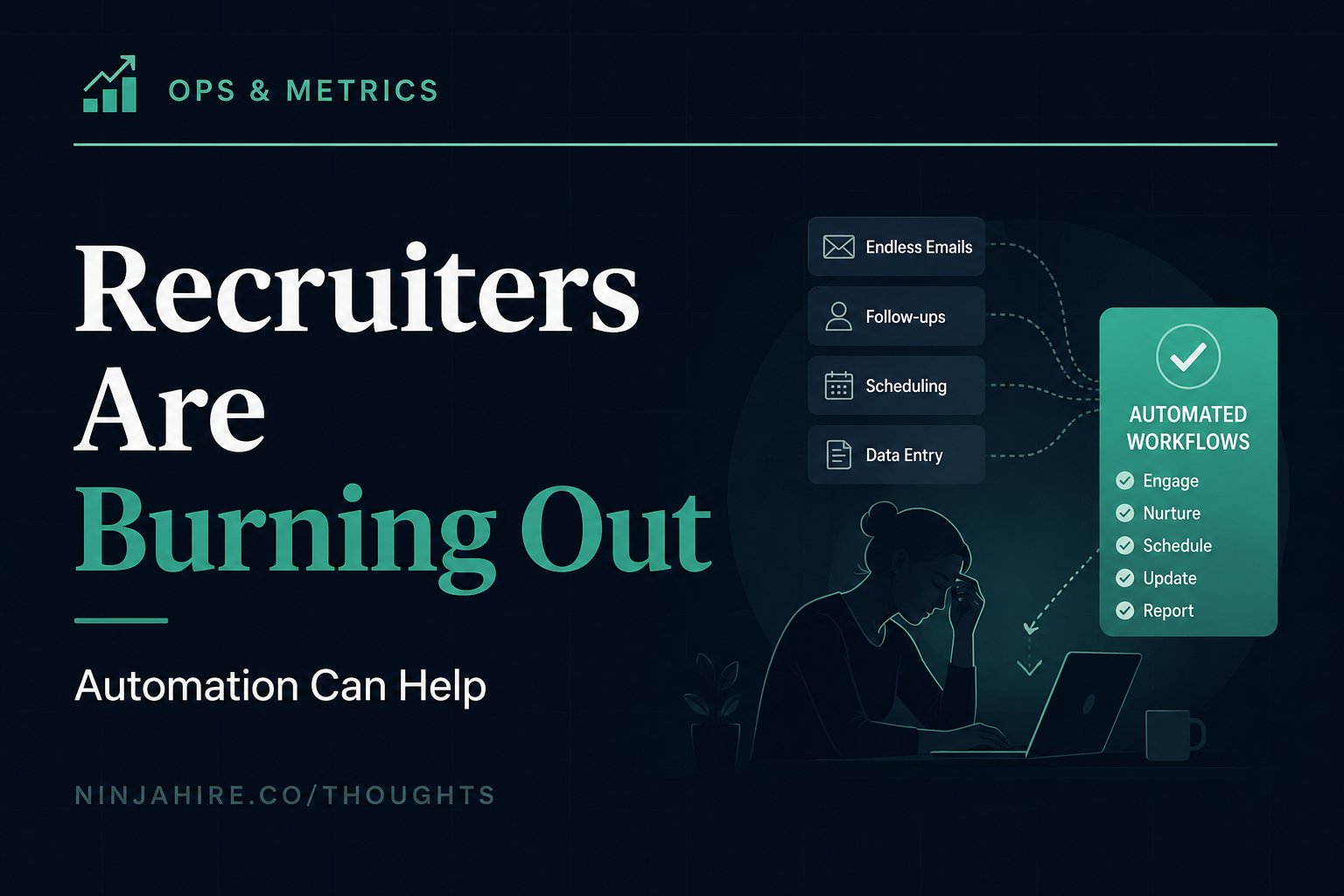
There is a particular kind of exhaustion that creeps up on recruiters who are good at their jobs. It doesn't come from hard conversations. It doesn't come from managing difficult hiring managers or sourcing passive candidates. It comes from sending the same follow-up email for the 40th time this week. From manually updating an ATS entry that took seven clicks. From chasing interview confirmations at 6pm on a Friday.
Req volumes are up. Hiring timelines are compressed. Candidates have more options and less patience for slow responses. And somewhere in between managing all of that, recruiters are expected to build genuine relationships that lead to placements.
That gap, between what recruiting actually requires and what recruiters are being asked to spend their time on, is where burnout begins. And it's where recruiting automation has the most to offer.
This guide is written for staffing operations leaders, recruiting managers, and agency owners who are watching their teams work harder without necessarily delivering better results. We'll get specific about which workflows should be automated, how to protect the recruiter-candidate relationship in the process, and what the productivity upside actually looks like in practice.
Why Recruiter Burnout Is Becoming a Staffing Operations Problem
Recruiter burnout used to be framed as an individual resilience problem. Someone wasn't managing their stress well enough, or they hadn't figured out the right work habits. That framing has always been off, but in high-volume staffing environments today, it's almost willfully wrong.
The real driver is structural: the administrative weight of a recruiter's job has grown faster than the tools available to manage it. VMS platforms generate reqs in bursts. Client expectations around turnaround time have tightened. Candidates, particularly in contract and temporary staffing, are more transient, meaning more first-touch outreach, more scheduling coordination, more reminders per placement.
Recruiter burnout is primarily caused by high volumes of repetitive administrative work, follow-up emails, interview scheduling, ATS updates, candidate reminders, that accumulates alongside actual recruiting responsibilities. When recruiters spend a significant portion of their day on tasks that don't require their judgment or relationship skills, their capacity for meaningful work erodes. Over time, the combination of cognitive load, high req volume, and communication fatigue leads to disengagement and turnover.
For staffing firms, this isn't just a wellness issue. Recruiter turnover is expensive, estimates typically range from 50% to 200% of annual salary when you account for lost placements, knowledge gaps, and ramp time for new hires. When experienced recruiters exit, they take candidate relationships and client institutional knowledge with them. Protecting recruiter capacity is protecting business continuity.
The Hidden Work Recruiters Spend Most of Their Time On
If you ask recruiters what they do all day, they'll tell you about sourcing, screening calls, and managing client relationships. But if you pull the calendar data or do a genuine time audit, something different emerges. A large portion of recruiter time, often the majority of it, goes to coordination and administration that candidates and clients never directly see.
| Activity | Strategic Value | Typical Time Consumed | Automatable? |
|---|---|---|---|
| Sending interview confirmations | Low | 45–90 min/day | Yes |
| Follow-up reminders to candidates | Low | 30–60 min/day | Yes |
| Manual ATS status updates | Low | 30–45 min/day | Yes |
| Candidate acknowledgement emails | Low–Medium | 20–40 min/day | Yes |
| Scheduling coordination back-and-forth | Low | 60–90 min/day | Yes |
| Pipeline status updates to hiring managers | Medium | 30–45 min/day | Partially |
| Candidate screening conversations | High | Variable | Partially |
| Candidate relationship building | High | Variable | No |
| Client relationship management | High | Variable | No |
| Offer negotiation & close | High | Variable | No |
The pattern is clear. The tasks consuming the most daily bandwidth are consistently the lowest-value ones. The work recruiters are trained for, relationship development, candidate assessment, negotiation, gets crowded out by coordination overhead. That's not a recruiting problem. It's a workflow problem, and it has a workflow solution.
What Recruiting Automation Actually Means
Recruiting automation is the use of software to handle repetitive, rule-based tasks in the hiring and candidate engagement process without requiring manual recruiter action for each instance. This includes automated candidate acknowledgements, interview scheduling, status update notifications, follow-up reminders, and workflow triggers that move candidates through a pipeline based on defined conditions. The goal is to reduce recruiter administrative load while maintaining consistent, timely candidate communication.
There's a lot of noise in this category. Some vendors use automation to describe AI screening tools that try to assess candidates algorithmically. Others use it to describe simple email templates. In staffing operations, the most practical and immediately valuable form of recruiting automation sits between those extremes: structured workflow automation that handles communication triggers, scheduling, and pipeline management without trying to replace human judgment on the things that require it.
Think of it less like a robot recruiter and more like a very reliable operations coordinator who handles all the logistics so your recruiters can focus on the actual talent work. The right automation doesn't make decisions. It handles execution.
Recruiting Tasks Staffing Teams Should Automate
Candidate Acknowledgements
- Manual:
- Recruiter sends individual confirmation emails for every application or inquiry
- Burnout risk:
- High, especially during high-volume campaigns
- Automation:
- Instant, personalized acknowledgement triggered on application or form submission
- Impact:
- Frees 20–40 min/day; candidates get faster, more consistent responses
Interview Scheduling
- Manual:
- Recruiter emails back and forth to find time slots, sends calendar invites manually
- Burnout risk:
- Very high, often multiple exchanges per candidate
- Automation:
- Automated scheduling links let candidates self-book within recruiter-defined availability
- Impact:
- Saves 60–90 min/day; reduces scheduling no-shows
Candidate Reminders
- Manual:
- Recruiter manually sends interview reminders 24–48 hours before
- Burnout risk:
- Medium-high, repetitive, low-stakes, but essential
- Automation:
- Timed reminder sequences triggered at configured intervals before events
- Impact:
- Reduces no-shows by 20–35%; removes entirely from recruiter task list
Screening Workflows
- Manual:
- Recruiter sends screening questions individually, tracks responses manually
- Burnout risk:
- High at volume
- Automation:
- Automated screening questionnaire sent on trigger, responses collected and scored
- Impact:
- Surfaces qualified candidates faster; reduces time-to-screen
Candidate Follow-Ups
- Manual:
- Recruiter tracks where each candidate is and manually sends check-in messages
- Burnout risk:
- Very high, multiplies across every active candidate
- Automation:
- Drip sequences triggered by pipeline stage; paused when candidate responds
- Impact:
- Consistent engagement without recruiter tracking overhead
Pipeline Updates
- Manual:
- Recruiter manually updates ATS on each stage change; updates client separately
- Burnout risk:
- Medium, tedious and error-prone
- Automation:
- Stage-change triggers update ATS and send status notifications automatically
- Impact:
- Reduces data entry errors; keeps stakeholders informed without separate effort
Candidate Rediscovery
- Manual:
- Recruiter manually searches ATS for previously placed or screened candidates
- Burnout risk:
- Medium, time-consuming and often skipped
- Automation:
- Automated re-engagement sequences for warm database contacts matching new reqs
- Impact:
- Increases database utilization; reduces cold sourcing volume
Internal Recruiter Notifications
- Manual:
- Recruiters manually check for candidate activity, new applications, or stage changes
- Burnout risk:
- Medium, constant context-switching
- Automation:
- Real-time internal alerts when candidates respond, complete forms, or advance stages
- Impact:
- Reduces context-switching; ensures fast response when human attention matters
How Automation Increases Recruiter Productivity
The productivity case for recruiting automation isn't abstract. When you remove the coordination overhead from a recruiter's day, you're not just saving time, you're recovering the cognitive bandwidth that makes good recruiting possible. A recruiter who isn't mentally tracking 40 pending follow-ups is a better interviewer. A recruiter who isn't manually scheduling across three time zones has more energy for discovery calls.
| KPI | Manual Recruiting | Automated Recruiting | Change |
|---|---|---|---|
| Average response time to new candidates | 4–24 hours | <15 minutes | ↑ 94% faster |
| Time to schedule interview | 2–5 business days | Same day | ↑ 70–80% faster |
| Recruiter capacity (open reqs managed) | 15–25 | 30–50 | ↑ 2× capacity |
| Candidate follow-up consistency | ~60% (manually tracked) | ~98% (system-triggered) | ↑ 63% improvement |
| Interview no-show rate | 20–30% | 10–15% | ↓ 40–50% reduction |
| ATS data accuracy | 70–80% | 90–98% | ↑ Cleaner data |
| Time on admin tasks | 35–45% of day | 10–15% of day | ↓ 65% reduction |
| Recruiter retention (12-month) | Lower | Higher | Improved |
Automation Without Losing the Human Touch
The most common objection to recruiting automation in staffing isn't technical. It's relational. The concern is that automated communication feels impersonal, and that candidates will sense it and disengage. It's a reasonable concern, poorly implemented automation does exactly that.
But the question isn't automation or human touch. It's about which tasks automation should own and which ones humans should own. When that boundary is drawn correctly, the result is actually a more human experience for candidates, not less.
| Automation handles | Recruiters handle |
|---|---|
| Application acknowledgements | Candidate discovery conversations |
| Interview reminders | Candidate assessment and evaluation |
| Scheduling coordination | Offer negotiation |
| Status update notifications | Client relationship management |
| Follow-up drip sequences | Placement decisions |
| Pipeline stage triggers | Candidate experience problem-solving |
| Database re-engagement | Long-term talent community building |
No. Recruiting automation handles repetitive, rule-based tasks, scheduling, reminders, status updates, follow-up sequences, so recruiters can focus on work that genuinely requires human judgment: candidate evaluation, relationship building, negotiation, and client management. Automation removes the administrative burden from recruiters; it doesn't replace the relational intelligence that makes recruiting effective. Firms that implement automation well typically see recruiter productivity and retention improve, not decline.
When a candidate gets an immediate acknowledgement after applying, that's not impersonal. That's actually better than waiting two days to hear anything. When they receive a scheduling link and can book at their convenience rather than waiting for a recruiter to find availability, that's a better experience. The key is ensuring that when human contact happens, it's substantive, and that recruiters have the bandwidth to make it so.
How Staffing Firms Scale Hiring Without Adding More Recruiters
There's a growth ceiling in staffing that most firms hit without seeing it coming. The req volume grows. The team tries to absorb it. Overtime becomes normal. Shortcuts creep in, fewer touchpoints per candidate, less database re-engagement, faster screening with less depth. And then placements start slipping, not because the recruiters are bad, but because the system wasn't built to scale the way it's being run.
Adding more recruiters is one response to that ceiling. But it's expensive, slow, and creates its own onboarding and management overhead. Recruiting automation is the other response, one that increases per-recruiter throughput before you have to hire.
A recruiter managing 20 reqs manually, spending 35–40% of their day on administration, has a realistic ceiling. Remove that administration through workflow automation and that same recruiter can realistically manage 35–45 reqs with more consistent execution across all of them. For a 10-person recruiting team, that's the difference between 200 reqs and 400 reqs without a single additional hire.
The other scaling lever is database utilization. Most staffing firms have years of candidate data sitting in their ATS, underused. Automated re-engagement sequences, triggered when a new req matches a previously screened candidate, can dramatically reduce cold sourcing volume. That's faster time-to-fill and less prospecting overhead for recruiters who are already stretched.
Recruiting Automation Use Cases for Staffing Agencies
MSP & VMS Staffing
High req velocity, strict SLAs, and multiple client portals make manual coordination unsustainable. Automation manages acknowledgements, reminders, and status updates across multiple VMS environments simultaneously.
Temporary Staffing
Short placement cycles and high candidate throughput require rapid scheduling and consistent follow-up. Automated drip sequences and scheduling tools handle the coordination volume without recruiter bottlenecks.
Seasonal Hiring
Seasonal surges create sudden spikes in application volume that overwhelm manual processes. Automation scales candidate acknowledgement and screening without requiring temporary headcount.
High-Volume Recruiting
When you're processing hundreds of applicants for the same roles, automated screening workflows and stage-triggered communication ensure no candidate falls through the cracks regardless of volume.
Executive Search Support
Even in lower-volume executive search, automation handles the logistics, scheduling, reminders, follow-up timing, freeing consultants to invest in deeper candidate relationship work.
Contract Staffing
Regular contract renewals and end-of-assignment check-ins benefit from automated touchpoint sequences. Keep talent engaged between placements without manual recruiter effort on every touchpoint.
Candidate Experience Improves When Recruiters Burn Out Less
There's a direct connection between recruiter workload and candidate experience that doesn't always get explicit attention. When recruiters are overwhelmed, candidates feel it, slower responses, inconsistent follow-through, less personalized conversations. Automation addresses both sides of that equation at once.
| Candidate Experience Metric | Manual Process | Automated Process |
|---|---|---|
| Time to first response after applying | Hours to days | Under 15 minutes |
| Interview scheduling speed | 2–5 business days of back-and-forth | Same day, candidate self-books |
| Communication consistency | Depends on recruiter bandwidth | Consistent regardless of workload |
| Pre-interview reminders | Sometimes missed | Always sent at configured intervals |
| Post-interview follow-up | Often delayed or missed | Triggered automatically on stage change |
| Candidate portal/status visibility | Only on request | Proactively updated |
| Database re-engagement for new roles | Ad hoc | Systematic, matched by profile |
Further Reading: Recruiter Burnout and AI Workflow Resources
Recruiting Automation Software Comparison
Not all recruiting automation platforms are built for staffing firms. Some are designed for in-house TA teams with single-client workflows. Others prioritize ATS depth over workflow automation. Here's an honest look at how the major platforms compare on the dimensions that matter for staffing operations.
| Feature / Platform | NinjaHire | Sense | Bullhorn Automation | Avionté | Vincere | Recruit CRM |
|---|---|---|---|---|---|---|
| Recruiter productivity focus | Primary focus | Partial | Partial | Partial | Partial | Partial |
| Workflow automation | Native | Strong | Add-on | Limited | Moderate | Basic |
| Candidate engagement automation | Yes | Yes | Partial | Partial | Partial | Basic |
| Scheduling automation | Native | Partial | Via integrations | Limited | Partial | Limited |
| Staffing-specific design | Yes | Yes | Yes | Yes | Yes | Partial |
| Burnout reduction design | Yes | Indirect | Indirect | Not primary | Not primary | Not primary |
| Setup complexity | Low | Medium | High | High | Medium | Low |
The right platform depends on your firm's size, ATS stack, and primary bottlenecks. For staffing firms where recruiter burnout and workflow efficiency are the primary concern, rather than just candidate volume tracking, the selection criteria should start with automation depth and recruiter experience, not feature count.
The Future of Recruiter Productivity
The direction is relatively clear: recruiting teams that treat automation as a core operational layer, not an add-on, will have a structural productivity advantage over those running primarily manual workflows. The gap is already visible, and it will widen.
The near-term evolution isn't about AI replacing recruiters. It's about recruiter copilots: systems that surface the right candidate at the right moment, draft the right message with the right context, and alert the recruiter when human attention is actually needed. Workflow orchestration, where multiple automation triggers work together across sourcing, communication, scheduling, and compliance, will become a standard expectation rather than a differentiator.
For staffing operations leaders, the strategic question isn't whether to adopt automation. It's which workflows to automate first, how to configure them to maintain candidate experience standards, and how to measure the productivity return. Firms that answer those questions clearly and act on them now will have more effective teams, lower recruiter turnover, and stronger delivery capability, without proportionally higher headcount costs.
Conclusion
Recruiter burnout isn't a personality problem or a resilience deficit. It's what happens when qualified, motivated people are asked to do too much coordination work alongside the relationship work they were hired for. The solution isn't to push harder, it's to build a recruiting workflow where the repetitive work runs automatically, and recruiters spend their time on what actually requires them.
That's what recruiting automation, properly implemented, actually delivers. Not a system that tries to replicate human judgment at scale. A system that handles scheduling, follow-ups, reminders, acknowledgements, and pipeline updates so recruiters can source better, screen more thoughtfully, and close with confidence.
If your team is managing high req volumes, dealing with communication fatigue, or watching good recruiters disengage, the operational fix is worth looking at before assuming the problem is purely a people or culture issue. Most of the time, it's a workflow issue, and workflow issues have workflow solutions.