.png)
Why Staffing Firms Need Recruiting Infrastructure, Not Just an ATS
.jpeg)
May 28, 2026
Why Staffing Firms Need Recruiting Infrastructure, Not Just an ATS
Most staffing firms don't fail because recruiters lack effort. They fail because recruiting workflows stop scaling, and the ATS was never built to fix that.
Here's something most staffing leaders have felt but rarely say out loud: the ATS is never the problem. And it's also never enough.
When a staffing firm is doing 40 placements a month, an ATS works fine. Recruiters know their reqs, coordinators stay on top of schedules, and someone has a rough sense of where the pipeline sits. Then something shifts, volume goes up, req counts double, the team expands, and the gaps those people were filling become operational sinkholes. Candidates disappear between stages. Submissions slow down for no visible reason. Coordination becomes a full-time job for someone who shouldn't have that job.
This is the moment every scaling staffing organization faces. Almost universally, they try to fix it the wrong way, by adding more people, more tools, more manual process. The firms that actually fix it recognize what they're missing isn't more staff. It's recruiting infrastructure.
What Is Recruiting Infrastructure?
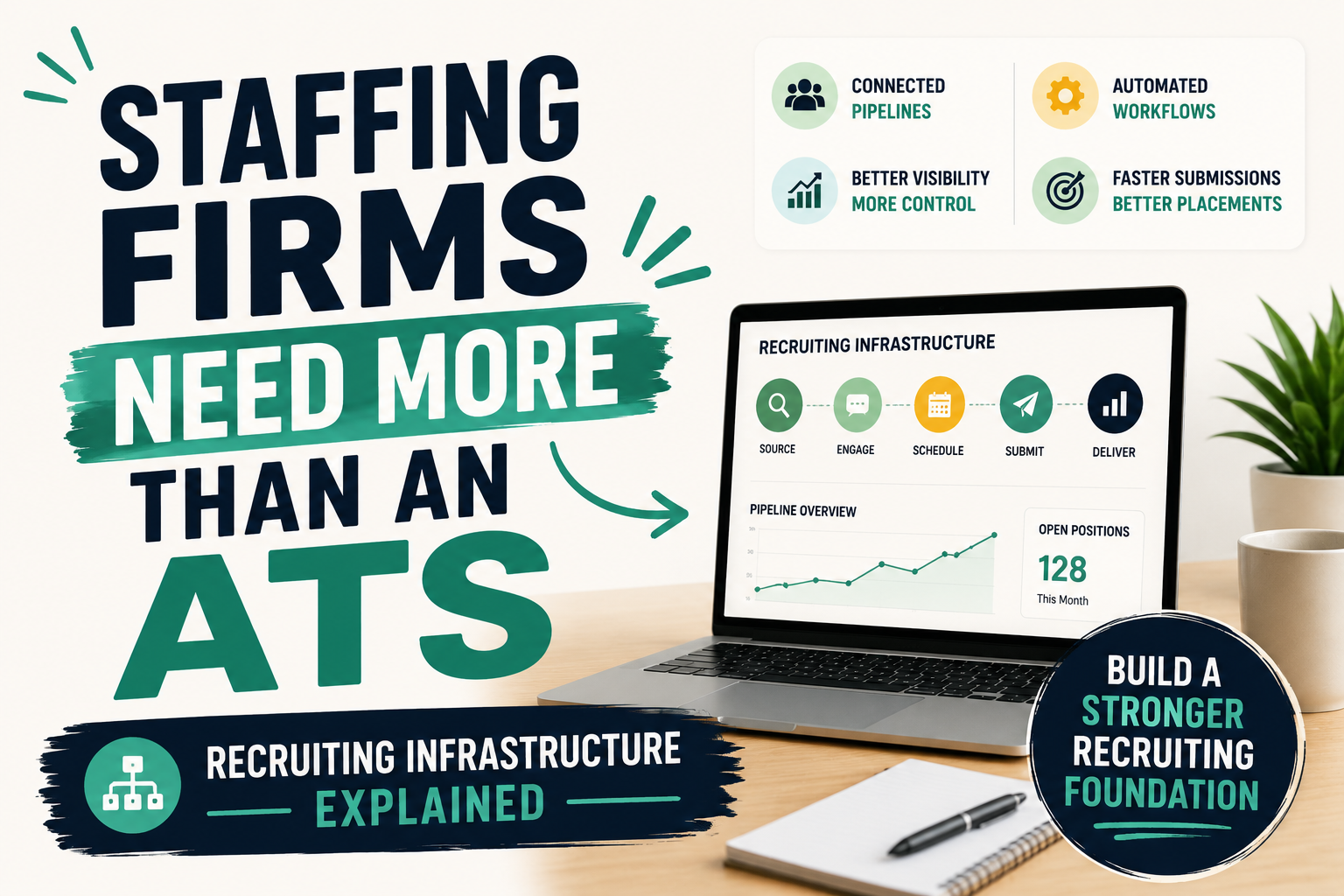
Recruiting infrastructure is the operational layer that coordinates how candidates move through a staffing pipeline, how recruiters manage workflow across requisitions, how engagement happens at scale, and how delivery gets tracked against SLAs, beyond what a database or ATS provides. It's the difference between storing recruiting data and actually running a recruiting operation.
Nobody confuses a road with a car. Roads are infrastructure, they make movement possible at scale without constant manual intervention. ATS systems are the cars. They move individual candidates when a recruiter drives them. Recruiting infrastructure is what makes that movement happen systematically across hundreds of candidates, dozens of recruiters, and multiple clients.
Concretely, recruiting infrastructure includes:
- Workflow orchestration, automated sequencing of recruiter tasks, candidate outreach, and submission steps
- Recruiter coordination, structured assignment, req visibility, and workload management
- Pipeline visibility, real-time view of candidate stage, movement velocity, and bottlenecks
- Engagement automation, candidate communication that happens on schedule without manual triggering
- Delivery operations tracking, SLA monitoring, time-to-submit benchmarks, placement rate visibility
- Scheduling infrastructure, interview coordination that doesn't collapse under high volume
None of these are things an ATS was designed to do. An ATS was designed to track. Infrastructure is designed to operate.
Why ATS Platforms Stop Working as Staffing Firms Scale
ATS platforms stop working at scale because they are fundamentally data storage systems, not operational coordination platforms. They track what happened. They don't orchestrate what happens next. As volume grows, the operational gaps between ATS records become workflow bottlenecks, and no amount of custom fields or integrations closes them.
ATS platforms were designed around a core function: collect applications, store candidate records, and route resumes to jobs. Everything added on top is still built around that same record-keeping orientation. The ATS is always asking what do we have? Staffing operations need a system that asks what needs to happen next, and who's responsible for it?
At scale, the failure modes are predictable:
Recruiter silos form immediately. Without workflow infrastructure, each recruiter operates their own system, notes in their head, spreadsheets on their desktop, personal follow-up cadences. When a recruiter leaves, those candidates and that context disappear.
Pipeline visibility collapses. ATS records tell you where a candidate was entered. They don't tell you where they actually are right now, why they haven't moved in five days, or which recruiter has 23 open tasks and which has three.
Candidate engagement falls through the gaps. In ATS-only environments, communication depends entirely on recruiter bandwidth, which is always scarce. Engagement cadences break down, candidates disengage, and fill rates drop.
Coordination becomes a full-time role. Scheduling, submission routing, client communication, these require someone to manually track status and keep things moving. As volume grows, coordinating the coordination becomes a job of its own.
Most staffing firms don't fail because recruiters lack effort. They fail because recruiting workflows stop scaling.
Where Staffing Workflows Break Down
| Stage | Workflow Gap | Operational Impact | Infrastructure Fix |
|---|---|---|---|
| Sourcing | No structured outreach cadence; ad hoc per recruiter | Uneven pipeline depth; wildly varying req-to-candidate ratios | Automated sourcing sequences with multi-channel triggers |
| Candidate Engagement | Follow-up depends on recruiter memory and bandwidth | Warm candidates go cold; fill rates drop | Stage-triggered engagement workflows |
| Scheduling | Interview coordination via email and calendar back-and-forth | 2–4 days lost per candidate per round; coordinator overload | Self-scheduling with automated reminders |
| Recruiter Coordination | No req assignment structure or workload visibility | Burnout; candidate handoffs fail; silos form | Workload distribution with structured handoff protocols |
| Submissions | Manual workflow; QA depends on recruiter diligence | Inconsistent quality; slow time-to-submit; client risk | Structured submission with checklists and SLA tracking |
| Pipeline Visibility | No real-time view of stage, velocity, or bottleneck location | Managers fly blind; delivery problems compound | Pipeline dashboards with bottleneck alerts |
| Delivery Operations | No SLA tracking; delivery evaluated retrospectively | Client SLAs missed; account risk goes undetected | Real-time SLA dashboards with escalation workflows |
The Staffing Workflows That Require Infrastructure
Candidate Pipeline Management
At volume, no recruiter can track 80 candidates across 15 reqs manually. ATS records show where candidates are, they don't alert you when a candidate has been stuck for 6 days or surface which reqs have the thinnest pipelines. Infrastructure provides automated stall alerts, stage velocity tracking, and req-level pipeline health scoring so recruiters see what needs attention and managers see delivery risk before it becomes a miss.
Recruiter Workflow Coordination
Growing teams fragment without structured coordination. ATS systems track candidates, not recruiter workload, there's no built-in mechanism for req assignment, capacity management, or handoff protocols. Infrastructure provides structured req assignment, task queues that surface what each recruiter needs to do next, and handoff workflows that capture context when a candidate changes hands.
Candidate Engagement Automation
Candidate communication is the first casualty of recruiter overload. When a recruiter is managing 60 candidates, follow-ups go from daily to weekly to eventually, and the candidate accepts an offer elsewhere. Stage-triggered engagement sequences send candidates the right communication at the right time without requiring a recruiter to initiate it. Routine touchpoints happen automatically; recruiter bandwidth goes toward high-value conversations.
Scheduling Infrastructure
Interview scheduling is a silent killer of time-to-submit performance. The average high-volume staffing operation loses 3–5 days per candidate round to scheduling back-and-forth. Automated scheduling with self-serve booking, availability sync, confirmation workflows, and reminder automation takes the scheduling step from days to hours.
Submission Workflow Automation
In manual environments, submission quality depends entirely on individual recruiter discipline. ATS systems track whether a candidate was submitted, they don't enforce a structured submission process, ensure QA, or surface when SLAs are at risk. Structured submission workflows with required fields, quality checklists, routing, and time-to-submit tracking ensure every submission follows a consistent process regardless of which recruiter handles it.
Recruiting Analytics & Delivery Visibility
Delivery leaders need to know what's happening right now, not what happened last month. ATS reporting is historical and candidate-centric, it answers backward-looking questions. Operational recruiting requires forward-looking visibility: where are pipelines thinning? Which reqs are at SLA risk? Which recruiters are hitting submit benchmarks? Real-time dashboards track pipeline velocity, recruiter productivity, submission rates, and SLA status at the req, recruiter, and client level.
ATS vs Recruiting Infrastructure
| Capability | ATS Platform | Recruiting Infrastructure |
|---|---|---|
| Candidate data storage | ✓ Core function | ✓ Included |
| Pipeline workflow orchestration | ✗ Not designed for this | ✓ Core function |
| Recruiter workload management | ✗ Not available | ✓ Built-in |
| Automated candidate engagement | Limited / manual | ✓ Stage-triggered sequences |
| Scheduling infrastructure | ✗ External tools needed | ✓ Native or deeply integrated |
| Time-to-submit tracking | Manual / reportable after | ✓ Real-time SLA tracking |
| Delivery operations visibility | ✗ Not available | ✓ Portfolio-level dashboards |
| Operational bottleneck detection | ✗ Reactive reporting only | ✓ Real-time alerts |
Operational Impact: ATS-Only vs Recruiting Infrastructure
| Metric | ATS-Only | With Infrastructure | Improvement |
|---|---|---|---|
| Average time-to-submit | 3–7 business days | 18–36 hours | 50–70% reduction |
| Recruiter req capacity | 8–12 reqs/recruiter | 18–28 reqs/recruiter | ~2× throughput |
| Candidate response rate | 12–22% | 28–45% | +15–25 pts |
| Interview scheduling time | 2–5 days/round | 4–12 hours/round | 75–85% faster |
| SLA compliance rate | 60–72% | 85–94% | +20–30 pts |
| Coordinator-to-recruiter ratio | 1:3–4 | 1:8–12 | 3× scale |
| Submission-to-placement rate | 12–20% | 22–35% | +8–15 pts |
Staffing Management Software Comparison
| Platform | Workflow Orchestration | Delivery Visibility | Automation Depth | Best For |
|---|---|---|---|---|
| NinjaHire | ✓ End-to-end | ✓ Real-time dashboards | ✓ Deep, stage-triggered | Scaling staffing orgs, workflow-first operations |
| Bullhorn | Moderate (add-on dependent) | Reportable, not real-time | Limited without add-ons | Large staffing firms needing robust ATS record management |
| Avionté | ATS-centric | Standard reporting | Moderate (payroll-integrated) | High-volume temp staffing with back-office needs |
| Vincere | Good CRM + ATS bridge | Analytics module | Moderate automation | Executive search and professional staffing |
| Recruit CRM | CRM-first, limited workflow | Basic reporting | Zapier-dependent | Small boutique agencies |
| Zoho Recruit | Moderate (Zoho ecosystem) | Standard dashboards | Moderate within Zoho stack | Budget-conscious teams already on Zoho |
The key differentiator isn't features, most platforms have lengthy feature lists. It's orientation. Platforms built as ATS systems with workflow features added on approach the problem differently than platforms built from the ground up around workflow infrastructure. That architectural difference shows up most clearly at scale.
Reducing Time-to-Submit Through Workflow Infrastructure
Time-to-submit is one of the most direct measures of staffing delivery efficiency. In competitive placement environments, VMS programs, preferred supplier lists, multi-agency direct clients, the firm that submits first with the strongest candidates wins. In ATS-only operations, time-to-submit is driven almost entirely by recruiter behavior. Workflow infrastructure changes that dynamic: when sourcing is automated, engagement runs on schedule, scheduling doesn't require 3 days of back-and-forth, and submissions route through a structured review, time-to-submit becomes a function of system efficiency, not individual hustle.
AI Recruiting Software and the Infrastructure Evolution
The conversation around AI in recruiting has been dominated by sourcing tools. Those have real value, but they're solving a narrow problem in the overall workflow. The more interesting development is AI at the infrastructure layer: intelligently routing candidates to the right recruiter, predicting which candidates are most likely to engage, identifying pipeline bottlenecks before they become delivery misses, and optimizing submission timing based on client response patterns.
This is the difference between AI as a feature (smart matching) and AI as recruiting infrastructure (a workflow system that learns and adapts). Staffing organizations evaluating AI recruiting platforms need to look beyond sourcing capabilities to ask how the platform handles workflow orchestration, delivery visibility, and operational coordination.
Conclusion
The ATS is not the problem. It's also not the answer, not at the scale most growing staffing firms are trying to operate at. ATS platforms store candidate data, track application history, and record what happened. What they don't do is coordinate the workflow that makes recruiting delivery happen: automated engagement sequences, structured submission processes, real-time pipeline visibility, SLA tracking, and recruiter workload management.
That coordination layer is recruiting infrastructure. For staffing organizations past a certain size, it's not optional, it's the operational foundation that determines whether growth compounds or fragments. The firms that figure this out stop treating staffing management software as a database upgrade and start treating it as an operational investment. The return shows up in time-to-submit numbers, fill rates, SLA compliance, recruiter capacity, and the client relationships that get protected when delivery actually happens as committed.
Ready to build recruiting infrastructure?
See how NinjaHire coordinates staffing workflows, automates recruiter coordination, and gives delivery teams the visibility they need to scale.
Improve Staffing Delivery →Frequently Asked Questions
Staffing Management Software & Recruiting Infrastructure
Answers to the questions staffing leaders ask most when evaluating recruiting operations software.