How Ninjahire Reduced Interview Scheduling Time by 67% and Recruiter Coordination Time by 72%
November 20, 2026
Executive summary
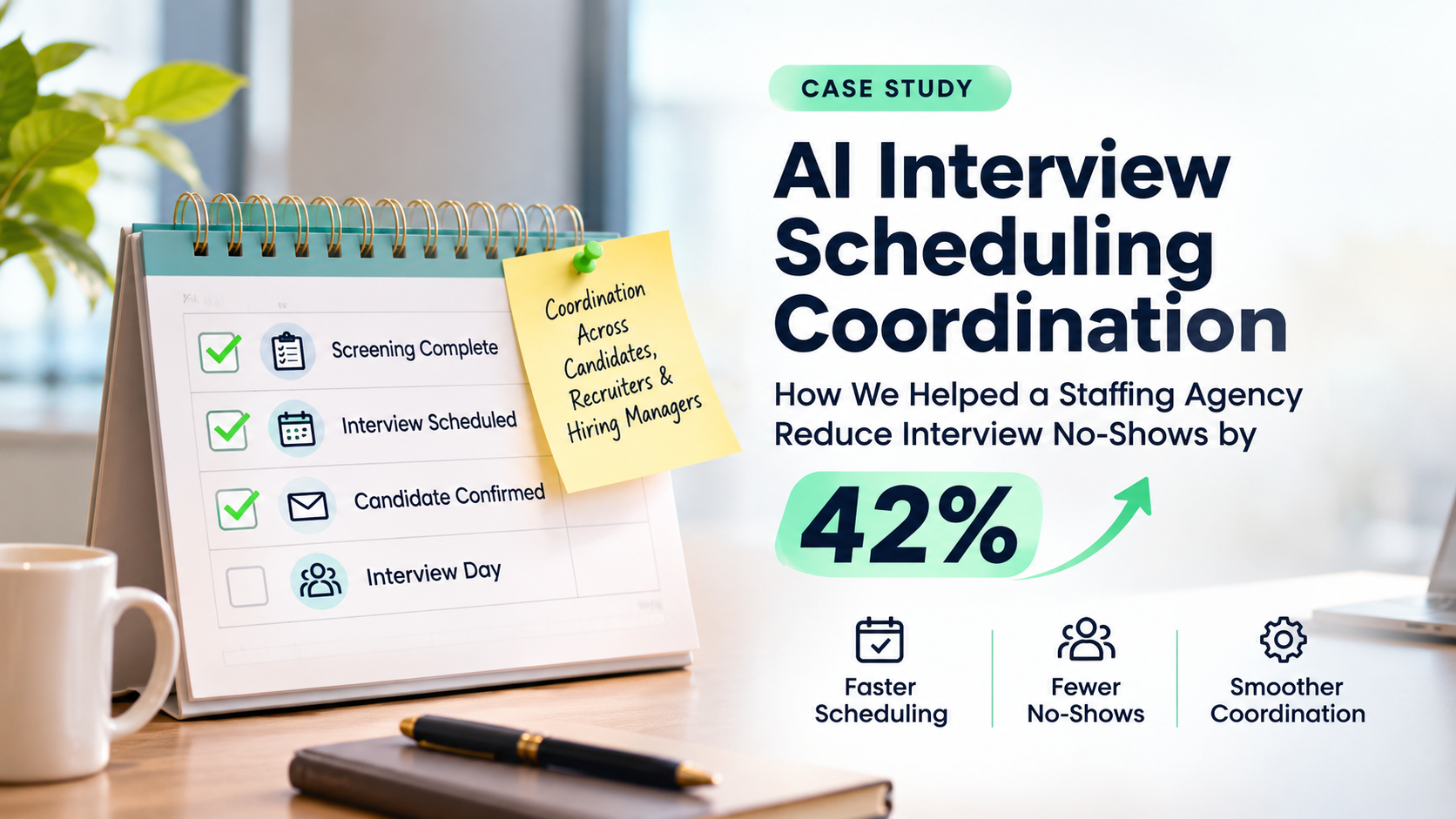
A regional staffing firm with about 40 recruiters and more than 220 peak concurrent requisitions was taking 4.8 days, on average, to get one interview scheduled. Its recruiters were also losing 3.2 hours of every working day to manual coordination between candidates, hiring managers and calendars. Teams comparing AI interview scheduling software tend to ask for a speed number first. The more useful question is what else had to change for that number to hold.
After a 12 week recruiting operations redesign, the average scheduling cycle fell to 1.6 days and recruiter coordination time fell to 0.9 hours per day. This article reads that result through one lens: how interview coordination actually works, what changed in the workflow, which Ninjahire capabilities are relevant, and what a buyer should verify before expecting similar gains.
These figures come from the engagement published in Solving Candidate Drop-Offs in High-Volume Staffing Environments. This article is a scheduling focused analysis of that same engagement. It is not a second client or a separate experiment, and the client remains anonymous.
The improvements followed a wider operational redesign covering workflow audit, candidate engagement, interview coordination, recruiter workflow and funnel visibility. They should not be read as the output of a scheduling tool on its own.
Why interview scheduling became the bottleneck
Before the engagement, scheduling a single interview meant a chain of manual exchanges. The published case study describes four stages: an availability exchange between recruiter and candidate, a second exchange between recruiter and hiring manager, manual calendar scheduling, and confirmation. In practice that chain expands into the ten steps below.
- Recruiter contacts the candidate
- Candidate shares availability
- Recruiter contacts the hiring manager
- Hiring manager shares availability
- Recruiter checks calendar conflicts
- Interview time is agreed
- Calendar invitation is sent
- Candidate and interviewer confirmations are tracked
- Changes and rescheduling restart the exchange
- Recruiter follows up with anyone who has not responded
Each step waits on another person to reply, so elapsed time grows with every handoff. The firm's audit found a candidate follow up lag of 28 to 31 hours, which the source study links to roughly 1.5 extra days per delay in the scheduling cycle.
The operational impact was visible in several places. Candidates who had agreed in principle to interview dropped off during the coordination lag. Recruiters carrying 40 to 60 open requisitions switched between sourcing, follow up, scheduling and admin all day. Hiring manager feedback arrived 6.2 days after interviews. The 72 hour MSP submission SLA was routinely missed, with partial compliance on two of three MSP accounts. The interview no-show rate stood at 24%.
Not every operation has this profile. A team with fewer requisitions per recruiter, a single calendar system or in house hiring managers may carry a much smaller coordination burden.
What the baseline revealed
The audit covered all 40 recruiters and reviewed response time patterns, scheduling cycle data, follow up documentation, hiring manager communication logs and VMS submission timing. Two measurements matter most here, and they measure different things.
| Metric | What it measures | Before | After | Reported change |
|---|---|---|---|---|
| Interview scheduling cycle | Elapsed time a candidate waits for an interview to be confirmed | 4.8 days | 1.6 days | 67% reduction |
| Recruiter manual coordination time | Recruiter labour spent on coordination, per recruiter per day | 3.2 hours | 0.9 hours | 72% reduction |
The arithmetic is simple. Scheduling cycle: (4.8 - 1.6) / 4.8 × 100 = 66.67%, rounded to 67%. Coordination time: (3.2 - 0.9) / 3.2 × 100 = 71.875%, rounded to 72%.
Cycle time is a candidate facing delay measured in days. Coordination time is a recruiter capacity cost measured in hours. A team can improve one without the other: a recruiter might work longer hours chasing replies to shrink the cycle, or spend fewer hours while candidates still wait. Here both fell together, which is consistent with a change to the workflow itself rather than to individual effort.
The funnel data pointed to the same place. Of 390 screened candidates, 198 reached a scheduled interview, and the source study attributes that 49% exit mainly to coordination lag.
What changed in the workflow
The published case study describes the intervention as an operational redesign, not a software rollout. Six workstreams made up the interview coordination change.
Workflow audit
Baselines for response time, scheduling cycle, follow up sequences, hiring manager communication and VMS submission timing.
Candidate availability capture
Availability collected at screening completion, so scheduling starts with data in hand instead of a new email thread.
Hiring manager alignment
Hiring manager availability synced on a recurring basis, with calendar confirmation automated once both sides aligned.
Confirmation and reminders
Interview confirmation and day of reminder sequences, which the study associates with no-shows falling from 24% to 9%.
Recruiter workflow stabilisation
Task batching, including a structured 30 minute scheduling window, in place of ad hoc scheduling over email threads.
Funnel visibility and measurement
A weekly view of stage conversion, scheduling cycle time, follow up lag by recruiter and SLA compliance by account.
The rollout ran in four phases: discovery in weeks 1 to 2, coordination redesign in weeks 2 to 4, a phased rollout starting with the highest volume requisition segments in weeks 4 to 6, and monitoring and optimisation in weeks 6 to 10. Results were measurable within the first six weeks of full operation, and the study reports a 12 week intervention period for its trend analysis.
The source study does not publish technical implementation details, such as which calendar systems were connected or how reminders were configured. This article does not add any.
How Ninjahire's AI agents support interview scheduling
Ninjahire's MSP AI Agents page describes seven specialised agents on one platform, working alongside human oversight. Four of them touch interview coordination, and they do different jobs. A fifth, the VMS Agent, covers candidate monitoring, requisition management, workflow automation and vendor communication, which matters in MSP programmes where the VMS sits between suppliers and clients.
| Agent | Documented capabilities | Role in coordination |
|---|---|---|
| Scheduling Agent | Microsoft native calendar sync, secure personalised scheduling links, full rescheduling support, privacy-controlled invitations | The candidate and calendar side: offering times, confirming interviews and handling changes |
| Hiring Manager Agent | Intent extraction through chat or voice, interview panel preferences, follow ups and reminders | The recruiter to hiring manager gap: capturing panel preferences and keeping hiring managers prompted. It does not make hiring decisions |
| AI Interview Agent | Asynchronous phone and web interviews, personalised questions, real time probing, AI evaluation summary | A different function: runs a structured screening interaction, which can reduce the number of live first stage interviews that need booking |
| Live Interview Co-Pilot | Joins as a digital assistant, structured note taking, highlights and lowlights, post interview feedback | Supports a live interview after it is scheduled. It does not schedule |
The same page describes scheduling automation for MSP programmes that coordinates across four parties and addresses cases where no candidate email address is available in the VMS. Public documentation does not break down those four parties or the exact behaviour, so treat that as a topic for a product conversation.
Scheduling automation versus AI interviewing
These two functions are often described with similar words, but they solve different problems.
Interview scheduling automation
Coordinates people, availability and calendars. The output is a confirmed time. It is needed whenever a live conversation with a human interviewer is part of the process.
Ninjahire agents: Scheduling Agent and Hiring Manager Agent.
AI interviewing
Conducts a structured screening interaction with the candidate. The output is a transcript, scores and a summary. It can run asynchronously by phone or web, so the candidate does not wait for a slot.
Ninjahire agent: AI Interview Agent.
The distinction affects product choice. An asynchronous AI interview can remove the need to schedule a live first stage screen, which shortens the path for candidates near the top of the funnel. Ninjahire's explainer on AI interviewer software covers how that first stage works. It does not remove scheduling for later rounds with hiring managers, which still need calendar coordination.
Question quality sits alongside both. Structured, role relevant questions, covered in Ninjahire's guide to AI interview question generators, make interviews more consistent, whether an AI or a person conducts them. Generating questions is interview preparation. It is not scheduling.
Measurable results
The two headline metrics sat inside a wider set of improvements. All figures are as published in the source case study.
Two further measures moved in the same period. MSP SLA compliance rose from 61% to 89%, a gain of 28 percentage points, and the overall fill rate rose from 58% to 74%, a gain of 16 percentage points. The source study shows these as relative increases of 46% and 28%. This article uses percentage points so they are not confused with the reductions above.
Why these improvements are related but not interchangeable
Faster candidate response gives a scheduling workflow more to work with. A shorter scheduling cycle reduces the time in which a candidate can lose interest, and confirmations and reminders act on no-shows directly. Fewer recruiter hours on coordination frees capacity for follow up. Each metric has its own definition, its own baseline and its own drivers.
The source study does not isolate how much of each improvement came from each change. The links above describe a plausible relationship between metrics, not measured causation, and no single metric can stand in for another.
How staffing teams can calculate interview scheduling ROI
This is a model, and it needs your own data. Use timestamps from your ATS or calendar system for the baseline, and your finance team for cost inputs.
Applying the third formula to the reported figures: 2.3 hours saved per recruiter per day (3.2 minus 0.9) × 220 working days × 40 recruiters = 20,240 hours a year. The 220 working days figure is an assumption for this illustration. The source study does not report annual hours, and no monetary value is claimed for this engagement.
Two cautions apply. Recovered hours create value only if they are redeployed to work that produces revenue, such as follow up, sourcing and candidate relationships. And the fourth formula depends on a cost figure that only you can supply.
What enterprise buyers should evaluate in AI interview scheduling software
The checklist below separates general buyer criteria from what Ninjahire documents publicly. Where a capability is not described on Ninjahire's public pages, it is marked for confirmation rather than assumed.
| Criterion | What to verify | What Ninjahire's published information says |
|---|---|---|
| Candidate self-scheduling | Can candidates choose from available slots without a recruiter coordinating each option? | Ninjahire describes secure, personalised scheduling links. |
| Calendar integration | Which calendar providers are supported, and does the connection read and update availability? | Microsoft-native calendar sync is described. Support for other calendar providers is not specified. |
| Interviewer availability | How is interviewer availability accessed and kept up to date? | Calendar sync is described. The Hiring Manager Agent can capture hiring manager preferences. |
| Multiple interviewers | Can the system find a shared slot for a panel and apply interviewer selection rules? | Interview panel preferences are mentioned. Automatic panel-slot optimisation and interviewer selection rules are not described. |
| Time zones | Are available slots displayed in each participant's local time? | Time-zone handling is not specified. |
| Rescheduling | Can a booking be changed without restarting the scheduling process? | Full rescheduling support is described. |
| Calendar invitations | What information appears in invitations, and how is sensitive information protected? | Privacy-controlled invitations are described. Exact invitation fields and controls are not detailed. |
| Confirmation and reminders | Are confirmations and reminders sent automatically, and to whom? | Follow-ups and reminders are described for the Hiring Manager Agent. Candidate reminder channels and rules are not specified. |
| Candidate communications | Which channels are supported, and can message content and tone be configured? | Scheduling-specific candidate channels and message controls are not specified. |
| ATS connectivity | Does interview information sync with the ATS, and which scheduling actions are supported for each integration? | Ninjahire lists more than 50 ATS integrations. Scheduling functions supported by each integration are not mapped in the published information. |
| Scheduling exceptions | How are non-responses, declined invitations, calendar conflicts and urgent changes handled? | Exception-handling rules are not described. |
| Recruiter visibility | Can recruiters see interview status, pending responses and candidates who are stuck? | Funnel tracking is described in a published case study. Product-level scheduling dashboards and status views are not detailed. |
| Human oversight | Can recruiters review activity and step in when needed? | Ninjahire describes its agents as working with human oversight. |
| Privacy and access controls | Which calendar permissions are requested, who can access availability, and how is access restricted? | Privacy-controlled invitations and SOC 2 Type II are stated. The calendar permission model is not detailed. |
| Auditability | Can teams review a record of scheduling actions and changes? | Scheduling audit logs are not described. |
| Scalability | How does the system perform at peak requisition and interview volumes? | Usage-based pricing is stated. Published performance limits and volume benchmarks are not provided. |
| Staffing and MSP workflows | Can the workflow account for suppliers, VMS processes and client-side stakeholders? | Ninjahire describes an MSP programme focus and a VMS Agent. |
| Reporting and measurement | Can teams report on scheduling cycle time, reschedules, confirmations and no-shows? | These measures appear in case-study reporting. Product reporting capabilities for these metrics are not specified. |
For ATS questions specifically, start from Ninjahire's integrations page, then ask which scheduling steps work with your system.
How to implement interview scheduling automation
These are general implementation steps, not a description of what Ninjahire configures automatically. For the candidate experience side of the same flow, Ninjahire's guide on how to use AI to schedule interviews without frustrating candidates is a useful companion.
- Establish the current scheduling baseline. Measure average time from first outreach to confirmed interview, and recruiter coordination hours per day.
- Map candidate and interviewer touchpoints. List every message, reply and calendar action from screening to confirmation.
- Identify manual coordination steps. Mark where a person is waiting on a reply or copying information between systems.
- Define calendar and ATS requirements. Decide which calendars must sync and which interview data must write back.
- Define approval and exception handling. Decide who handles no-replies, declined invitations and urgent requests.
- Configure scheduling rules. Set windows, buffers, panel requirements and reminder timing.
- Test candidate and interviewer journeys. Run real scenarios, including time zones, reschedules and a missing email address.
- Measure scheduling cycle time. Compare against the baseline weekly, by requisition segment.
- Monitor rescheduling and no-show rates. Rising reschedules can point to poor slot fit or unclear confirmations.
- Refine using operational evidence. Adjust rules based on stage level data, as the source engagement did with two protocol refinements.
Conclusion
Scheduling is not calendar administration. It is a core part of candidate progression and recruiter capacity. In this engagement, a 4.8 day coordination chain and 3.2 hours of daily manual effort were symptoms of a workflow with no structured handoffs. Fixing that took process design, measurement and tooling together.
That is why connected workflows matter. Scheduling works best when it shares information with candidate engagement, hiring manager coordination and ATS records, so that one delay does not restart three conversations.
See the agent workflow on your own numbers
If you want to see how Ninjahire's agents handle scheduling alongside screening and hiring manager coordination, book a demo. Bring your current scheduling cycle time and coordination hours, so the conversation starts from your baseline.
Frequently asked questions
What is AI interview scheduling software?
It is software that uses automation and AI to coordinate interview times between candidates, interviewers and recruiters. It typically reads calendars, offers available slots, sends invitations and handles changes. It differs from AI interviewing software, which conducts the interview itself.
How does AI interview scheduling work?
The software connects to calendars, works out availability for the required participants, offers the candidate times through a personalised link or message, books the confirmed slot and handles reminders and changes. How much runs automatically depends on the product and how it is configured.
How does automated interview scheduling reduce recruiter workload?
It removes the manual exchanges between recruiter, candidate and hiring manager. In the engagement described here, recruiter manual coordination fell from 3.2 to 0.9 hours per day, as part of a wider workflow redesign.
Can AI schedule interviews with multiple interviewers?
Scheduling software in general can compare several calendars and find shared availability, and some vendors document interviewer selection and load balancing. Ninjahire's public pages describe interview panel preferences captured by the Hiring Manager Agent. Confirm panel scheduling behaviour in a demo.
What is the difference between interview scheduling and AI interviewing?
Scheduling coordinates people and calendars for a live conversation. AI interviewing conducts a structured screening interaction, often asynchronously, and produces transcripts and scores. Ninjahire separates them into the Scheduling Agent and the AI Interview Agent.
Can candidates choose their own interview slots?
Yes, through candidate self-scheduling. Ninjahire's Scheduling Agent uses secure personalised scheduling links. The times offered depend on interviewer availability and the rules your team sets.
Does AI interview scheduling software support rescheduling?
It should. Ninjahire documents full rescheduling support in its Scheduling Agent. Ask how reschedule requests are routed and who is notified.
Does interview scheduling software integrate with an ATS?
Most enterprise tools do. Ninjahire lists more than 50 ATS integrations, across a range of applicant tracking systems, but its public pages do not say which integrations support each scheduling capability. Confirm this for your own ATS.
How can staffing agencies measure interview scheduling ROI?
Baseline the scheduling cycle and recruiter coordination hours, measure again after the change, then convert recovered hours into value using your own fully loaded recruiter cost. Track no-show and drop-off rates alongside.
How much time can interview scheduling automation save?
It depends on your baseline. In this engagement the scheduling cycle fell 67% (4.8 to 1.6 days) and coordination time fell 72% (3.2 to 0.9 hours per recruiter per day) after a wider redesign. Treat that as a reference point, not a guarantee.
How does Ninjahire's Scheduling Agent work?
According to Ninjahire's MSP AI Agents page, it syncs with Microsoft calendars, sends secure personalised scheduling links, supports rescheduling and issues privacy-controlled invitations. Detailed configuration is not publicly documented, so ask for it in a demo.
What happens when a candidate or interviewer changes availability?
The intended path is rescheduling, where the change leads to new availability and an updated invitation instead of a fresh email chain. Ninjahire documents rescheduling support. Which parties are notified, and how conflicts are resolved, should be confirmed with the team.
Other insights
Continue reading


The AI recruiter for staffing teams. Sourcing, outreach and screening, around the clock.
Get new posts by email
Research, case studies and field notes on AI recruiting. No spam.