Staffing operations case study | Candidate submission software
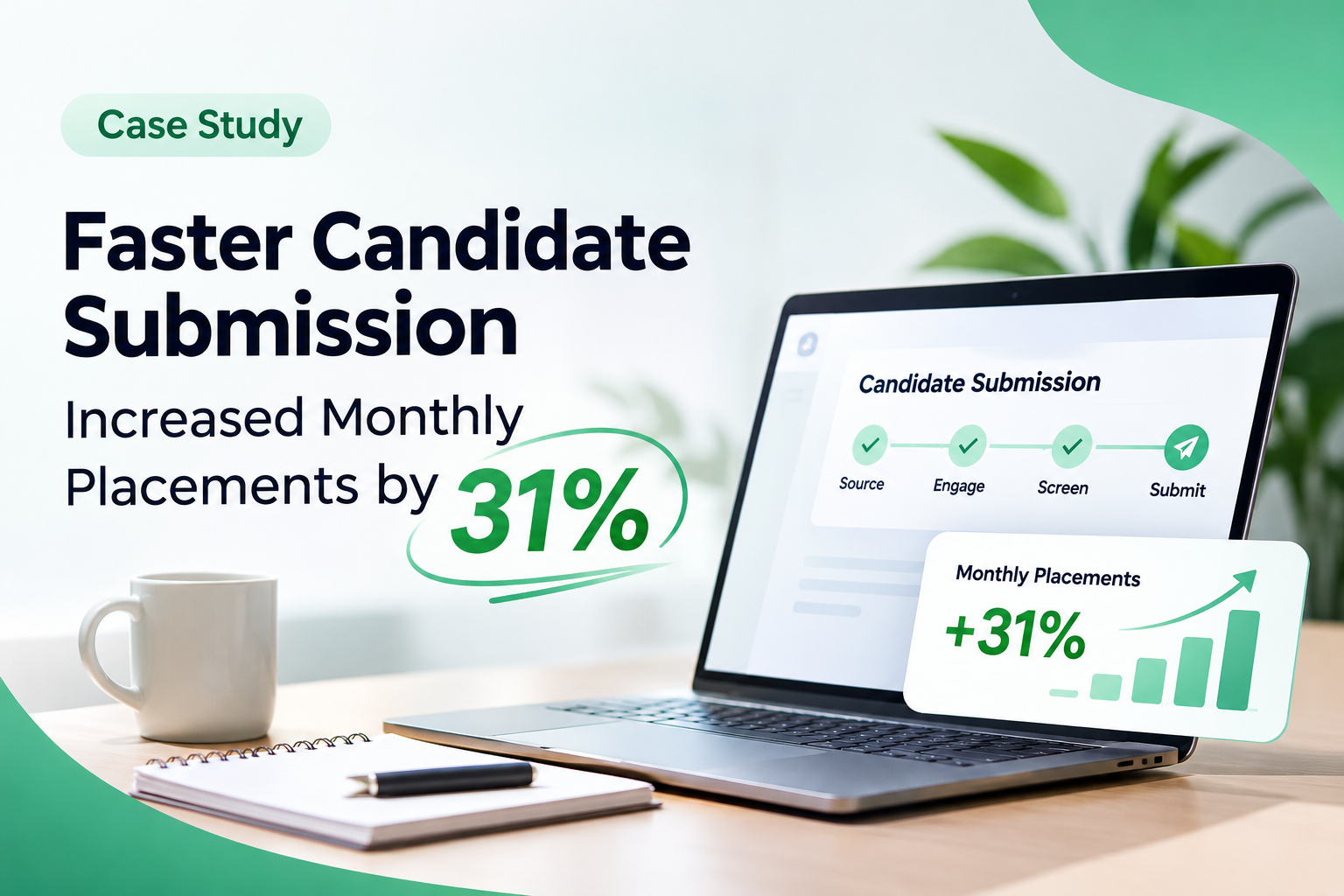
A US-based IT staffing firm was managing more than 140,000 candidate profiles, yet recruiters were still spending heavily on external sourcing and losing time to manual searches, resume reviews, candidate follow-ups and submission preparation. After redesigning its recruitment workflow with Ninjahire, the agency reduced average time-to-submit from 72 hours to 24 hours and increased monthly placements by 31% over a six-month evaluation.
This case study looks at what changed, why candidate submission speed had become a business problem, and how connected sourcing, candidate rediscovery, outreach, screening and workflow automation helped the team improve delivery without adding more recruiters.
The central lesson: Faster candidate submission did not come from asking recruiters to work faster or send more resumes. It came from removing delays between a new requisition, finding a relevant candidate, confirming interest, screening for fit and preparing the profile for client review.
The staffing firm and its recruitment environment
The engagement involved a US-based, mid-market IT staffing firm serving enterprise clients across North America. The agency worked across contract, contract-to-hire and direct-hire placements, with a focus on software engineering, DevOps, data architecture, cybersecurity and enterprise cloud roles.
| Operating detail | Case study context |
|---|---|
| Recruitment team | 22 recruiters and account managers within a 35-person organisation |
| Monthly requisition volume | Approximately 85 to 110 open technical requisitions |
| Candidate database | More than 140,000 profiles in the existing ATS |
| Placement mix | 60% contract, 30% direct hire and 10% contract-to-hire |
| Client environment | Enterprise organisations, mid-market technology firms and MSPs |
| Evaluation period | Six months after implementation |
The agency did not have a simple candidate-volume problem. It had a workflow problem. A sizeable internal database existed, but recruiters were not consistently finding and re-engaging candidates already known to the business. At the same time, manual sourcing and administration made it difficult to respond quickly when clients released new requirements.
Why candidate submission was taking too long
Candidate submission is often treated as the final administrative step in recruitment. In a staffing agency, it is the outcome of several connected activities. A recruiter must identify a suitable person, establish whether the person is interested and available, validate key requirements, collect relevant information and prepare a profile that meets the client's expectations.
When each activity sits in a different tool or depends on manual follow-up, small delays accumulate. The agency's average time-to-submit had reached 72 hours. That delay mattered in competitive technical hiring, where several suppliers may be working on the same requisition.
The main operational bottlenecks
- Repeated external sourcing: Recruiters were searching job boards and paid resume databases even though the ATS contained more than 140,000 candidate profiles.
- Limited candidate rediscovery: Legacy keyword search and inconsistent profile data made it difficult to identify relevant people already in the database.
- Manual resume review: Recruiters were reviewing profiles line by line and comparing experience against job requirements without a consistent, structured first-pass workflow.
- Slow candidate engagement: Individual emails and follow-ups delayed the process of confirming interest, availability and relevant details.
- Disconnected tracking: Candidate activity was spread across inboxes, spreadsheets and the ATS, making status visibility and ownership harder to maintain.
- Administrative work: Profile formatting, status updates and interview coordination reduced the time available for candidate conversations and client delivery.
| Baseline measure | Starting position | Why it mattered |
|---|---|---|
| Average time-to-submit | 72 hours | Delayed candidate delivery on competitive requisitions |
| ATS candidate reuse | 14% of placements | Existing candidate data was underused |
| Candidate outreach response rate | 12% | Generic, delayed outreach limited engagement |
| External sourcing spend | $18,500 per month | High recurring spend despite a substantial internal database |
| Cost-per-hire | $4,150 | Recruitment delivery was more expensive than the agency wanted |
The team needed more than a resume parser or a standalone candidate submission tracker. It needed a way to connect the steps that happen before a candidate is ready to submit.
Why the existing ATS was not enough
An applicant tracking system remains essential for managing candidate records, requisitions, communication history and recruitment stages. However, an ATS does not automatically guarantee that recruiters can rediscover relevant profiles, interpret adjacent skills, reach candidates quickly or complete every preparation task without manual effort.
In this case, the agency's ATS held valuable candidate information, but much of it was difficult to activate for new roles. Recruiters often started searches externally because the existing workflow did not make internal matching and re-engagement efficient.
This is where candidate submission software and recruitment workflow automation need to be evaluated together. A useful solution should support the full path from requisition to qualified candidate, while keeping the ATS as the system of record where appropriate.
For a deeper explanation of how existing databases can be used more effectively, see ATS candidate matching and rediscovery. The distinction matters: matching identifies potential fit, while a submission workflow must also establish candidate interest, confirm relevant details and prepare the information required by the client.
The Ninjahire approach: connect the steps before submission
Ninjahire was introduced as an automation layer across the agency's existing recruitment workflow. The objective was not to replace recruiters or remove human judgement. It was to reduce repetitive work, make candidate information easier to use and help recruiters spend more time on the conversations that influence hiring decisions.
The implementation centred on five connected workstreams: profile parsing and enrichment, candidate rediscovery, personalised outreach, interview coordination and operational reporting.
1. Structure candidate data so it could be searched properly
The team began by reviewing the existing ATS data, identifying duplicate records and standardising key fields such as job titles and technical skills. Ninjahire's resume parsing and enrichment workflow converted resume information into more structured candidate profiles. This helped reduce the dependence on exact keyword searches and made relevant experience easier to identify.
For technical staffing, this distinction is important. A candidate may describe cloud infrastructure experience through projects, tools or responsibilities rather than the exact phrase used in a job description. Contextual matching can help surface related experience that a narrow keyword search may miss. Recruiters still review whether that experience is suitable for the specific role.
2. Rediscover candidates already in the ATS
Instead of starting every requisition with a new external search, the team used candidate rediscovery to search the agency's existing database. Ninjahire ranked potential matches against the role requirements and surfaced relevant profiles for recruiter review.
This workstream addressed an expensive operational blind spot: the firm was paying to find candidates while a large part of its existing talent pool remained underused. Over the evaluation, the share of placements sourced from the internal ATS increased from 14% to 56%.
Candidate rediscovery is particularly useful for staffing agencies with repeat hiring patterns, specialist talent pools and historical candidate relationships. It can make past sourcing work useful again, provided that profile accuracy, candidate ownership and current availability are checked.
3. Reach suitable candidates with relevant outreach
Once potential matches were identified, the team used automated email and SMS sequences to initiate candidate engagement. Messages could draw on candidate-specific details such as previous projects, skills and certifications rather than relying on one generic message for every person.
The purpose was to reduce the time between identifying a possible match and finding out whether that person was open to the opportunity. The agency's candidate outreach response rate increased from 12% to 34% over the reported evaluation.
Automated outreach should remain relevant, appropriately timed and consistent with candidate communication preferences. Recruiters need visibility into previous contact, responses and opt-outs to avoid duplicate or unwanted messages.
4. Move interested candidates through screening and scheduling
Candidate interest alone does not make a profile ready for client submission. The agency needed to confirm relevant experience and collect the information required for the next recruitment stage. Ninjahire's workflow supported initial screening and interview coordination, including self-service scheduling for candidates who passed the configured initial questions.
Reducing repeated email exchanges helped shorten the time between candidate response and the next conversation. Recruiters remained responsible for deeper assessment, relationship building, compensation discussions and the final decision about whether a candidate should be presented.
Ninjahire's broader platform includes AI phone, video and web screening capabilities, structured questions and scored summaries. These capabilities can support a consistent first-round process, while the precise workflow depends on the agency's configuration and the role being filled. Learn more about Ninjahire's AI screening agent.
5. Give managers visibility into delivery performance
The team used recruitment analytics to monitor pipeline activity, candidate engagement and stage-by-stage movement. This made it easier to identify where requisitions were slowing down and whether the issue related to sourcing, response, screening or coordination.
Without consistent measurement, an agency may know that placements are down but not understand which part of the process is responsible. Tracking time-to-submit alongside candidate response, ATS reuse and conversion ratios gives managers a more actionable view of delivery.
How the implementation was carried out
The agency completed a phased six-week rollout while continuing its ongoing recruitment activity. The sequence mattered: automating an unstructured workflow would have carried existing data and process problems into the new system.
| Phase | Focus | Work completed |
|---|---|---|
| Week 1 | Recruitment audit and data hygiene | Reviewed ATS data quality, removed duplicate profiles and standardised job title and skill categories. |
| Week 2 | ATS integration and configuration | Connected Ninjahire with the existing ATS/CRM and established synchronisation for relevant records and activity. |
| Week 3 | Parsing and matching calibration | Configured semantic search parameters, technical skill categories and matching weights. |
| Week 4 | Recruiter pilot | Trained an initial group of five recruiters on rediscovery, outreach and workflow steps. |
| Week 5 | Wider deployment | Rolled the workflow out to all 22 recruiters and activated configured outreach and scheduling processes. |
| Week 6 | Performance review | Reviewed early delivery data, refined outreach templates and adjusted matching based on recruiter feedback. |
Three implementation decisions were especially important. First, the team addressed data quality before relying on matching. Second, recruiters were involved in the pilot so that the workflow reflected real delivery practices. Third, performance was reviewed using operational measures rather than software activity alone.
The wider lesson is that successful recruitment automation depends on process design and adoption as much as the software itself. A platform can make work faster, but teams still need clear rules for candidate ownership, outreach frequency, status updates and recruiter approval.
The results: faster submissions and 31% more monthly placements
Across the six-month evaluation, the agency reported improvements in delivery speed, candidate reuse, recruiter productivity and cost. The most relevant outcome for this case study was a 31% increase in monthly placements, alongside a reduction in average time-to-submit from 72 hours to 24 hours.
| Performance metric | Before Ninjahire | After implementation | Reported change |
|---|---|---|---|
| Average time-to-submit | 72 hours | 24 hours | 66.6% faster |
| Monthly placements | Baseline | Higher monthly volume | 31% increase |
| Cost-per-hire | $4,150 | $2,573 | 38% lower |
| Resume screening speed | Baseline | Faster review process | 52% faster |
| ATS candidate reuse | 14% | 56% | 42 percentage-point increase |
| Candidate outreach response | 12% | 34% | 22 percentage-point increase |
| Time-to-fill | 38 days | 22 days | 42.1% lower |
| Monthly external sourcing spend | $18,500 | $6,200 | 66.4% lower |
| Interview no-show rate | 22% | 8% | 63.6% lower |
Figures above are the outcomes reported in the six-month Ninjahire IT staffing case study. They describe one agency's implementation and should not be read as guaranteed results for every staffing business.
What changed for recruiters
The operational value was not limited to the time saved on an individual task. More candidates from the existing database became usable for new requisitions. Outreach moved faster. Recruiters had better visibility into responses and screening progress. The agency could direct more attention towards qualified conversations instead of repeatedly searching, formatting and updating records.
The original case study also reports an increase in placements per recruiter per month from 2.1 to 2.8, a 33.3% improvement. This is a separate productivity measure from the 31% increase in total monthly placements. Keeping the two measures distinct is important when evaluating the impact.
Why faster candidate submission can improve placement outcomes
Reducing time-to-submit does not automatically create a placement. The candidate still needs to meet the client's requirements, remain interested, perform well in interviews and accept the offer. However, submission speed can influence whether a qualified candidate reaches the client while the requisition is still active and the candidate is available.
In a competitive staffing environment, a delayed submission can mean that another supplier has already introduced a suitable candidate. Faster delivery gives recruiters a better opportunity to participate early in the client's decision process. The strongest workflow combines speed with relevance and candidate readiness.
Speed is useful only when submission quality is protected
Staffing agencies should avoid measuring success by the number of resumes sent alone. A high volume of poorly matched submissions can create more work for clients, weaken supplier credibility and reduce interview conversion. Candidate submission software should help teams improve the quality and consistency of delivery, not simply increase outbound volume.
- Match candidates against the actual skills and experience required, including relevant adjacent skills.
- Confirm interest and availability before presenting a profile.
- Check location, work authorisation, compensation expectations and other role-specific requirements where applicable.
- Use structured screening questions to identify gaps that need recruiter review.
- Keep candidate ownership, consent and previous communication visible.
- Require recruiter review before final client submission where the workflow or client agreement requires it.
What candidate submission software should include
For staffing agency leaders comparing candidate submission software, the most useful question is not whether a vendor can automate one step. It is whether the platform reduces friction across the complete delivery process and works with the systems the agency already uses.
| Capability to evaluate | Questions to ask a vendor | Why it matters |
|---|---|---|
| Candidate matching | Can it interpret skills and experience in context, rather than relying only on exact keywords? | Improves the relevance of the initial candidate pool. |
| ATS candidate rediscovery | Can it search existing records and surface previously engaged candidates? | Helps agencies use their existing database before paying for new sourcing. |
| Contact enrichment | Can it help identify current contact information, and show the source or status of that data? | Reduces time spent trying to reach otherwise relevant candidates. |
| Candidate outreach | Can recruiters configure personalised email, SMS and phone workflows with appropriate controls? | Shortens the time between identifying a candidate and confirming interest. |
| Screening and qualification | Can it collect structured answers and provide useful summaries for recruiter review? | Helps maintain a consistent qualification process. |
| Submission preparation | Can it organise candidate information in the format required by the client or programme? | Reduces manual formatting and repeated data entry. |
| ATS and VMS connectivity | Does it connect with the agency's current ATS, CRM and relevant VMS? | Limits disconnected records and duplicate administration. |
| Reporting | Can managers measure time-to-submit, response, conversion and recruiter workload? | Shows where workflow improvements are producing value. |
| Recruiter controls | Can the team review, edit, approve and override automated recommendations? | Keeps human accountability in candidate decisions. |
Ninjahire is designed for staffing workflows that bring sourcing, outreach and screening together. Its platform includes AI sourcing, candidate rediscovery, multi-channel outreach, phone and video/web screening, and ATS/VMS connectivity. Agencies can review the available Ninjahire ATS and VMS integrations against their current technology stack before planning an implementation.
How Ninjahire's wider agent workflow supports candidate delivery
The case study focused on the automation and process changes used by the IT staffing firm. Ninjahire's broader product architecture builds on the same operational principle: specialised agents handle repeatable work at different stages, while recruiters retain responsibility for judgement, candidate relationships and client decisions.
The sourcing agent can begin with the agency's connected ATS or CRM, then extend discovery through Ninjagraph and supported job-board sources. The outreach agent can run configured email, SMS and phone engagement. The screening agent can conduct structured first-round conversations, apply role-specific questions and return summaries for recruiter review.
This is not a claim that every client submission is fully autonomous. The aim is to reduce the work required to identify, contact and qualify candidates so recruiters can make informed decisions and complete client-facing steps with less delay.
For a broader explanation of how specialised agents work together across recruiting stages, read how multi-agent AI recruiting works. To understand the sourcing layer in more detail, explore Ninjahire AI sourcing.
How to measure the return on candidate submission automation
Before selecting a platform, establish a baseline. Measure the same role types, client segments and time periods before and after implementation. Otherwise, changes in requisition mix or hiring demand may be mistaken for software impact.
| Metric | Suggested calculation | What it tells the agency |
|---|---|---|
| Time-to-submit | Time from receipt or release of a requisition to the first qualified candidate submission | How quickly the delivery team responds to client demand. |
| Qualified submission rate | Qualified submissions ÷ total submissions × 100 | Whether faster delivery is maintaining candidate relevance. |
| Submission-to-interview ratio | Client interviews ÷ candidate submissions × 100 | How well submitted candidates align with client expectations. |
| Interview-to-placement ratio | Placements ÷ client interviews × 100 | How effectively the team converts interviews into hires. |
| ATS reuse rate | Placements sourced from existing ATS records ÷ total placements × 100 | Whether the agency is activating its existing talent database. |
| Candidate response rate | Positive candidate responses ÷ candidates contacted × 100 | Whether targeting and outreach are relevant. |
| Placements per recruiter | Total placements ÷ active recruiters in the period | How delivery capacity changes over time. |
| Cost-per-hire | Recruitment operating and sourcing costs ÷ completed placements | Whether workflow improvements are translating into better unit economics. |
For a useful evaluation, segment results by role family, client, recruiter and sourcing channel. Review both speed and quality. A lower time-to-submit accompanied by a falling qualified submission rate may indicate that the process is moving too quickly or that matching criteria need adjustment.
Who benefits most from candidate submission automation?
IT and technical staffing agencies
Technical recruiters often work with detailed skill requirements and overlapping technology stacks. Semantic matching and candidate rediscovery can help surface profiles that may be missed by exact keyword searches, while structured screening helps validate the experience that matters for the role.
High-volume staffing teams
When many requisitions are active at once, manual outreach, follow-ups and profile updates can become a significant operational burden. Automation can standardise repeatable steps and help teams manage candidate movement more consistently.
MSP and VMS suppliers
Agencies working within managed service programmes need to pay close attention to submission deadlines, client-specific data requirements and status updates. Integration and structured candidate information can reduce avoidable re-entry, although the exact level of VMS automation depends on the platform, configuration and client process.
Agencies with large legacy candidate databases
Recruitment businesses that have accumulated years of candidate records may have valuable talent that is difficult to search or re-engage. Candidate rediscovery can help turn those records into a more active sourcing resource, provided that data quality, consent and ownership are managed carefully.
Implementation lessons from the engagement
- Fix data quality before scaling matching. Duplicate, outdated or inconsistently labelled records can reduce the usefulness of candidate search and rediscovery.
- Start with the highest-friction workflow. Identify where recruiters lose the most time between requisition intake and qualified submission, then automate in a controlled sequence.
- Involve recruiters in configuration. Recruiter feedback helps ensure that matching criteria, outreach language and screening questions reflect real client requirements.
- Keep the human review point clear. AI can organise information and handle repeatable first-stage tasks, but recruiters should remain accountable for candidate assessment and final presentation.
- Measure outcomes, not logins. Adoption matters, but the business case should be based on submission speed, candidate quality, conversion, placements and cost.
- Maintain communication discipline. Candidate contact history, preferences and opt-outs need to be visible across the workflow.
Frequently asked questions about candidate submission software
What is candidate submission software?
Candidate submission software helps staffing teams prepare, organise and deliver candidate profiles against client job requirements. More advanced platforms connect sourcing, candidate outreach, screening and submission preparation so recruiters can move qualified candidates through the process with less manual work.
How does candidate submission software reduce time-to-submit?
It can reduce manual work involved in searching candidate databases, reviewing resumes, contacting candidates, collecting screening information and preparing profiles. The greatest gains usually come when these steps are connected rather than handled in separate tools.
What is the difference between an ATS and candidate submission software?
An ATS stores and manages requisitions, candidate records and recruitment stages. Candidate submission capabilities focus on preparing and moving relevant candidate information to a client or hiring programme. Some platforms provide both capabilities, while others integrate with an existing ATS.
Can candidate submission automation work with an existing ATS?
Yes, when the platform supports the agency's ATS and the required integration is configured. Ninjahire offers connections with a range of ATS and VMS systems. Agencies should confirm the specific connector, data fields, sync direction and workflow permissions needed for their environment.
Does faster candidate submission guarantee more placements?
No. Faster submission can improve the opportunity to present qualified candidates while a requisition is active, but placements also depend on candidate fit, interest, interview performance, compensation, client decisions and market conditions. Agencies should measure submission speed alongside quality and conversion metrics.
Make every candidate search count
Candidate submission speed improves when sourcing, rediscovery, outreach and screening work as one connected process. See how Ninjahire can help your staffing team reduce manual effort and move qualified candidates through delivery faster.
Explore Ninjahire