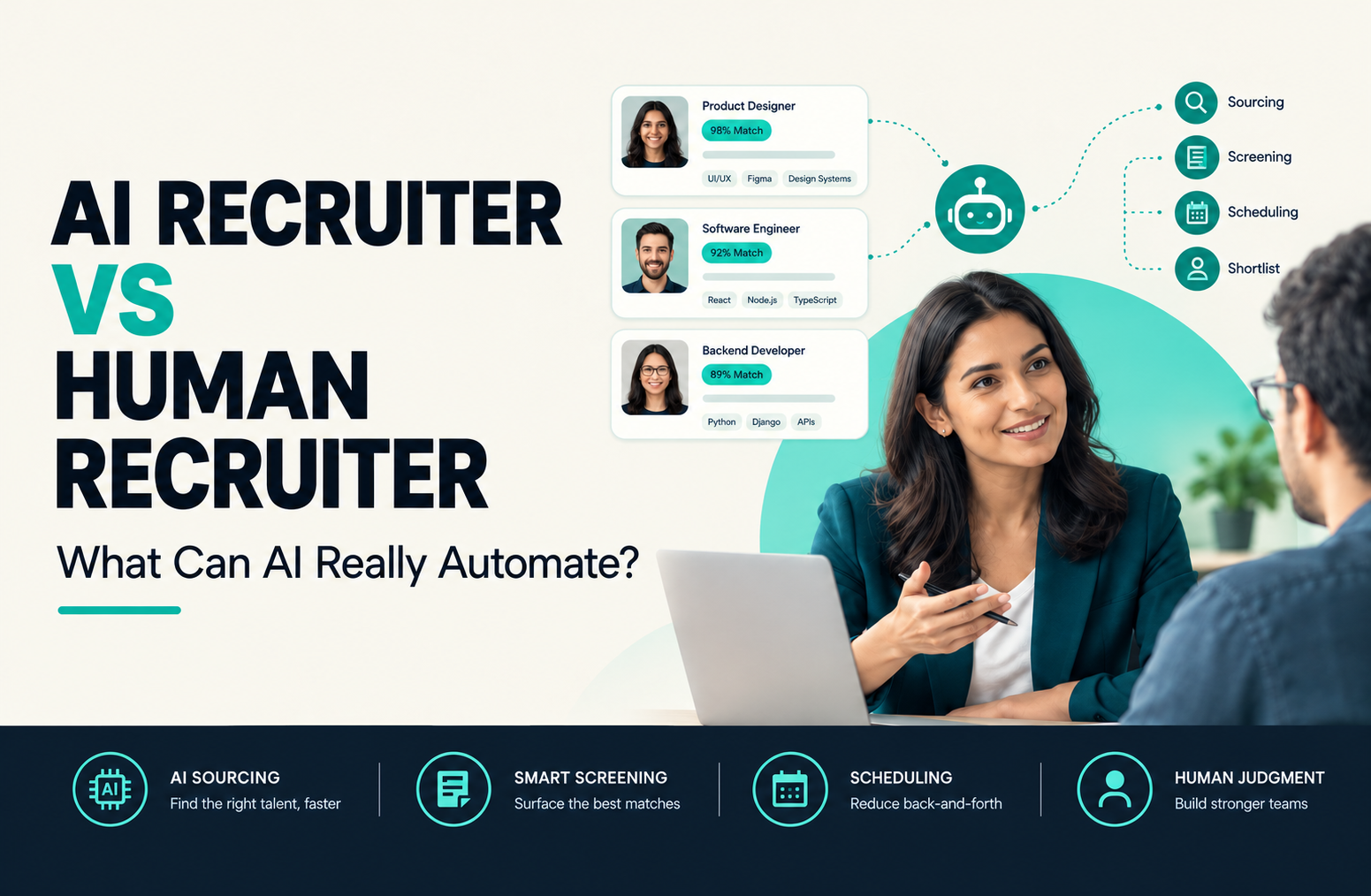
AI Recruiter automates tasks such as candidate searching, filtering, outreach, and scheduling of interviews, leaving the relational aspects, intricate assessment of candidates, negotiation, and hiring decisions for human recruiters.
It all boils down to how AI and humans differ when it comes to recruiting: AI has speed, consistency, and scalability; humans have intuition, empathy, and context understanding. With large teams, the use of both results in an efficient hiring process with the human element preserved.
LinkedIn's 2025 Future of Recruiting research found that 73% of talent acquisition professionals believe AI will change how organizations hire. Among TA professionals already experimenting with or integrating generative AI, the average reported time savings was about 20% of their workweek. Supporting this shift, a study of 70,000+ job applicants found that AI-led interviews resulted in 12% more job offers, 18% more job starts, and 16% higher 30-day retention than human-led interviews.
What Is an AI Recruiter vs a Human Recruiter?
An AI recruiter is software that uses AI to execute defined recruiting activities such as finding candidates, evaluating profiles against job requirements, communicating with candidates, conducting structured screening interviews, and moving qualified candidates through a workflow.
A human recruiter brings contextual judgment, communication skills, relationship management, candidate advocacy, and accountability to the hiring process.
The difference becomes clearer when recruiting is viewed as a workflow:
Job requirement → sourcing → matching → outreach → screening → interview → recruiter review → hiring decision
AI can increasingly execute several of the middle steps. Humans remain critical at the decision points where context, empathy, business understanding, and accountability matter most.
| Recruiting Activity | AI Recruiter | Human Recruiter |
|---|---|---|
| Candidate sourcing | Helps in finding suitable candidates for numerous openings from big pools of talent. | Develops specialized talent pipelines and engages with passive candidates for challenging positions. |
| Candidate matching | Evaluates candidates on their qualifications, experience, location, and compensation requirements. | Identifies transferable skills and potential employees who cannot be evaluated based on their resumes alone. |
| Outreach | Delivers personalized messages and follow-up scheduling in bulk. | Establishes rapport, deals with objections, and reconnects high-value candidates who have gone cold. |
| Resume screening | Selects qualifications based on criteria set by the company. | Focuses on career gaps, ambiguous experience, and candidates who might be wrongly screened out. |
| First-round screening | Asks pre-defined questions and records answers based on criteria. | Examines experiences more deeply, evaluates claims made, and examines competencies. |
| Interview scheduling | Coordinates available times and sends reminders to minimize scheduling issues and missed appointments. | Helps resolve last-minute issues and conflicting schedules between candidates and the recruiter. |
| Candidate engagement | Monitors reactions and alerts for any questions not answered or candidates who may quit. | Addresses issues pertaining to pay, position, corporate culture, and other offers. |
| Hiring decision | Ranks and offers supporting data for evaluating candidates. | Considers the factors involved and the business requirements prior to recommending for hire. |
| Offer negotiation | Automates communications and approval tracking depending on setup. | Negotiates the compensation, handles counteroffers, and matches candidate expectations to budget. |
| Hiring-manager collaboration | Highlights the metrics of pipelines, availability of candidates, and recruitment outcomes. | Critiques unrealistic job requirements, balances candidate expectations, and provides insights into market conditions. |
The distinction is important because AI is strongest when the task is repetitive, measurable, and based on defined criteria. Human involvement becomes more important as ambiguity, consequence, and relationship complexity increase.
What Can an AI Recruiter Automate?
AI recruitment automation is most valuable when it removes repetitive work without removing human accountability.
1. Candidate Sourcing and Matching
- AI can comb through a large pool of candidates, select those who fit the position’s needs, and rank candidates depending on their skills and experience. Unlike regular keyword searches, AI can recognize related skills and transferable experience.
Example: An organization that hires a Digital Marketing Executive would need people with knowledge of Meta Ads, campaign reporting, and SEO. Rather than having to search for such candidates on various platforms manually, the AI sourcing tool can find suitable candidates with such skills, irrespective of their job title.
Ninjahire example: According to its Modern AI sourcing, Ninjahire can:- Look into previous ATS/CRM database sources for previously sourced candidates.
- Look into its Ninjagraph talent database, which claims to have over 800 million professional profiles.
- Source candidates from Monster, Indeed, ZipRecruiter, Dice, and CareerBuilder.
- Rank the matching profiles and supplement candidate profiles with their contact details.
- Adjust sourcing criteria based on feedback from candidates and qualifications.
Human factor: Establish criteria for an ideal candidate, verify peculiar or special cases of candidates, and evaluate their fitness.
2. Candidate Outreach and Follow-Up
The recruiting process often involves wasting considerable time on following up on replies and chasing up messages, which can be forgotten. When contacting a number of candidates for different positions, good prospects can be missed easily.
This task can be automated using AI by personalizing the outreach process, following up on the response, and then triggering follow-ups according to defined processes.
Practical illustration: A recruiter sends out a reach-out to 100 candidates for the post of Digital Marketing Executive. Out of these, some respond back instantly, while others require further information.
An AI-powered recruiting workflow can:
- Personalize outreach based on the candidate’s skills and experience.
- Monitor responses so that recruiters know which candidates are showing interest.
- Automate follow-up messages for those candidates who haven’t responded yet within the set period.
- No need for extra reminders for candidates who respond provided the workflow is configured that way.
- Prioritize interested candidates and push them towards screening or scheduling interviews.
- Exception handling like when salary is an issue or availability.
Ninjahire example: As per its official website, Ninjahire provides AI-personalized outreach services along with communication through email, SMS, AI calls, WhatsApp, and LinkedIn, together with customized engagement flows and response tracking. The company’s AI Recruiter webpage highlights automated outreach campaigns using pre-approved templates.
Role of humans: To establish candidate connections, deal with complicated issues, offer negotiations, and step in where there is need for empathy and judgment.
3. Resume Screening and Candidate Prioritization
Resume screening is one of the clearest applications of AI recruiting software.
Instead of recruiters manually reviewing every profile, AI can:
- Parse candidate information.
- Extract skills and experience.
- Compare profiles with job requirements.
- Identify potential matches.
- Rank candidates.
- Flag missing or conflicting information.
- Create a prioritized shortlist.
SHRM's 2025 research found that recruiting is the HR area where organizations reported the highest AI usage, with common applications including resume screening and automated candidate searches. Nearly 9 in 10 HR professionals whose organizations use AI for recruiting said it saves time or increases efficiency.
Human role: Review shortlisted candidates, investigate context that the system cannot understand, and challenge questionable recommendations.
4. First-Round Candidate Interviews
The AI tool can automate the first round of interviewing candidates by asking questions and scoring the answers, as well as producing transcripts and evaluations.
Practical example: An organization recruiting 50 customer service executives has AI conduct an interview where every candidate gets the same set of basic questions regarding communication skills, ability to solve problems, and willingness to work shifts. The recruiters receive structured reports that will help them decide whom to select for the next round.
Consistent evaluation importance: Giving each candidate the same set of questions and using specific criteria for scoring allows for more consistent evaluations and helps in comparing candidates. Nevertheless, consistency does not mean lack of bias or accuracy of the scoring.
Example of Ninjahire: The AI Interviewer talks about phone interview, video interview, web-based interview, personalized questions, scoring criteria, knockouts, transcripts, and candidate ranking.
Task for humans: Review AI-generated assessment, research strange results, assess complex competencies and interpersonal skills, and make final decisions about hiring someone.
5. Recruiting Workflow Coordination
AI can also connect individual recruiting activities into one continuous workflow.
For example:
Open requisition → AI sourcing → candidate matching → automated outreach → AI screening → ranked shortlist → recruiter review → human interview
Instead of a recruiter manually moving candidates from one tool to another, the workflow can trigger the next step based on predefined conditions.
This is the difference between using isolated AI tools and implementing AI recruitment automation as an operating workflow.
Ninjahire describes its recruiting workflow as a connected process from sourcing and outreach through screening and recruiter review, with ATS and VMS integrations supporting the broader recruiting operation.
What Should Human Recruiters Still Do?
AI can automate execution, but recruiting is not simply a sequence of administrative tasks.
Human recruiters remain particularly valuable when decisions require context.
Relationship Building
Candidates often need someone who understands their career goals, concerns, motivations, and expectations.
AI can initiate communication and handle routine interactions, but recruiters build the relationships that influence candidate trust and acceptance.
Complex Candidate Evaluation
A candidate can appear to be a weak match based on structured criteria but still be the right hire.
For example, a candidate may have transferable experience, unusual career progression, or domain expertise that does not map cleanly to a job description.
Human recruiters can investigate those cases instead of relying entirely on an automated score.
Hiring-Manager Consultation
Recruiters do more than find candidates.
They help hiring managers clarify requirements, challenge unrealistic expectations, calibrate candidate quality, and understand the market.
That advisory role requires business context and communication that cannot simply be reduced to AI candidate matching.
Final Hiring Decisions
AI-generated rankings should be treated as decision support, not unquestionable hiring decisions.
Recruiters and hiring managers should remain accountable for consequential decisions, particularly when candidate evaluation involves ambiguity or sensitive factors.
AI Recruiter vs Human Recruiter: Which Is Better?
The better approach for most recruiting teams is AI plus human recruiters, not AI instead of human recruiters.
| Factor | AI Recruiter | Human Recruiter |
|---|---|---|
| Speed | Excellent for high-volume processing | Limited by available time |
| Scale | Can process large candidate volumes simultaneously | Limited by recruiter capacity |
| Consistency | Strong when criteria are clearly defined | Can vary between recruiters and situations |
| Relationship building | Limited | Strong |
| Contextual judgment | Limited | Strong |
| Repetitive work | Excellent | Poor use of recruiter time |
| Complex hiring decisions | Supporting role | Primary role |
| Candidate empathy | Limited | Strong |
| Strategic hiring advice | Limited | Strong |
| Workflow automation | Strong | Requires manual coordination |
| Exception handling | Limited | Strong |
| Final accountability | Should remain limited | Human-owned |
The goal is not maximum automation. It is appropriate automation.
A useful rule is:
Automate the work that is repetitive and measurable. Keep humans responsible for work that is complex, consequential, or relationship-driven.
LinkedIn's research supports this direction. Its 2025 report describes AI as a tool for automating routine work while allowing recruiting professionals to focus more on strategic and human-centered responsibilities.
How Should Recruiting Teams Implement AI Automation?
The safest approach is to start with the parts of recruiting that have high volume, clear criteria, and measurable outcomes.
Start With One Recruiting Bottleneck
Do not automate everything simultaneously.
Identify the largest operational constraint:
- Too many resumes to review?
- Slow candidate sourcing?
- Poor outreach follow-up?
- Recruiter hours lost to first-round interviews?
- Too much manual scheduling?
- Candidates getting stuck between recruiting stages?
Then automate that specific stage.
Define the Human-AI Handoff
For every automated task, define three things:
What AI does → What the recruiter reviews → When the recruiter takes over
For example:
AI: Sources and ranks 100 candidates.
AI: Sends approved outreach.
AI: Screens candidates against defined criteria.
Human: Reviews the highest-priority candidates.
Human: Investigates exceptions.
Human: Conducts substantive interviews.
Human: Makes or owns the hiring recommendation.
This creates an accountable workflow rather than an uncontrolled automated process.
Measure Outcomes, Not Just Activity
Recruiting leaders should evaluate:
- Time-to-submit
- Time-to-screen
- Candidate response rate
- Interview completion rate
- Recruiter hours saved
- Qualified-candidate rate
- Interview-to-submission rate
- Candidate experience
- Quality of hire
AI automation is valuable only when it improves the recruiting operation, not simply because more tasks are automated.
What Does the Future of AI Recruiting Look Like?
The strongest recruiting model is moving toward human-led, AI-assisted execution.
AI will continue taking on more repetitive recruiting work, particularly sourcing, matching, outreach, screening, scheduling, and workflow coordination.
Recruiters will increasingly spend their time on activities where human judgment has greater value:
AI handles volume → recruiters handle judgment → hiring managers make informed decisions
This model also provides a practical way to scale without assuming that every hiring decision can or should be automated.
For organizations evaluating AI recruiting software, the key question is therefore not:
"Can AI replace our recruiters?"
The better question is:
"Which parts of our recruiters' workload should never require manual execution?"
That question leads to a more useful automation strategy.
Conclusion
The AI recruiter vs human recruiter debate is ultimately a question of task allocation rather than replacement.
AI is well suited to repetitive, high-volume recruiting work such as sourcing, matching, outreach, resume screening, first-round interviews, scheduling, and workflow coordination. Human recruiters remain essential for relationship building, contextual evaluation, strategic hiring advice, candidate experience, and consequential decisions.
For recruiting teams considering AI recruitment automation, the strongest model is a controlled handoff:
AI handles the volume. Humans provide the judgment.
Ninjahire is designed around this model, connecting AI sourcing, outreach, screening, interviewing, candidate matching, and recruiting workflows while keeping recruiters involved in the stages where human judgment matters.
If the goal is to reduce repetitive recruiting work without removing recruiter control, the next step is to identify the highest-volume workflow that can be automated first.