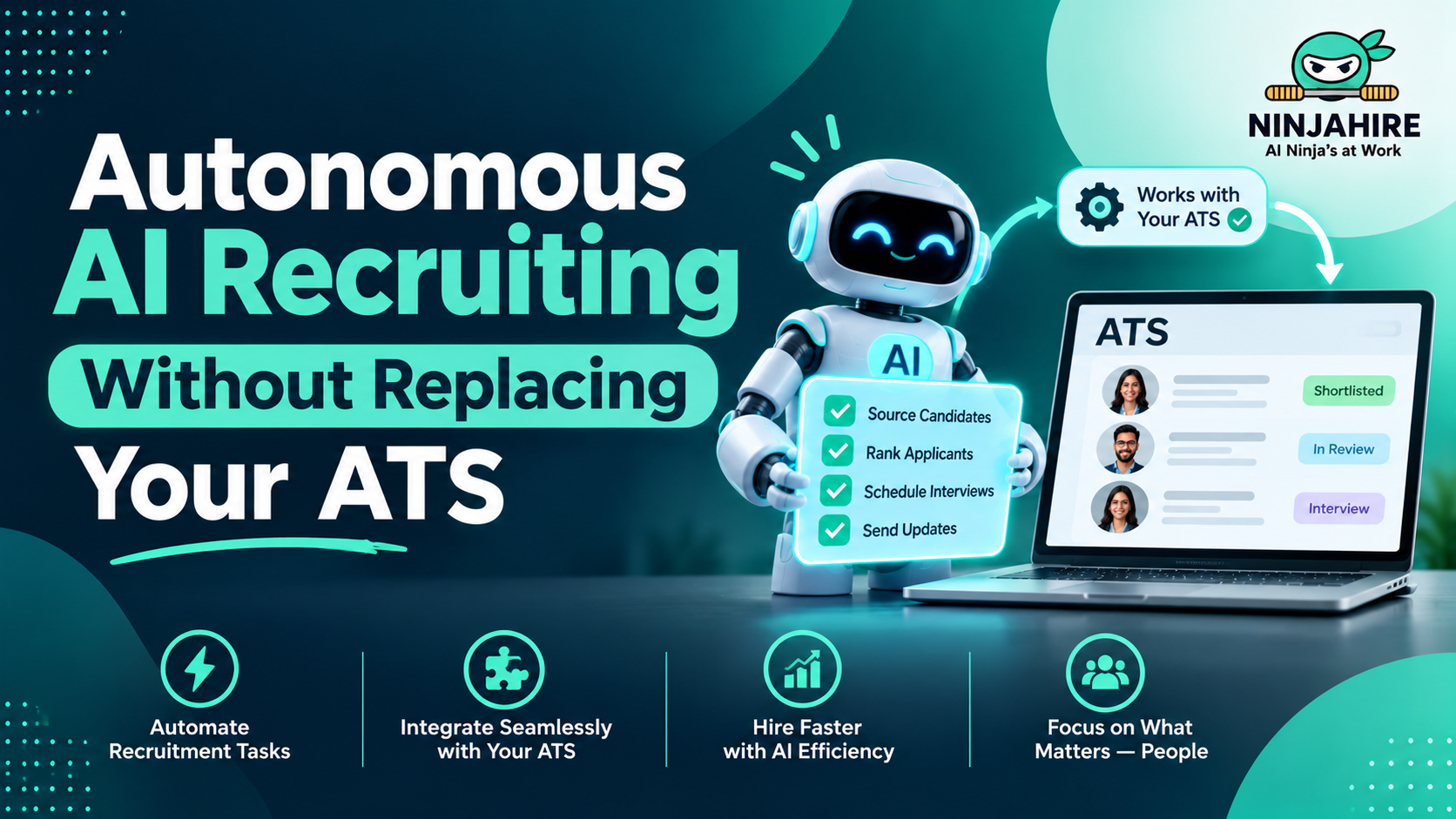
The principle is simple. Keep the ATS as the system of record, and add AI around it through verified integration methods, narrow permissions and human review of consequential decisions. This guide covers the architecture, rollout sequence, governance controls and metrics.
What autonomous AI recruiting means
Autonomous AI recruiting describes workflows where AI agents complete multi-step tasks without step-by-step prompting. An agent might search talent pools, rank candidates, draft outreach, run a screening conversation and propose a status update. Many vendors call this "agentic AI recruiting."
Autonomy is not a single setting. It varies by product, task and configuration, so treat it as a spectrum when scoping.
| Level | What the AI does | What the recruiter does |
|---|---|---|
| Assisted | Drafts messages, summarizes resumes, suggests matches | Reviews, edits, sends |
| Approval-gated | Prepares and queues actions | Approves each action |
| Bounded autonomy | Executes defined low-risk actions within limits | Monitors, handles exceptions |
| Full autonomy | Makes and acts on consequential decisions | Minimal oversight |
Few recruiting tasks belong at the highest level. Decisions affecting a candidate's opportunity, such as rejection, warrant human review. Autonomy is earned one workflow at a time, on pilot evidence.
Why the ATS should stay the system of record
An ATS typically holds candidate records, requisitions, workflow stages, communication history, submittal and interview records, reporting, and documentation used in audits or client reviews. Capabilities differ by platform, so map responsibilities against the system in use.
Record integrity also carries legal weight. The Uniform Guidelines on Employee Selection Procedures, 29 CFR Part 1607 expect employers to keep records showing the impact of selection procedures by sex and by race or ethnic group, to hold validity documentation where a component shows adverse impact, and to treat the four-fifths rule as a general indicator. A trail fragmented across tools is harder to produce and defend. That is a practical argument for protecting the system of record, not legal advice.
AI tools complement an ATS most reliably in sourcing, outreach, screening conversations, scheduling and summarization: high-volume, repeatable work where errors stay visible and recoverable.
A reference architecture for AI alongside an ATS
The pattern below is a general architecture, not a confirmed implementation for any vendor or ATS. Validate each element against vendor documentation.
- ATS — system of record (candidates, requisitions, stages, history)
↕ verified integration: connector, API, webhook or file exchange - AI layer (sourcing, matching, outreach, screening, scheduling)
↓ - Recruiter review + exception queue
↓ - Approved updates back to the ATS
↓ - Monitoring, audit logs, error queue, rollback
Steps 3 and 5 decide whether this survives production. Without them, failed syncs and weak output enter the pipeline unnoticed.
Step-by-step implementation plan
- Map the workflow and find the bottleneck. Document each stage from intake to submittal, with handoffs and time spent, then target measurable delay.
- Select one low-risk, measurable pilot. Candidate rediscovery in existing ATS data, or first-touch outreach for one requisition type, works well. Leave rejections out.
- Define the system of record field by field. Name the owner of candidate IDs, contact details, resume version, pipeline stage, notes, scores and disposition. Ambiguity causes most duplicate records.
- Confirm integration capability in writing. Ask both vendors for documentation; marketing language is not a specification.
- Read the ATS API documentation before scoping. Real constraints live there. The Greenhouse Harvest API documentation describes permissions granted per endpoint rather than broad scopes, rate limits enforced in ten-second windows with HTTP 429 responses, and retirement of older API versions on a published date.
- Apply least-privilege access. Grant only the endpoints and fields the pilot needs; reading resumes does not require writing dispositions.
- Write the action boundary down. State what the AI may read, recommend, draft, update automatically, and never do without approval.
- Map identifiers, statuses and failure paths. Confirm job IDs, the ATS deduplication rule, status equivalence, time zones and behavior when a write fails.
- Test in a sandbox or limited slice. Validate matching, write-backs, deduplication and failure handling, and confirm a rollback path.
- Train recruiters on exceptions, not features. They need to know what the AI did, how to override it, and where failures surface.
- Expand on evidence. Extend autonomy to a second workflow only when pilot data supports it.
Integration patterns and when each fits
| Pattern | Typical fit | Main caution |
|---|---|---|
| Native or pre-built connector | Widely used ATS platforms | Confirm actual fields and sync directions |
| API integration | Flexible, higher-volume needs | Permission scoping, versioning, rate limits |
| Webhooks | Event-driven updates where timing matters | Needs retry logic and alerting |
| Middleware or iPaaS | Several systems, little internal engineering | Adds a vendor and a failure point |
| Scheduled file exchange | Restrictive environments, low volume | Batch delays, duplicate risk |
| Controlled manual workflow | Early pilots, exception handling | Does not scale, but teaches quickly |
Suitability depends on the ATS, vendor support, security requirements, data volume and technical resources. Not every option exists for every platform.
Example workflow (hypothetical)
This illustrative example shows bounded autonomy in practice. It is not a case study or a performance claim.
An agency filling recurring warehouse roles lets an AI workflow search its ATS and sourcing channels overnight, rank candidates against the live requisition and draft outreach. Each morning a recruiter reviews the shortlist and drafted messages in a queue. Approved messages send, and replies are tracked. When a candidate accepts a screening call, the approved status change and interview record write back to the ATS. Failed writes, duplicate matches and low-confidence rankings route to a human exception queue.
The decisive choice is not the ranking model. It is that nothing consequential reaches the ATS unapproved, and nothing fails quietly.
Governance, privacy and human oversight
Governance belongs in the integration design, not a later review. Core controls include lawful basis and candidate notice where applicable, data minimization, least-privilege access, defined retention, encryption, audit logs, accessible candidate-facing interactions, bias monitoring and documented human review of consequential decisions.
The NIST AI Risk Management Framework offers a voluntary structure for that work, organized around four functions: Govern, Map, Measure and Manage. It is not a hiring regulation, and NIST notes it is being revised, but it gives recruiting teams a defensible way to document risk decisions.
Assessment quality matters equally. The U.S. Office of Personnel Management's assessment and selection guidance treats job analysis as the foundation of effective assessment and names predictive validity a tool's most important characteristic. A screening workflow built on vague criteria inherits that weakness at scale. State and local AI hiring rules apply on top, and keeping an ATS does not by itself make a workflow compliant.
KPIs to monitor
| Metric | Definition | Caution |
|---|---|---|
| Recruiter admin time | Hours on sourcing, outreach, data entry | Counts only if redirected to productive work |
| Time to shortlist | Open requisition to approved shortlist | Speed can mask weaker screening |
| Qualified-to-interview rate | Interviews per AI-recommended candidate | Best signal of matching quality |
| ATS data completeness | Required fields populated after sync | Falling completeness means a mapping problem |
| Duplicate record rate | New duplicates per 1,000 synced records | Should trend to zero after tuning |
| Sync error rate | Failed writes over attempted writes | Track resolution time, not counts |
| Override rate | Recommendations recruiters reject or edit | High rate means autonomy expanded too early |
Record a baseline before the pilot, including candidate experience feedback. Without one, any improvement claim is an estimate.
Common implementation mistakes
- Leaving system-of-record ownership undefined
- Granting broad API credentials because scoping takes longer
- Automating rejections or dispositions without human review
- Ignoring the ATS deduplication rule, then importing duplicates
- Shipping integrations with no retry logic, alerting or rollback
- Feeding poor-quality ATS data in, then blaming the model
- Measuring speed while quality goes unmonitored
How to evaluate an AI recruiting platform
- Which exact ATS platforms are supported, with which fields and sync directions?
- Is the integration native, API-based, webhook-driven or middleware-dependent?
- Can access be narrowed to a pilot scope, and what permissions are requested?
- Are audit logs complete, exportable and attributable to a user or agent?
- How are failed syncs surfaced and retried, and what rollback exists?
- Which actions can be gated behind human approval by configuration?
- What certifications, subprocessor lists, retention controls and exit terms apply?
A vendor answering with documentation is lower risk than one answering with adjectives. Ninjahire publishes a checklist on what to check before buying an ATS and AI integration.
Where Ninjahire fits
Ninjahire is an AI recruiting platform for staffing agencies built around specialized agents. Its published product information describes a Sourcing Agent for multichannel candidate discovery and ranking, an Outreach Agent for messaging and follow-up across channels, and a Screening Agent that runs voice and web screening conversations and scores candidates. Those agents sit in the AI layer, not the system of record.
Its integrations page states that Ninjahire connects with 50+ ATS platforms, VMS systems and productivity tools through pre-built connectors, naming Bullhorn, JobDiva, Greenhouse, Workday, iCIMS and Lever among others. Agencies should still confirm which fields sync, in which direction and under what permissions for their own ATS version. Ninjahire also publishes a wider view of an AI recruiting stack built around an existing ATS.
Start small, keep the record, expand on evidence
Autonomous AI recruiting does not require an ATS migration. Agencies can modernize incrementally: define the system of record field by field, scope permissions tightly, pilot one measurable workflow, keep consequential decisions with recruiters, and expand where evidence supports it. The teams that succeed treat integration design and governance as part of the buying decision.
To scope a pilot for a specific ATS and requisition type, contact the Ninjahire team and request the integration documentation for that platform.
Frequently Asked Questions
Can AI recruiting software work with an existing ATS?
Often yes, through native connectors, APIs, webhooks, middleware or scheduled file exchange. Availability depends on the ATS and vendor, so confirm supported fields and sync directions in documentation first.
Does autonomous AI recruiting replace an ATS?
Generally no. The ATS remains the system of record for candidate data, pipeline stages, communication history and reporting. AI agents add execution capacity around it.
What data should sync between an AI recruiting tool and an ATS?
Typically candidate identifiers, contact details, resume data, requisition details, screening outputs, outreach activity and approved status changes. Define the owning system per field first.
How should staffing agencies pilot AI recruiting automation?
Choose one low-risk workflow, record a baseline, scope permissions to that workflow alone, test in a sandbox, keep approval gates on consequential actions, and review quality metrics before expanding.
Who is accountable when an AI recruiting agent makes a mistake?
The agency or employer using the tool stays accountable for its hiring process. That makes audit logs, human review and a rollback path operational requirements.