An AI recruiting agent executes multistep recruiting workflows within configured permissions. An AI copilot assists a recruiter who stays in control of the work. A recruiting chatbot handles conversational interactions with candidates and recruiters. Task execution, assistance, conversation — that is the core distinction, and it is the one most product pages blur.
Teams reach this question practically: sourcing eats hours, administrative work piles up, candidates wait for replies. Vendors promise relief, but the labels are unreliable. Gartner calls the problem “agent washing” — rebranding assistants, robotic process automation and chatbots as agents — and estimates only about 130 of thousands of agentic AI vendors are genuine (Gartner, June 2025).
The categories also overlap. One platform may run multistep sourcing, draft outreach for approval, and hold a voice conversation with a candidate.
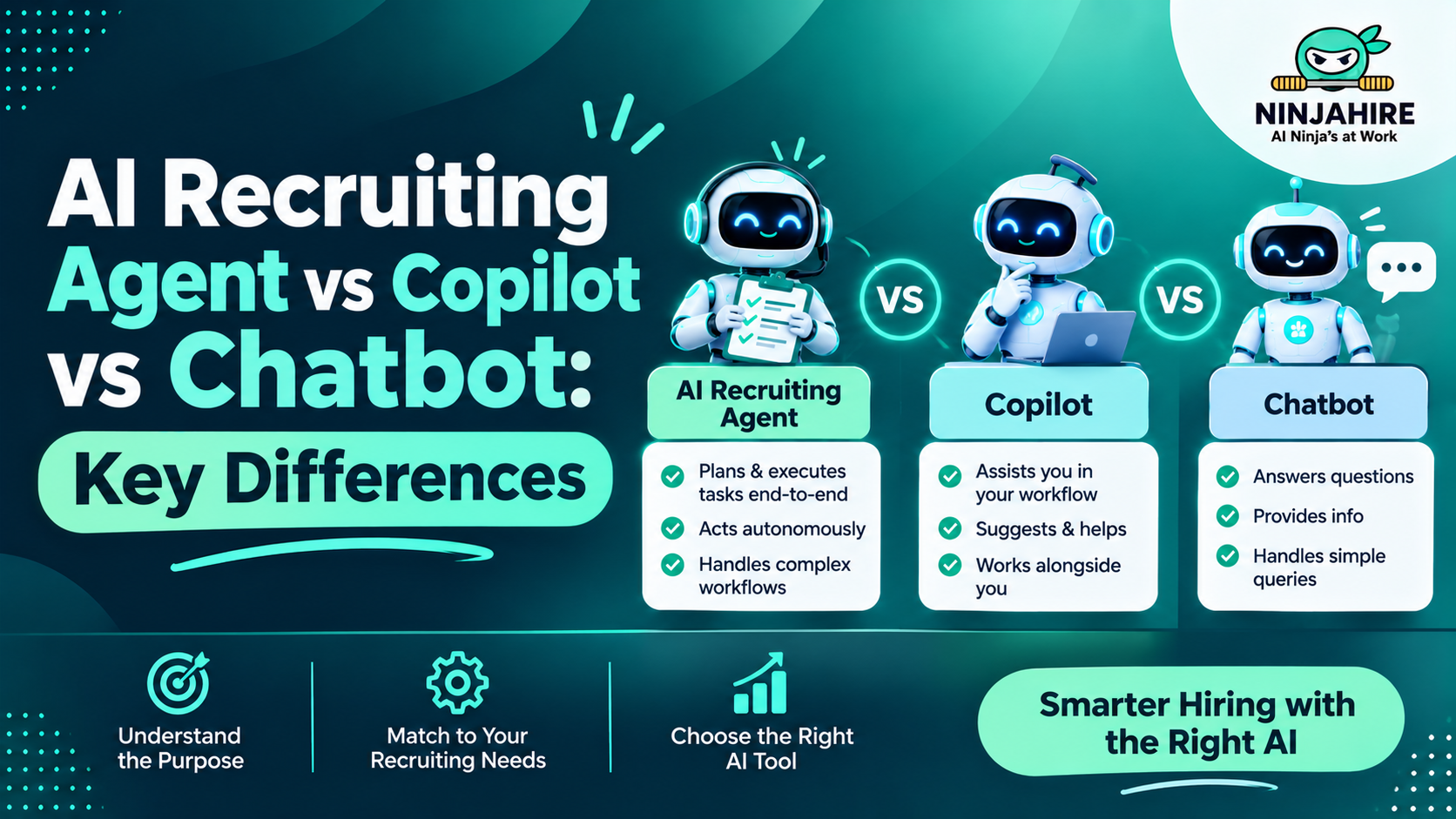
AI Recruiting Agent vs. AI Copilot vs. Recruiting Chatbot: Quick Comparison
AI recruiting agent. Software that pursues a defined recruiting objective across several connected steps - searching approved sources, evaluating matches, initiating approved outreach, handling responses - carrying context between stages within its configured permissions.
AI recruiting copilot. An assistant supporting a recruiter doing the work: summarizing profiles, drafting messages, comparing candidates against requirements, preparing interviews. The recruiter directs it and reviews the output.
Recruiting chatbot. A conversational interface — web chat, SMS or voice — that answers questions, collects information, gives status updates and guides users through a flow. Some run decision trees; others use language models over a knowledge base.
These are working definitions, not standardized product categories.
| Technology | Primary purpose | Typical interaction | Level of autonomy | Human involvement | Best use cases |
|---|---|---|---|---|---|
| AI recruiting agent | Execute a multistep workflow toward a hiring objective | Configured once, then runs and reports back | High, bounded by permissions | Sets criteria and approval gates; reviews exceptions | Sourcing, rediscovery, outreach, qualification |
| AI recruiting copilot | Assist a recruiter’s own work | Prompt-and-response inside existing tools | Low to moderate; acts when asked | Continuous: directs and reviews each output | Drafting, summarizing, comparing, interview prep |
| Recruiting chatbot | Hold a conversation with candidates or recruiters | Chat or voice turn-taking | Low; set by flow or knowledge base | Monitors and handles escalations | FAQs, pre-qualification, status updates |
What Is an AI Recruiting Agent?
An AI recruiting agent is software given an objective rather than a single instruction. It interprets the requirement, plans a sequence of steps, uses the tools it has been authorized to use, and adapts as conditions change — a candidate replies, a source returns nothing, a knockout criterion fails.
That separates it from traditional recruitment automation, which fires a fixed action when a trigger occurs. An agent chooses the next step within its boundaries and passes context forward, so a sourced candidate moves into outreach without anyone copying data between tools.
Autonomy here is a configuration, not a property of the category. It depends on permissions, integrations, criteria and approval checkpoints: an agent that can only read an ATS behaves very differently from one authorized to write records and send messages.
How Does an AI Recruiting Agent Work?
- Receive a defined recruiting objective.
- Interpret the job requirements and configured criteria.
- Search approved candidate databases or connected sources, where supported.
- Identify and organize potentially relevant candidates.
- Apply configured screening criteria, where supported.
- Initiate approved outreach, or request recruiter approval first.
- Track responses and update permitted workflow records.
- Escalate exceptions and uncertain cases to a recruiter.
- Summarize actions taken, results and outstanding decisions.
No agent supports every step. Plenty stop at step four and hand the shortlist to a human.
What Can an AI Recruiting Agent Automate?
Potential capabilities include multistep sourcing, candidate rediscovery, data enrichment, initial qualification checks, matching and prioritization, approved outreach and follow-ups, interview scheduling, ATS record updates and exception routing.
Each is a capability some agents have, not a definition of the category. Rediscovery needs a working ATS integration, outreach needs messaging permissions and consent handling, and record updates need write access many integrations do not grant. Ask a vendor to demonstrate each on a live requisition.
What Is an AI Copilot for Recruiters?
An AI recruiting copilot supports a recruiter who owns the workflow. It does not run the requisition; it makes the recruiter faster at running it. Interaction is prompt-and-response, usually inside the ATS, CRM or inbox the recruiter already works in.
Human direction matters because the copilot has no objective of its own. It answers what it is asked, with the context it is given, and the recruiter judges whether the answer is right.
What Can an AI Recruiting Copilot Do?
Common capabilities: drafting job descriptions and outreach messages; summarizing résumés, profiles and interview notes; comparing qualifications against requirements; generating interview questions and follow-ups; summarizing pipeline status; producing reports; preparing recruiters for hiring manager meetings. What a given copilot can do depends on its integrations — one with no ATS connection cannot summarize a pipeline it cannot see.
What Is a Recruiting Chatbot?
A recruiting chatbot communicates with job seekers and applicants through text or voice, sitting where candidates already are: a careers page, a job advert, an SMS thread.
Rule-based chatbots follow predefined conversation trees with fixed questions and branches. AI-powered conversational chatbots use language models and a knowledge source to interpret phrasing they were never scripted for — more flexible, and more prone to answering confidently when they should defer.
Conversational ability is not workflow execution. A chatbot that discusses an opening fluently may still be unable to book an interview, because booking needs an integration and a permission, not a better conversation.
AI Recruiting Agent vs. AI Copilot vs. Recruiting Chatbot: Key Differences
None is superior in the abstract. An advanced copilot may execute approved actions, a chatbot may integrate with scheduling, an agent may expose a conversational interface. What separates them is the primary operating model.
AI Recruiting Agent vs. AI Copilot vs. Recruiting Chatbot: Practical Use Cases
High-volume candidate sourcing. An agent suits repeatable sourcing across many similar requisitions; a copilot suits a recruiter working a few hard roles who needs research support rather than throughput.
Candidate screening and qualification. An agent applies documented criteria at volume, a copilot helps a recruiter interrogate a shortlist, and a chatbot collects preliminary facts before anyone invests time.
Candidate engagement and communication. Chatbots handle inbound questions at any hour, copilots help recruiters write messages needing a human voice, and agents run outbound sequences and stop them when someone replies or opts out.
Interview coordination. Agents coordinate scheduling where integrations allow, copilots prepare question sets and draft confirmations, chatbots gather availability.
Recruiter productivity and administration. Copilots compress individual tasks; agents reduce coordination across a process. For simple, predictable administration, conventional workflow automation is often cheaper and more reliable.
Can an AI Recruiting Agent, Copilot, and Chatbot Work Together?
They frequently do, inside one platform or across several. Conceptually: a chatbot answers an applicant’s questions and collects preliminary information; an agent, if configured for it, coordinates discovery or qualification; a copilot helps the recruiter review profiles and prepare questions; the agent or connected automation handles approved scheduling; the chatbot sends instructions and reminders; the recruiter handles evaluation, stakeholders and difficult conversations; the hiring team decides.
Responsibilities depend on the products chosen and how they are integrated. What makes the combination work is unglamorous: shared and accurate candidate data, a real ATS integration, defined permissions, approval checkpoints, audit trails, consistent communication, enforced access controls, and clear ownership of decisions.
Benefits of Using AI Recruiting Technologies
Reduced administrative work. Repetitive data entry, status communication and coordination can be absorbed by software rather than recruiters.
Faster workflows. Sourcing support, structured information processing and scheduling assistance remove avoidable waiting — the gaps between steps, not the steps.
More consistent processes. Documented criteria applied the same way improves comparability, but only when the criteria are sound; a flawed rubric applied uniformly produces uniformly flawed outcomes.
Limitations and Risks to Consider
AI accuracy and hallucinations. Generated summaries, extracted details and recommendations can be wrong in ways that read as confident, so anything informing a decision needs checking against the source.
Algorithmic bias. Historical hiring data, proxy criteria and poorly designed evaluation logic can reproduce or amplify unfair patterns. New York City’s Local Law 144 requires an independent bias audit within a year of use, a published summary of results, and notice to candidates at least 10 business days before an automated employment decision tool is used (NYC DCWP).
Data privacy and security. Candidate data handling, access controls, retention periods and vendor security practices deserve scrutiny before implementation.
Human oversight and accountability. Teams need review processes, escalation routes and a named owner for hiring decisions. The NIST AI Risk Management Framework, voluntary but widely referenced, organizes this around four functions: govern, map, measure and manage (NIST).
Compliance considerations. Obligations vary by jurisdiction and use case. In the EU, AI used in employment and recruitment falls under Annex III of the AI Act, with high-risk obligations applying from 2 December 2027 after the AI Omnibus amendments (European Commission). US state and city rules differ again. Assess what applies to your organization and take professional advice where the answer is not obvious.
How to Choose the Right AI Recruiting Technology
Consider an AI recruiting agent when the team needs multistep execution across connected activities, objectives and permissions can be defined clearly enough to guide a workflow, and the product offers exception handling and approval mechanisms.
Consider an AI copilot when recruiters need help with research, writing, summarization or analysis, and humans should stay actively involved in most actions.
Then work through an evaluation checklist: defined use cases; sourcing; screening and matching; workflow execution; conversational capabilities; human-in-the-loop controls; ATS and VMS integration depth; data privacy and security; auditability and reporting; bias testing; customization; escalation procedures; candidate experience; implementation requirements; total cost of ownership; vendor transparency.
Evaluate demonstrated behavior on a real requisition. The label on the product page is marketing; what the software does in a live demo is evidence.
How Ninjahire Fits Into the AI Recruiting Landscape
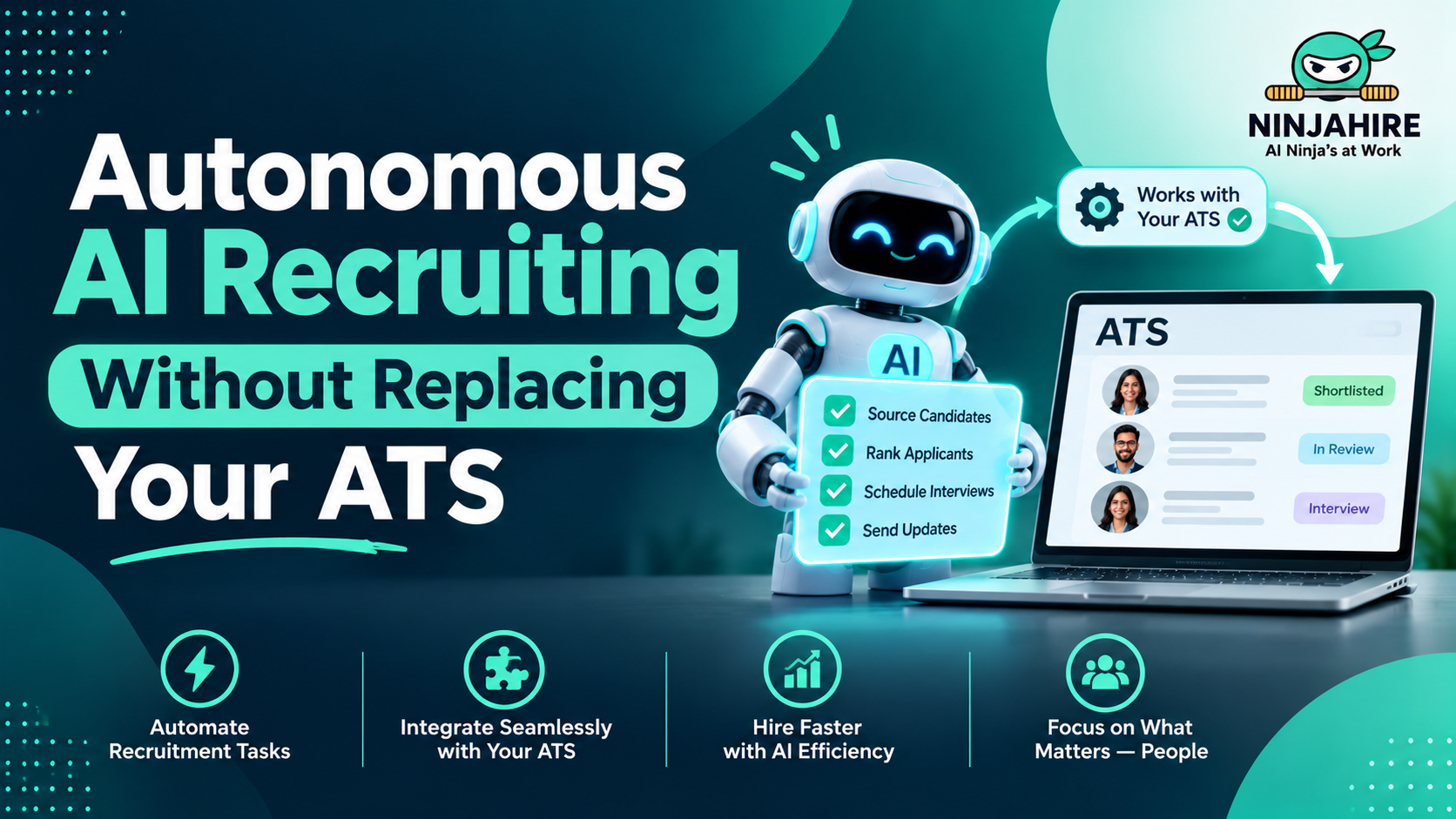
Ninjahire positions itself as an AI-powered recruiting platform for staffing agencies, corporate talent acquisition teams, RPOs and MSP programs, built around what its site describes as an execution layer that works alongside an existing ATS rather than replacing it.
Its official pages describe three coordinated agents: sourcing (ATS and CRM rediscovery, external discovery, match analysis, enrichment), outreach (personalized sequences across supported email, SMS and phone channels, with response capture), and screening (phone, web and video interviews with knockout questions and structured reports). On that evidence the platform sits in the agent category, while its screening component uses conversational AI — which is why a single label fits awkwardly here and elsewhere.
The site states two operating modes, Autopilot and human-in-the-loop, and that recruiters retain control over requirements, candidate experience and hiring decisions. It also publishes an AI bias audit report and states SOC 2 Type II compliance. Integration scope varies, and the site advises confirming which data operations are available for a specific ATS or VMS.
Conclusion
AI recruiting agents execute defined, multistep workflows within configured permissions. AI copilots help recruiters research, analyze, write and decide. Recruiting chatbots handle conversational interactions. The categories overlap, and real capability depends on the product rather than the label.
Human recruiters remain essential for judgment, relationships, sensitive communication, stakeholder management and final hiring decisions. The useful question is not whether a product calls itself an agent, a copilot or a chatbot, but which recruiting problem your team needs solved and whether the software can be shown to solve it.
Frequently Asked Questions
What is the difference between an AI recruiting agent and an AI copilot?
An agent executes a sequence of recruiting steps toward an objective within permissions you configure, reporting on results and exceptions. A copilot assists a recruiter who is doing the work, producing drafts, summaries and analysis on request. The difference is delegation versus assistance.
How is a recruiting chatbot different from an AI recruiting agent?
A chatbot’s primary function is conversation: answering questions, collecting information, giving updates. An agent’s primary function is executing a workflow, which may include conversation but is not defined by it. A chatbot can act in other systems only if it has been integrated to do so.
What is an AI recruiting agent?
Software that receives a recruiting objective, interprets the requirements and carries out multiple connected steps — searching approved sources, evaluating matches, initiating approved outreach, tracking responses — using the tools and data it has been authorized to access, and escalating cases it cannot resolve.
What is an AI copilot for recruiters?
An AI assistant that works alongside a recruiter inside their existing tools. It drafts job descriptions and messages, summarizes résumés and interview notes, compares candidates against requirements and prepares interview questions. The recruiter directs each interaction and reviews what it produces.
Can an AI recruiting agent screen candidates automatically?
Many apply configured screening criteria and knockout questions, and some conduct structured phone or video screens. Whether a given product does this, and how results are scored and documented, varies. Automated screening does not remove the need for human review of consequential decisions.