Choosing recruiting software used to mean choosing an ATS. In 2026, it means deciding how much of the recruiting workflow should run without a recruiter touching it — and which vendor should own that layer.
This guide compares ten recruiting platforms used by staffing agencies, highlighting what each tool offers, its key features, and the problems it helps solve. The platforms are grouped by their primary use cases rather than ranked, helping agencies identify the right fit for their recruitment needs.
TL;DR
- AI recruiting platforms help staffing agencies automate sourcing, outreach, screening and candidate matching — but they split into two very different categories.
- Some replace your ATS and CRM entirely; others sit on top of the system you already run.
- The right choice depends on agency size, placement model, hiring volume, existing ATS and how pricing is metered — per seat, per credit, or both.
- Ninjahire is worth evaluating for agencies that want connected AI agents across sourcing, outreach and screening without replacing their ATS.
What Is AI Recruiting Software for Staffing Agencies?
AI recruiting software automates parts of the agency workflow that previously required recruiter hours: finding candidates, personalising outreach, screening responses, scoring fit against a job order, and keeping candidate records current.
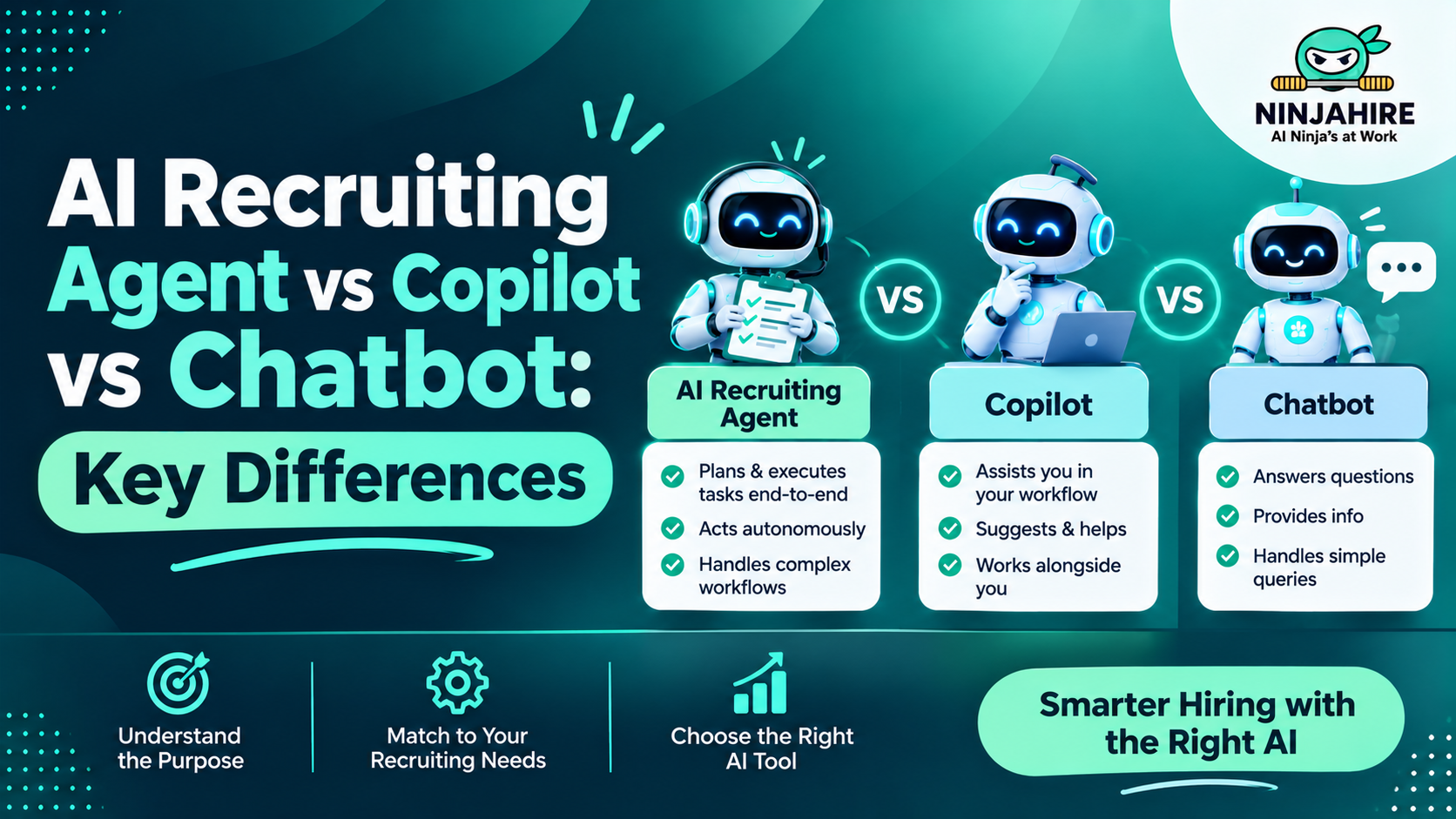
The important distinction is architectural, and it extends the older recruiting CRM vs ATS question. A full-suite agency ATS and CRM is your system of record — it holds candidates, clients, job orders, submissions and placements, and increasingly adds AI on top. A specialist AI tool owns one job exceptionally well, such as sourcing or conversational screening, and integrates with whatever ATS you already run.
Agencies get this wrong in both directions. Buying a full suite to solve a sourcing problem means an unnecessary migration. Buying four specialist tools means four contracts and manual handoffs between them.
Candidate expectations have shifted alongside the tooling. The Bullhorn GRID 2026 Talent Trends Report, based on a survey of nearly 2,300 people who worked with recruitment firms over the past three years, found that 69% of candidates encountered AI deployed by their staffing firm for pre-screening or interviewing, and 81% of those who worked with recruitment AI rated the experience positively.
The 10 Best AI Recruiting Platforms for Staffing Agencies in 2026
| Platform | Comparable plan | Pricing basis | Five user monthly cost | Best for |
|---|---|---|---|---|
| NinjaHire | Starter | $170/month for 5 users, annual billing | $170 | Agencies automating sourcing, outreach and screening on an existing ATS |
| Bullhorn | Starter | $99/user/month | $495 | Mid-market and enterprise staffing firms |
| Loxo | Core | $149/user/month, annual billing | $745 | Firms consolidating ATS, CRM, sourcing and outreach |
| Recruiterflow | Platform | $149/user/month | $745 | Search and direct-hire firms wanting deep automation |
| Recruit CRM | Pro | $95/user/month | $475 | Growing agencies wanting transparent tiered pricing |
| Crelate | Business | $119/user/month | $595 | Staffing firms needing VMS and back-office connections |
| Manatal | Professional | $15/user/month, annual billing | $75 | Small teams and cost-sensitive agencies |
| hireEZ | Solo recruiter | $494/month for one solo recruiter | Not comparable | Enterprise TA teams consolidating a sourcing stack |
| Juicebox | Starter | $99/seat/month, annual billing | $495 | Individual recruiters and boutique agencies |
| Sense | Custom plan | Quote-based | Not publicly available | High-volume staffing with large redeployment pools |
Agency ATS and CRM platforms with AI built in
Bullhorn is the staffing industry's incumbent, serving over 10,000 firms. Its Amplify layer adds digital workers, a staffing-specific chat assistant, and AI search and match. Starter is $99 per user per month and Core $165; the Pro and Max tiers carrying the full agentic layer are quote-based, so the AI you are shopping for sits above the published price.
Loxo sells consolidation — ATS, CRM, sourcing and outreach in one platform, with an agentic workforce covering intake, longlisting, shortlisting and outreach. Core starts at $149 per user per month annually, but the agent workforce and the 850M+ profile talent graph sit in the quote-based Professional tier. A 7-day trial of the full platform is available.
Recruiterflow targets search firms with strong automation recipes and its AIRA agent suite — notetaker, matchmaker, job-change alerts and submission agents. The Platform plan is listed at $149 per user per month; the AIRA plan is custom-priced, with all current and future agents included rather than sold separately.
Recruit CRM publishes the clearest tiers in the category: Pro at $95, Business at $135 and Enterprise at $215 per user per month, each with a pooled monthly credit allowance. Credits meter sourcing across 800M+ profiles, enrichment, automation and multiposting, so real cost depends on volume. A 30-day free trial is offered.
Crelate suits staffing firms that need more than recruiting — VMS integration, onboarding, and middle and back-office connections. Essentials is $85 per user per month annually and Business $119, with Business Plus and Platform quoted. Its Discover and Insights agents are available through the higher tiers rather than the published plans.
Manatal is the budget entry point at $15, $35 and $55 per user per month on annual billing, with a 14-day trial and no card required. It covers ATS, CRM, AI recommendations and sourcing across a 700M+ candidate database, with an AI Interviewer add-on. The trade-off is less depth in contract staffing and back-office workflows than staffing-first platforms.
AI sourcing and outreach specialists
hireEZ has repositioned from a sourcing tool to an agentic platform running on top of your ATS, covering sourcing across 45+ channels, talent CRM, voice AI screening, scheduling and analytics, with 40+ native ATS integrations. Solo recruiters start at $494 per month with a 7-day trial; team and enterprise pricing is configured against the stack it replaces. For a feature-level view, see Ninjahire vs hireEZ.
Juicebox offers natural-language talent search across 800M+ profiles with the lowest barrier to entry here — a free tier, Starter at $99 per seat per month annually, and Growth at $179. Agents are a $199-per-agent monthly add-on. ATS and CRM integrations are restricted to the custom Business plan, which matters for agency workflows.
AI agent layers for sourcing, outreach and screening
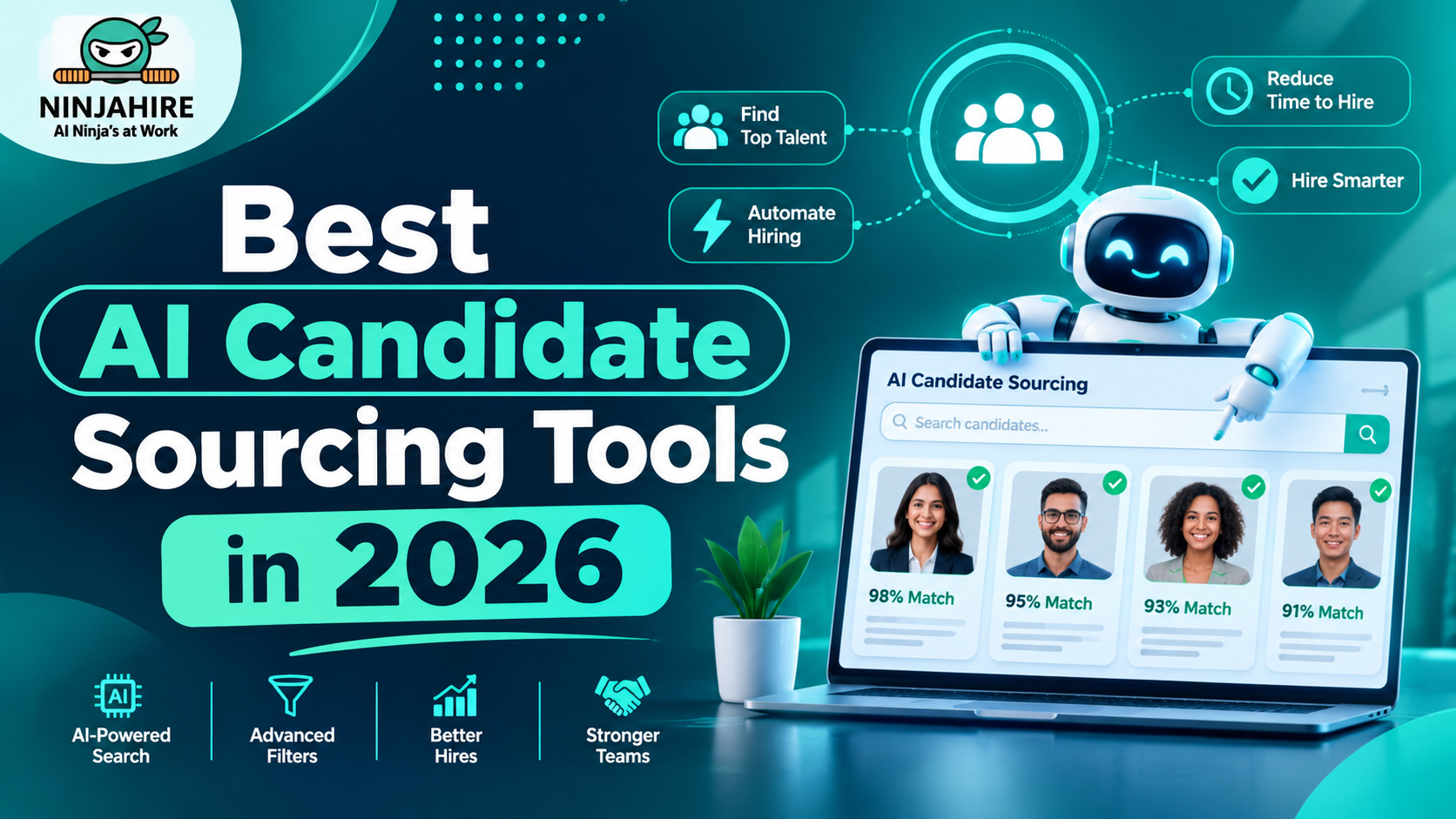
Ninjahire runs three specialised agents — sourcing, outreach and screening — against 2.4B + profiles and across phone, SMS, email, WhatsApp and LinkedIn, with conversational voice and web screening. It integrates with 50+ ATS platforms rather than replacing them. Ninjahire pricing starts at $170 per month for Starter and $509 for Professional on annual billing, with a 30-day trial and no card required.
Sense is built for high-volume and redeployment-heavy staffing, combining an AI recruiter, AI interviewer, voice AI, chatbot, SMS and WhatsApp messaging and interview scheduling on top of Bullhorn, Avionté, JobDiva, LaborEdge and others. Pricing is demo-only, which makes early budget comparison harder than with self-serve competitors.
Key Features to Look For in an AI Recruiting Platform
- Sourcing reach and data freshness — profile volume matters less than how current contact data is and whether enrichment is metered separately.
- Candidate rediscovery — most agencies already own the candidates they need, and candidate rediscovery in your own database is usually cheaper than new sourcing.
- Multichannel outreach — phone, SMS, email and WhatsApp, with adaptive follow-up rather than a single send.
- Conversational screening — voice or web screening that produces structured output, not just a transcript.
- ATS and VMS integration depth — confirm two-way sync, not export-only, and check whether integrations sit above the published price tier.
- Human oversight — a clear decision gate between shortlist and action.
- Security and bias auditing — SOC 2 Type II, encryption, and documented independent bias audits.
- Pricing transparency — understand whether you are buying seats, credits, or both.
How to Choose the Right AI Recruiting Platform
Start with the system of record questions. If your ATS works and your team knows it, buy an AI layer that sits on top and avoid a migration. If your ATS is the bottleneck, a consolidation play like Loxo or Recruiterflow makes more sense than bolting agents onto a system you are about to leave.
Then work through the practical filters: agency size and seat count; permanent versus contract staffing placement mix, since timesheets and billing rule out some platforms entirely; monthly job order volume against credit allowances; and whether the AI capability you are actually buying sits in the published tier or above it. That last point catches more agencies than any other — several vendors publish an attractive entry price while the agentic features live in a quote-based plan.
Compliance belongs in the evaluation, not after it. New York City's Local Law 144 prohibits employers and employment agencies from using an automated employment decision tool unless it has had a bias audit within the prior year, the results are published, and candidates have received the required notice. Agencies placing across multiple states should check the AI hiring laws by state and confirm what each vendor supplies in writing — an independent bias audit report, candidate notice templates, and data retention terms.
How Ninjahire Helps Staffing Agencies Automate Recruitment
Ninjahire is built specifically for staffing operations rather than adapted from corporate TA software. Its AI candidate sourcing agent works continuously across multiple channels and your internal ATS; the outreach agent personalises and follows up across phone, SMS, email, WhatsApp and LinkedIn; and the conversational AI screening agent runs voice and web assessments that return scored, ranked candidates into your pipeline.
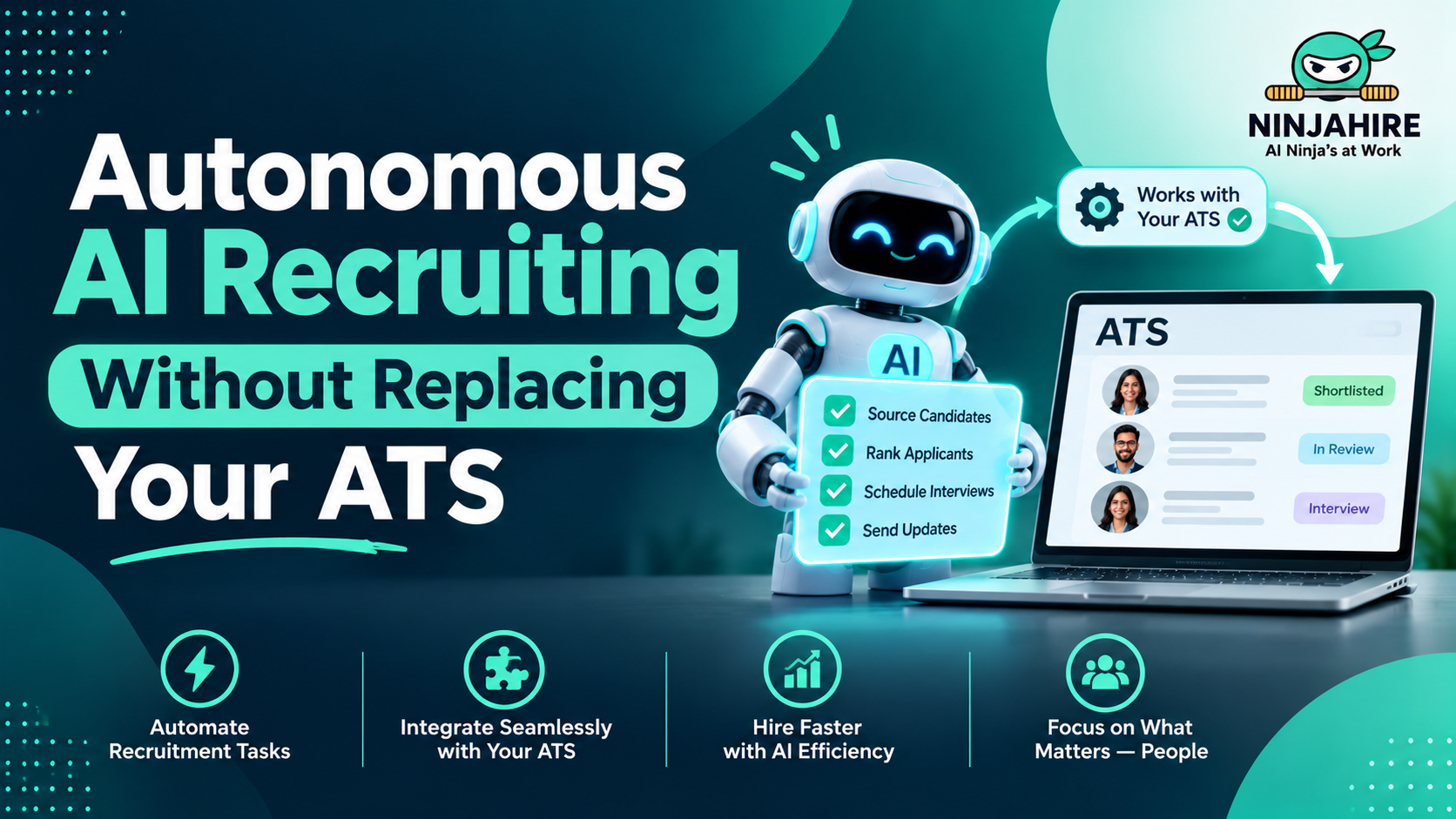
Because it connects to 50+ ATS platforms including Bullhorn, JobDiva, Workday and Greenhouse, agencies can add automation without a migration. The platform is SOC 2 Type II compliant, encrypts data at rest and in transit, and publishes an independent AI bias audit report — relevant for agencies operating under multi-state AI hiring rules.
See how Ninjahire can automate candidate sourcing, outreach and screening for your agency — start the 30-day free trial, no credit card required.
Frequently Asked Questions
What is the difference between AI recruiting software and an ATS?
An ATS is the system of record that stores candidates, job orders and placements and tracks them through stages. AI recruiting software performs the work — finding candidates, sending outreach, running screens, scoring fit. Some platforms do both; many of the strongest AI tools do only the second and integrate with your existing ATS.
Can AI recruiting platforms work with an existing agency CRM?
Most can, but integration depth varies and is often tier-dependent. Confirm three things before buying: whether sync is two-way or export-only, whether your specific ATS is natively supported or needs custom work, and whether integrations are included in the plan you are quoted or sit in a higher tier.
Which AI recruiting tools are suitable for small staffing agencies?
Agencies under ten recruiters typically do best with a low per-seat entry point and self-serve onboarding. Manatal, Crelate Essentials, Recruit CRM Pro and Juicebox Starter all publish entry pricing under $100 per seat. If the pain is sourcing and screening capacity rather than candidate tracking, an agent layer on your current ATS is usually the cheaper fix.
How should agencies evaluate the ROI of AI recruiting software?
Measure against recruiter hours reclaimed and submission speed, not placements directly — too many other variables affect placements. Track time to submit, screens completed per recruiter per week, and cost per screen before and after. Run these during a trial on live job orders rather than accepting vendor benchmarks.
How should agencies protect candidate data when using AI recruitment tools?
Require SOC 2 Type II at minimum, confirm encryption in transit and at rest, and establish where candidate data is stored and whether it trains vendor models. Ask for the independent bias audit report and candidate notice templates. Work through a vendor contract checklist so data retention and deletion terms are built into the agreement rather than left to the vendor's default policy.