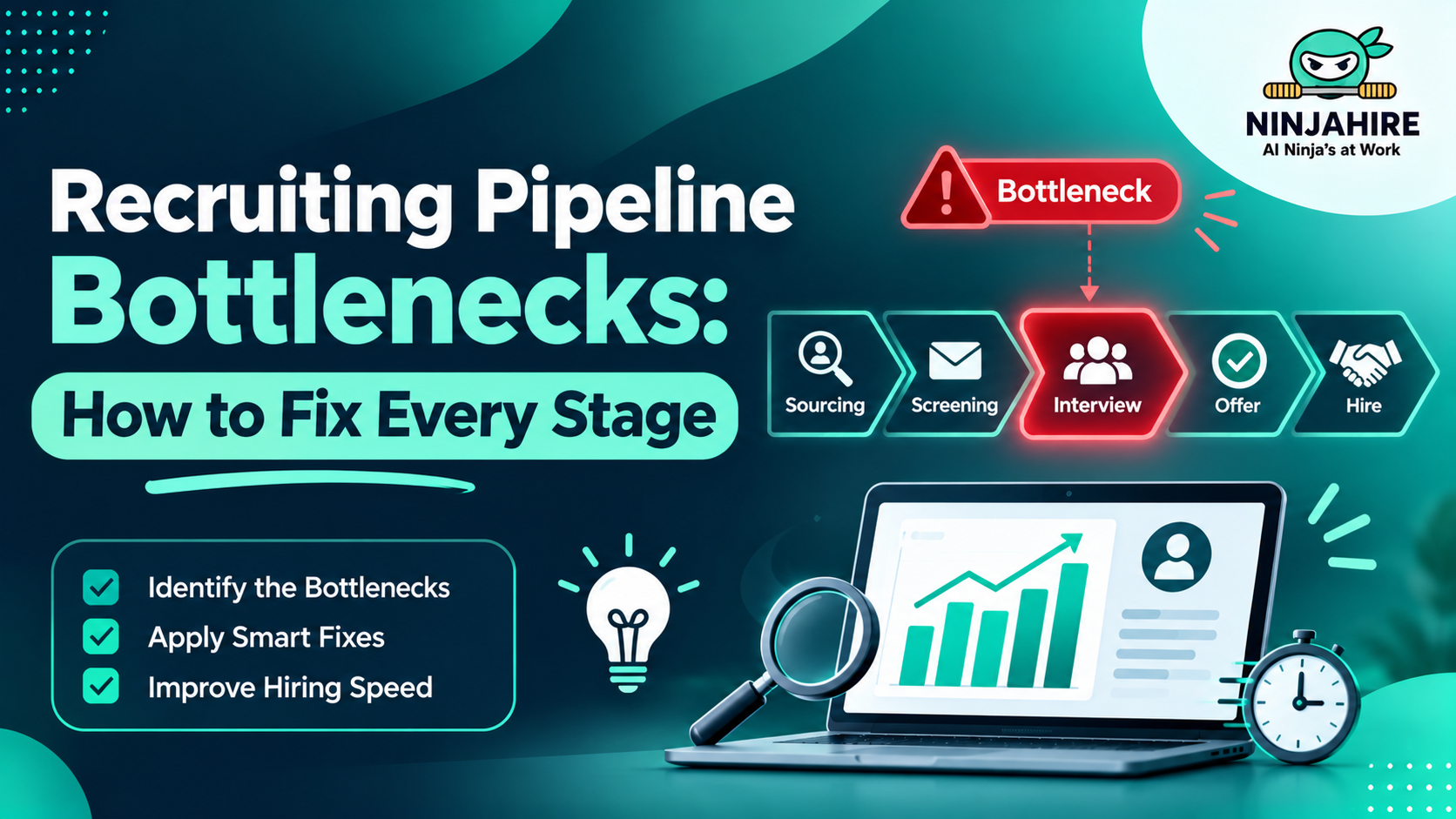
Most recruiting teams know their hiring is slower than it should be. Far fewer can name the stage responsible. A requisition that takes 50 days to close rarely loses that time evenly; it loses it in one or two places, usually while candidates wait for a decision. This guide covers how to locate recruiting pipeline bottlenecks, what causes the most common ones, which metrics expose them, and where automation helps.
What Are Recruiting Pipeline Bottlenecks?
A recruiting pipeline bottleneck is any stage of the hiring process where candidates arrive faster than they can be moved forward, causing delays, disengagement, and avoidable drop-off. The stage itself is not always broken. More often, the capacity, decision-making, or communication at that stage cannot keep pace with the volume entering it.
The damage compounds. Candidates lose momentum and accept offers elsewhere. Recruiters absorb the delay as rework: chasing feedback, re-engaging cold candidates, rescheduling interviews. The business carries the vacancy longer than necessary.
SHRM's 2026 recruiting benchmarking, drawn from more than 4,600 organizations, reports a median time to fill of 39 calendar days for nonexecutive positions, down from 44 days the previous year. A median says nothing, though, about which stage consumed those days inside any one organization.
How to Identify Bottlenecks at Every Stage of the Recruiting Pipeline
Finding a bottleneck means examining the recruitment pipeline stage by stage rather than looking at the total. Four signals do most of the diagnostic work:
- Stage conversion rate. A sharp fall between two adjacent stages points directly to friction.
- Time in stage. Long dwell time usually means waiting on a person, not on work being done.
- Candidate drop-off. Separates rejection, which is a decision, from attrition, which is a failure.
- Recruiter and hiring manager feedback. Qualitative input that explains what the numbers show.
Apply all four before changing anything. The table below maps the common failure point and the most revealing metric for each stage of the funnel.
| Pipeline Stage | Common Bottleneck | Metric to Monitor |
|---|---|---|
| Candidate sourcing | Too few qualified applicants | Qualified candidates per source |
| Application | Complicated application process | Application completion rate |
| Screening | Manual resume reviews | Screening turnaround time |
| Interview scheduling | Calendar coordination delays | Time from screening to interview |
| Interviewing | Inconsistent evaluation | Interview-to-next-stage conversion |
| Offer | Slow approvals or uncompetitive offers | Offer acceptance rate |
| Hiring | Delayed final decisions | Time to fill |
How to Measure Candidate Drop-Off Between Stages
Divide the candidates who left a stage without being rejected or advanced by the total who entered it, then multiply by 100. If 200 candidates enter screening, 120 advance, 30 are rejected, and 50 stop responding, drop-off for that stage is 25%.
The comparison matters more than the number. Rising drop-off at a stage that used to convert well almost always reflects a process change: a longer assessment, a new approval step, a slower response. Where an applicant tracking system cannot report this, exporting stage-change timestamps to a spreadsheet gives the same view.
Common Recruiting Pipeline Bottlenecks and How to Fix Them
Low-quality candidate sourcing. A shortage of qualified applicants is usually a targeting problem, not a volume problem. Measure which sources produce candidates who pass screening, not which produce the most applications, then reallocate spend.
High application abandonment. Appcast data reported by SHRM found that 92% of people who begin an online job application never complete it, with length, repeated data entry, and forced account creation among the leading causes. Cut required fields to what a screening decision needs, allow resume-based applications, and test the form on a phone.
Poor candidate communication. Silence produces withdrawal. Trigger a status update at every stage change, and set a maximum interval after which a candidate hears something regardless of progress.
How to Reduce Resume Screening Delays
AI resume screening backs up when review is manual and the criteria live in the reviewer's head. Agree on must-have requirements before the role opens, convert them into knockout questions, and rank candidates against those criteria instead of reading in order received. Set a turnaround commitment, such as 48 hours from application to screening decision, and report it weekly.
How to Improve Interview Scheduling and Feedback
Interview Scheduling delays are coordination failures, not calendar shortages. Collect interviewer availability in advance, let candidates self-schedule from open slots, and cap panel size. Feedback delays need accountability: a structured scorecard within 24 hours, with the stage left visibly open until it arrives.
How to Identify Offer-Stage Conversion Problems
A falling offer acceptance rate usually traces to compensation misaligned with the market, a process long enough that candidates accumulate competing offers, or expectations never tested earlier. Ask about compensation range, notice period, and competing processes during the first screening call, and review every decline. Patterns emerge across five or six.
Recruiting Pipeline Metrics Every Team Should Track
A small set of metrics tracked consistently beats a large dashboard reviewed occasionally:
- Time to fill and time to hire, measuring vacancy cost and process efficiency.
- Stage-by-stage conversion rate, the core diagnostic for locating bottlenecks.
- Candidate drop-off rate by stage.
- Screening turnaround time from application to decision.
- Interview no-show rate, an early signal of weak confirmation or communication.
- Offer acceptance rate, segmented by decline reason.
- Source quality, measured by candidates who pass screening, not applications generated.
- Cost per hire, to judge whether speed gains carry disproportionate expense.
Segment each by role, department, location, and sourcing channel. Blended averages hide the problem: a warehouse role and a senior engineering role in one report produce a number describing neither.
How to Optimize the Recruiting Pipeline With Automation
Automation reduces delays caused by manual handoffs and waiting, which is where most pipeline time is lost. The areas that benefit most are candidate sourcing and matching, resume screening, outreach and follow-up sequences, interview scheduling, structured interview workflows, candidate status updates, and analytics that report stage conversion without manual exports.
Sequencing matters more than tool selection. Automate a stage only after data has shown it to be a bottleneck, then measure that stage metric for four to six weeks to confirm the delay was removed rather than shifted downstream.
How Ninjahire Can Help Streamline Recruiting Workflows
Ninjahire applies automation across the stages where pipelines most often stall. AI sourcing agent searches more than 2.4 billion profiles alongside connected job boards and an existing ATS, then matches and ranks candidates against the role. The outreach agent handles personalized follow-up across phone, SMS, email, WhatsApp, and LinkedIn, with scheduling and response tracking built in, addressing the silence that drives mid-funnel drop-off.
The AI interviewer runs structured interviews by phone, video, or web, generates questions from each candidate's resume, scores responses against a defined rubric, and returns ranked shortlists with transcripts and shareable reports. Results sync through integrations with more than 50 ATS platforms, so screened candidates re-enter the existing pipeline, not a parallel one.
Identify where your recruiting workflow is losing time, then see how Ninjahire's AI-powered sourcing, outreach, screening, and interviewing close those gaps. Book a demo to review your pipeline stage by stage.
Frequently Asked Questions
What is the difference between a recruiting pipeline and a recruiting funnel?
A recruiting pipeline is the set of candidates moving through defined hiring stages, including passive talent who have not applied to a role. A recruiting funnel is the measurement view of that movement: how many candidates enter each stage and what proportion converts. Pipeline describes supply; funnel describes conversion.
How often should recruiting teams review pipeline performance?
Weekly for active requisitions, where stalled candidates and turnaround breaches can still be recovered. Monthly or quarterly for structural review, where conversion trends, source quality, and offer acceptance patterns become meaningful. High-volume hiring justifies a shorter cycle than specialist search.
What is a good candidate conversion rate for each recruiting stage?
No single benchmark applies. Conversion varies by role seniority, industry, hiring model, and sourcing channel, and a rate that signals a healthy funnel in hourly hiring would indicate a problem in executive search. Establish a baseline from your own data per role family, then treat deviation from it as the signal.
How can small recruiting teams diagnose bottlenecks without advanced analytics software?
Export stage-change dates from the applicant tracking system into a spreadsheet and calculate two columns: days spent in each stage, and the percentage advancing from it. Ten to fifteen recent requisitions are usually enough for a pattern to appear. Pair this with a recorded reason for every withdrawal.
When should a company automate its recruiting process?
Automate when a stage has been measured, found to be a repeated constraint, and the delay comes from manual effort or waiting rather than judgment. Screening, scheduling, and follow-up communication meet that test most often because the work is high-volume and rule-based. Final interviews and offer decisions rarely do: the delay there is a decision-making problem technology cannot resolve.