.png)

What Is Recruiting Automation Software?
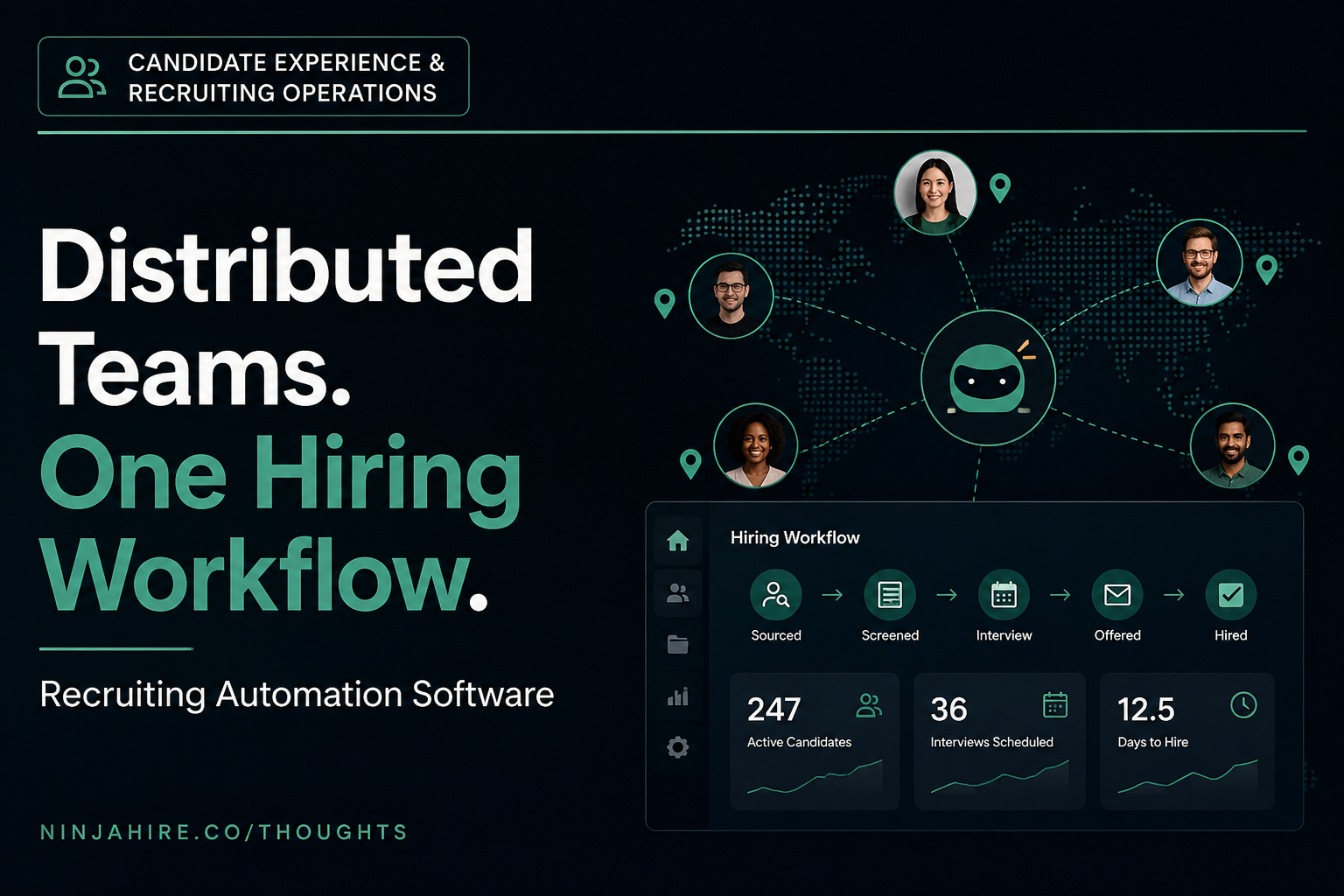
Recruiting automation software is a platform that uses rules-based logic and AI to automate repetitive tasks in the recruiting workflow — candidate outreach, resume screening, interview scheduling, follow-up communication, status updates, and pipeline reporting. It connects the different stages of the hiring process with automated triggers and actions so that candidate movement, recruiter notifications, and hiring manager updates happen without manual intervention at every step.
The practical difference between an ATS and a recruiting automation platform: an ATS stores and tracks candidate information. Automation software acts on that information — triggering messages, scheduling interviews, updating stakeholders, and moving candidates through defined workflow stages based on status changes or timing rules.
For distributed teams, the key capabilities are: workflow automation (standardized processes that run consistently regardless of which recruiter is handling a role), candidate communication (timely outreach and follow-up that doesn't depend on a recruiter's inbox being clear), scheduling automation (interview coordination without the email tennis), and pipeline visibility (real-time status accessible to all stakeholders regardless of time zone).
Why Distributed Hiring Teams Struggle With Coordination
The coordination challenges in distributed recruiting aren't always dramatic — they're usually a series of small delays that compound into significant hiring slowdowns. A candidate waits two days for a response because the recruiter handling their application is in a different time zone. A hiring manager doesn't get a pipeline update because the recruiter covering their requisition works on a different delivery team.
| Coordination Challenge | Operational Impact |
|---|---|
| Recruiters across time zones | 8–16 hour response gaps; candidates in active searches move to competitors |
| Multiple hiring managers | Different update preferences create inconsistent stakeholder experiences |
| Global candidates | Scheduling across international time zones requires 2–4 extra coordination touchpoints per interview slot |
| Communication delays | Average 4–6 hour lag on follow-ups in distributed teams vs. same-hour response in co-located operations |
| Workflow inconsistencies | Different recruiters apply different processes; shortlist quality and candidate experience vary |
| Visibility gaps | No single source of pipeline truth; stakeholders interrupt recruiter workflow with status requests |
| Recruiter handoffs | Candidates fall through the gap when coverage changes; context doesn't transfer reliably |
MSP staffing programs feel these challenges acutely — coordinating between multiple vendor suppliers, client hiring managers, and VMS workflows across locations means the coordination surface is larger and the margin for error smaller.
The Hidden Cost of Manual Recruiting Coordination
The visible cost of manual coordination is recruiter time — hours spent sending follow-up emails, chasing scheduling confirmations, composing status updates, and logging activity in the ATS. Research consistently puts this administrative overhead at 30–40% of a recruiter's working week in distributed operations.
"Distributed hiring doesn't fail because teams lack talent. It fails when coordination can't keep up with hiring demand."Recruiting Operations Insight — NinjaHire
Recruiting Workflows Distributed Teams Should Automate
The highest-value targets are workflows that are repetitive, time-sensitive, and currently dependent on individual recruiter memory or inbox management.
Candidate Outreach
Automation handles send timing, channel selection, and follow-up sequencing so every candidate in the sourcing pipeline receives consistent, timely first contact — regardless of which recruiter sourced them or what time zone the candidate is in.
Resume Screening
Automated screening parses incoming applications, evaluates qualification fit against defined criteria, and surfaces a ranked shortlist for recruiter review — ensuring consistent screening standards across all team members.
Interview Scheduling
Automating this step — with calendar integration, time zone detection, and self-scheduling options — eliminates the typical 3–5 round-trip email exchange. For global hiring, this is one of the single highest-leverage automation investments available.
Follow-Up Communication
Automated follow-up sequences — post-interview check-ins, status updates, next-step confirmations — maintain engagement without requiring a recruiter to manually track every outstanding touchpoint across the pipeline.
Hiring Manager Updates
Automated pipeline reports — triggered weekly or at status change milestones — give hiring managers the visibility they need without interrupting recruiter workflow.
Pipeline Reporting
Automated dashboards and scheduled reports give team leads real-time visibility into where roles stand, where bottlenecks exist, and which team members or locations are running behind — without anyone building a spreadsheet.
Recruiting Automation vs Manual Recruiting
| Capability | Manual Process | Automated Process |
|---|---|---|
| Communication | Depends on recruiter availability; gaps during off-hours and handoffs | Consistent, timely messages regardless of recruiter workload or time zone |
| Scheduling | 3–5 round-trip emails; 2–5 day delay to confirmed booking | Self-scheduling links; same-day confirmation; time zone detection built in |
| Follow-Ups | Dependent on recruiter memory; commonly missed under volume pressure | Triggered automatically by status or timing rules; no candidates fall through |
| Recruiter Capacity | 30–40% of time consumed by coordination and admin | Admin overhead reduced significantly; recruiters focus on judgment-heavy work |
| Workflow Visibility | Fragmented across email threads, spreadsheets, ATS notes | Centralized pipeline dashboards; shared visibility across all locations |
| Hiring Speed | Coordination delays add 5–8 days in distributed environments | 3–7 day reduction typical with automated scheduling and follow-up |
| Candidate Experience | Variable; high-quality candidates often lost to faster-moving competitors | Consistent, responsive experience regardless of recruiter location |
Benefits of Recruiting Automation for Distributed Teams
Faster Hiring
Removing manual coordination steps compresses time-to-hire. Scheduling that previously took four days happens in 24 hours. Each compressed step adds up to a materially faster overall process — typically 3–7 days in distributed environments.
Better Candidate Experience
Candidates evaluate recruiters on responsiveness. In competitive talent markets, consistent responsiveness is a genuine differentiator. An automated follow-up within two hours carries more weight than one arriving two days later.
Improved Recruiter Productivity
When automation handles outreach, scheduling, follow-ups, and reporting, recruiters shift toward higher-value activities: qualification conversations, candidate coaching, client relationship management, passive sourcing.
Consistent Workflows
Automation enforces a consistent workflow regardless of who is handling a requisition — every candidate receives the same process, every hiring manager receives the same communication cadence.
Increased Hiring Capacity
A distributed team running structured automation can handle 40–60% more active requisitions than the same headcount managing the same workload manually.
Recruiting Automation for Staffing Agencies
Staffing agencies running distributed delivery teams have a specific operational profile that makes recruiting automation high-value: multiple clients, multiple role types, submission deadlines, and recruiters managing relationships across different cities simultaneously.
MSP staffing programs layer additional coordination complexity on top of standard recruiting workflows. VMS platforms, client-specific submission requirements, and tight submission windows mean manual coordination is a source of missed placements. Automated workflows that trigger submission reminders, track VMS deadline windows, and maintain candidate pipeline visibility give MSP-focused agencies a meaningful operational advantage.
Multi-client recruiting creates a context-switching cost that manual operations absorb as lost time and errors. Automation that applies client-specific workflow rules — different screening criteria, reporting cadences, and candidate communication templates per client — removes the cognitive overhead of tracking those differences manually.
"The staffing firms that scale without proportional headcount increases are the ones that figured out which workflows a recruiter needs to own and which ones a system can run better."Talent Operations Perspective
Recruiting Across Multiple Time Zones
International scheduling is the friction point that derails global recruiting most visibly. A recruiter in London coordinating an interview between a candidate in Singapore and a hiring manager in New York must manually calculate availability across a 13-hour spread. Self-scheduling automation with time zone detection removes this calculation entirely.
Practical note: When evaluating platforms for global operations, prioritize native time zone handling in scheduling, language flexibility in candidate communication templates, and reporting that aggregates pipeline data across regions.
Candidate communication timing matters more than most teams realize. Automation that optimizes send timing for candidate time zone — rather than recruiter time zone — improves open rates and response rates for global pipelines.
Can Recruiting Automation Replace Recruiters?
No — recruiting automation handles repetitive administrative tasks, not the judgment-intensive work that makes recruiting valuable. Recruiters still own relationship building, candidate evaluation, hiring manager collaboration, compensation discussion, and the final recommendation. Automation handles coordination, communication sequencing, and reporting — freeing time for work that requires human judgment.
The best distributed recruiting teams use automation to eliminate the administrative tax on recruiter time and concentrate human attention on the decisions that move the needle. That's not replacing recruiters — it's removing the tasks that prevent them from doing their best work.
Recruiting Automation Software Comparison
| Platform | Workflow Automation | Scheduling | Staffing Use Case | Distributed Support |
|---|---|---|---|---|
| NinjaHire Best for Staffing | ✓ Full workflow automation | ✓ Built-in scheduling automation | ✓ Staffing-first design | ✓ Multi-location pipeline visibility |
| Sense | ✓ Strong engagement automation | Moderate | ✓ Staffing-focused | Moderate |
| Paradox | ✓ Conversational AI workflows | ✓ Strong scheduling AI | Hourly/high-volume primary | Moderate |
| Bullhorn Automation | ATS-native automation | Basic | ✓ Staffing-native | Limited cross-location features |
| Avature | ✓ Highly configurable | Moderate | Enterprise-primary | ✓ Strong for global enterprise |
Coordination Is the Constraint — Automation Is the Fix
The challenges distributed hiring teams face aren't fundamentally talent shortages or bad recruiting processes. They're coordination challenges — the predictable result of manual workflows stretched across locations, time zones, and multiple stakeholders who don't share the same physical space or working hours.
Recruiting automation software addresses those challenges at the source. Consistent workflows run regardless of recruiter location. Candidate communication happens at the right time regardless of time zone. Scheduling coordination happens in hours rather than days. Pipeline visibility is available to every stakeholder without anyone assembling it manually.
The recruiting teams consistently winning on time-to-hire, candidate experience, and recruiter retention in distributed environments aren't staffed differently — they're systematized differently.