Orchestration Layers: How Our Agents Talk to Each Other to Close Roles Faster
Explore how AI agent orchestration connects recruiting workflows, coordinates agent handoffs and supports enterprise staffing operations.
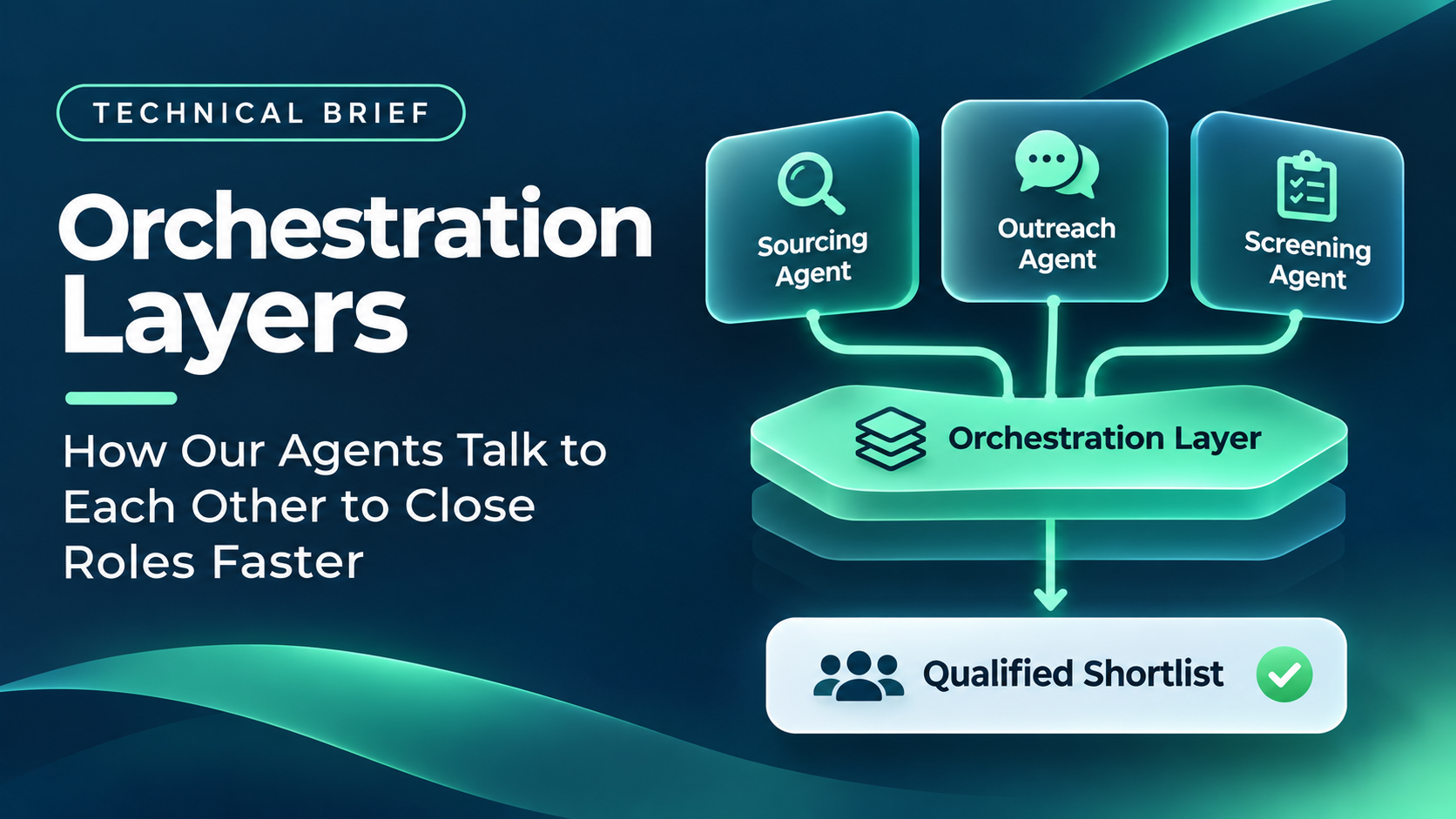
How specialist recruiting agents are coordinated, how information moves between sourcing, outreach and screening, and what enterprises should verify before trusting an orchestration layer.
Why AI Recruiting Needs an Orchestration Layer
A staffing agency receives a new client requisition at nine in the morning. By noon the work has touched an applicant tracking system, a candidate database, at least one outreach channel and a screening process. Each step depends on the one before it, and each produces information the next one needs. Automate any single step and the recruiter is left doing the connecting work: exporting a list, rewriting a message, retyping a screening note into a record. AI agent orchestration removes that connecting work by coordinating specialist agents toward one hiring outcome.
Sourcing and engagement are different processes with different data. Sourcing produces profiles. Engagement produces responses, availability and consent. Screening needs both, plus role-specific criteria. Candidate status has to be tracked across all of it, and recruiters need to see progress without asking three systems. When those pieces are disconnected, coordination falls back on people, which is why automating individual tasks does not automate the workflow. So how does AI automate the recruitment process? Not by replacing recruiters, but by running the repeatable stages (search, contact, first-round screening and record updates) while recruiters keep the judgment calls. We have already described what each specialist does in our overview of multi-agent AI recruiting. This article is about the layer above them: what assigns the work, moves the information and decides what happens next.
What Is AI Agent Orchestration?
AI agent orchestration is the coordination layer that assigns work to specialist AI agents, passes context and structured outputs between them, tracks progress and applies rules for sequencing, routing and escalation. An orchestration layer in AI is the component, or set of rules, that decides which agent acts next and what information it receives.
In practice that covers seven jobs: AI agent coordination, task assignment, delegation, handoffs, context exchange, workflow execution and progress tracking. Delegation gives a bounded task to a specialist and takes the result back. A handoff transfers responsibility for the next step. Context exchange decides what the receiving agent is told. Progress tracking records where every candidate and requisition stands.
Conventional workflow automation can also branch, loop and call APIs, so the distinction is not that one has logic and the other does not. The difference is what executes each step and how well it copes with variation.
| Dimension | Traditional task automation | Multi-agent orchestration |
|---|---|---|
| What runs each step | Fixed rules and scripted actions | Specialist agents directed by rules, code or a coordinating model |
| Input handling | Expects consistent, structured input | Can interpret variable input such as free-text job descriptions and candidate replies |
| Context between steps | Field values passed along | Structured outputs plus selected context for the next agent |
| Failure behavior | Retry or stop on a defined error | Needs rules for partial, ambiguous and low-confidence results |
| Oversight | Review of logs and outputs | Approval gates, exception queues and traceable decisions |
| Best fit | Stable, repeatable steps | Multi-stage work with variable inputs |
How Multi-Agent Orchestration Works
Multi-agent orchestration draws on a small set of patterns, and any AI orchestration framework or AI agent workflow orchestration design is built from them. The OpenAI Agents SDK guide to agent orchestration separates two broad approaches: letting a model decide the sequence, and letting code decide it. Model-driven control adapts to open-ended tasks. Code-driven control is more predictable, easier to audit and usually cheaper to run.
In a manager pattern, a central orchestrator, meaning one coordinating agent, receives the goal, calls specialists as tools and keeps control of the final result. In a handoff, control moves to the receiving agent, which continues the work. The OpenAI documentation on handoffs describes this as delegating part of a conversation to another agent. The distinction matters: an agent used as a tool returns a result and the caller carries on, while a handoff changes who is responsible for the next step.
Microsoft's Agent Framework orchestration documentation lists sequential, concurrent, handoff, group chat and Magentic patterns, which differ mainly in who controls the next step. AWS describes a supervisor pattern that adds asynchronous orchestration, fallback handling and state tracking across loosely coupled agents in its multi-agent collaboration write-up.
| Pattern | Who controls the next step | Strength | Limitation |
|---|---|---|---|
| Manager with agents as tools | Coordinating agent | Central view of progress and one place to enforce rules | The coordinator can become a bottleneck or single point of failure |
| Handoff | The agent currently working | Natural routing to a specialist | Harder to trace; responsibility moves with each transfer |
| Code-driven pipeline | Application logic | Predictable cost, speed and audit trail | Rigid when the process varies |
| Model-driven routing | A language model | Adapts to unexpected situations | Variable behavior; harder to test and audit |
No platform needs every pattern, and more agents do not automatically mean better results. A workflow with clear stage boundaries, such as sourcing, outreach and screening, leans toward code-defined sequencing with conditional branches. That is a design observation about the category, not a statement about any vendor's internals, ours included.
The Five Layers of an AI Recruiting Workflow
The model below is a conceptual AI orchestration architecture for recruitment workflow automation. It applies to any platform and is not a description of Ninjahire's internal design.
Requisition intake and task definition. Turns a job description, intake call or ATS requisition into task definitions: must-have skills, location, pay range, knockout criteria and approval rules. Vague intake produces vague downstream work, so this layer sets the quality ceiling.
Orchestration and task routing. Decides which agent receives which task, in what order and under what conditions. It applies sequencing, branching and escalation rules and owns the question of what happens next.
Specialist agent execution. Sourcing, outreach and screening agents each perform one bounded job with their own tools and data access.
Information exchange and workflow state. Carries structured outputs between stages and records the status of every candidate against every requisition, so the workflow can resume, retry or report.
Governance, review and final outcomes. Approval gates, exception queues, audit records and the recruiter decisions that close the loop.
How Ninjahire Coordinates Sourcing, Outreach and Screening
These AI recruitment agents work on one problem. Staffing operations depend on candidate discovery, engagement and qualification happening in the right order for the same requisition. Our approach focuses on connecting specialised recruiting capabilities rather than treating sourcing, outreach and screening as separate tools. For AI recruiting workflow automation, our platform is designed around the practical requirements of staffing teams, where a recruiter describes a role in plain language and configured agents carry the work forward while the recruiter keeps control of requirements and hiring decisions.
Sourcing Agent
The Sourcing Agent starts from the talent a team already has. As described on our AI sourcing page, it searches the connected ATS or CRM first, expands through NinjaGraph and supported job boards such as Monster, Indeed, ZipRecruiter, Dice and CareerBuilder, merges and deduplicates overlapping records, assesses fit against the requisition and attempts contact enrichment through eligible providers. The result is a set of contact-ready candidates, or a shortlist a recruiter reviews before outreach.
Outreach Agent
The Outreach Agent engages those candidates through the channels a team approves: email, SMS and AI phone calls, with WhatsApp and LinkedIn depending on configuration and account permissions. It records replies and stops unnecessary follow-ups when a candidate responds or opts out. Recruiters control templates, consent, channels, scheduling and approvals.
Screening Agent
The Screening Agent delivers AI-led screening through structured interviews by phone, video or web chat, using resume-personalized questions, customizable rubrics and knockout criteria. According to our AI screening agent page, it returns ranked results with transcripts and summaries that sync to supported ATS records, and it can run up to 100 screening conversations in parallel.
Our public product documentation describes the agents passing results and context between stages, with configurable approval points. It does not detail the internal coordination mechanism, and this article does not guess at one.
See how Ninjahire connects recruiting workflows. Start a 30-day trial and run a real requisition through sourcing, outreach and screening.
Explore the platformHow AI Agents Communicate and Transfer Information
How do AI agents communicate with each other? AI agent communication in production systems is mostly structured payloads rather than open conversation. One stage emits a defined output, and the next receives the fields it needs and little else. Agent-to-agent communication can also be conversational, as in group chat patterns, but recruiting stages with clear boundaries are better served by explicit contracts between them.
Clean AI agent handoffs also depend on explicit workflow dependencies, meaning which outputs a stage must receive before it may start. Three distinctions prevent confusion. Shared context is not shared persistent memory: context is what a given agent is shown for a given task, and it can be rebuilt each time. Workflow state is not agent memory: state records where each candidate and requisition stands, and it must survive an agent restart. A handoff is not a tool call: by default, the OpenAI SDK passes the full conversation history in a handoff and offers input filters to control what the next agent sees. Choosing what each agent is shown is often called context engineering, and it is a design task, not an afterthought.
Every handoff needs identifiers that survive the journey: a candidate ID, a requisition ID and the source record in the ATS. Without them, a reply cannot be matched to the right role and a screening result cannot be written back to the right record. An AI recruiting workflow moves a candidate from sourcing to screening only when each stage has produced the validated outputs the next one requires: a deduplicated record, usable contact data, a recorded response and an accepted screening invitation. Beyond identifiers, a useful handoff carries task inputs, structured outputs, candidate response status, screening outcomes, relevant context and a next-action instruction. The receiving stage should validate what it receives. Missing contact data, an unresolved duplicate or an unclear response status are reasons to hold a candidate, not to guess.
From a recruitment operations perspective, a handoff is only useful when the receiving stage has what it needs to proceed. The table is an illustrative information-exchange model for moving candidates from sourcing to screening. It is not a confirmed Ninjahire data schema.
| Handoff | Information carried | Checked before the next stage starts | Why it matters |
|---|---|---|---|
| Requisition to sourcing | Job requirements, skills, location, pay range, candidate criteria | Required fields present; knockout criteria separated from preferences | Weak intake produces weak search results |
| Sourcing to outreach | Candidate and requisition IDs, match rationale, contact details, source record, opt-out status | Duplicates resolved; contact data present; opted-out records excluded | Prevents repeat or unauthorized contact |
| Outreach to screening | Response and interest status, availability, channel preference, conversation summary | Positive response recorded; candidate eligible for invitation | Screening starts only for interested candidates |
| Screening to recruiter | Transcript, rubric scores, knockout results, evaluation summary, flagged concerns | Score components visible; low-confidence results flagged | Recruiters need evidence, not only a number |
| Recruiter to workflow | Approval, rejection, feedback or next action, with reason | Decision recorded with an owner | Closes the loop and updates the record |
Sequential, Parallel and Conditional Orchestration
Can AI agents perform recruitment tasks simultaneously? Yes, where the tasks are independent. Whether they should depends on the dependencies between them. Multi-agent workflow automation uses three basic shapes, and a recruiting workflow usually combines them.
Sequential orchestration runs tasks in order because each needs the previous result: sourcing, then outreach, then screening for one candidate. Parallel orchestration runs independent tasks at the same time, such as searching several approved candidate sources for the same requisition and merging the results. Conditional orchestration chooses the next task from a defined outcome: a candidate who responds positively proceeds to screening, while one who stays silent receives a follow-up or is closed.
Google Cloud's guidance on choosing an agent design pattern recommends the sequential pattern for highly structured, repeatable processes, and notes that the parallel pattern can reduce latency while adding cost and complexity. Those trade-offs are why AI agent task delegation needs explicit rules rather than enthusiasm for concurrency.
| Pattern | Recruiting example | Useful when | Coordination overhead |
|---|---|---|---|
| Sequential | Sourcing, outreach and screening for one candidate | Each step needs the previous result | Low, but slowest end to end |
| Parallel | Searching several approved sources for one requisition | Tasks are independent | Results must be merged and deduplicated; higher peak resource use |
| Conditional | Positive responders proceed to screening | The next step depends on an outcome | Rules are needed for every outcome, including no response |
Concurrency also exists inside a single stage. Our screening agent page documents up to 100 screening conversations running in parallel. Running several source searches side by side for one requisition is a separate design choice.
Sequential
Parallel
Conditional
Managing Workflow State, Exceptions and Human Approvals
Enterprise AI workflow automation needs more than agents passing messages. It needs workflow state: a record of which tasks are in progress, completed, failed or waiting for a person. Microsoft's Agent Framework workflow documentation treats checkpointing, event-based observability and human-in-the-loop requests as core workflow capabilities rather than extras, and that is a useful benchmark for any AI workflow monitoring design.
Staffing work produces awkward cases daily. A candidate answers half of an outreach thread and goes quiet. A screening call drops at question six. A client changes the required certification after sourcing has started. So what happens when an AI agent fails to complete a task? In a well-designed workflow the answer is defined in advance, not improvised.
| Situation | General handling | Human role |
|---|---|---|
| Outreach failure, such as a bounced email or invalid number | Mark the channel failed, try an approved alternative, log the outcome | Review when every channel fails |
| Incomplete candidate response | Hold as pending, limit follow-ups, stop on reply or opt-out | Decide on candidates stuck in pending |
| Duplicate candidate records | Merge or flag before outreach begins | Resolve ambiguous matches |
| Interrupted screening | Keep the partial transcript, offer to resume, never score as complete | Review partial or low-confidence results |
| Changed job requirements | Version the requirement and re-evaluate affected candidates | Approve the change and its impact |
| Failed agent task | Retry within limits, then route to an exception queue | Own the exception queue |
Retry logic needs limits. Repeated attempts against one candidate's phone number are a compliance problem, not a resilience feature. Audit records matter for the same reason: they show what each agent did, with which inputs, and who approved what.
Here is what we can confirm about our own platform. Our AI recruiter documentation states that follow-ups stop once a candidate responds or opts out, that Autopilot workflows include automatic handoffs and exception handling, and that human-in-the-loop operation lets a recruiter approve criteria, messages, shortlists or stage transitions before the next action. Through ATS integration, screening results sync to candidate records on the platforms listed on our integrations page, subject to what each integration supports. Our guide to human-in-the-loop AI recruiting covers which decisions should keep a named reviewer. Retry limits, exception queues and audit exports are exactly what a buyer should ask us to show in a demonstration.
How Orchestration Supports Multiple Job Requisitions
Consider a staffing agency working three requirements at once: contract Java backend engineers for one client, forklift operators across two shifts for another, and IT support analysts for a third. Skills, certifications, channels, screening questions and urgency all differ. Recruitment process orchestration has to keep them apart.
That means each requisition carries its own criteria and screening rubric. Candidate status belongs to the pairing of a candidate and a requisition, not to the candidate alone, because the same person may be qualified for one role and ineligible for another. Client-specific details such as pay range or shift pattern stay attached to their requisition. Candidate pipeline management across requisitions matters here. Recruiters need one view across all of them that shows where each requisition is stalling, which is the core of AI recruiting operations at scale.
Our AI recruiter page states support for multiple client campaigns with role-specific criteria and reporting, and our screening page describes screening applicants across several client roles at once. Questions about how client data is separated belong in your evaluation, and the next section covers them.
Criteria A, rubric A
Stage: outreach
Criteria B, rubric B
Stage: screening
Criteria C, rubric C
Stage: sourcing
What Enterprises Should Evaluate in AI Orchestration Platforms
Enterprise AI orchestration, like any enterprise AI automation, is judged on operations, not agent counts. The checklist applies to any autonomous recruiting platform, ours included. The right-hand column names the evidence worth requesting.
| Area | What to ask | Evidence to request |
|---|---|---|
| Integration reliability | Which ATS and VMS operations are read, write or two-way? | Live demo on your own ATS; sync failure behavior |
| Data permissions | What data can each agent access? | Role and scope documentation |
| Client-level isolation | How are client records and criteria separated? | Architecture notes and contract terms |
| Workflow scalability | How does it behave at peak requisition volume? | Reference customer at similar volume |
| Execution monitoring | Can you see every task's status? | Dashboard walkthrough |
| Error handling | What happens when a step fails or is partial? | Documented exception paths |
| Failure recovery | Can a workflow resume without duplicate contact? | Recovery demonstration |
| Agent observability | Can you trace which agent did what, with which inputs? | Trace or log samples |
| Audit trails | Are criteria, scores, reviewers and overrides retained and exportable? | Sample export |
| Human oversight | Which stages need approval, and is it configurable? | Configuration walkthrough |
| Security | What certifications, encryption and retention policies apply? | Current audit reports and policies |
| System interoperability | How does it work with your ATS, CRM and VMS? | Integration list and scope per system |
Evaluating AI recruiting automation for your organization? Bring your requisition volumes, ATS and approval requirements, and we will walk through them with you.
Talk to our teamHow Ninjahire Supports Coordinated Recruiting Operations
Ninjahire is an autonomous AI recruiting platform built around a practical problem: the work between a client requisition and a recruiter-ready shortlist is mostly coordination. Our approach pairs three specialised agents with configurable approval points, so teams can run repeatable, high-volume requisitions with more automation and sensitive or regulated roles with more review. The AI recruiter page describes both operating modes, Autopilot and Human-in-the-Loop, and states that recruiters retain control of requirements, candidate experience and hiring decisions.
For staffing agencies, AI-powered staffing automation earns its place when it reduces manual handoffs without hiding how a candidate reached the shortlist. We do not claim that more agents produce better outcomes. We claim that connected stages, visible status and clear review points make a hiring workflow easier to run and easier to inspect, which is what enterprise hiring operations need from AI recruitment automation.
Move beyond disconnected recruiting tasks. See how Ninjahire brings sourcing, outreach and screening capabilities together on a requisition of your own.
Book a product demoFrequently Asked Questions
It is the coordination of specialist AI agents toward one outcome.
An orchestration approach assigns tasks, passes structured outputs and context between agents, tracks workflow state and applies routing and escalation rules. In recruiting, that lets sourcing, outreach and screening progress for the same requisition without a recruiter moving data between them.
It is the component, or rule set, that decides which agent acts next.
The layer also decides what information that agent receives, records the result and handles failures or escalations. It can be code, a coordinating model or a combination. It is separate from the agents themselves, which perform the specialist work.
Mostly through structured outputs and selected context, not free conversation.
One agent emits a defined result, such as a candidate record with identifiers and status, and the next receives the fields it needs. Some patterns, like group chat, allow conversational exchange, but stages with clear boundaries usually work better with explicit data contracts.
A coordinating mechanism assigns tasks, sequences them and manages information between agents.
The mechanism may be a manager agent, application code or handoffs between agents. It routes work to specialists, passes validated outputs forward, records state and applies rules for branching, retries and human review before the workflow continues.
Automation runs fixed steps; orchestration coordinates agents that handle variable inputs.
Both can branch and call systems. Orchestration adds specialist agents that interpret unstructured input, pass context between stages and need rules for ambiguous or low-confidence results, along with approval gates and traceable decisions.
Sequential tasks run one after another; parallel tasks run at the same time.
Sequential suits dependent steps, such as outreach before screening. Parallel suits independent work, such as searching several sources for one requisition. Parallel can reduce waiting time but adds merging, deduplication and resource overhead.
They pass structured outputs and identifiers that the next task validates before acting.
A handoff typically carries a candidate ID, requisition ID, status, relevant context and a next-action instruction. Workflow state stores where each candidate stands so a task can resume, retry or report without relying on an agent's memory.
Yes, when their tasks are independent.
Concurrent patterns let agents work on separate sub-tasks at once and then combine results. Tasks that depend on earlier outputs, such as screening after a positive reply, still need to wait. Concurrency adds coordination work that the design must handle.
Well-designed systems define the response in advance.
Typical handling includes bounded retries, alternative channels, preserving partial results and routing unresolved cases to an exception queue for a person. Unlimited retries are risky in recruiting because repeated candidate contact can create compliance problems.
It is a design where a person approves defined steps before the workflow continues.
Approval gates can sit on criteria, outreach messages, shortlists or stage transitions. Meaningful review also gives the reviewer access to evidence and a way to override a recommendation, with the reason recorded.
It connects sourcing, outreach and screening so a requisition progresses without manual handoffs.
Recruiters spend less time exporting lists, copying notes and chasing status. They spend more time on judgment, client relationships and candidate conversations, with a record of what each stage did.
Yes, for configured, repeatable work, with human review where decisions carry consequences.
Agents can search candidate sources, contact candidates through approved channels and run structured screening interviews. Recruiters set criteria and approvals and make hiring decisions, since automation does not remove accountability for them.
Mainly through faster, more consistent progress from client requisition to shortlist.
Agencies manage many requisitions at once, so reduced manual coordination, consistent screening and clearer status help recruiters handle more roles. Results depend on well-defined criteria and sensible approval points, and should be measured against your own baseline.
Integration depth, data permissions, monitoring, error handling, audit trails and human oversight.
Also ask about client-level data isolation, failure recovery, interoperability with your existing systems and current security documentation. Request a live demonstration on a real requisition rather than relying on a slide deck.
Other insights
Orchestration Layers: How Our Agents Talk to Each Other to Close Roles Faster



The AI recruiter for staffing teams. Sourcing, outreach and screening, around the clock.
Get new posts by email
Research, case studies and field notes on AI recruiting. No spam.