How AI Recruiting Agents Helped One Agency Handle 3x More Requisitions
November 16, 2026
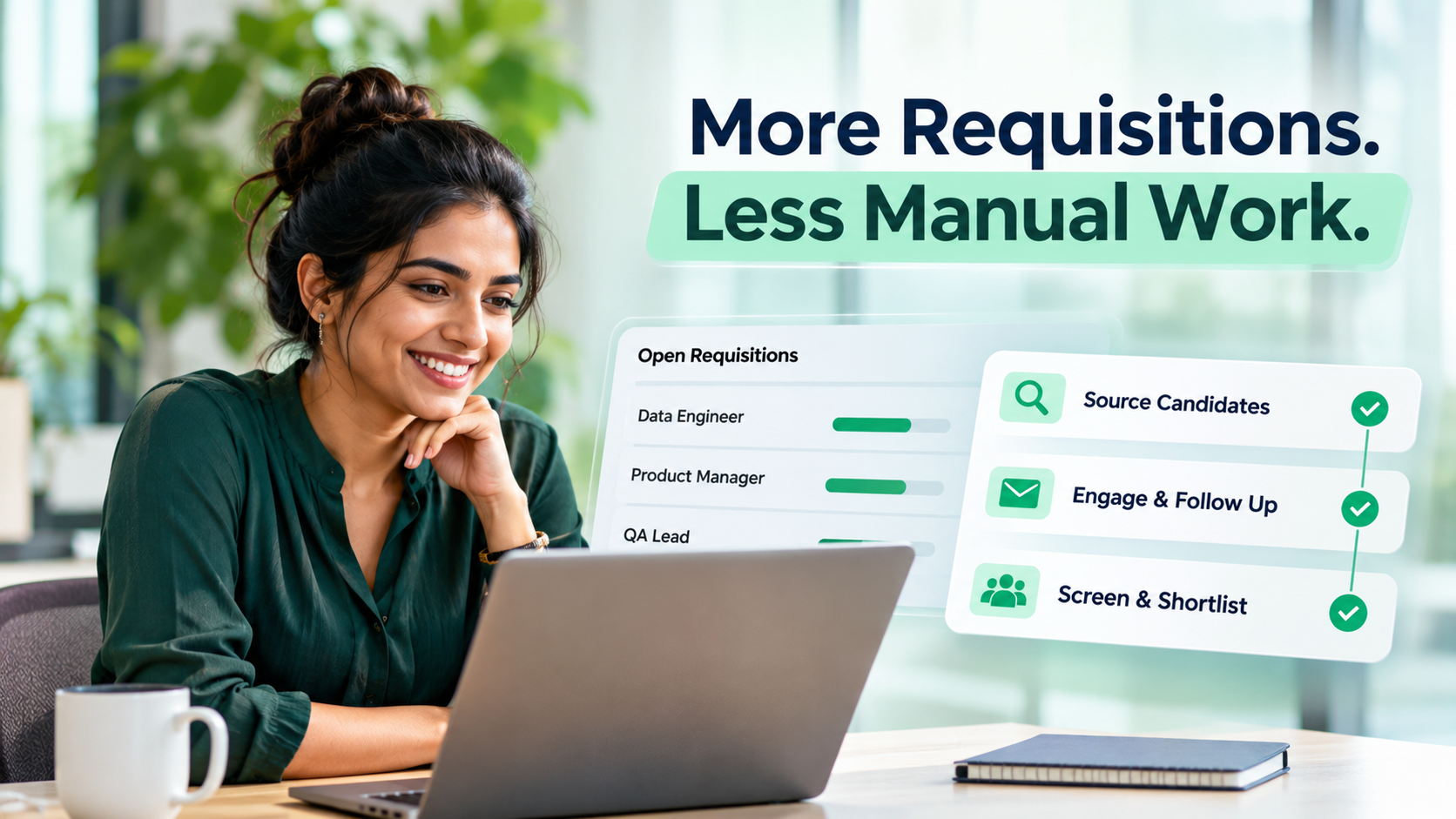
How AI Recruiting Agents Help Staffing Teams Manage More Requisitions
A practical look at how connected sourcing, outreach and screening workflows can reduce repetitive recruitment work while keeping recruiters in control.
When More Requisitions Arrive, Recruiter Capacity Becomes the Constraint
AI recruiting agents for staffing agencies are most useful when they address a measurable operating constraint. For a growing recruitment business, that constraint is often the number of active requisitions each recruiter can progress without delays in candidate discovery, engagement and screening.
Every new job order creates a chain of work. Recruiters interpret the requirement, search internal records and external sources, compare profiles, contact candidates, follow up, conduct initial screening and prepare a shortlist. When several requisitions move at the same time, these tasks compete for the same hours.
Our approach at Ninjahire starts with the workflow rather than the technology. We look at where the team spends time, where work waits between stages and which repeatable activities can be handled by AI recruiting agents under defined instructions.
THE CAPACITY QUESTION
How can a staffing agency progress more open requisitions with its existing team while protecting candidate experience, screening quality and recruiter judgement?
The answer is not to automate every interaction. It is to reduce repeated manual work across the recruitment lifecycle so recruiters can focus on role calibration, meaningful candidate conversations, client communication and final decisions.
Why Recruitment Workload Compounds Across Multiple Open Roles
Recruitment workload does not increase only because there are more job descriptions. It increases because each requisition repeats several activities, and delays in one stage affect the stages that follow.
Manual sourcing starts again for every requirement
Recruiters may search the same ATS, CRM, job boards and professional networks repeatedly. Candidates who were assessed for a previous role can be overlooked when titles, skill names or job-description language differ. A database with many profiles is not automatically a searchable source of current, relevant talent.
Outreach becomes a separate administrative queue
After identifying candidates, recruiters draft messages, personalise context, send follow-ups, monitor replies and update records. Without a consistent process, promising candidates can wait too long for a response or receive duplicate communication.
Initial screening competes with client delivery
Recruiters need to confirm essential requirements, experience, location, availability, compensation expectations and interest. When every initial interaction must be arranged and completed manually, screening capacity becomes a bottleneck.
Context is lost at handover points
When sourcing, outreach and screening sit in disconnected tools, recruiters repeat questions, copy information between systems and reconstruct candidate context. These small handovers add up across a busy staffing desk.
| Workflow bottleneck | Operational effect | Automation opportunity |
|---|---|---|
| Repeated candidate searches | Longer time to identify relevant profiles | AI sourcing and candidate rediscovery |
| Manual first-touch communication | Delayed engagement and inconsistent follow-up | Configured AI outreach sequences |
| Repetitive first-pass screening | Recruiter time spent confirming basic criteria | Structured AI-assisted screening |
| Disconnected stage handovers | Repeated data entry and lost context | Connected recruitment workflow and ATS/CRM updates |
How Our Team Diagnoses the Recruitment Workflow Before Automating It
We do not begin by switching on every available automation. Our recruitment and technology teams first map how a requisition moves through the agency, what information is available at each stage and where human review is essential.
- Map the requisition lifecycle. Document job intake, requirement clarification, sourcing, matching, outreach, screening, shortlist review, client submission and interview coordination.
- Establish the workload baseline. Record active requisitions by recruiter, role type, seniority, urgency and delivery status. Separate newly opened roles from paused, filled or cancelled requisitions.
- Measure time by activity. Estimate recruiter effort spent on sourcing, profile review, first contact, follow-up, screening and administration. Use system timestamps where possible rather than relying only on recall.
- Review candidate data and systems. Examine ATS/CRM fields, duplicate records, resume quality, candidate history, consent status, integration options and ownership rules.
- Identify tasks suitable for agents. Select repeatable, bounded activities with clear inputs, expected outputs and escalation rules.
- Define human checkpoints. Specify who approves job criteria, outreach rules, shortlist progression, interview decisions and client submissions.
This diagnostic stage prevents a common implementation mistake: automating a poorly defined process and then expecting software to correct the underlying operating model.
Why We Use Specialised AI Recruiting Agents Instead of One Generic Assistant
AI recruiting agents are software systems configured to carry out defined recruitment tasks using instructions, data and connected tools. A specialised agent is responsible for a bounded part of the workflow, such as candidate sourcing, candidate engagement or initial screening. The agent can prepare or execute permitted tasks, while decisions that affect candidate progression remain subject to the agency's configured review process.
We structure the workflow around three complementary capabilities. This makes responsibilities easier to configure, test and measure.
Interprets role requirements, searches relevant candidate sources, identifies possible matches and prepares profiles for recruiter review.
Supports personalised candidate communication, approved follow-up sequences, response handling and handover to the recruitment team.
Conducts configured initial screening, gathers role-related information and returns structured summaries for human assessment.
Recruiters validate role criteria, review candidate fit, handle exceptions, assess context and make progression and hiring decisions.
This is a multi-agent AI recruiting model: specialised agents support different stages while the overall process remains connected. It is not a claim that an AI system independently owns hiring decisions. The distinction between task execution and decision authority is central to responsible recruitment automation. Anthropic's engineering guidance on building effective AI agents also emphasises simple, composable systems and clear tool use rather than unnecessary complexity.
AI Sourcing Agent: Find Relevant Candidates Across Existing and New Talent Sources
An AI sourcing agent helps recruiters identify potential candidates against a role requirement. Its value is not simply returning a large list. It is helping the team find relevant profiles, including people already present in the agency's ATS or CRM, before spending additional time on external sourcing.
Step 1: Convert the job requirement into searchable criteria
The workflow begins with the job description and recruiter-approved intake details. Relevant information can include essential skills, adjacent skills, years and type of experience, industry exposure, location, work arrangement, seniority, certifications and constraints that genuinely matter for the role.
Step 2: Search existing candidate records
Candidate rediscovery checks whether the agency already has people who may fit the new role. Semantic matching can help identify related terminology and transferable experience that exact keyword searches may miss. Recruiters should still verify whether the record is current, whether the candidate has already been contacted and whether the person is available or interested.
Step 3: Extend the search where required
If the existing database does not produce a sufficient pool, the sourcing workflow can extend to connected and approved external sources. Search scope should be clear to the agency, and source access must follow the relevant platform terms and data permissions.
Step 4: Present evidence with the match
A useful candidate match should show why the profile was surfaced. Recruiters need to see the relevant experience, skills, location or other role criteria, along with gaps or information that needs verification. A score without supporting evidence is not enough to justify progression.
WHAT THE SOURCING AGENT SHOULD RETURN
A ranked set of potential candidates, the role criteria each profile appears to meet, missing or uncertain information, source provenance and a clear next step for recruiter review.
For a deeper explanation of Ninjahire's sourcing capabilities, see AI-powered candidate sourcing. The existing candidate rediscovery case study provides a separate example of how existing talent records can be brought back into the recruitment workflow. Its reported results should not be treated as the outcome of this requisition-capacity story.
AI Outreach Agent: Keep Candidate Engagement Moving Without Losing Personal Context
Finding a suitable profile is only the beginning. The next challenge is reaching the candidate with relevant information, responding to questions and keeping the process moving. An AI outreach agent can support this work through approved email, SMS or voice workflows, depending on the channels configured for the agency.
Personalisation should be grounded in the candidate's profile
Useful outreach explains why the opportunity may be relevant. It can reference the role, location, skills or experience that prompted contact. It should not invent familiarity, exaggerate the opportunity or imply that a candidate has been selected when the recruiter has not made that decision.
Follow-ups need clear limits
Agencies should configure appropriate timing, message frequency, quiet hours, opt-out handling and stop conditions. A candidate reply, request not to be contacted, withdrawal or indication that the role is no longer relevant should change the workflow immediately.
Replies should reach the right person
When a candidate asks about compensation, work arrangements, role expectations or a sensitive issue, the system should provide only approved information or route the conversation to a recruiter. The purpose of automated candidate engagement is to reduce repetitive coordination, not to remove human support.
Where supported and configured, the outreach workflow can connect email, SMS and AI phone conversations. See the Ninjahire AI Recruiter for the platform-level workflow.
AI Screening Agent: Structure Initial Qualification Across Multiple Requisitions
Initial screening can consume substantial recruiter time when the same basic information must be confirmed for every candidate. An AI screening agent can conduct configured first-stage conversations, collect role-related information and organise the responses for recruiter review.
Build questions around the actual job requirements
Screening questions should be derived from the role intake and should distinguish essential requirements from preferences. Depending on the role, this may include relevant project experience, technical skills, shift or location requirements, notice period, work authorisation where lawful, compensation expectations and candidate interest.
Use structured outputs, not unexplained scores
A recruiter-ready screening summary should capture the candidate's answers, evidence relevant to the role, missing information and any points that need follow-up. If a score is used, the agency should understand the criteria behind it and should not treat it as a final decision.
Keep a human decision-maker in the process
Recruiters review the information, ask follow-up questions and decide whether the candidate should progress. The UK Information Commissioner's Office advises meaningful human involvement in recruitment decisions supported by AI, including the ability to disagree with and overturn AI outputs. Its recruitment and selection guidance is a useful reference for organisations operating under UK data protection requirements.
For more detail on the screening stage, see Ninjahire's AI candidate screening case study. That case study reports a separate screening-time outcome and should remain distinct from any requisition-capacity result.
Connecting Sourcing, Outreach and Screening Into One Recruitment Workflow
The practical value of AI recruitment workflow automation comes from continuity between stages. A sourcing result should carry its role context into outreach. A candidate response should inform screening. Screening information should be available to the recruiter without requiring the candidate to repeat the same details unnecessarily.
- Requisition intake. The recruiter confirms the job description, must-have criteria, preferred experience, location and client-specific requirements.
- Candidate discovery. The AI sourcing agent searches approved internal and external sources and returns potential matches with supporting evidence.
- Recruiter validation. The recruiter checks the criteria, approves the profiles and confirms which candidates may be contacted.
- Candidate outreach. The outreach agent sends approved, relevant communication and follows configured contact rules.
- Response and screening. Interested candidates enter the configured initial screening workflow. Exceptions and sensitive questions are routed to a recruiter.
- Shortlist review. The recruiter reviews candidate responses, verifies key information and decides who should progress.
- Client submission and interview coordination. The agency follows its normal approval and submission process, using the organised candidate information to support delivery.
This workflow can support several open requisitions at once, provided role-specific criteria, candidate ownership, communication permissions and recruiter checkpoints remain clear. It does not mean that every candidate should receive the same message or that every requisition should use identical screening questions.
| Stage | Agent contribution | Recruiter responsibility |
|---|---|---|
| Job intake | Extract and organise role details | Confirm requirements and priorities |
| Sourcing | Search and rank potential matches | Validate relevance and approve contact |
| Outreach | Send approved messages and manage configured follow-ups | Handle exceptions and relationship-sensitive conversations |
| Screening | Ask configured questions and organise responses | Assess evidence and decide progression |
| Submission | Prepare structured candidate information | Approve submission and manage client decisions |
How We Would Roll Out AI Recruiting Agents Without Disrupting Live Recruitment
A phased rollout lets an agency validate the workflow before extending it across the recruitment desk. The exact schedule depends on ATS access, data quality, integrations, security review and the number of workflows in scope. The following is an implementation framework, not a claim that every client deployment follows the same timetable.
| Phase | Work undertaken | Exit criteria |
|---|---|---|
| 1. Discovery | Map requisitions, recruiter tasks, systems and baseline KPIs | Agreed workflow map and measurement definitions |
| 2. Data and integration review | Review ATS/CRM fields, permissions, duplicates and sync requirements | Approved data flow and ownership rules |
| 3. Workflow configuration | Set sourcing criteria, outreach rules, screening questions and escalation paths | Test cases approved by recruitment leads |
| 4. Controlled pilot | Run selected requisitions with a small recruiter group | Quality, candidate experience and exception handling reviewed |
| 5. Team enablement | Train recruiters and managers; document operating procedures | Users understand review points and escalation routes |
| 6. Optimisation | Review outcomes, tune criteria and address workflow friction | Performance is measured consistently over an agreed period |
We recommend starting with a defined role family or a limited set of requisitions. This makes it easier to compare like with like, gather recruiter feedback and identify problems before broader deployment.
How to Measure Whether AI Recruiting Agents Increase Requisition Capacity
Requisition capacity is not the same as placements, hires or revenue. It measures how many active requisitions a recruiter or team can manage under a defined set of operating conditions. A credible case study should report capacity alongside quality and conversion measures, so that a higher workload does not conceal weaker delivery.
RECRUITER REQUISITION CAPACITY
Average active requisitions per recruiter = total eligible active requisitions ÷ delivery recruiter headcount.
Define whether the count includes paused, duplicate, evergreen, confidential or low-activity requisitions. Use the same rules before and after implementation.
How to validate a 3x increase
If an agency claims it moved from 4 active requisitions per recruiter to 12, the calculation is 12 divided by 4, or 3x. The comparison is meaningful only if recruiter headcount, requisition complexity, activity status and measurement windows are comparable. A rise in requisition count alone does not prove improved placements or service quality.
| Metric | Definition | Why it matters |
|---|---|---|
| Active requisitions per recruiter | Eligible active requisitions divided by delivery recruiter headcount | Direct measure of desk capacity |
| Time to shortlist | Time from approved job intake to recruiter-approved shortlist | Measures early delivery speed |
| Time to first qualified submission | Time from requisition approval to first candidate submission meeting criteria | Shows speed to client-ready talent |
| Candidate response rate | Candidate replies divided by successfully delivered outreach | Measures engagement quality |
| Screening completion time | Time from candidate entering screening to completed review | Shows screening throughput |
| Submission-to-interview ratio | Client interviews divided by candidate submissions | Checks shortlist relevance |
| Interview-to-placement ratio | Placements divided by client interviews | Connects delivery to outcomes |
| Candidate experience | Feedback, opt-outs, complaints and process drop-off | Protects quality while scaling |
Separate productivity from business outcomes
More requisitions per recruiter is an operational capacity measure. More interviews, placements, retained clients or gross margin are downstream outcomes. Report them separately and explain the factors that may influence each one, including role difficulty, hiring manager response time, candidate availability and market conditions.
Ninjahire has published other case studies with distinct measured outcomes. The AI recruitment software case study on reducing time to hire from 14 days to 3 days describes a separate workflow and metric. The IT staffing firm AI recruitment ROI case study reports its own cost-per-hire and delivery results. Neither should be merged into this story as if all figures came from one agency engagement.
Human Oversight, Fairness and Candidate Data Must Be Part of the Design
Recruitment automation handles personal information and can influence access to employment opportunities. A responsible AI recruiting workflow therefore needs defined purposes, appropriate data access, transparent candidate communication, documented review and a way to correct inaccurate information.
Keep criteria job-related
Role requirements should be based on the work and the skills genuinely needed. Avoid using protected characteristics or unrelated personal information as matching criteria. Review whether proxies or historical patterns could create unfair outcomes.
Make AI recommendations reviewable
Recruiters should understand why a candidate was surfaced or flagged, be able to challenge an output and record the reason for an override. AI fit scores should not become automatic rejection rules without appropriate validation and governance.
Control candidate data
Agencies should define lawful purpose, access permissions, retention periods, correction processes, vendor responsibilities and security requirements. The Information Commissioner's Office has published findings from its review of AI recruitment tools and job-seeker data protection. In the United States, the EEOC guidance on employment tests and selection procedures explains that selection tools must comply with applicable anti-discrimination requirements.
OUR OPERATING PRINCIPLE
AI agents can carry out approved recruitment tasks and organise information. Recruiters remain accountable for evaluating context, resolving exceptions, deciding who progresses and managing the candidate and client relationship.
A Practical AI Recruiting Automation Playbook for Staffing Agencies
Before purchasing AI recruiting agent software, staffing leaders should test it against a real requisition and a real workflow. A polished demonstration is not enough. Ask the provider to show how the system handles incomplete information, candidate replies, duplicate records and recruiter overrides.
Questions to ask during a vendor demonstration
- Can the platform interpret a job description and let recruiters confirm the essential criteria?
- Can it search an existing ATS or CRM as well as approved external sources?
- Does candidate matching explain which skills and experience support a recommendation?
- Can outreach be personalised without inventing candidate details?
- Can the agency configure contact frequency, opt-outs and escalation rules?
- Can screening questions vary by role and capture structured responses?
- Can recruiters review, override and document AI recommendations?
- Which candidate records and activities sync back to the ATS?
- Can the agency measure requisition capacity, time to shortlist and downstream conversion?
Where AI recruiting agents are likely to be most useful
AI recruiting automation can be particularly relevant to staffing firms managing repeatable role families, high application volumes, multiple concurrent requisitions or large historical candidate databases. Technical staffing can benefit from structured skill and project matching. High-volume commercial and industrial staffing may benefit from consistent first-stage engagement and screening. Specialist and executive search teams may use automation for research and coordination while retaining more intensive human assessment.
The appropriate level of automation depends on role complexity, candidate expectations, data quality, system integration and the consequences of an incorrect recommendation.
How Ninjahire Connects AI Recruiting Agents to the Work Staffing Teams Need Done
At Ninjahire, we approach recruitment automation as an operating workflow, not a collection of disconnected AI features. The platform's sourcing, outreach and screening capabilities are designed to support different stages of candidate delivery and help recruiters spend less time on repetitive coordination.
Our AI Recruiter platform brings the recruitment workflow together. The AI Sourcing capability supports candidate discovery and matching, while AI Phone Screening supports configured candidate screening conversations. The value for a staffing agency depends on how these capabilities are configured around its actual processes, connected systems and human review requirements.
Our implementation focus is practical: understand the agency's delivery model, configure the workflow around its requisitions, preserve recruiter control and measure whether the changes improve capacity without compromising candidate experience or submission quality.
Can Your Recruitment Team Manage More Requisitions Without More Manual Work?
Review your sourcing, outreach and screening workflow with Ninjahire. Identify where AI recruiting agents could reduce repetitive tasks and help your recruiters focus on qualified candidates and client delivery.
Frequently Asked Questions About AI Recruiting Agents
What are AI recruiting agents?
AI recruiting agents are software systems configured to perform defined recruitment tasks, such as candidate sourcing, outreach, follow-up and initial screening. They use role instructions and connected tools to carry out permitted steps, while recruiters oversee candidate progression and hiring decisions.
How can AI recruiting agents help staffing agencies?
AI recruiting agents can reduce repetitive work across sourcing, candidate engagement and initial screening. This can help staffing teams use recruiter time more effectively and manage concurrent requisitions, provided the workflow is properly configured and outcomes are measured.
Can AI recruiting agents manage multiple job requisitions at once?
They can support workflows across multiple requisitions when each role has clear criteria, candidate ownership rules, communication permissions and screening instructions. Recruiters should monitor exceptions and verify that candidates are being considered for the correct role.
What is the difference between an AI recruiting agent and recruitment automation software?
Traditional workflow automation generally follows predefined triggers and rules. An AI agent can interpret instructions and use connected tools to complete a delegated task within configured boundaries. Products may combine both approaches, so buyers should test the actual workflow rather than rely on the label.
Can AI recruiting agents integrate with an existing ATS?
Integration depends on the platform's supported connectors, APIs, permissions and the ATS configuration. Before deployment, confirm which candidate fields, notes, activities and status changes can be read or written, how duplicates are handled and which system remains the source of truth.
Do AI recruiting agents replace recruiters?
No. They can support repeatable tasks such as candidate discovery, approved outreach and structured first-stage screening. Recruiters remain essential for interpreting client needs, evaluating context, building candidate relationships, handling exceptions and making progression decisions.
How should a staffing agency measure AI recruiting agent ROI?
Measure operational indicators such as active requisitions per recruiter, time to shortlist, time to first qualified submission, screening turnaround and recruiter hours spent on repetitive tasks. Then track downstream indicators such as submission-to-interview conversion, placements, retention and cost per hire.
Does handling three times more requisitions mean three times more placements?
No. Requisition capacity and placement output are different measures. A team may manage more active roles without achieving a proportional increase in placements. Any 3x claim should define the baseline, recruiter headcount, requisition status rules, comparison period and quality outcomes.
How can AI recruiting agents improve candidate experience?
They can support timely, relevant communication and reduce delays between recruitment stages. Candidate experience still depends on accurate job information, appropriate contact frequency, accessible communication, transparent use of data and a clear route to a human recruiter.
What should agencies check before adopting autonomous AI recruiting agents?
Check ATS integration, data permissions, sourcing coverage, matching explanations, outreach controls, screening configuration, audit trails, human overrides, privacy safeguards and reporting. Run a controlled pilot with real requisitions before expanding the workflow.
Scaling Recruitment Capacity Starts With Better Workflow Design
For staffing agencies, the opportunity in AI recruiting agents is not simply faster automation. It is the ability to connect candidate sourcing, engagement and screening so that fewer requisitions stall in repetitive manual work. The strongest implementation begins with a clear operational baseline, assigns bounded responsibilities to specialised agents, preserves recruiter oversight and measures both capacity and quality.
That is how we approach recruitment automation at Ninjahire: understand the delivery problem first, configure technology around the real workflow and measure the results that matter to staffing leaders.
Other insights
Continue reading



The AI recruiter for staffing teams. Sourcing, outreach and screening, around the clock.
Get new posts by email
Research, case studies and field notes on AI recruiting. No spam.