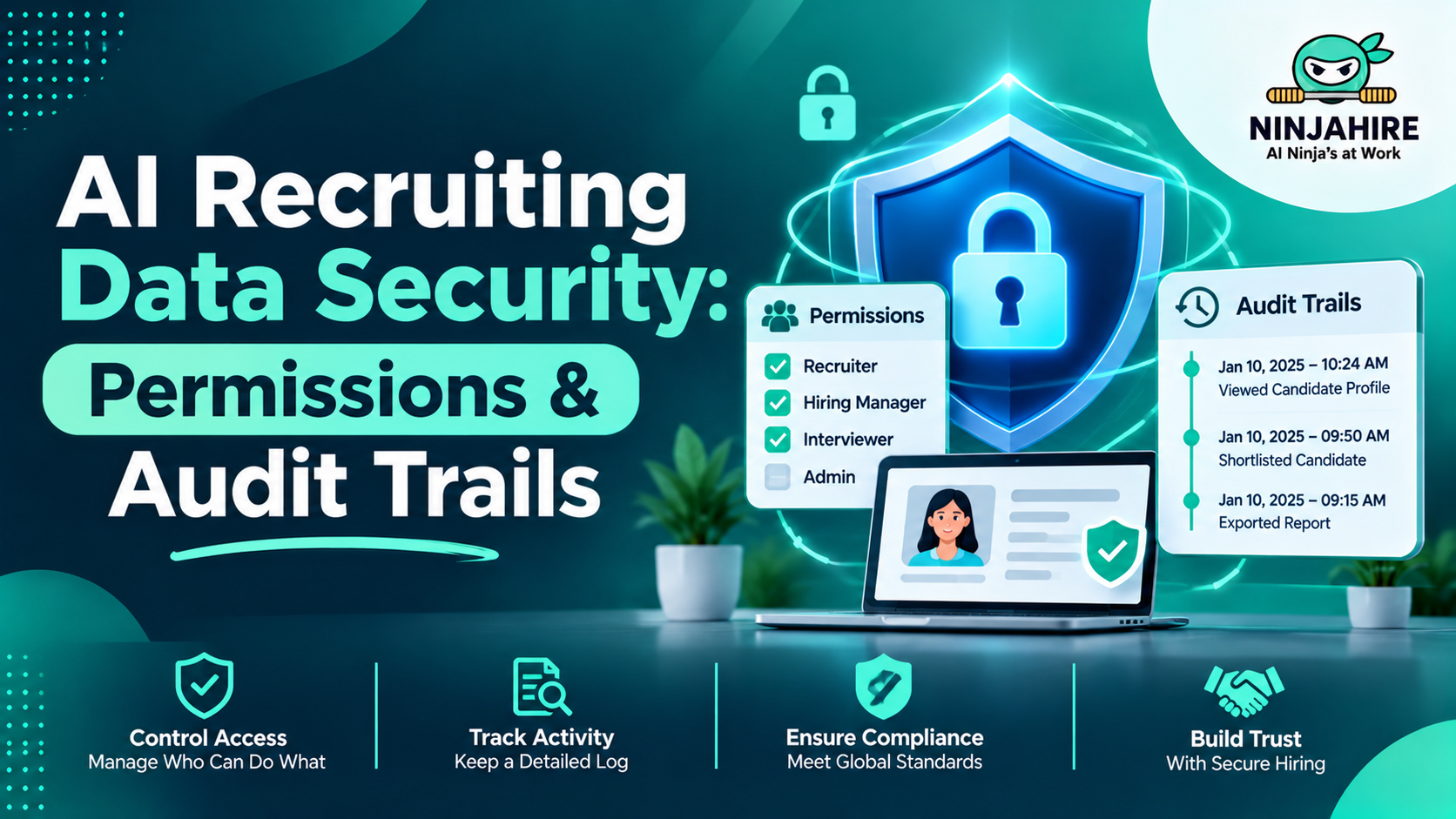
AI recruiting data security is the set of controls that limit which people and systems reach candidate information and that record what happens to it. Three controls do most of that work: permissions define authorized actions, access controls enforce those boundaries, and audit trails document relevant activity. Recruiting teams handle resumes, contact details, employment histories, interview recordings, and assessments across sourcing, screening, interviewing, and hiring. As AI tools and connected systems join that workflow, more accounts and automated actions touch candidate data. Secure AI recruiting depends on restricted access, traceable actions, and meaningful human oversight.
What Is AI Recruiting Data Security?
AI recruiting data security refers to the practices that protect candidate information handled by AI-assisted hiring tools: resumes, contact information, employment histories, interview notes and transcripts, assessment results, and records in an applicant tracking system.
Three related terms describe different things. Data security protects information from unauthorized access, alteration, or loss. Recruiting data privacy governs what may be collected, why, and for how long. Access management decides which people and systems may use it at all.
AI recruiting software handles candidate data at several stages, including sourcing and matching, resume screening, interview transcription, automated outreach, and ATS synchronization. At each stage, proper permissions, access controls, and activity logging are essential.
What Are Permissions in AI Recruiting Software?
Permissions define which actions a user or AI-enabled workflow may perform: viewing candidate profiles and resumes, editing application records, sending candidate communications, exporting candidate data, accessing interview notes, viewing reports, and managing system settings.
Viewing is not acting. A sourcer who reads a profile does not need to export a list, delete a record, or email that candidate. Separating read, write, export, and administrative rights limits how far a mistake or compromised login travels.
Least-privilege access applies the same logic to automation. An AI screening workflow that scores applications needs read access to them and write access to a score field, not permission to message candidates or export a database. OWASP ranks broken access control as the leading web application security risk.
For example, a staffing agency might let its AI phone screening workflow read open requisitions and write call summaries, while rejection decisions stay with recruiters.
What Are Access Controls in Recruitment?
Access controls are the mechanisms that enforce permission decisions. Role-based access control (RBAC) is the practical starting point: rights attach to roles — recruiter, hiring manager, coordinator, administrator — rather than to individuals, which keeps access consistent and easier to review.
Roles need different boundaries. A hiring manager usually needs only their own requisitions, not the whole talent pool, and external staffing partners or MSP suppliers should be scoped to the programs they support.
Multi-factor authentication adds a second verification step at sign-in, which matters because recruiting platforms are reached from browsers, phones, and shared machines. Entitlements also accumulate as people change roles, so scheduled access reviews and prompt removal of unused accounts keep rights current.
Integrations deserve the same scrutiny: a connected calendar, mailbox, or ATS connector holds standing access to candidate data. NIST's control catalog treats account management, access enforcement, and least privilege as separate controls for this reason.
What Are Audit Trails in AI Recruiting?
An audit trail is a time-stamped record of significant system activity. Where permissions and access controls prevent unwanted actions, audit trails make activity reconstructable afterwards — who acted, what changed, and when.
Events worth capturing include candidate record changes, data exports and downloads, permission and role changes, administrative actions, sign-ins and failed attempts, AI-enabled workflow activity where the platform logs it, human approvals or overrides, and other security events.
Overrides matter in hiring. When a recruiter sets aside an AI screening score, logging that decision supports quality review and any later account of how the candidate was assessed.
Logging capability varies between platforms: some produce exportable, candidate-level records, others only aggregate usage data. Logs need protection of their own, and NIST log management guidance emphasizes safeguarding them against unauthorized access and alteration.
Permissions vs. Access Controls vs. Audit Trails
| Security Control | Purpose | Recruitment Example | Benefit |
|---|---|---|---|
| Permissions | Define what a user or AI workflow may do | A coordinator schedules interviews but cannot export candidate lists | Limits what any account can do |
| Access controls | Enforce those restrictions | A hiring manager sees only their own requisitions after an MFA sign-in | Reduces exposure of candidate data |
| Audit trails | Record relevant activity for review | A log shows which account exported 400 resumes, and when | Supports accountability and investigation |
The relationship is sequential: permissions define authorized actions, access controls enforce them, and audit trails document what happened. None verifies identity or protects the data itself — authentication confirms who is signing in, and encryption protects candidate data at rest and in transit.
How to Secure AI Recruiting Workflows
- Map candidate data flows. Document where candidate information is collected, stored, processed, and shared, including every AI tool and integration.
- Apply least-privilege permissions. Build roles from minimum access and add rights on request, rather than cloning an existing user's profile.
- Secure integrations. Review the access granted to connected ATS, email, calendar, and sourcing systems, confirm what each reads and writes, and disconnect unused connectors.
- Enable audit logging. Switch on logging where configurable, decide which events are reviewed and by whom, and set a review cadence rather than querying logs only after an incident.
- Set data retention rules. Define how long resumes, transcripts, recordings, and screening outputs are kept, and automate deletion. ICO audits of AI recruitment tools found candidate data retained indefinitely.
- Review and monitor access. Re-check permissions on a schedule, investigate unusual activity such as bulk exports, and remove access when people change roles or leave.
Common AI Recruiting Data Security Risks
- Excessive user permissions. Rights accumulate over time; use role-based defaults and scheduled reviews.
- Overprivileged AI integrations. Connectors often get broad scopes at setup; narrow them to what each workflow needs.
- Unauthorized candidate data exports. Bulk downloads are hard to reverse; restrict export rights and alert on large ones.
- Incomplete audit logs. Gaps limit investigation; confirm which events are logged before deployment.
- Poor data retention practices. Old records expand exposure; set retention periods and automate deletion.
- Third-party vendor risks. Sub-processors handle candidate data too; review vendor security documentation and sub-processor lists.
- Sensitive information in unapproved AI tools. Set a policy on which tools may receive candidate data.
- Inadequate human oversight. Keep consequential decisions with a named reviewer and log overrides.
Privacy, employment, and data protection requirements differ by jurisdiction and use case, so organizations should confirm which apply to their hiring programs.
How to Evaluate AI Recruiting Software Security
A practical vendor checklist covers role-based permissions, configurable access controls, audit logging scope and export, human approval and override mechanisms, candidate data retention and deletion, integration permission scopes, encryption and identity protection, security documentation, sub-processor practices, and incident response procedures.
Verify these through technical documentation, contractual terms such as a data processing agreement, and a working demonstration rather than marketing material. Asking to see an audit log export during a demo is more informative than a feature list.
Ninjahire Context
Ninjahire is an AI recruiting platform offering sourcing, outreach, and screening agents that connect to applicant tracking systems. Its website states that the platform is SOC 2 Type II compliant, encrypts data with AES-256 at rest and TLS 1.2+ in transit, and publishes an independent AI bias audit report alongside its privacy policy and data processing agreement.
Organizations should review the vendor's documentation to understand how user permissions, audit logging, and data retention are managed. They should also check whether these settings can be customized to meet their security and data protection requirements.
Frequently Asked Questions
What is AI recruiting data security?
It is the practice of protecting candidate information processed by AI-assisted hiring tools. Permissions, access controls, audit trails, authentication, encryption, and retention rules together govern who reaches that data and what happens to it.
Why are access controls important in recruitment?
Recruiting systems hold resumes, contact details, and interview records for many people. Access controls restrict each user and integration to the candidates and actions their role requires, limiting unnecessary exposure.
What is the difference between permissions and access controls?
Permissions define what a user or AI workflow may do, such as viewing or exporting records. Access controls enforce those definitions through role-based access control, multi-factor authentication, and limits on integrations.
What should AI recruiting audit trails record?
Candidate record changes, data exports, permission and role changes, administrative actions, sign-in events, AI workflow activity where logged, and human approvals or overrides, each with an account and timestamp attached.
How can companies protect candidate data when using AI?
Map where candidate data flows, apply least-privilege permissions to staff and automated workflows, narrow integration scopes, enable audit logging, set retention rules, review access regularly, and keep consequential decisions with a human.
Conclusion
AI recruiting data security depends on more than the AI tool itself. Clearly defined permissions, enforced access controls, and reliable audit trails form the core, supported by secured integrations, sound retention periods, vendor evaluation, and human oversight. Recruitment teams should select AI recruiting software on verifiable security capabilities and establish written procedures for protecting candidate information.