Most recruitment teams already use AI somewhere in their process. A resume parser ranks applicants. A scheduling tool proposes interview slots. A chatbot answers candidate questions on the careers page.
None of those are autonomous AI recruiting. They are discrete features that wait for a recruiter to act.
Autonomous AI recruiting describes something structurally different: software agents that pursue a defined hiring objective across several connected steps, within permissions a recruiting team sets in advance.
TL;DR
- Autonomous AI recruiting uses AI agents to coordinate multi-step recruitment workflows rather than single tasks.
- AI-assisted recruiting supports individual recruiter tasks, while agentic systems can execute connected actions within defined permissions.
- Autonomous workflows can support sourcing, screening, outreach, and interview coordination.
- Human oversight, fairness, data security, and accountability remain essential to responsible AI recruitment.
What Is Autonomous AI Recruiting?
Autonomous AI recruiting is the use of AI agents to plan and carry out sequences of recruitment tasks toward a stated hiring goal, with limited step-by-step human input and under predefined permissions.
The distinguishing capability is sequencing. A task-automation tool completes one instruction. An agent decides what to do next based on the outcome of the previous step, then continues until the objective is met or an exception requires a human.
An autonomous AI recruiting platform connects to the systems where hiring data already lives: the applicant tracking system, calendars, communication channels, and approved candidate sources. The agent reads from those systems, writes back to them, and leaves a record of what it did.
Three categories get confused in vendor marketing. The distinction matters when evaluating software.
| Type | What it does | Who decides the next step |
|---|---|---|
| Chatbot | Answers questions and collects information through conversation | The person typing |
| AI automation tool | Executes a configured rule or single task when triggered | The rule’s author |
| Autonomous AI agent | Plans and sequences multiple actions toward a goal | The agent, inside set permissions |
Human oversight remains central in all three. Autonomy describes how much of a workflow runs without intervention, not whether accountability transfers to the software. Employment decisions carry legal consequences, and those consequences stay with the employer.
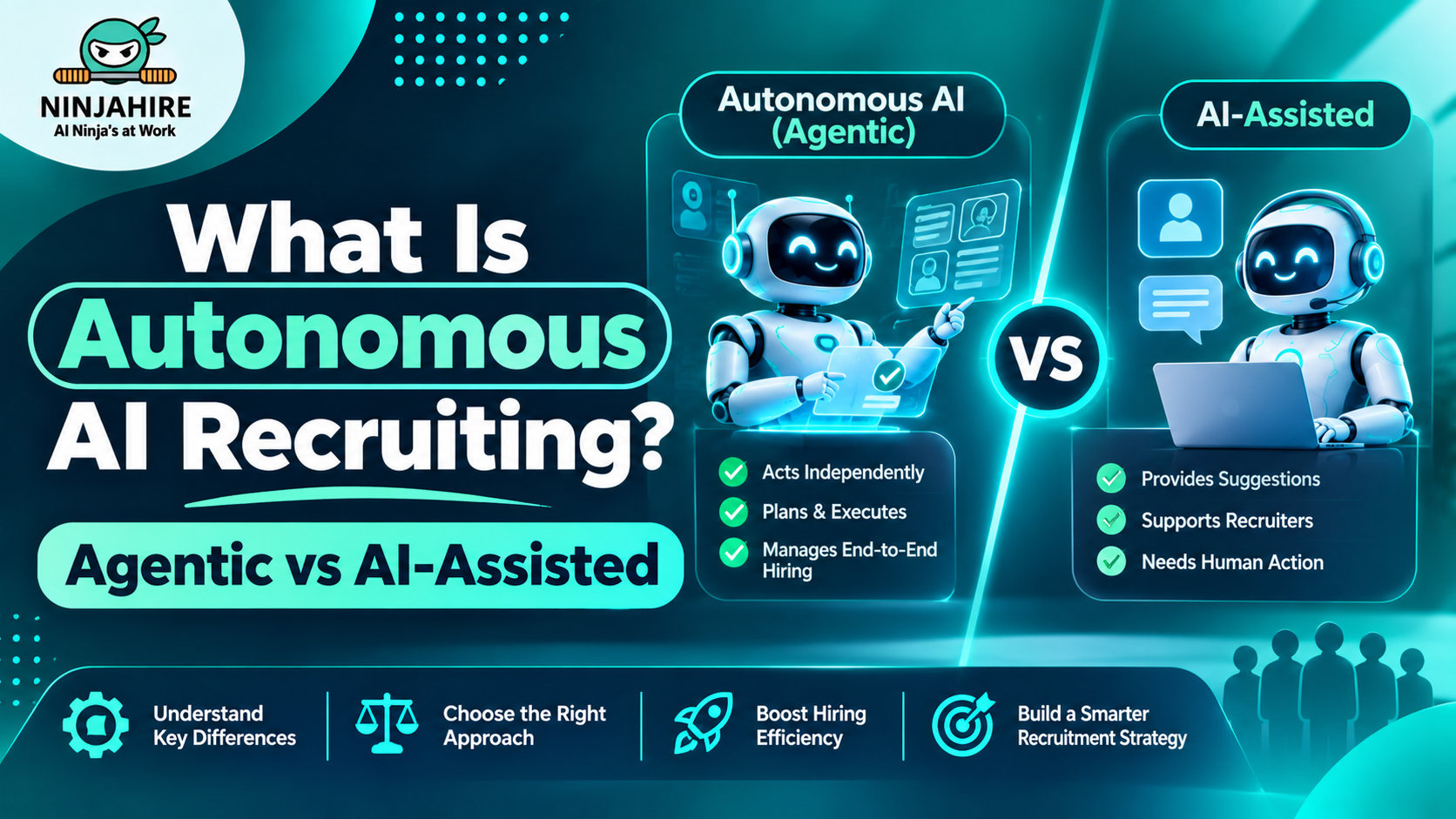
Agentic AI Recruiting vs AI-Assisted Recruiting
This is the comparison that determines whether a platform changes how a recruiting team works or simply adds a feature to the existing process.
| Criteria | AI-Assisted Recruiting | Agentic AI Recruiting |
|---|---|---|
| Main role | Supports recruiter decisions and tasks | Executes connected tasks toward defined goals |
| Workflow | Usually task-specific | Can coordinate multiple workflow steps |
| Decision-making | Provides suggestions and recommendations | Can plan and select actions within permissions |
| Execution | Recruiter typically initiates each action | Agents can execute approved actions autonomously |
| Human involvement | Frequent human input | Human supervision, approvals, and exception handling |
| Example | AI recommends suitable candidates | An agent sources candidates, evaluates predefined criteria, and prepares a shortlist |
| Best suited for | Individual recruitment tasks | Connected recruitment workflows |
A practical example clarifies the gap. A recruiter opens a requisition for a senior backend engineer.
Under AI-assisted recruiting, the recruiter runs a search, reviews ranked results, writes outreach using an AI drafting tool, sends it, waits, then opens a scheduling tool for anyone who replies. The AI shortens each step. The recruiter still drives every transition between steps.
Under agentic recruiting, the recruiter defines the role requirements, the screening criteria, and the approval points. An agent then works the requisition: searching approved sources, comparing profiles against the criteria, sending outreach from pre-approved templates, and booking interviews against available calendar slots. The recruiter reviews the shortlist and handles anything the agent escalates.
Agentic systems are not unrestricted decision-makers. They operate inside objectives, policies, permissions, and escalation rules configured before the workflow runs. The architectural difference between workflow-executing agents and systems built primarily to store records is covered in more depth in this analysis of how agentic recruiting differs from a traditional ATS.
How Does Autonomous AI Recruiting Work?
A typical autonomous workflow moves through four stages, from hiring requirement to recruiter handoff.
Job Requirement Analysis and Candidate Sourcing
The agent interprets the requisition first. It extracts required skills, seniority signals, location or work-authorisation constraints, and any must-have qualifications.
It then translates those requirements into search criteria and queries approved sources. AI candidate sourcing at this stage covers both external talent pools and existing records inside the ATS, where qualified past applicants are frequently overlooked.
Scope matters here. Agents should only search sources the organisation has permission to use, and sourcing criteria should exclude proxies for protected characteristics.
Candidate Screening and Matching
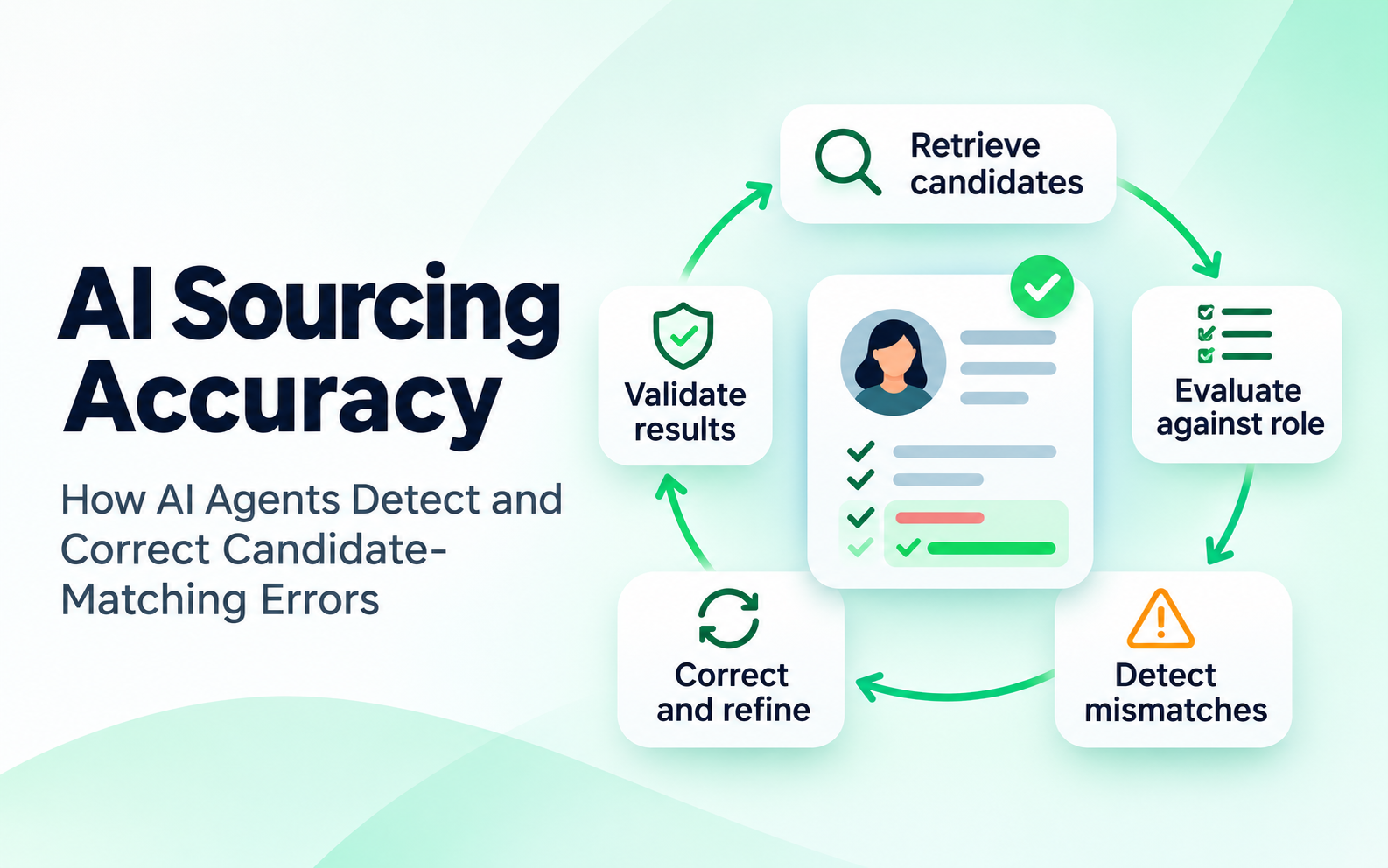
Next, the agent compares candidate information against the predefined criteria. Relevant experience is checked, gaps are flagged, and profiles are organised for recruiter review.
Automated candidate screening works best when the criteria are explicit and documented. Vague requirements produce inconsistent evaluations and make the reasoning difficult to audit later.
Screening output should be reviewable evidence, not a single opaque score. A recruiter needs to see why a candidate was advanced or set aside.
Candidate Outreach and Interview Coordination
Approved communication comes next. The agent prepares personalised outreach based on the role and the candidate’s background, sends it through approved channels, and manages replies.
For high-volume roles, AI phone screening can collect structured answers to qualifying questions before a recruiter invests time. Scheduling runs against live calendar availability, which removes most coordination back-and-forth.
Candidates should be told when they are interacting with an AI system. Several jurisdictions now require that disclosure, and transparency also reduces drop-off.
Candidate Evaluation and Recruiter Handoff
Finally, the agent organises what it gathered. Interview responses are summarised, evaluation evidence is compiled against the stated criteria, and candidates are escalated to the recruiter with that record attached.
AI-powered candidate interviews produce transcripts and structured notes rather than verdicts. The hiring decision sits with the recruiter and hiring manager, supported by consistent documentation.
Explore how Ninjahire’s AI agents support candidate sourcing, screening, and recruitment workflows. See the platform →
Key Benefits of Autonomous AI Recruiting
The reported advantages are operational rather than magical. They come from removing coordination work, not from replacing judgment.
- Less manual administration. Search, data entry, follow-up scheduling, and status updates absorb a large share of recruiter hours.
- Faster movement through sourcing and screening. Agents work continuously and do not queue requisitions behind one another.
- Consistent execution. The same criteria and the same questions apply to every candidate in a requisition.
- Improved recruiter capacity. Time returns to candidate conversations, hiring manager alignment, and difficult searches.
- Better pipeline visibility. Every agent action is logged, which makes bottlenecks visible.
- More room for human judgment. Recruiters spend their attention where context and persuasion matter.
Claimed time or cost improvements vary widely by organisation, role type, and hiring volume. Any vendor figure should be treated as vendor-reported and tested against a defined pilot before it informs a business case.
Risks and Limitations of Agentic AI in Recruitment
Autonomy raises the consequences of a configuration error. These risks need addressing before deployment, not after.
Algorithmic bias. Models trained on historical hiring data can reproduce historical exclusion. New York City’s Local Law 144 has required employers and employment agencies using automated employment decision tools to commission an annual independent bias audit, publish a summary of the results, and notify candidates, with enforcement beginning in July 2023.
Candidate data privacy. Agents touch large volumes of personal data across several systems. Retention periods, access controls, and cross-border transfer rules all apply.
Fabricated or incorrect output. Generative models can produce plausible but wrong summaries. Evaluation evidence should be traceable to source material.
Limited context. Career breaks, non-linear paths, and unconventional backgrounds are poorly served by rigid criteria matching.
Transparency gaps. If a recruiter cannot explain why a candidate was screened out, the organisation cannot defend the decision.
Over-automation of communication. Fully automated candidate experience damages employer brand, particularly at senior levels.
Accountability. Consequential employment decisions require human review. The case for keeping a human in the loop is both ethical and practical: automated rejection at scale is a legal exposure as much as a candidate-experience problem.
AI regulation varies by jurisdiction. Under the EU AI Act, employment-related AI systems are classified as high-risk. Following the Digital Omnibus, relevant high-risk obligations apply from 2 December 2027, while transparency rules apply from 2 August 2026.
In the US, the EEOC’s January 2025 withdrawal of AI guidance was a change in agency guidance, not federal employment law. Title VII, the ADA and the ADEA still apply to AI-based hiring decisions (EEOC guidance). Illinois has specific AI employment provisions under Public Act 103-0804, while Texas’s TRAIGA is a broader AI governance law. The NIST AI Risk Management Framework offers a voluntary approach to managing AI risks.
Legal requirements depend on jurisdiction and should be confirmed with counsel.
How to Choose an Autonomous AI Recruiting Platform
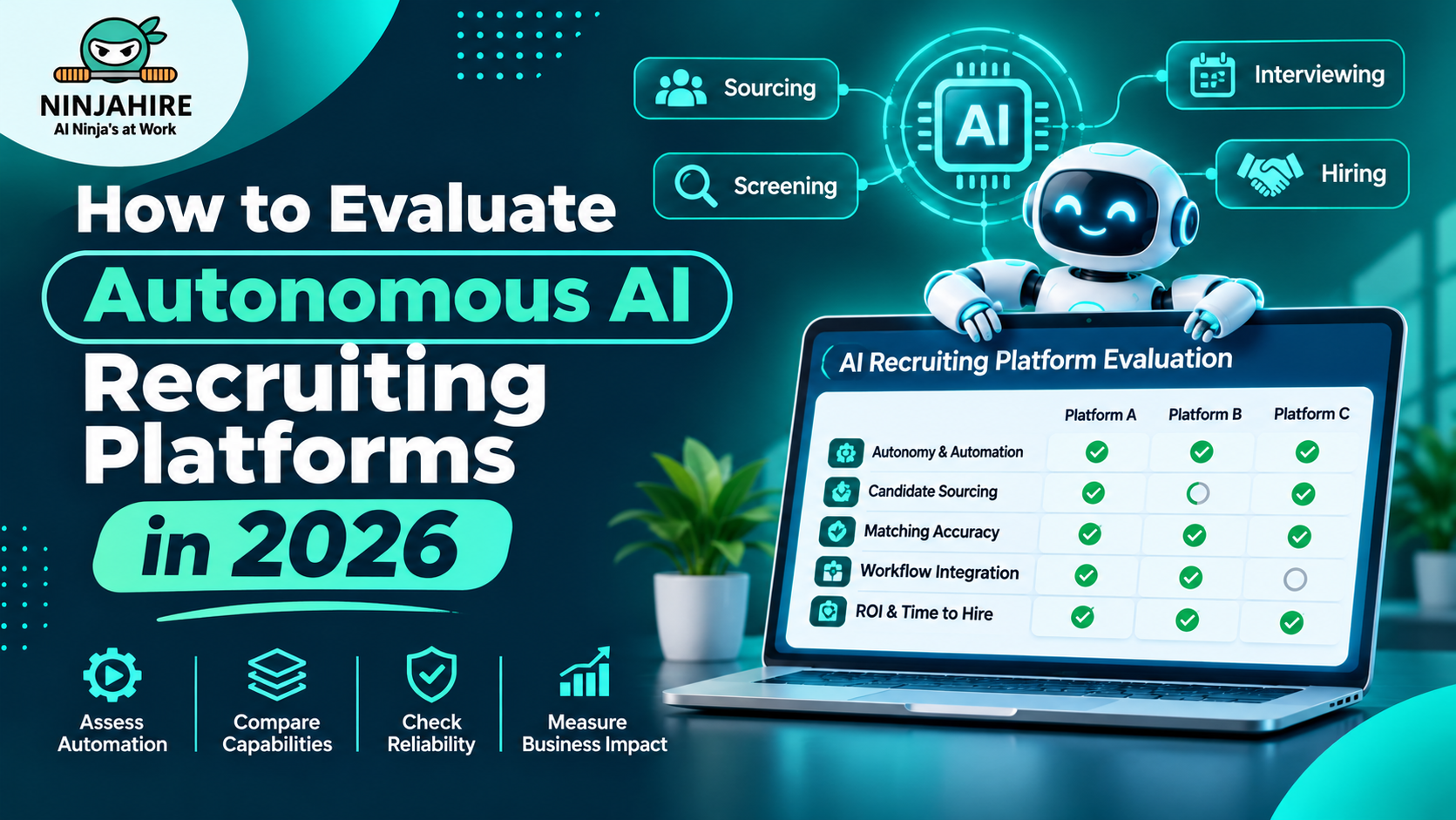
Eight criteria separate genuine agentic platforms from AI-labelled feature sets.
- Multi-agent workflow capability. Can the system run a connected sequence, or only individual tasks?
- Sourcing and screening depth. Does it search external sources and existing ATS records?
- ATS and recruitment system integrations. Bidirectional sync matters more than a one-way feed.
- Approval and escalation controls. Which actions require sign-off, and who configures that?
- Data privacy and security. Residency, retention, subprocessors, and deletion on request.
- Bias testing and explainability. Can the vendor produce audit documentation and per-decision reasoning?
- Workflow customisation. Can criteria and sequences be adapted per role family?
- Reporting. Does it measure stage conversion, not just activity volume?
Ask for the audit documentation during evaluation. A vendor that cannot supply it has shifted a compliance obligation onto the buyer.
How Ninjahire Supports Agentic AI Recruiting
Ninjahire uses specialised AI agents to support different stages of the recruitment process, including candidate sourcing, screening, and phone and video interviewing. These capabilities are designed to support recruiters across different stages of a requisition workflow.
Rather than relying on a single general-purpose assistant, the platform uses specialised capabilities for specific recruiting tasks. The extent to which these agents share information or pass work between stages depends on the configured workflow.
Recruiters retain control over important parts of the process, including role criteria, outreach templates, approval steps, and escalation rules. Recruiters review candidate shortlists and remain responsible for hiring decisions.
Ninjahire is designed to work with existing ATS and recruitment systems. It also supports workflows for MSP and staffing-supplier programmes.
Frequently Asked Questions About Autonomous AI Recruiting
What is the difference between autonomous AI recruiting and AI-assisted recruiting?
AI-assisted recruiting improves one task at a time and waits for a recruiter to trigger the next step. Autonomous AI recruiting coordinates several connected steps toward a hiring goal within set permissions. The difference is whether the software completes a task or runs a workflow.
What is agentic AI in recruitment?
Agentic AI refers to AI systems that plan and take sequences of actions toward an objective, rather than only generating output on request. In recruitment, that means an agent can interpret a requisition, search for candidates, evaluate them against criteria, and coordinate interviews, escalating to a recruiter when a decision falls outside its permissions.
Can autonomous AI agents conduct candidate interviews?
Agents can conduct structured screening interviews by phone or video, ask predefined questions, and produce transcripts and summaries. They should not deliver hiring verdicts. Candidates must generally be informed that an AI system is involved, and some jurisdictions require explicit consent for AI analysis of recorded interviews.
Can AI recruiting agents make hiring decisions?
No. Consequential employment decisions require human review and human accountability. Agents prepare evidence, organise shortlists, and flag exceptions. Employment law obligations rest with the employer regardless of how the recommendation was generated.
What recruitment tasks can autonomous AI automate?
Candidate sourcing across approved sources, resume and profile screening against defined criteria, candidate rediscovery within the ATS, first-touch outreach, interview scheduling, structured screening interviews, interview summarisation, and pipeline reporting. Final selection, offer decisions, and sensitive candidate conversations stay with recruiters.
Is agentic AI recruiting suitable for small businesses?
It can be, particularly where a small team handles recurring high-volume roles and has no dedicated recruitment coordinator. The practical constraints are integration effort and hiring volume. Below a certain number of open roles, configuration time may exceed the time saved.