AI sourcing accuracy: how recruiting agents detect and correct matching errors

November 19, 2026
AI sourcing accuracy is how reliably an AI sourcing system returns candidates who meet a role's requirements, backed by candidate information that is correct, current and traceable to evidence. Teams usually test it after recruiters have already spent a week contacting the wrong people, which is the expensive moment to learn that a shortlist looked better than it was.
This article covers where AI candidate sourcing goes wrong, what a self-correction loop can and cannot do, how our documented sourcing workflow handles search and enrichment, and how to measure AI recruiting accuracy on your own requisitions. We keep three things apart: what we document publicly, what we recommend as sound design and what we do not claim. Examples marked illustrative are invented and are not customer results.
Why AI candidate sourcing still produces inaccurate results
Automated candidate sourcing reads a requisition, searches candidate data and ranks what it finds. Each step can introduce an error, and the errors compound because later steps trust earlier ones. AI sourcing automation then multiplies a flawed shortlist across every outreach message. These are the most common causes of AI sourcing errors:
- Incomplete candidate profiles that leave required facts unstated.
- Incorrect skill extraction, such as reading a technology mentioned in passing as hands on experience.
- Keyword matching that rewards shared vocabulary over demonstrated capability.
- Outdated candidate records, where employer, location or availability has changed.
- Duplicate profiles that inflate a shortlist and cause repeat contact.
- Search conditions that are too broad and return noise.
- Search conditions that are too restrictive and hide strong candidates who use different titles.
- Misread job titles and employment history, since the same title means different things at different companies.
- Unsupported assumptions, where the system infers a qualification the record never states.
More profiles do not mean better sourcing. A larger pool raises the chance that a good candidate exists and also the volume of near matches a recruiter must read. Coverage and accuracy are separate properties: a source with enormous reach and weak record quality can produce a longer list and a worse shortlist than a smaller source with fresher records.
A taxonomy of sourcing errors
Teams fix errors faster when they name the layer where the error occurred. The last column shows which errors software can repair and which need a person or fresh evidence.
| Error type | What goes wrong | Illustrative example | Who or what can fix it |
|---|---|---|---|
| Retrieval error | The search misses good candidates or floods the results | A query requires the exact title Software Engineer III and skips Backend Developer | Automated: refine the query or add a source |
| Extraction error | A fact or skill is read wrongly from a profile | A line saying a candidate evaluated Kafka is read as Kafka experience | Automated when source text settles it; a person when the text is ambiguous |
| Matching error | A candidate is scored against the wrong requirement or weight | A preferred skill outweighs a mandatory work authorisation requirement | Automated through requirement level rules; weighting policy belongs to people |
| Candidate data error | The source record is stale or wrong | The profile shows an employer the candidate left two years ago | Fresh evidence or candidate confirmation |
| Enrichment error | A contact detail is missing, undeliverable or attached to the wrong person | An email address belongs to a previous employer's domain | Automated retry with another eligible provider; wrong person cases need a human |
| Verification failure | A claim is presented as verified without evidence | A shortlist states work authorisation with no source | Automated labelling as unverified; a person decides whether to proceed |
What is a self-correction loop in AI recruiting?
A self-correction loop in AI recruiting is a process in which a sourcing agent checks its own output against defined criteria and outside evidence, flags results that fail the check, applies a bounded fix and then checks the revised result before passing it on. Two words carry the weight: bounded and outside. Without a limit, a loop can run indefinitely. Without outside evidence, it can only repeat its own assumptions.
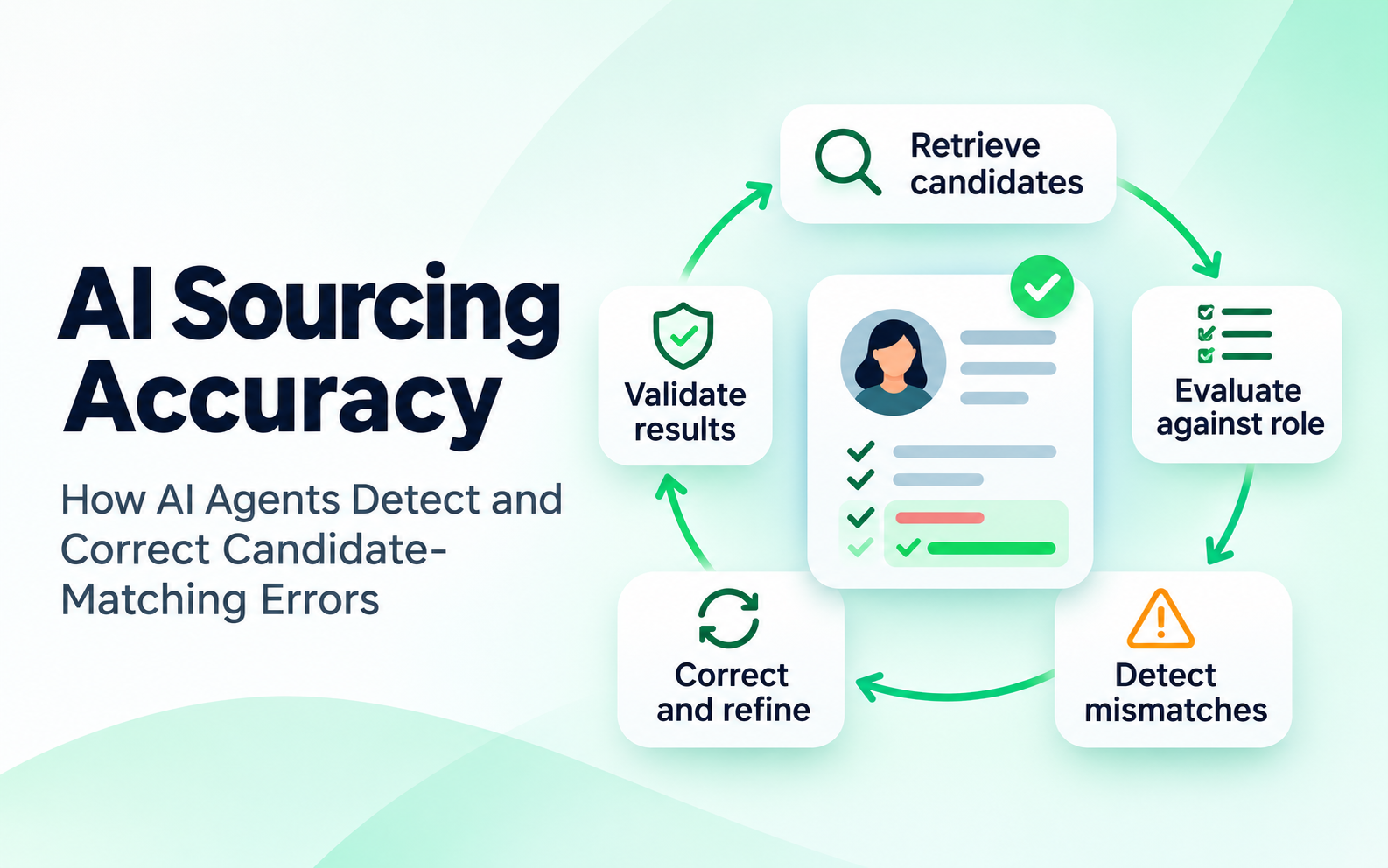
We describe AI agent self-correction in five stages:
- Retrieve. The agent searches the available sources and returns candidate records for the requisition.
- Evaluate. Each record is compared with the requirements, keeping mandatory requirements apart from preferred ones.
- Detect. The agent flags a mismatch, a conflict between sources, a missing fact or a claim without supporting evidence.
- Correct. The agent applies a defined fix, such as a revised query, another source, a reread of the profile text or an enrichment retry.
- Validate. The revised result is checked again against the same criteria. Anything still unresolved goes to a recruiter.
Read as a diagram, the stages form a circle: after Validate, a result that still fails returns to Evaluate, and a stopping condition ends the circle.
Why a model critiquing its own output is not enough
It is tempting to treat self-correction as a prompt: ask the model to review its shortlist and fix mistakes. The research does not support relying on that alone. In a critical survey published in Transactions of the Association for Computational Linguistics, Kamoi, Zhang, Zhang, Han and Zhang report that no prior work they reviewed demonstrates successful self-correction using feedback from prompted language models, except in tasks unusually well suited to it. They also find that self-correction works well when reliable external feedback is available. The survey does not show that every self-correction system works or fails. It supports a design rule: a correction needs a signal from outside the model's own judgement.
In sourcing, reliable outside signals include the original profile text that supposedly supports a skill, structured fields in the ATS, dates that can be checked arithmetically, a deliverability check on an email address and a recruiter's accept or reject decision. A model that rereads its own shortlist and declares it correct has not verified anything.
How AI sourcing agents detect candidate matching errors
Detection is where most accuracy is won or lost. A 2025 paper in Frontiers in Computer Science by Hadžić, Brandner, Weber and Rätsch describes AI driven active sourcing as four modules: active searching, skills extraction, skills matching and a personalised approach. It also argues that recruiters and candidates should be able to understand, question and intervene in system outputs. The paper proposes a framework and calls for empirical testing, so we use it as a map of where errors can enter, not as proof of any vendor's performance. Each module needs its own checks.
- Requirement level validation. Check every candidate against each requirement separately, keeping mandatory apart from preferred. Missing a mandatory requirement is a mismatch however strongly preferred skills score.
- Skill extraction checks. Tie each extracted skill to the passage that supports it. A skill with no supporting text is an unsupported inference and should be labelled as one.
- Experience interpretation. Calculate years from dated roles instead of accepting a stated total, and read duties as well as titles.
- Location and employment information. Compare dates and locations with the requisition, and flag records with an old last update.
- Duplicate detection. Compare names, employers, contact details and identifiers across sources, and route uncertain matches to a person.
- Missing versus incorrect information. A missing fact calls for more retrieval or a question to the candidate. An incorrect fact appears as a conflict between sources and calls for evidence.
- Source evidence. Store where each claim came from so a recruiter can inspect it.
- Confidence and uncertainty. Show unverified items as unverified. A system that never says it does not know is hiding its errors.
An illustrative example
This example is illustrative and invented. A staffing team opens a requisition for a contract backend engineer. Java 17 experience and authorisation to work in the United States are mandatory, Kafka is preferred and the role is hybrid in Chicago.
The agent returns a candidate whose profile lists Java, Kafka and a Chicago address. Evaluation finds that Java appears in three dated roles, while the Kafka mention comes from a single line saying the candidate compared Kafka with another tool. That is weak support for hands on experience, so the skill is flagged as unsupported. Java 17 is not stated anywhere, and the latest role ended more than two years ago, so the record is marked stale. Work authorisation is absent, which counts as missing and not as failed. A second record from another source shows the same name and employer, so the pair goes to duplicate review.
The right output is not a single score. It is a shortlist entry stating which mandatory requirements are met, which are unverified, which skills lack support and why the record needs refreshing before outreach. That is candidate profile validation in practice, and the basis of explainable AI recruitment: a recruiter can see why the candidate appeared and what remains unknown.
How AI agents correct sourcing errors
Correction is a set of different operations, and each applies to a different kind of error. We group them into eight types.
- Query refinement. Broaden a search that returns too little, tighten one that returns noise and add adjacent titles and skill synonyms.
- Alternative source retrieval. Search a second source when the first lacks coverage for a requirement.
- Candidate profile reassessment. Score the record again against the requirement level criteria after new information arrives.
- Skill extraction correction. Reread the profile text and remove or relabel a skill when the supporting passage is missing or says something different. This is valid only where source text supports the change.
- Contact enrichment retries. Query another eligible provider when a contact detail is missing or fails verification.
- Duplicate resolution. Merge records only when identifiers agree, and flag the rest.
- Validation of revised results. Run the same checks again on whatever changed.
- Human escalation. Hand unresolved items to a recruiter with the evidence attached.
What a changed query cannot fix
Changing a search query changes which records come back. It does not change what a record says. If a profile claims eight years of Java experience and the dated roles add up to four, no query will repair that claim. The agent can flag the conflict, look for stronger evidence in another source or ask the candidate. Treating query changes as factual correction is the most common way vendors overstate self-correction, which is why the next section draws the line explicitly.
Retry limits and stopping conditions
Every loop needs exits. Reasonable stopping conditions include a maximum number of refinements per search, a maximum number of enrichment attempts per candidate, no new evidence from the latest attempt, an opt out or restriction on the candidate record and a cost ceiling. Retry limits matter beyond efficiency. Repeated contact attempts against one person are a compliance risk, and endless refinement can drift a search away from the original requirement. An item that hits a limit should leave the loop with its history attached.
Search refinement versus actual self-correction
Search refinement and self-correction are related but different. Refinement improves which candidates are retrieved. Self-correction repairs a specific output found to be wrong. Buyers should know which one a vendor means when it talks about AI search refinement.
| Dimension | Search refinement | Self-correction |
|---|---|---|
| Purpose | Improve which records are retrieved | Repair a specific wrong or unsupported output |
| Trigger | Too few results, too many results or poor relevance | A detected mismatch, conflict, missing evidence or failed check |
| Operation | Change titles, skills, filters, sources or query structure | Reread source text, rescore, enrich again, resolve duplicates or relabel claims |
| Evidence | Result quality signals such as counts and recruiter feedback | Source text, structured fields, independent checks and human review |
| Outcome | A different or larger set of candidates | A corrected, relabelled or escalated record |
| Limitations | Cannot change what a record states and can drift from the requirement | Needs reliable evidence, can introduce false corrections and needs limits |
Research on iterative retrieval shows why refinement is worth having and where it stops. Trivedi, Balasubramanian, Khot and Sabharwal introduced IRCoT, a method that interleaves retrieval with step by step reasoning, and reported better retrieval and question answering on four multi step benchmarks at ACL 2023. Those results concern finding relevant text for questions. They do not show that the retrieved text is true, and they say nothing about candidate records. An agent can therefore improve its results automatically through refinement and still pass along a wrong fact that it retrieved faithfully.
Inside Ninjahire's AI sourcing workflow
This section describes what we publicly document about our Sourcing Agent, in the order a requisition moves through it. The detail sits on our AI sourcing page.
Sourcing runs across three layers. The first is ATS and CRM rediscovery: we search the records a team already holds, including prior applicants, silver medalists and previously screened talent, before looking elsewhere. The second is NinjaGraph, which adds external professional profile coverage while keeping one workflow for relevance assessment and deduplication. The third is external job boards and partner sources, including Monster, Indeed, ZipRecruiter, Dice and CareerBuilder, depending on plan, access and connected accounts. Coverage varies by source, and not every source exposes the same fields.
The workflow starts by extracting skills, experience, role context, location, compensation and other lawful criteria from the requisition. Our AI sourcing agent then builds several sourcing strategies, searching with different combinations of titles, skills and adjacent role concepts instead of relying on one literal query. That is our documented search refinement. Results from all layers are merged and deduplicated, and each candidate is assessed for fit. The assessment highlights which required criteria appear satisfied, which are unverified and why the person is worth contacting. Where a customer configuration supports it, recruiter review and campaign outcomes are used to adjust later searches.
Enrichment uses multiple providers. When contact information is missing, we query eligible connected providers, subject to plan, geography, credits and data restrictions. We label contact availability and verification status and do not imply certainty. Enrichment finds a way to reach a person. It does not confirm that the profile is accurate or that the candidate matches the role.
Sourcing hands off to the other AI recruiting agents on our platform, which is our approach to agentic AI in recruitment. The Outreach Agent contacts candidates through channels a team approves, and it stops further follow up messages once a candidate replies or opts out. The Screening Agent runs structured interviews against role specific rubrics and knockout criteria, then returns transcripts and summaries that sync to supported ATS records. We describe how these agents are coordinated in our research on AI agent orchestration in recruitment, and how context can carry across requisitions in our research on agent memory in AI recruiting. Teams can run workflows in Autopilot or Human-in-the-Loop mode, with approval checkpoints set by the team.
Here is the boundary of our claims. Our public documentation describes agentic search refinement, fit assessment that separates satisfied from unverified criteria, deduplication and multiple provider enrichment. It does not describe a system that detects every candidate data error, rewrites incorrect records, extracts every skill again or validates every fact against independent evidence, and we do not claim any of that. The correction practices in this article are design principles and evaluation criteria for any platform, ours included. When a vendor says its agents correct their own errors, ask to watch it happen on your data.
For context on why rediscovery matters, Gem reports in its recruiting benchmarks that the share of sourced hires already in a company's CRM or ATS rose from 29.1% in 2021 to 44.0% in 2024. That figure describes hiring patterns in Gem's data, not a Ninjahire result. It does show why candidate rediscovery software depends on fresh, accurate records.
See Ninjahire in action. Bring a real open requisition and watch how we source, assess fit and refine a search. Book a demonstration.
How to measure AI sourcing accuracy and reliability
Accuracy claims mean little without a definition and a reference set. The metrics below are proposed evaluation measures for any AI sourcing system, and they support a fair assessment of AI candidate matching accuracy and AI recruiting reliability. They are not Ninjahire performance figures, and we publish no accuracy percentages in this article.
| Metric | Formula | How to read it |
|---|---|---|
| Precision@K | Relevant candidates in the top K divided by K | Of the first K candidates shown, how many meet the requirement. Falls as noise rises. |
| Recall@K | Relevant candidates in the top K divided by all relevant candidates in the reference set | How many known good candidates surfaced. Needs a labelled set. |
| Skill extraction accuracy | Correct skill extractions divided by skill extractions reviewed | Report it beside the share of true skills the system missed. |
| Duplicate rate | Duplicate records in the output divided by total records returned | Lower is better. Also check for false merges of different people. |
| Correction success rate | Errors correctly resolved divided by errors flagged for correction | Confirm by human review, not by the agent's own report. |
| False correction rate | Corrections that made a correct item wrong divided by corrections applied | The cost of aggressive correction. |
| Search recovery rate | Failed searches that met the target after refinement divided by searches that initially failed | Measures whether refinement works. |
| Unresolved error rate | Errors still open at the stopping condition divided by errors detected | Includes items escalated to a person. |
| Mean correction time | Total time from detection to confirmed resolution divided by corrections resolved | Report the median too, since a few slow cases skew the mean. |
Build a human labelled reference dataset
Choose representative requisitions, run the system and have experienced recruiters label a sample of records for each: relevant or not, which requirements are met, which skills are supported and which records are duplicates. Include hard cases such as adjacent titles and thin profiles, have two reviewers label a subset to measure agreement and settle disagreements with a written rule. Refresh the set periodically.
Why relevance criteria must be defined first
Precision and recall have no meaning until relevance is defined. A candidate who meets every mandatory requirement but lacks a preferred skill may be relevant on one team and not on another. Write the criteria before the test and apply them identically to every system.
Human oversight, data validation and enterprise AI governance
A sourcing agent should not invent missing candidate information. When a required fact is absent, the right output is an explicit unknown with a prompt to retrieve it or ask for it, not a plausible guess. Strong AI recruitment governance builds on that principle:
- Evidence based validation. Every claim shown to a recruiter links to its source or is labelled unverified.
- Recruiter approval. Consequential actions, such as first contact or shortlist submission, pass through a named reviewer who can see the evidence and override it.
- Audit trails. Keep the original result, the revised result, the reason for each change and who approved it.
- Correction history. Record every correction so false corrections can be found and the rules adjusted.
- Retry limits. Cap attempts and define what leaves the loop.
- Bias testing. Compare precision, recall and correction behaviour across candidate groups where the law allows that data to be collected, and investigate gaps.
- Candidate data freshness. Set maximum ages for fields such as employer and location, and treat older values as leads to refresh.
- Human escalation. Define the conditions that always go to a person, including conflicting evidence and low confidence.
Our guide to human in the loop AI recruiting sets out which decisions should keep a named reviewer, and why a signature without inspection is weak oversight.
Regulation shapes how these controls are documented, and it varies by jurisdiction and by how a tool is used. In the European Union, Regulation (EU) 2024/1689, known as the AI Act, lists AI systems used for recruitment and selection among the high risk uses in Annex III. The Act was amended in 2026 and the dates for high risk obligations moved, so check the consolidated text and your counsel for current timing. In New York City, Local Law 144 requires covered automated employment decision tools to have a bias audit within one year of use, publicly available information about that audit and candidate notices. Whether a sourcing tool is covered by a given rule depends on its role in the decision. This is general information and not legal advice.
What enterprise buyers should look for when evaluating AI sourcing software
Use the checklist below with any vendor. For each point, ask for a demonstration on your own requisitions and data, not a slide.
- Source coverage. Which sources are searched, which fields each one exposes and where coverage is thin for your roles. Ask to see results from each source separately.
- Candidate rediscovery. Can it search your ATS and CRM with proper permissions, respect opt outs and write back? Ask to run a rediscovery search on a closed requisition and compare it with the people you hired.
- Matching transparency. Does each match show which requirements are met, unverified or failed? Ask for the reasoning on ten matches you choose.
- Search refinement. How does the system change a failing search, and what limits apply? Ask to watch a refinement on a hard to fill role.
- Candidate data quality. How old can a field be, and how is freshness shown? Ask for the last update date on every field displayed.
- Duplicate management. How are duplicates detected across sources, and how are uncertain pairs handled? Seed known duplicates into the test and see what happens.
- Validation. What does the system check against independent evidence, and what does it only infer? Ask for one example of each.
- Error recovery. What happens when a check fails, a source is unavailable or a provider returns nothing? Ask to see the exception path.
- Auditability. Can you export original and revised results, reasons and approvers? Ask for a sample export.
- Human oversight. Which steps need approval, and can reviewers override and record why? Ask to configure it live.
The checklist is vendor neutral and applies to Ninjahire as much as to any other AI sourcing software.
Implementation considerations for enterprise teams
These steps work whether or not you buy from us, because they test a system against your own definition of a good candidate.
- Define the job requirement baseline. Write mandatory and preferred requirements for a handful of representative roles.
- Establish candidate relevance criteria. Decide what counts as relevant and what counts as a near match.
- Test the sourcing workflow. Run each system on the same requisitions with comparable configuration.
- Label representative candidate profiles. Build the reference dataset described above.
- Measure initial precision and recall. Record the starting point before any tuning or correction.
- Introduce validation checks. Add evidence checks for mandatory requirements and key skills.
- Evaluate correction behaviour. Measure correction success, false corrections and correction time.
- Review false corrections. Examine each case where a fix made a correct item wrong, then change the rule or the evidence requirement.
- Establish escalation conditions. Write down what always goes to a recruiter.
- Monitor results over time. Measure again on a regular schedule and after any change to sources, models or process, since data and requirements drift.
Start small. Two or three roles with carefully labelled records teach more than a broad pilot with no reference set.
Where this leaves AI sourcing accuracy
AI sourcing accuracy comes from the whole workflow: retrieval wide enough to find good candidates, evaluation that separates mandatory from preferred, evidence behind each claim, bounded correction and a person who can overrule the system. Search refinement is the part vendors can demonstrate most easily. Factual correction is the part that deserves the closest questions.
Test sourcing accuracy on your own requisitions. Talk to our team about running a real requisition through our sourcing workflow and measuring the results against your own criteria.
Frequently asked questions
What is AI sourcing accuracy?
AI sourcing accuracy is how reliably an AI sourcing system returns candidates who meet a role's requirements, with candidate information that is correct, current and supported by evidence. Teams measure it with metrics such as Precision@K and Recall@K against a human labelled reference set and written relevance criteria.
How do AI agents correct candidate matching errors?
They detect a mismatch, a conflict between sources or an unsupported claim, then apply a bounded fix such as a revised query, another source, a reread of the profile text, a contact enrichment retry or duplicate resolution. The revised result is checked again, and unresolved items go to a recruiter with the evidence attached.
Can AI recruiting agents verify their own results?
Only to a limited degree. Research on language model self-correction finds that correction works best with reliable external evidence, such as source text, structured fields or recruiter decisions, and that a model reviewing its own output without that evidence is a weak check. Treat a model's check of its own work as a first filter and keep human review for consequential decisions.
What is the difference between search refinement and self-correction?
Search refinement changes which candidates are retrieved by adjusting titles, skills, filters or sources. Self-correction repairs a specific output that was found to be wrong or unsupported. Refinement cannot change what a candidate record states, so it cannot fix a stale or incorrect fact on its own.
How can enterprises evaluate the reliability of AI sourcing software?
Run each tool on the same real requisitions, have recruiters label a sample of the results against written relevance criteria, and measure precision, recall, duplicate rate and false correction rate. Then ask the vendor to demonstrate matching transparency, error recovery, audit exports and human approval steps on your own data.