AI Candidate Matching for Staffing Agencies: Recovering Lost Placements
November 9, 2026
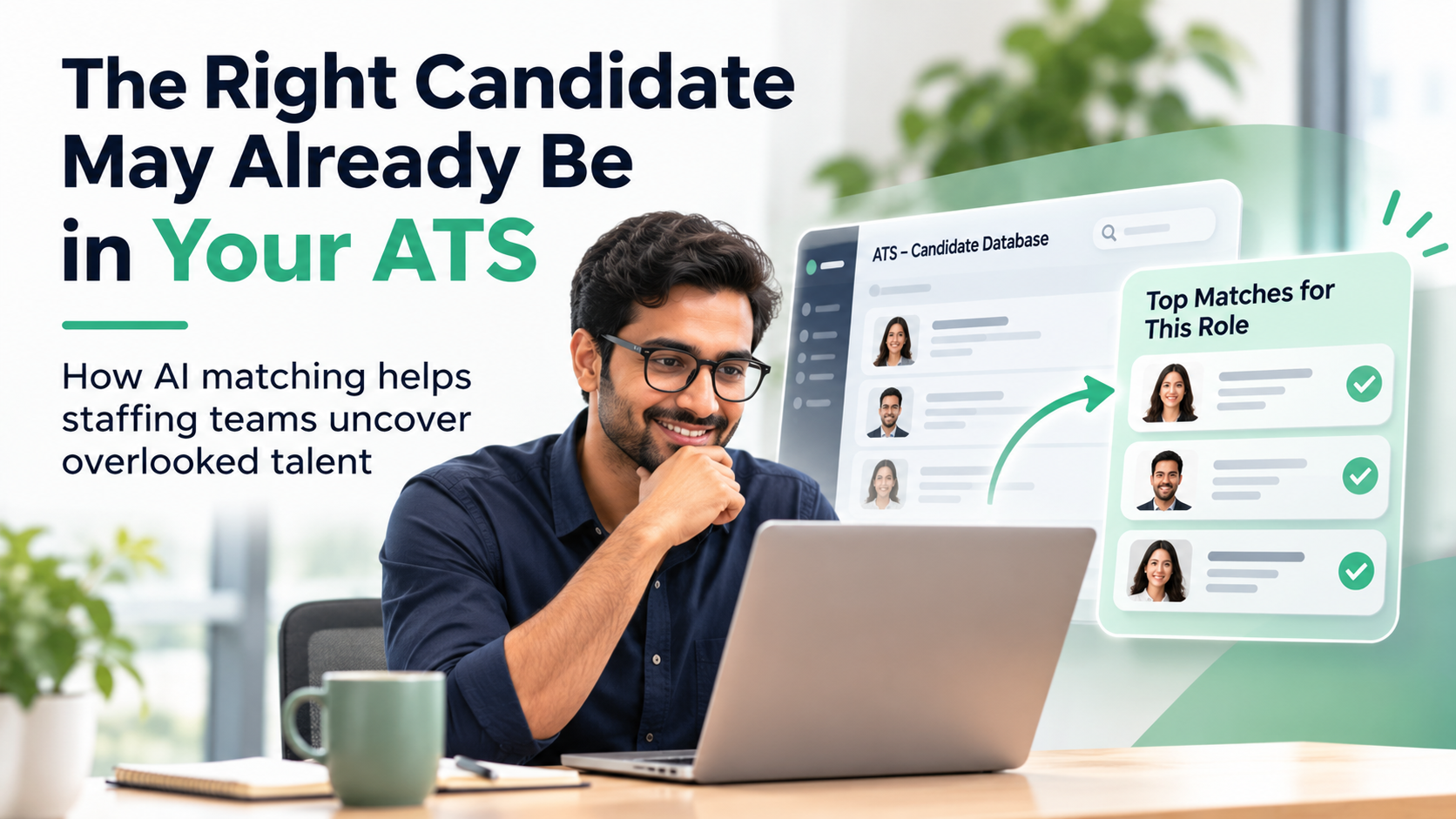
How staffing teams can recover placement opportunities by finding relevant candidates already in their talent pool, evaluating fit in context and moving from a new job order to a recruiter-approved shortlist with less repetitive searching.
The placement opportunity may already be in your ATS
A new client requirement lands with a tight submission deadline. The recruiter understands the role, knows the market and has access to a database built through years of sourcing, applications, interviews and previous placements. Yet the first instinct is often to open a job board and start searching again.
That decision is understandable. Under pressure, recruiters need profiles they can trust quickly. But it can also leave relevant candidates undiscovered. A person who was screened for a similar role six months ago may now be a strong fit for a new requirement. A software engineer whose resume says platform engineering may have the cloud infrastructure experience a client needs. A candidate who was not selected for one position may be right for another.
This is the problem we focus on at Ninjahire: helping staffing teams find relevant talent across the candidate data they already have, then extending the search when the existing pool does not provide enough suitable coverage.
THE CENTRAL QUESTION
Before paying to source another candidate, can your team reliably identify the people already in its ATS or CRM who match the new job order, understand why they match and confirm whether they are still interested?
AI candidate matching is valuable when it answers that question in a practical recruitment workflow. It should not simply return a list of resumes. It should help recruiters prioritise the right conversations and make better use of the talent relationships their agency has already built.
Why staffing agencies lose placement opportunities despite having large candidate databases
A large database is not automatically a useful talent pool. Its value depends on how accurately information is captured, how easily it can be searched and whether recruiters can recognise a candidate's relevance to a new requirement.
Keyword searches can miss relevant experience
Recruiters often search by job title, tool, certification or exact skill phrase. That works when candidate and job descriptions use the same language. It is less reliable when titles vary, skills are described differently or experience is embedded in project descriptions. A search for DevOps Engineer, for example, may miss a candidate whose recent title is Cloud Platform Engineer even when the underlying work overlaps substantially.
Candidate records age, but experience does not disappear
Profiles become stale as people change roles, locations, compensation expectations and availability. An old record may still contain valuable career history, but it needs validation before it can be treated as a current opportunity. A matching system should surface relevance without pretending that old information is current.
Recruiter knowledge is difficult to scale
Experienced recruiters remember people they have screened, placed or spoken with. That knowledge is valuable, but it is not consistently available across every desk, shift or location. When candidate history sits in notes, attachments and separate systems, another recruiter may repeat sourcing that has already been done.
New requisitions create repeated work
Without a repeatable rediscovery process, teams can rebuild searches for every job order. Recruiters spend time writing Boolean strings, opening profiles and reconstructing candidate context instead of contacting suitable people and understanding what the client actually needs.
| What goes wrong | What the recruiter experiences | Potential commercial consequence |
|---|---|---|
| Exact-title dependence | Relevant candidates do not appear in initial searches | Smaller shortlist and unnecessary external sourcing |
| Fragmented candidate history | Prior screening and engagement context is hard to find | Repeated work and slower candidate conversations |
| Outdated profile data | Recruiters cannot tell whether a match is still viable | Time spent contacting unsuitable or unavailable people |
| Inconsistent search methods | Results depend on each recruiter's search habits | Uneven coverage across roles and teams |
| No rediscovery measurement | Teams cannot see how often existing talent produces submissions | Lost visibility into database value and sourcing costs |
The issue is not that Boolean search has no place. It remains useful for precise filters and specialist requirements. The gap appears when exact terms are the only way a recruiter can discover talent.
How our team diagnoses candidate matching gaps
At Ninjahire, we approach candidate matching as a recruitment operations problem as much as a technology problem. Before changing a search workflow, our team needs to understand the job orders, candidate records, recruiter behaviour and systems involved.
We start by mapping how a requirement moves through the agency. That includes how a client brief is received, how the recruiter interprets essential criteria, where candidate records are searched, how profiles are reviewed and what happens after a potential match is found.
- Review the data landscape. Understand which ATS or CRM records are available, what fields are populated, how resumes and notes are stored, and where duplicates or outdated information may affect search quality.
- Study real requisitions. Separate must-have requirements from preferences. Identify skills, seniority, location, work authorisation, certifications, compensation and other constraints that materially affect suitability.
- Inspect current search behaviour. Review the Boolean strings, filters and manual steps recruiters use. Look for repeated searches, missed synonyms, title variations and bottlenecks between search and outreach.
- Define what a useful match means. Agree on the criteria recruiters need to see before contacting or submitting a candidate. A high similarity score alone is not a definition of qualification.
- Establish a baseline. Capture time to first relevant profile, time to recruiter-approved shortlist, rediscovery rate, response rate and downstream conversion measures.
- Run a controlled pilot. Test matching on a defined group of roles, collect recruiter feedback and inspect false positives as well as missed candidates.
WHY THE DIAGNOSTIC MATTERS
AI cannot repair missing or contradictory candidate information by itself. Matching quality improves when the system has usable data, clear job criteria and a feedback loop that allows recruiters to correct weak recommendations.
How AI candidate matching works in a staffing workflow
AI candidate matching compares the requirements of a role with information in candidate profiles and ranks potential matches for human review. A capable system goes beyond looking for the same words in two documents. It interprets skills in context, recognises related experience and applies role-specific constraints.
For staffing agencies, this can support AI candidate matching for recruitment agencies, contract staffing, direct hire and high-volume recruiting. The matching logic should still reflect the role. A cloud infrastructure position, a registered clinical role and a warehouse supervisor position should not be evaluated using one generic definition of fit.
The job description is parsed into required skills, experience, seniority, certifications, location, shift, compensation and other essential or preferred criteria. Recruiters can clarify ambiguous requirements before matching begins.
Resume and candidate records are organised into structured information such as skills, employment history, projects, education, certifications and relevant notes. Missing or uncertain fields remain visible for review.
The system compares role requirements with candidate evidence. Semantic matching can recognise related terminology and transferable experience that an exact keyword query may not retrieve.
Potential candidates are prioritised according to the role's criteria. Recruiters should be able to understand which requirements are supported by the profile and which details still need confirmation.
A recruiter checks the evidence, reviews candidate history, confirms current interest and availability, and decides whether the person should move to screening or client submission.
Job description parsing: understanding the actual requirement
Job descriptions are often written for several audiences at once. They may include essential skills, desirable tools, internal terminology, broad responsibilities and copied boilerplate. AI resume matching works better when these are separated into meaningful criteria before comparing candidates.
For example, a role asking for Kubernetes, AWS, Terraform and production incident management should not treat every phrase as equally important. If production Kubernetes experience is mandatory while a particular monitoring tool is preferred, the matching process should reflect that difference.
Resume parsing: turning documents into searchable information
Resume parsing extracts structured information from candidate documents. This may include job titles, employers, dates, technical skills, certifications, education and project details. Extraction is not the same as verification. Recruiters still need to check unclear dates, overlapping employment, unsupported claims and outdated contact information.
Semantic matching: looking beyond exact keywords
Semantic matching evaluates meaning and relationships between terms. It can help connect related job titles, tools and responsibilities where the wording differs. A candidate describing infrastructure automation with Terraform may be relevant to a role that uses the phrase infrastructure as code, provided the experience is supported by the profile.
This does not mean every adjacent skill is interchangeable. Similarity should help discover candidates, not silently convert a preferred skill into a proven qualification.
AI skills matching and role-specific ranking
AI skills matching should weigh evidence according to the role. A current professional certification may be essential for one position and irrelevant for another. Recent hands-on experience may matter more than a skill mentioned once in an old project. A useful candidate matching platform makes the criteria explicit and lets the recruiter inspect the evidence.
Candidate-job matching should include constraints
Technical fit alone is not enough. Location, work arrangement, shift, pay expectations, notice period, work authorisation and candidate preferences can determine whether a technically strong profile is actionable. The system should distinguish between a skills match and a candidate who is ready to be considered for a specific opening.
From missed candidates to recruiter-ready shortlists
Our recommended workflow starts with the talent an agency already knows. When a new requisition arrives, the team first checks whether the existing ATS or CRM contains relevant profiles. This protects the value of past sourcing activity and can reduce avoidable repetition.
Ninjahire's AI sourcing workflow is designed to begin with candidate rediscovery from connected ATS or CRM records, then extend discovery to the Ninjagraph talent graph and supported external sourcing channels when additional coverage is needed. This layered approach means recruiters do not have to treat every new job order as a completely new search.
| Traditional workflow | AI-assisted workflow |
|---|---|
| Recruiter starts a fresh search for each job order | Existing ATS or CRM candidates are checked first |
| Search relies heavily on exact job titles and terms | Contextual matching can surface related experience |
| Profiles are opened and compared one by one | Potential matches are prioritised for recruiter review |
| Candidate history must be reconstructed manually | Available profile history can inform the next action |
| External sourcing may begin before internal talent is reviewed | Search expands beyond the existing pool when needed |
The improvement is not that every AI recommendation becomes a placement. The improvement is that recruiters can make a more informed decision about which candidate conversations to start, which profiles need validation and where further sourcing is still required.
For a related example of how rediscovery can unlock overlooked talent, see our case study on rediscovering 12,000 candidates already inside an ATS. That is a separate documented case study, not a result attributed to the workflow described on this page.
From job order to candidate conversation
AI candidate matching creates value when it is connected to what recruiters do next. The following workflow shows how a staffing team can move from a client requirement to a validated shortlist without confusing automated discovery with a completed screening decision.
- Receive and clarify the job order. Capture the role, client context, mandatory criteria, preferred experience, location, pay range and submission deadline.
- Convert the brief into searchable criteria. Parse the job description and let the recruiter confirm which requirements are essential and which are flexible.
- Search existing candidate records. Run ATS candidate matching and candidate rediscovery against the agency's accessible database.
- Expand the search where necessary. If the internal pool does not provide enough viable candidates, extend to the wider talent graph and supported sourcing channels.
- Review ranked profiles. Inspect matching evidence, identify gaps and remove candidates who do not meet essential requirements.
- Contact candidates. Use personalised outreach to confirm interest, availability, location, compensation expectations and other current details.
- Complete screening. Apply the agency's screening process and use structured questions or AI-assisted phone screening where appropriate.
- Submit with recruiter accountability. Present only candidates who have been reviewed and validated against the client's requirements.
In this model, AI candidate matching software supports discovery and prioritisation. The recruiter remains responsible for the relationship, the interpretation of candidate context and the decision to submit.
Where teams need to reduce repetitive initial screening work after matching, Ninjahire's AI candidate screening case study describes a separate high-volume workflow and its reported screening-time outcome. It should not be interpreted as a measured placement result for this candidate-matching workflow.
How we measure whether AI candidate matching is improving placements
A candidate matching system should be evaluated on the quality of the opportunities it creates, not just the number of profiles it returns. A large list can increase recruiter workload if it contains weak matches. We recommend measuring performance from the first search through to placement and, where available, redeployment.
| Metric | Definition | Why it matters |
|---|---|---|
| Time to first relevant profile | Elapsed time from job intake to the first recruiter-confirmed relevant profile | Shows whether discovery is faster |
| Time to approved shortlist | Elapsed time from job intake to a recruiter-approved shortlist | Measures usable delivery speed rather than raw system output |
| Internal rediscovery rate | Share of relevant profiles surfaced from the existing ATS or CRM | Shows how effectively the agency reuses its talent pool |
| Match acceptance rate | Share of AI recommendations accepted for recruiter review or progression | Indicates whether recommendations are useful |
| Candidate contact rate | Share of surfaced candidates successfully reached | Tests whether contact data and outreach processes work |
| Candidate response rate | Share of contacted candidates who respond | Measures engagement, not technical match quality alone |
| Submission-to-interview ratio | Client interviews divided by candidate submissions | Signals shortlist relevance and submission quality |
| Interview-to-placement ratio | Placements divided by client interviews | Connects matching to downstream conversion |
| Placements from existing talent | Placements sourced from previously held candidate records | Shows the commercial contribution of rediscovery |
Build a baseline before claiming improvement
Compare a defined period before and after implementation. Keep role mix, recruiter group, geography and job volume visible. If the post-implementation period contains more easy-to-fill roles or a different client mix, a simple before-and-after comparison may overstate the impact of the technology.
For a useful pilot, record the requisition ID, role family, date received, search start, first relevant match, shortlist approval, outreach, submission, interview and placement outcome. This makes it possible to trace which stage improved and where the remaining bottleneck sits.
HOW TO CALCULATE INTERNAL REDISCOVERY RATE
Internal rediscovery rate = relevant candidates first identified from the existing ATS or CRM ÷ all relevant candidates identified for the requisition × 100.
Define what counts as relevant before measuring. A profile should not count simply because an AI system returned it.
Separate matching quality from sourcing volume
More profiles surfaced does not necessarily mean better candidate matching. Track recruiter acceptance, candidate response, client interview and placement conversion alongside search volume. This helps identify whether the system is finding genuinely useful candidates or simply producing more records to review.
Where possible, segment results by job family, seniority and role difficulty. A matching workflow that performs well for common software engineering roles may need different criteria and validation for niche infrastructure, healthcare or regulated positions.
AI candidate matching vs traditional Boolean search
Boolean search remains a practical tool for recruiters. It is precise, transparent and useful when the required terms are known. AI-assisted matching adds another discovery method by interpreting context and relationships across job and candidate information.
| Dimension | Boolean and keyword search | AI-assisted matching |
|---|---|---|
| Search logic | Uses explicit terms, operators and filters | Can evaluate semantic similarity and related experience |
| Title variations | May require the recruiter to anticipate alternate titles | Can identify related titles when the experience supports the relationship |
| Transferable skills | Usually depends on the terms entered | Can surface adjacent skills and contextual evidence |
| Precision controls | Strong for exact terms and structured filters | Needs clear constraints and recruiter review to control false positives |
| Explainability | Search terms are visible and easy to inspect | Good systems should show the evidence behind recommendations |
| Best use | Known skills, mandatory credentials and narrow filters | Broader discovery, candidate rediscovery and prioritising likely matches |
The strongest recruitment workflow does not need to choose one method exclusively. Recruiters can use Boolean filters for hard constraints and AI matching to discover relevant profiles whose experience is described in different language.
WHAT AI MATCHING SHOULD NOT DO
It should not infer a licence that is not documented, assume a candidate is available, treat a similar job title as proof of capability or make an unreviewed hiring decision. The system should make discovery more useful while keeping the evidence and uncertainty visible.
How Ninjahire supports AI candidate matching for staffing agencies
Ninjahire is built around the operational needs of staffing teams. Candidate matching is most useful when it connects to sourcing, outreach, screening and recruiter visibility rather than sitting as an isolated ranking feature.
Start with the talent the agency already has
Ninjahire's AI sourcing workflow begins by rediscovering relevant candidates in connected ATS or CRM records. This helps agencies check the value of their existing talent pool before expanding into new sourcing channels. Read more about AI sourcing and candidate rediscovery.
Extend discovery when the internal pool is not enough
When a requisition requires additional coverage, the workflow can extend to Ninjagraph, Ninjahire's talent graph described on its product page as containing more than 800 million professional profiles, and supported external job boards. This layered approach helps recruiters balance reuse with reach. Profile availability, data coverage and contactability should always be checked for the specific search.
Move from discovery to engagement
Finding a candidate is only the first step. Ninjahire's outreach capabilities support personalised engagement across supported channels, including email, SMS and calls. Recruiters can use the response and screening stages to establish whether a candidate is still interested and aligned with the requirement.
Support initial screening and recruiter review
The AI screening workflow can help teams collect initial information and organise candidate evaluation. For a closer look at the separate screening use case, see the AI candidate screening case study linked earlier in this article. The outcome reported there concerns screening time, not the placement results of the matching process described here.
Give teams operational visibility
A recruitment dashboard helps teams monitor activity across their workflows. For staffing leaders, the important question is whether matching and automation are improving the measures that matter to the desk: recruiter-approved shortlists, response, submission quality and placements.
Our other published work provides related evidence from distinct workflows. The ATS candidate reuse case study reports a 65% increase in candidate reuse. That figure belongs to that case study and should not be presented as the result of this article's matching workflow.
A practical implementation roadmap for staffing teams
Successful implementation depends on adoption and data readiness as much as model capability. A phased rollout gives the agency a way to validate matching quality before making it part of every recruiter's daily process.
| Phase | Work to complete | Evidence to collect |
|---|---|---|
| 1. Workflow discovery | Map requisition intake, sourcing, screening and submission | Current process map and baseline timings |
| 2. Data readiness | Review ATS access, profile completeness, duplicates and field quality | Data quality issues and integration requirements |
| 3. Matching design | Define role criteria, hard constraints and recruiter review rules | Approved matching rubric and sample test roles |
| 4. Pilot | Run selected requisitions through AI-assisted discovery alongside existing practice | Match acceptance, false positives and missed-match feedback |
| 5. Recruiter enablement | Train users to inspect evidence, validate details and record outcomes | Adoption, override reasons and process compliance |
| 6. Optimisation | Review performance by role family and refine criteria | Shortlist speed, conversion and placement contribution |
What to test during the pilot
- Can the system find candidates with related job titles but relevant experience?
- Does it distinguish essential skills from preferred skills?
- Can recruiters see why each candidate was recommended?
- Are outdated or incomplete records clearly flagged?
- Does the system reduce repeated searches without creating an unmanageable review queue?
- Do candidates respond and progress through the agency's existing process?
Do not expand the pilot solely because the system returns a high number of profiles. Expand when recruiters trust the recommendations, the workflow fits the desk and the downstream measures show improvement.
Why human review remains essential in AI candidate matching
AI matching can help identify patterns across large volumes of information, but it can also reproduce gaps or bias in the underlying data and criteria. A candidate whose career path differs from historical hiring patterns should not be overlooked simply because the profile looks less familiar to the model.
Staffing agencies should use job-related criteria, test recommendations across relevant candidate groups and keep recruiters accountable for decisions. They should also explain how candidate data is used, apply appropriate access controls and follow applicable privacy and employment laws in the markets where they operate.
Keep evidence separate from inference
A profile may show that a candidate worked with AWS. It may not show the depth, recency or production context of that experience. Matching should surface the evidence and flag what needs to be asked, rather than converting a broad keyword into an assumed qualification.
Keep candidate data current and protected
Only use candidate information for appropriate recruitment purposes, apply retention policies and make sure connected systems have the right permissions. Review the accuracy of enriched information and provide a process for correcting records. AI candidate matching is only as trustworthy as the data and governance surrounding it.
Monitor false positives and false negatives
False positives are profiles that look relevant to the system but do not meet the actual requirement. False negatives are suitable candidates that the system fails to surface. Both matter. Recruiter feedback should be captured in a structured way so the team can improve criteria and identify recurring gaps.
What staffing agencies should look for in AI candidate matching software
When evaluating AI candidate matching software, staffing leaders should look beyond an attractive match score or a large database claim. The right platform should fit the agency's systems, role types and recruiter process.
- Existing ATS and CRM search: Can the platform rediscover candidates already in the agency's systems?
- Contextual skill understanding: Can it recognise related skills and experience without treating every adjacent term as equivalent?
- Role-specific criteria: Can recruiters distinguish mandatory requirements from preferences?
- Transparent recommendations: Can users inspect the profile evidence behind a match?
- Data freshness: Can recruiters identify stale contact details, availability and candidate preferences?
- Workflow continuity: Does matching connect to outreach, screening and recruiter review?
- System compatibility: Can it work with the agency's existing ATS or CRM and its permission model?
- Outcome reporting: Can the team measure shortlist time, candidate response, interview conversion and placements?
- Human control: Can recruiters review, correct and override recommendations?
- Responsible data practices: Are data access, retention, security and candidate communication handled appropriately?
Find more value in the talent you already know
See how Ninjahire can help your staffing team rediscover existing candidates, extend sourcing when needed and move relevant profiles into recruiter-led conversations.
Explore NinjahireFrequently asked questions about AI candidate matching
AI candidate matching uses artificial intelligence to compare job requirements with candidate information and identify profiles that may fit a role. It can analyse skills, experience, job history and related terminology, then prioritise candidates for recruiter review. In staffing, it can also help rediscover people already recorded in an ATS or CRM.
The system analyses a job description, extracts role criteria, parses candidate profiles and compares the information using keyword and contextual methods. It ranks potential matches and presents them for human review. Recruiters then validate experience, availability, interest and other requirements before progressing a candidate.
Yes, when the AI recruiting platform has authorised access to the ATS or CRM data. Candidate rediscovery compares new job requirements with existing records to surface relevant people who may have been overlooked in earlier searches. Recruiters must still confirm that the information is current.
They solve related but different problems. Boolean search is useful for exact terms and precise filters. AI matching can help identify contextual relationships and related experience that may not use the exact wording in the search string. Many staffing teams benefit from using both methods.
Accuracy depends on the quality of candidate data, job criteria, matching model and role type. Agencies should measure recruiter acceptance, false positives, missed matches and downstream conversion instead of relying on a single vendor accuracy percentage. A match score is a prioritisation signal, not proof that a candidate is qualified.
Yes. AI can parse job descriptions into skills, experience, qualifications and other criteria, then compare them with candidate resumes and profiles. Recruiters should confirm which criteria are mandatory and check whether the candidate's experience supports the match.
AI resume matching compares a resume or candidate profile with a job requirement. Candidate rediscovery focuses on finding relevant people already stored in an organisation's ATS or CRM. A platform can combine both by parsing profiles and searching the existing database for new requisitions.
AI can support faster candidate discovery, more consistent shortlisting, candidate outreach and initial screening. To establish whether it improves placements, agencies should track the complete funnel from job intake through shortlist, submission, interview and placement, comparing results with a defined baseline.
No. It supports repetitive search and prioritisation work, while recruiters remain essential for understanding client context, assessing nuance, building candidate relationships, validating information and making submission decisions.
Look for ATS or CRM connectivity, contextual matching, role-specific criteria, transparent recommendations, current candidate data, recruiter controls, workflow integration and reporting that connects matching activity to placement outcomes.
Other insights
Continue reading


The AI recruiter for staffing teams. Sourcing, outreach and screening, around the clock.
Get new posts by email
Research, case studies and field notes on AI recruiting. No spam.