.png)
Case Study
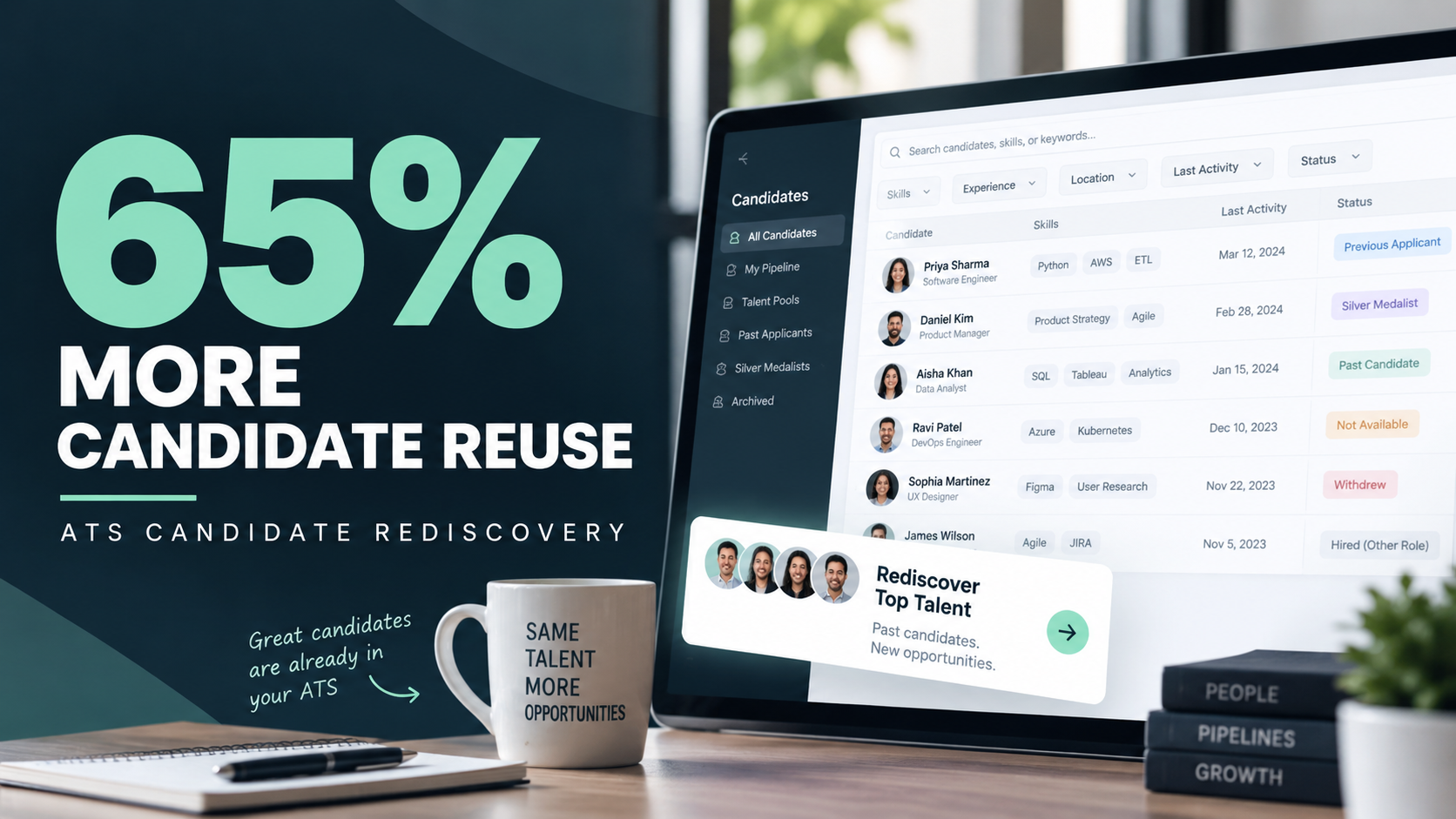
An agency's ATS had years of candidate history sitting in it, but that history was rarely the first place recruiters looked when a new requirement came in. Once ATS candidate rediscovery became a deliberate step in the workflow, rather than an afterthought, candidate reuse from the existing database increased by 65%.
ATS Candidate Rediscovery Case Study: 65% More Candidate Reuse
The agency in this case study already had a sizable candidate database. Years of applicants, submissions, and previous searches were sitting in the ATS. The issue was not a shortage of candidates. It was that recruiters routinely started new searches from scratch rather than checking whether a good fit already existed in the system.
That pattern is common. A recruiter under time pressure tends to reach for familiar sourcing channels rather than run a fresh search against a database that might not surface obvious matches. Once candidate rediscovery became a standard step early in the workflow, instead of something recruiters tried only after external sourcing came up short, ATS candidate reuse increased by 65%.
Measured after candidate rediscovery became a standard part of the agency's recruiting workflow, rather than an occasional or secondary step.
This case study reports one confirmed figure: a 65% increase in ATS candidate reuse. It does not report how reuse was calculated, what the starting baseline was, or downstream effects on time-to-fill, placements, or cost. Those figures were not part of the measured result, so they are left out rather than estimated.
The Problem: A Large ATS, but Too Little Candidate Reuse
A big candidate database is only useful if recruiters actually search it. This section covers what was happening before rediscovery became part of the standard workflow.
Candidates accumulated but were rarely revisited
Every closed requisition added candidates to the database, but there was no consistent process for revisiting them once the role they applied for was filled. Profiles piled up without a clear path back into active consideration.
Recruiters often started new searches externally
When a new requirement landed, the default move was often to source externally rather than check the ATS first. External sourcing feels more direct in the moment, even when a relevant candidate is already sitting in the system.
Historical candidate information was difficult to surface
Even when a recruiter did search the ATS, finding the right candidate among years of accumulated records was not always straightforward. Relevant history was there, but locating it took effort that competed with other priorities.
Good candidates became invisible after a requisition closed
A strong candidate who was not selected for one role, often called a silver medalist, had no consistent path back into the pipeline once that specific requisition closed. Without a deliberate rediscovery step, that candidate's fit for future roles went unexamined.
The agency was not getting enough value from its existing candidate database
None of this reflects a database problem. It reflects a workflow problem. The candidates were there. The habit of checking for them first was not.
What Is ATS Candidate Rediscovery?
ATS candidate rediscovery is the process of searching an existing applicant tracking system for candidates who may fit a new requirement before relying entirely on external sourcing. It treats the candidate database as an active resource for every new role, not just an archive of past applicants.
For a fuller explanation of how candidate rediscovery works, including the mechanics of ATS search and matching, that guide covers the topic in more depth. This case study focuses specifically on what changed operationally and the reuse increase that followed.
Why Candidates Already in Your ATS Are Worth Reconsidering
An ATS accumulates several types of candidates worth a second look. Previous applicants who were never contacted for a later role. Silver medalists, strong finalists who lost out to another candidate on a specific requisition. Candidates who matched a different role but not the one they applied for. Candidates who were qualified but unavailable at the time, and candidates who withdrew for reasons that may no longer apply. Skills, certifications, and availability can all change between when a candidate first entered the system and when a new requirement comes up.
None of this means an old candidate is automatically the right fit. Previous ATS history provides useful context, not a shortcut past evaluation. A candidate who was a strong match eighteen months ago still needs to be reviewed against the current role and current circumstances before moving forward.
How the Agency Was Using Its ATS Before Candidate Rediscovery
The previous workflow followed a fairly typical pattern for a busy staffing desk.
- 1A new requirement comes in from a client.
- 2The recruiter begins external sourcing to build a candidate pool.
- 3New candidates are identified and added to the pipeline.
- 4Candidates go through screening.
- 5Qualified candidates are submitted to the client.
Meanwhile, candidates already sitting in the ATS from prior searches were often left untouched unless a recruiter happened to remember a specific person who might fit. There was no consistent step that required checking the existing database before moving to external sourcing.
The New ATS Candidate Rediscovery Workflow
The updated workflow added a deliberate rediscovery step early in the process, before external sourcing became the default.
- 1New requirement: A client requisition comes in, same as before.
- 2Search the existing ATS: The database is checked for potential matches before external sourcing begins.
- 3Match candidates against the requirement: Candidate records are compared against the specific skills, experience, and criteria for the new role.
- 4Surface relevant historical candidates: Candidates with a plausible fit, including previous applicants and silver medalists, are identified for review.
- 5Review candidate history: The recruiter reviews prior stage, outcome, and interaction history for context.
- 6Re-engage suitable candidates: Candidates who still look relevant are contacted to confirm interest and current availability.
- 7Screen and qualify: Standard screening still applies, regardless of whether a candidate is new or rediscovered.
- 8Submit: Qualified candidates move forward to the client, same as any other candidate.
The core change is where the process starts. Instead of defaulting to external sourcing, the ATS became the first stop for every new requirement.
How Candidate Rediscovery Increased ATS Candidate Reuse by 65%
This is the central result of the case study, and it is worth being specific about what actually changed to produce it.
Recruiters considered the ATS before starting a new external search
Making rediscovery a required early step, rather than an optional one, meant the existing database got checked consistently instead of occasionally.
Relevant historical candidates became easier to identify
Matching candidate records against a new requirement's specific criteria made it faster to spot who might actually fit, rather than relying on a recruiter's memory of past searches.
Candidate history gave recruiters more context
Seeing a candidate's prior stage and outcome, such as being a finalist on a previous role, gave recruiters useful information for deciding who was worth re-engaging.
Recruiters could re-engage relevant candidates
Once a plausible match was identified, reaching back out to confirm interest and current availability became a normal part of the workflow rather than an extra task.
Rediscovery became part of the normal recruiting workflow
The biggest shift was not a new tool by itself. It was making rediscovery a standard step for every requirement instead of something recruiters only tried when external sourcing was not producing results.
The result: 65% increase in ATS candidate reuse. This case study does not claim that the change also produced faster hiring, lower costs, more placements, or more revenue. Those outcomes were not measured here, and it would be inaccurate to imply they were.
What Changed for Recruiters?
The practical shift was in how a search started, not necessarily in how much work a recruiter did overall. Less time went into rebuilding candidate pipelines from scratch for roles that resembled previous requisitions. Recruiters had easier access to candidates they, or a colleague, had already evaluated at some point. Historical candidate information became something recruiters actively used instead of something that sat unused in old records.
Candidate rediscovery can reduce repeated sourcing work when relevant candidates already exist in the database. It does not eliminate sourcing altogether, and it does not remove the need to screen or qualify a rediscovered candidate the same way a new one would be screened.
Why Candidate Rediscovery Matters for Staffing Agencies
Staffing agencies are a natural fit for this kind of workflow change. Most agencies are running multiple simultaneous requisitions, often across recurring job families where similar roles come up again and again for different clients. A large candidate database, built up over years of searches, holds real potential value for exactly this kind of repeat pattern.
Urgent client requirements add pressure to move fast on candidate submissions, and time-to-submit expectations do not leave much room for slow, from-scratch sourcing on every role. When a candidate who already matched a similar past role is sitting in the ATS, checking there first is a faster starting point than sourcing externally, even before accounting for any measured result. The same candidate database that already exists becomes more valuable simply by being used more consistently.
Candidate Rediscovery vs. External Sourcing
| External Sourcing | ATS Candidate Rediscovery | |
|---|---|---|
| Candidate source | New candidates outside the existing database | Candidates already in the ATS |
| Search starting point | Job boards, outreach, referrals, other channels | Existing candidate records |
| Existing candidate history | Not available | Prior stage, outcome, and application history available |
| Prior recruiter interaction | None | Often exists from a previous requisition |
| Candidate relationship | Starting from zero | Some prior relationship or contact may exist |
| Sourcing process | Full sourcing cycle required | Search and match against existing records |
| Re-engagement opportunity | Not applicable | Candidate can be re-contacted with context |
Rediscovered candidates are not automatically cheaper, better, faster, or more qualified than externally sourced candidates. What rediscovery offers is a different starting point: candidate rediscovery can reduce repeated sourcing work when relevant candidates already exist in the ATS, but every candidate, rediscovered or new, still goes through the same evaluation before being submitted.
What Makes ATS Candidate Rediscovery Work?
Clean candidate data
Search and matching are only as good as the underlying records. Incomplete or inconsistent candidate data makes relevant candidates harder to find.
Searchable candidate profiles
Candidate information needs to be structured in a way that supports search, not buried in unstructured notes or attachments.
Consistent candidate information
When candidate records are formatted consistently across the database, comparing candidates against a new requirement is faster and more reliable.
Historical stage and outcome data
Knowing where a candidate landed in a previous process, such as being a finalist, gives recruiters context that a bare resume does not.
Candidate matching
Comparing candidate records against the specific criteria of a new requirement is what turns a large database into a usable shortlist.
Data freshness
Candidate information changes over time. Skills, availability, and contact details from years ago may no longer be accurate, which affects how much weight to give an old record.
Recruiter review
Matching surfaces candidates for consideration. It is still the recruiter's job to review that history and decide who is actually worth re-engaging.
Candidate re-engagement
Identifying a good match does not help if there is no consistent process for reaching back out to that candidate and confirming current interest and availability.
How AI Improves ATS Candidate Rediscovery
Traditional ATS search generally works through keywords and filters: a recruiter enters specific terms, applies filters for location or experience, and reviews whatever matches those exact criteria. This works, but it depends on the recruiter guessing the right keywords, and it can miss candidates whose records use different terminology for the same skill or experience.
AI-assisted matching works a step differently. Instead of relying only on exact keyword matches, it starts from the job requirement, builds an understanding of what the role actually needs, compares that against candidate records, and ranks candidates by relevance for recruiter review. This is often described as semantic matching: recognizing that "project lead" and "project manager" may reflect similar experience even though the exact words differ.
This kind of matching is meant to help recruiters surface and prioritize candidates faster. It is not meant to replace recruiter judgment or make a hiring decision. A ranked list still requires a recruiter to review candidate history and current fit before anyone gets contacted. For more on how this plays out specifically around candidate matching, see NinjaHire's AI candidate matching resource.
What Features Should Candidate Rediscovery Software Have?
| Feature | Why It Matters |
|---|---|
| ATS integration | Rediscovery only works if it connects directly to where candidate records already live |
| Candidate database search | The core function of finding relevant candidates within existing records |
| AI or semantic matching | Helps surface candidates whose records don't use exact keyword matches |
| Candidate ranking | Prioritizes which candidates are most worth a recruiter's time |
| Candidate history | Shows prior stage and outcome data for informed re-engagement decisions |
| Silver-medalist identification | Surfaces strong finalists from past requisitions who may fit a new role |
| Candidate segmentation | Groups candidates by skill, role type, or status for easier review |
| Data freshness | Flags when candidate information may be outdated |
| Duplicate detection | Prevents the same candidate from appearing as multiple separate records |
| Candidate re-engagement | Supports reaching back out to confirm interest and availability |
| Outreach workflows | Makes re-engagement a repeatable process rather than a one-off task |
| Recruiter review | Keeps the final call with a person, not the software |
| Match explanations | Helps recruiters understand why a candidate was surfaced |
| Reporting | Shows how much candidate reuse is actually happening over time |
These are evaluation criteria for buyers assessing candidate rediscovery software generally. This case study does not confirm that every one of these features was used or available in the specific implementation described here.
How to Measure ATS Candidate Reuse
"Candidate reuse" can be measured a few different ways, and it matters which one a team is actually tracking. Possible measures include the percentage of hires that came from existing ATS candidates, the raw number of ATS candidates reused, the percentage of submissions drawn from existing candidates, rediscovered candidates surfaced per requisition, the rediscovery-to-contact rate, the contact-to-screen rate, the rediscovery-to-submission rate, the rediscovery-to-placement rate, time-to-submit specifically for rediscovered candidates, and the amount of external sourcing avoided.
This case study reports a 65% increase in ATS candidate reuse without specifying which of these measures the figure reflects or what the underlying denominator was. Rather than guess at a methodology that was not provided, it is more accurate to present the number exactly as confirmed and note that any agency tracking a similar change should define its own reuse metric clearly before comparing results.
What the 65% Increase Means for the Agency
In plain terms, more candidates already stored in the ATS became usable for new requirements after rediscovery became a standard step in the workflow. That is the direct interpretation of the confirmed result.
Beyond that direct interpretation, a few operational implications are reasonable to consider, using careful language rather than treating them as measured outcomes. Greater ATS utilization can mean more value from historical candidate data that was already being collected regardless. Less dependence on starting every search externally may reduce some duplicated sourcing effort. Easier access to known candidates can support more consistent database usage across a recruiting team over time. None of these are separately measured in this case study; they are reasonable operational implications of the confirmed 65% increase in reuse.
Common Candidate Rediscovery Mistakes
Searching the ATS only after external sourcing fails
Treating rediscovery as a backup plan instead of a first step limits how consistently it actually gets used.
Treating every old candidate as equally relevant
Not every historical candidate is a fit for a new requirement. Matching and review still matter.
Ignoring candidate data freshness
Contact details, availability, and skills can change. Old information should be verified, not assumed accurate.
Ignoring previous candidate outcomes
Why a candidate did not move forward previously is useful context that should inform whether to re-engage them now.
Reaching out without reviewing candidate history
Contacting a candidate without checking prior interactions can create an awkward or repetitive experience for them.
Sending generic re-engagement messages
A message that ignores a candidate's specific history and current relevance is less likely to get a useful response.
Letting AI ranking replace recruiter judgment
A ranked list is a starting point for review, not a final decision. Recruiter evaluation still matters for every candidate.
Not measuring rediscovery as a sourcing channel
Without tracking reuse as its own metric, it is difficult to know whether rediscovery efforts are actually working.
Is ATS Candidate Rediscovery Right for Your Staffing Agency?
This approach tends to matter most for agencies with a large ATS database, a substantial amount of historical candidate data, repeat hiring across similar roles, multiple recruiters working from a shared database, high requisition volume, recurring job families, frequent urgent searches, and meaningful ongoing external sourcing activity. In those conditions, a database that already holds relevant candidates is likely being underused without a deliberate rediscovery step.
It is likely to matter less for agencies with a very small candidate database, very low hiring volume, poor candidate data quality, or little usable historical ATS information to begin with. In those cases, there may simply not be enough existing candidate history for rediscovery to meaningfully change the workflow yet.
Frequently Asked Questions
What is ATS candidate rediscovery?
ATS candidate rediscovery is the process of searching an existing applicant tracking system for candidates who may fit a new requirement before relying entirely on external sourcing. It treats the existing candidate database as an active resource rather than an archive.
What is candidate reuse in recruiting?
Candidate reuse refers to using candidates already in a recruiting database for new requirements, rather than sourcing new candidates for every role. It reflects how much value a team is getting from candidates it has already collected.
How does ATS candidate rediscovery work?
A new requirement is compared against existing candidate records in the ATS. Matching candidates are surfaced, their history is reviewed, and relevant candidates are re-engaged before or alongside external sourcing efforts.
How can staffing agencies reuse candidates from their ATS?
By making ATS search a required early step for every new requirement, reviewing candidate history for context, and building a consistent process for re-engaging candidates who still look relevant rather than starting external sourcing by default.
What is the difference between candidate sourcing and candidate rediscovery?
Candidate sourcing finds new candidates outside the existing database. Candidate rediscovery searches candidates already inside the database. Rediscovery generally starts from a database that already contains some relevant history; sourcing starts from zero.
How does AI improve candidate rediscovery?
AI-assisted matching can compare a job requirement against candidate records using more than exact keyword matches, helping surface relevant candidates whose records use different terminology. It is meant to support recruiter review, not replace it.
Can candidate rediscovery reduce sourcing time?
Candidate rediscovery can reduce repeated sourcing work when relevant candidates already exist in the database. This case study did not measure sourcing time directly, so no specific time figure is claimed here.
What candidates should recruiters rediscover first?
Strong candidates for rediscovery typically include silver medalists from past requisitions, previous applicants who matched a different role, and candidates who were qualified but unavailable at the time. Each still needs review against the current requirement.
How do you measure ATS candidate reuse?
Possible measures include the percentage of hires or submissions from existing candidates, the number of candidates rediscovered per requisition, and rates like rediscovery-to-contact or rediscovery-to-submission. Agencies should define their reuse metric clearly before tracking it.
What is a good candidate rediscovery strategy?
Making rediscovery a required early step for every new requirement, keeping candidate data clean and searchable, reviewing candidate history before re-engaging, and measuring reuse consistently over time.
What should candidate rediscovery software include?
Key features include ATS integration, candidate database search, matching and ranking, candidate history visibility, data freshness indicators, duplicate detection, re-engagement workflows, and clear recruiter review at every stage.
Is candidate rediscovery useful for staffing agencies?
Yes, particularly for agencies with a large candidate database, repeat hiring patterns, and high requisition volume. Existing candidate records represent a resource that is easy to underuse without a deliberate rediscovery process.
How did the agency increase ATS candidate reuse by 65%?
By making ATS candidate rediscovery a required step early in the workflow for every new requirement, rather than something recruiters tried only after external sourcing did not produce results. That workflow change was associated with a 65% increase in ATS candidate reuse.
The Bottom Line
A large ATS is only valuable when recruiters can actually use the candidates stored inside it. This case study shows what happened when one agency stopped treating its candidate database as a backup option and made rediscovery a required part of every new requirement: ATS candidate reuse increased by 65%.
Making that shift did not require replacing recruiter judgment. It required making the existing database the first place recruiters looked, not the last. Agencies dealing with high requisition volume, repeat job families, and tight submission timelines are likely to find their own database holds more value than current workflows are capturing. For related workflow context, see NinjaHire's article on reducing time-to-submit.
Explore NinjaHire
See how NinjaHire can help your recruiting team make better use of the candidates already in your ATS.
Explore NinjaHire








.jpg)