Most recruiting teams evaluating agentic AI in 2026 are not asking whether to automate. They are asking which claims are real. Korn Ferry's 2026 talent acquisition research, based on a survey of more than 1,670 global talent leaders, found that 84% of talent leaders planned to use AI in the coming year, and 52% planned to add autonomous agents to their teams. That buying wave has produced a crowded market where assistive features and genuine multi-step agents share the same vocabulary. This guide gives staffing agencies and talent acquisition teams a framework for telling them apart.
TL;DR
- Autonomous AI recruiting platforms differ widely in how independently they execute work. "Agentic" is a marketing label, not a capability tier.
- Evaluate real workflow coverage, exception handling, ATS integration depth, explainability, and human control gates — not demo polish.
- A structured pilot on two live requisitions, measured against a documented baseline, is the only reliable proof of performance.
- ROI must combine recruiter hours saved, candidate quality, and cost per qualified candidate. Speed alone proves nothing.
1 — What Are Autonomous AI Recruiting Platforms?
An autonomous AI recruiting platform executes a sequence of connected recruiting tasks toward a hiring goal — searching talent sources, evaluating matches, contacting candidates, handling replies, and organizing screening — without a recruiter triggering each individual step. That is the functional difference from an applicant tracking system, which records activity, and from a copilot, which drafts or suggests on request. An autonomous AI recruiter is defined by what it finishes, not by what it proposes.
Autonomy exists on a ladder, and most products marketed as agentic sit lower on it than their positioning implies:
| Level | What it does | Recruiter involvement |
|---|---|---|
| Assistive AI | Suggests candidates, drafts messages, summarizes notes | Every action initiated manually |
| AI copilot | Executes a single defined task on request | Prompts each task |
| Semi-autonomous agent | Completes multi-step workflows under supervision | Approves stage transitions |
| Autonomous agent | Runs configured workflows end to end, escalates exceptions | Sets rules, reviews exceptions and outcomes |
The practical test is simple: ask a vendor to name the last step in a workflow their system completes without a human click. If the answer is "it surfaces a shortlist," the product is a sourcing tool with an agent label.
2 — Key Criteria for Evaluating Autonomous AI Recruiting Platforms
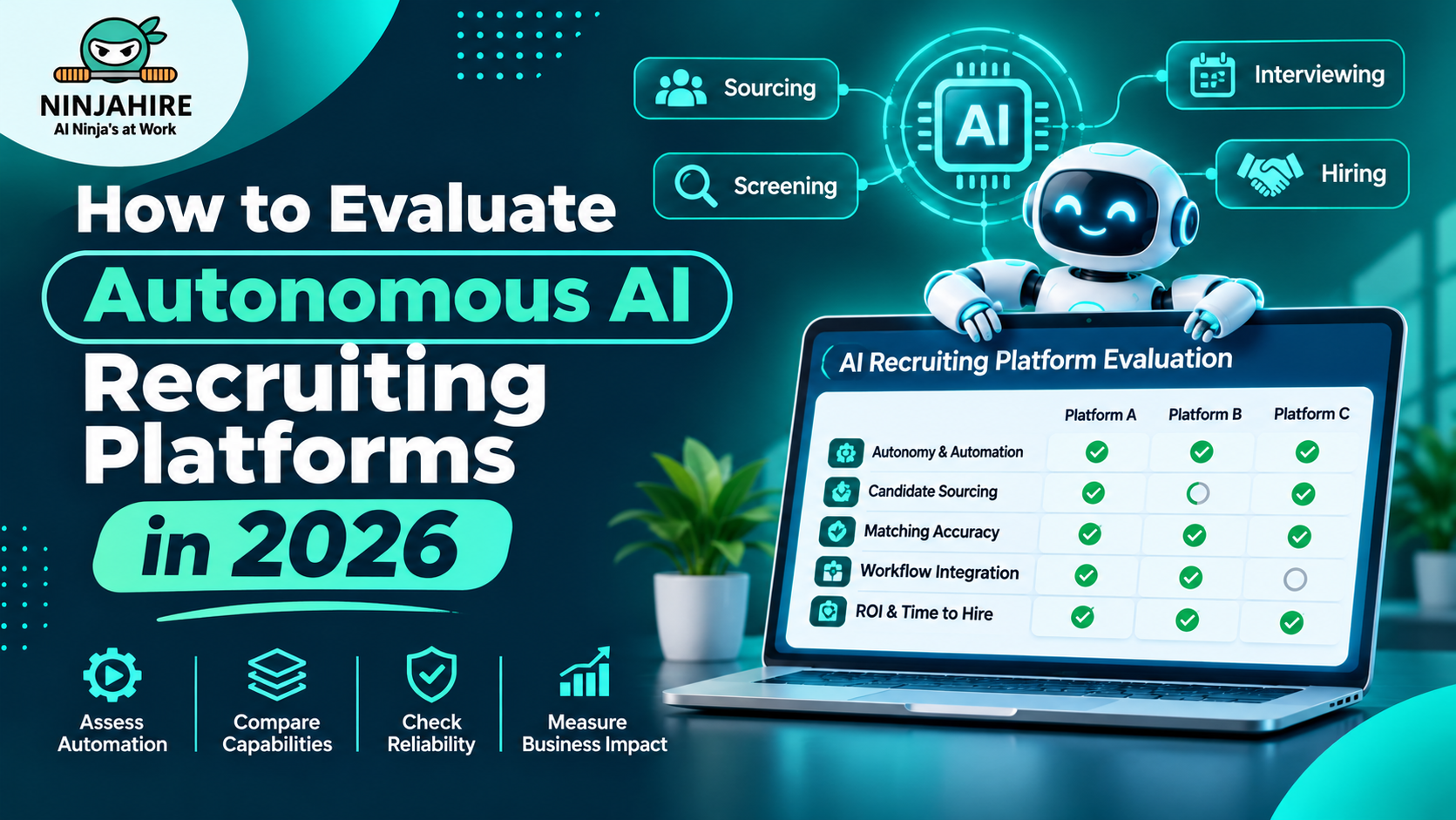
Buyers who score vendors against a fixed grid make better decisions than buyers who react to demos. Eight criteria separate platforms that change recruiting throughput from platforms that add another window to the stack.
Autonomy, Workflow Coverage, and Exception Handling
Map which stages the platform actually executes: sourcing, rediscovery of existing ATS records, outreach, reply handling, prequalification, screening interviews, and scheduling. Then ask what happens at the edges. A candidate asks about visa sponsorship, withdraws, or replies at 2 a.m. with a counter-question — the system's handling of that moment reveals more than its handling of the happy path. Request a written list of exception types, which are handled automatically and which escalate.
ATS Integration, Data Security, and Auditability
Integration depth is where most implementations stall. "We integrate with your ATS" can mean a nightly CSV export or full read-write synchronization of candidate records, notes, and stage changes, so what to check before you buy is which specific records can be read, created, updated, and synchronized in your system. On the security side, require documented data retention periods, access permissions by role, encryption standards, an independent security attestation such as SOC 2 Type II, and complete audit logs of agent actions. Capture those commitments in writing using an AI recruiting vendor contract checklist rather than a demo promise. An agent that acts on candidate data without a reviewable log is not auditable after a complaint.
Human Oversight and Candidate Evaluation
Every consequential decision needs an identifiable human owner. Confirm that recruiters can approve message templates before send, override a screening score, stop an active sequence, and inspect each interview question, answer, and rubric rather than a single composite score. Structured scorecards for AI interviews make that inspection consistent across recruiters. Platforms that expose only an opaque match percentage make it impossible to defend a decision later, and they make it harder to spot when the model is wrong.
3 — How to Test an AI Recruiting Platform Before You Buy
Vendor demos use curated data and ideal roles. A structured pilot uses yours.
- Select one high-volume role and one hard-to-fill role. The two break in different ways.
- Document baseline metrics first — time to shortlist, submittals per recruiter per week, screening turnaround, and current cost per qualified candidate.
- Run the pilot against real, appropriately authorized candidate data, including your existing ATS database.
- Have a recruiter independently assess the same candidate pool, blind to the AI ranking.
- Compare the two assessments, then review every failed task, mismatch, and escalation.
- Measure candidate-side outcomes: completion rate, response rate, opt-outs, and complaints.
- Document results before negotiating. A four-week pilot record is stronger leverage than a feature checklist.
4 — Security, Compliance, and Human Oversight
Regulatory requirements vary by jurisdiction and by use case, and the 2026 landscape shifted materially. In the EU, the Digital Omnibus on AI — Regulation (EU) 2026/1744 — moved the compliance date for stand-alone high-risk Annex III systems, which include recruitment, from 2 August 2026 to 2 December 2027. The classification did not change; only the deadline did.
In the United States, obligations are already live in several jurisdictions, and AI hiring laws by state now differ enough to affect where an agent can run unchanged. Illinois HB 3773 took effect on 1 January 2026, requiring employers to notify candidates when AI is used in recruitment and hiring decisions and prohibiting AI use that results in discrimination, while Colorado's AI Act was amended by SB 26-189 to take effect on 1 January 2027. New York City's Local Law 144 requires an annual independent bias audit of automated employment decision tools, public disclosure of a results summary, and at least ten business days' notice to candidates. Build the evidence trail for that requirement the way AI bias audits in hiring are normally scoped.
One detail matters specifically for autonomous platforms: New York City's guidance indicates that Local Law 144 applies to tools assessing candidates who have already applied for a specific position, so scanning a resume bank or conducting outreach to potential candidates falls outside its bias-audit and notice requirements. An agent that sources, screens, and schedules may therefore cross a regulatory boundary partway through its own workflow. Confirm with counsel which stages of a given agent's run are in scope for your jurisdictions, and verify current obligations against official sources rather than vendor summaries.
5 — How to Measure ROI From Autonomous AI Recruiting
Adoption is outpacing demonstrated value. A Gartner survey published in October 2025 found that 88% of HR leaders said their organizations had not realized significant business value from AI tools. That gap usually comes from measuring activity instead of outcomes. Two figures do most of the work here: cost per screen and the distinction between time to fill and time to hire.
Pilot Testing, Performance Metrics, and ROI
| Metric | What it shows |
|---|---|
| Time to shortlist | Whether the agent compresses the slowest stage |
| Recruiter hours saved per requisition | The real capacity gain |
| Qualified candidate response rate | Outreach quality, not volume |
| Candidate completion rate | Whether screening experience holds up |
| Recruiter override rate | How often the agent's judgment is wrong |
| Cost per qualified candidate | Efficiency net of platform and credit costs |
| Submittal-to-interview ratio | Whether quality survived the speed gain |
Recruiter override rate is the most underused figure on this list. A falling override rate across a pilot indicates the rubric is calibrated; a persistently high one indicates the agent is fast at producing work a recruiter has to redo. Compare every figure against the documented baseline, and treat faster processing as a cost input, not a hiring outcome.
6 — How Ninjahire Fits Into an Autonomous Recruiting Workflow
Ninjahire can be assessed against the same criteria applied to any other vendor, and against the platform comparisons published for the category. The platform coordinates three agents — sourcing, outreach, and screening — so that candidates move between stages without recruiters copying records between tools. Sourcing begins with rediscovery inside a connected ATS or CRM before expanding to NinjaGraph and the job board sources listed on its integrations page. Outreach runs sequenced email, SMS, and AI phone workflows, with other channels dependent on configuration and account permissions. The AI screening agent supports phone, web, and video formats with defined question sets, knockout criteria, and scoring rubrics.
On the oversight criterion, the platform offers two operating modes: Autopilot for pre-approved repeatable work, and human-in-the-loop for sensitive, executive, or regulated hiring where a recruiter approves criteria, messages, or stage transitions before the next action. Final hiring decisions remain with authorized people. Security documentation covers SOC 2 Type II attestation, AES-256 encryption at rest and TLS 1.2+ in transit, and an independently audited bias report.
Bring a live requisition to the evaluation rather than a hypothetical one. Book a Ninjahire demo and score it against the criteria in this guide.
Frequently Asked Questions
How is an autonomous AI recruiting agent different from a recruiting chatbot?
A chatbot responds within a conversation and waits for input. An agent pursues a goal across multiple systems and stages, deciding what to do next based on what happened in the previous step. A chatbot answers a candidate's question about shift timing; an agent sources the candidate, contacts them, handles the reply, screens them, and routes the result to a recruiter.
Can autonomous recruiting agents operate across multiple ATS platforms?
Some can, but capability varies by integration rather than by vendor. A platform may support deep read-write sync with one ATS and read-only access to another. Agencies running multiple client systems should request a per-system matrix of supported operations before signing, not a logo wall.
What happens when an AI recruiting agent encounters an unexpected candidate response?
Behavior should be configurable. Well-designed systems classify the response, attempt a scoped reply if it falls within approved territory, and escalate to a named recruiter otherwise. Ask vendors to demonstrate escalation live, including what the recruiter sees and how quickly they are notified.
Who is accountable for actions taken by an autonomous recruiting agent?
The employer or staffing firm deploying the system. Vendor contracts may allocate certain responsibilities, but employment and anti-discrimination obligations sit with the organization making hiring decisions. This is why audit logs, override controls, and documented human review points are procurement requirements rather than nice-to-haves.
How should companies phase in autonomous recruiting without disrupting existing workflows?
Start with a single stage on a single role family — usually rediscovery of existing ATS records or first-touch outreach — in human-in-the-loop mode. Widen autonomy one stage at a time, and only after the override rate on the previous stage stabilizes. Teams that switch on full autonomy across all requisitions at once lose the ability to diagnose which stage is underperforming.