.png)
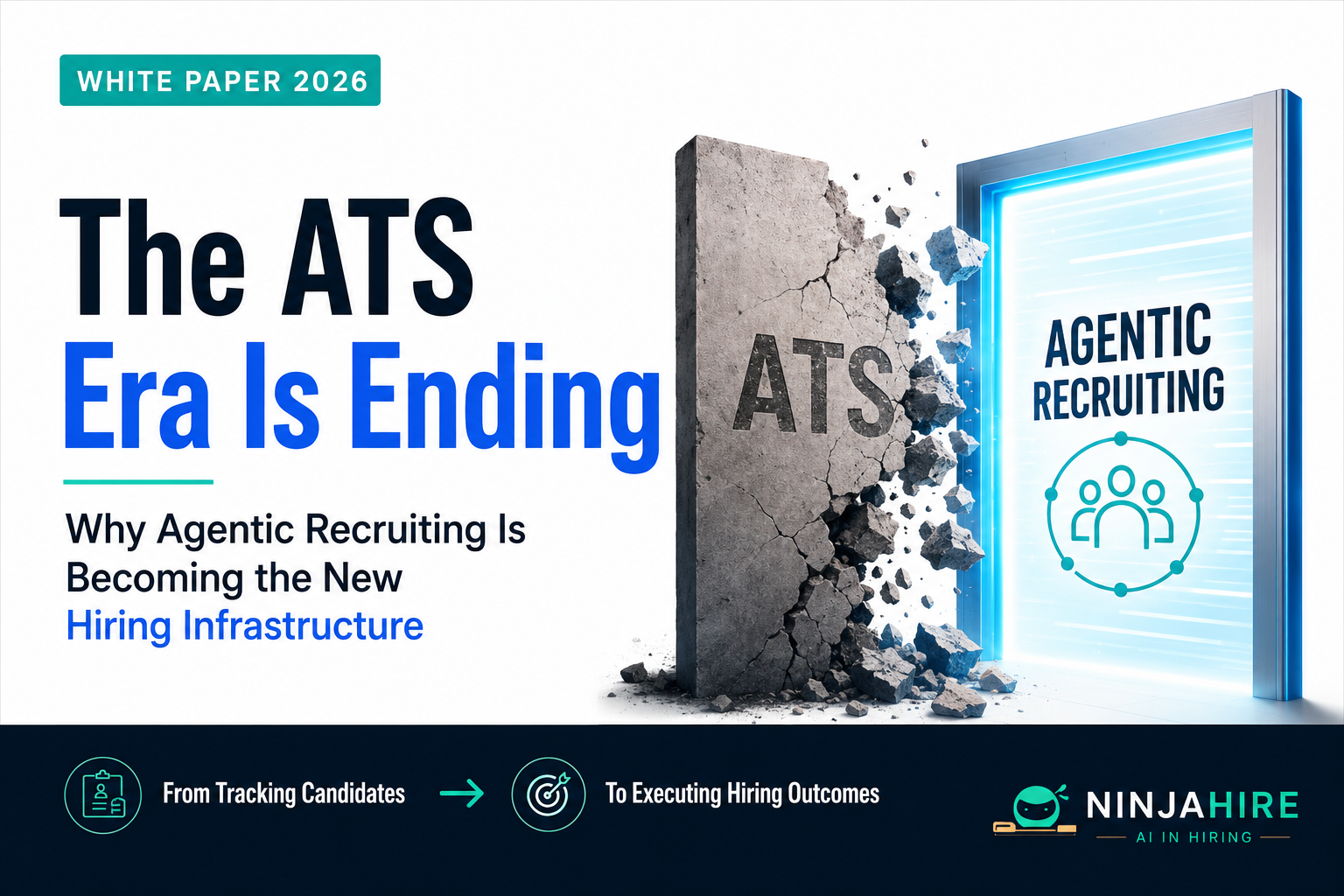
The Agentic Mandate: Why Traditional ATS Systems Are Failing the 2026 Market
Discover why traditional ATS platforms are struggling to meet modern hiring demands and how agentic recruiting is reshaping talent acquisition through AI recruiting agents, autonomous workflows, and next-generation hiring infrastructure.
NinjaHire Research
The Agentic Mandate: Why Traditional ATS Systems Are Failing the 2026 Market
Discover why traditional ATS platforms are struggling to meet modern hiring demands and how agentic recruiting is reshaping talent acquisition through AI recruiting agents, autonomous workflows, and next-generation hiring infrastructure.
Section 01
Executive Summary
The hiring system is broken. Not slightly misaligned , structurally broken.
For nearly three decades, the applicant tracking system has been the central nervous system of enterprise talent acquisition. Born in the era of paper resumes and fax machines, the ATS was a genuine breakthrough: a way to digitize candidate pipelines, track hiring stages, and keep the process legally compliant. It solved a real problem for its time.
That time has passed.
In 2026, the conditions that made ATS platforms valuable have inverted. Talent markets are tight. Hiring timelines have compressed from weeks to days. Candidates expect consumer-grade experiences. Skills are more valuable than credentials. The competitive edge in hiring no longer belongs to the firm with the most structured process , it belongs to the firm that moves fastest, communicates best, and makes the most intelligent decisions with the least friction.
An ATS, no matter how refined, cannot deliver that. It is a passive system in an era that demands active intelligence. This paper introduces a new category , Agentic Recruiting , and argues that the era of ATS-centric talent acquisition is ending, not because ATS platforms will disappear, but because they will be relegated to passive infrastructure while AI agents take over the execution layer of hiring.
of enterprise TA leaders say their ATS does not meaningfully improve recruiter productivity. (Gartner, 2025)
of candidates report a poor or impersonal hiring experience , a number barely moved in a decade. (LinkedIn Talent Trends, 2025)
of recruiter time is spent on administrative tasks AI agents can fully automate. (Deloitte Human Capital, 2025)
faster time-to-offer for organizations using AI-orchestrated recruiting workflows vs. ATS-only. (Josh Bersin, 2025)
estimated productivity loss globally from unfilled roles and inefficient hiring by 2027. (WEF, 2024)
of staffing firms say recruiter-to-submission ratios have deteriorated over three years. (SIA, 2025)
Section 02
The ATS Era Is Ending
The applicant tracking system had a noble origin story. Before its arrival in the early 1990s, hiring was genuinely chaotic: applications in filing cabinets, resumes routed by hand, compliance records maintained unevenly. First-generation ATS vendors offered real breakthroughs , centralized storage, keyword search, and basic workflow tracking for a market that desperately needed it.
Over the following two decades, ATS platforms matured into enterprise staples. Taleo, Kenexa, iCIMS, Greenhouse, Lever, Workday Recruiting , each generation added more features. The ATS became the system of record for talent acquisition, and enterprise HR departments built entire operating models around it.
But the ATS never evolved from a system of record into a system of action. It got better at tracking. It never got better at hiring.
Market Trend 1: ATS market growth has slowed to 7-9% annually while adjacent categories , AI sourcing, conversational recruiting, and workflow automation , are growing at 34-42% CAGR. The market is not abandoning the ATS; it is building around it. (Gartner, 2025)
The reason is structural. ATS systems are fundamentally pull-based. They wait for candidates to apply. They wait for recruiters to review. They wait for hiring managers to respond. In a tight labor market where the best candidates are employed, passive, and considering multiple opportunities simultaneously, a system built on waiting is not merely inefficient , it is strategically counterproductive.
How ATS Became Systems of Record (And Stopped There)
Recruiting CRM vs ATS: compare how modern recruiting teams use CRM capabilities alongside ATS infrastructure.
ATS platforms became extraordinarily good at data storage, workflow documentation, and compliance reporting. But enterprise buyers were, for most of the 2000s and 2010s, more concerned with audit trails than hiring velocity. The result: ATS platforms became the world's most expensive resume databases. Enterprise Greenhouse accounts average 143,000 candidate records with fewer than 18% ever meaningfully re-engaged. These are not data systems. They are digital graveyards.
"The ATS was built for the world where hiring was a process you managed. We now live in a world where hiring is a competition you run. Those are fundamentally different design requirements."
NinjaHire Research TeamSection 03
The Hidden Cost of ATS-Centric Recruiting
Database Graveyards
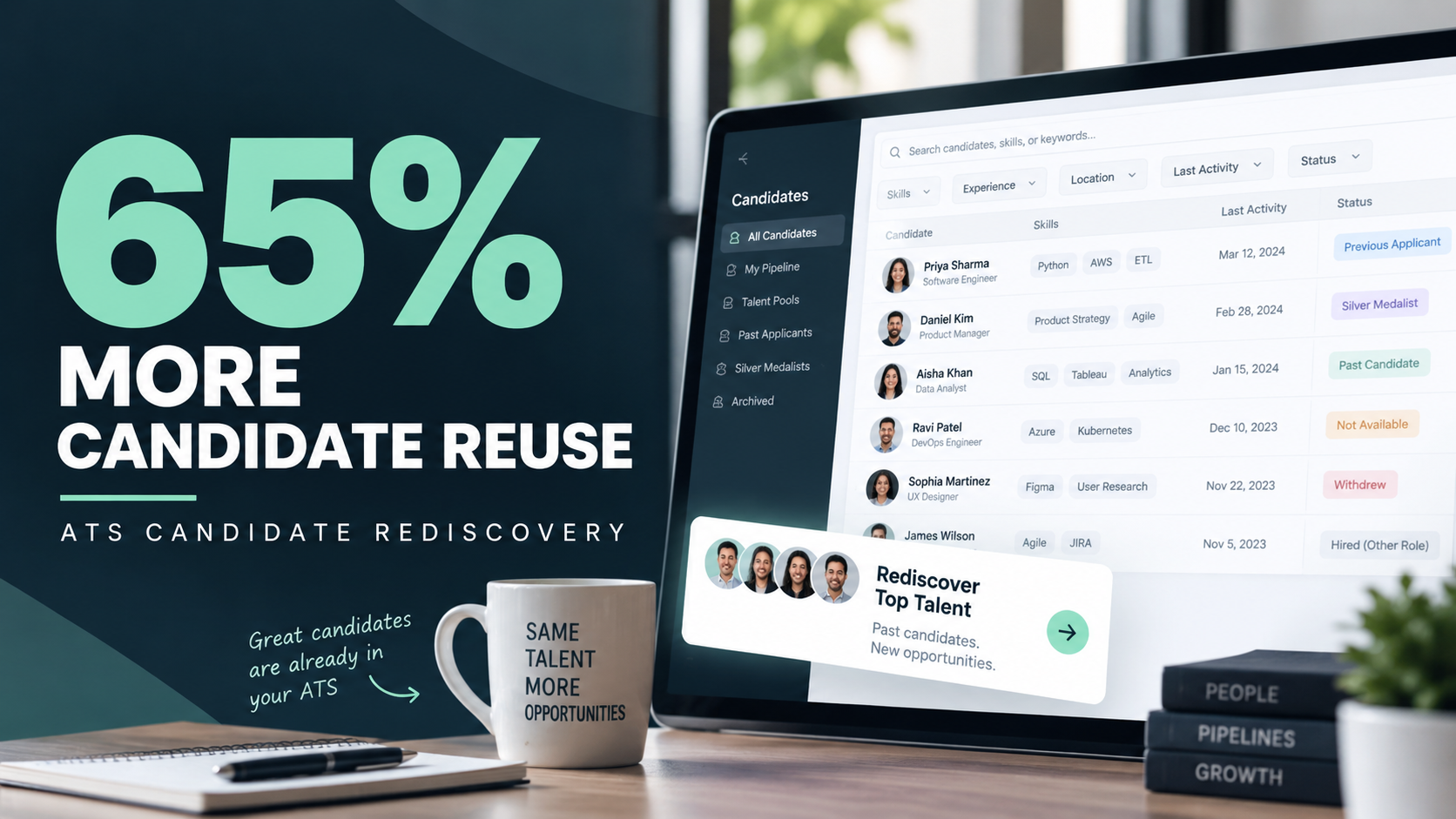
The average enterprise ATS contains 80,000,300,000 candidate profiles accumulated over years. Yet the re-engagement rate for ATS databases sits at 12-17% across enterprise organizations (Gartner, 2025). There is no agent checking whether a candidate who applied for a DevOps role two years ago now fits a Platform Engineering opening. The data exists. The intelligence does not.
Recruiter Overload
Modern recruiters carry 20-45 open requisitions simultaneously (SHRM, 2025). The ATS does nothing to relieve this pressure , in fact, it often adds to it. Updating candidate statuses, logging call notes, sending stage notifications , these manual tasks consume recruiter hours without generating hiring outcomes.
Market Trend 2: The average corporate recruiter spends 28 hours per week on administrative tasks that could be automated. That is 70% of a full work week. The ATS is doing nothing to solve it. (Deloitte Human Capital, 2024)
Tool Fragmentation
In response to the ATS's execution limitations, the market invented workarounds: sourcing tools, engagement tools, scheduling tools, assessment platforms, analytics dashboards. The average enterprise TA team now operates 7-12 distinct platforms. A candidate's journey from first touchpoint to offer happens across five or six systems, with handoffs that create friction and data loss at every transition.
"Seventy-eight percent of candidates say the hiring process reflects how a company treats its employees. An ATS that ghosts candidates is not a technology problem. It is a reputation problem."
Based on LinkedIn Talent Trends research, 2025Section 04
What Is Agentic Recruiting?
Agentic recruiting is not recruiting automation , automation executes predefined rules and is deterministic. It is not AI-assisted recruiting, where the human remains the agent and AI is the co-pilot. Agentic recruiting is something categorically different.
Proprietary Definition , NinjaHire Research: Agentic Recruiting is autonomous talent acquisition infrastructure in which AI agents independently perceive the state of the hiring environment, set intermediate goals, execute multi-step workflows, adapt to new information, and orchestrate human involvement at moments of highest judgment value , without requiring step-by-step instruction.
The key word is autonomous. An agentic system does not wait to be told what to do. It sources candidates across 40+ platforms, enriches profiles with verified contact data, personalizes outreach, follows up at optimal intervals, scores responses, schedules conversations, and surfaces top candidates with full context for recruiter review. The recruiter's role does not disappear. It elevates.
Section 05 · NinjaHire Framework
The Five Agentic Layers of Modern Recruiting
Agentic recruiting is an architecture , a layered stack of specialized agents that each perform a distinct function within the hiring process. NinjaHire's framework is based on direct analysis of workflows across staffing agencies, enterprise TA teams, and GCC hiring programs.
Autonomously sources candidates across LinkedIn, GitHub, job boards, talent communities, and proprietary databases. Enriches profiles with verified contact data and real-time availability signals. Surfaces warm candidates from your existing ATS database who match new requirements without manual search.
Analyzes candidate profiles against role requirements using multi-dimensional scoring: skills match, experience depth, career trajectory, compensation alignment, and cultural fit signals. Conducts asynchronous pre-qualification conversations and surfaces only candidates most likely to convert.
Manages all candidate communication with the personalization of a thoughtful recruiter and the consistency of a system. Crafts tailored outreach, executes multi-channel follow-up sequences, responds intelligently to candidate questions, and maintains relationship continuity across days and weeks.
Coordinates the entire hiring process from first touchpoint to offer. Manages interview scheduling across time zones, routes candidates based on qualification signals, triggers hiring manager reviews, requests feedback, and escalates stalled decisions. Integrates with the ATS as system of record.
Generates continuous insight from every data point in the recruiting operation. Identifies highest quality-to-cost sourcing channels. Predicts time-to-fill. Detects bottlenecks before they become delays. Benchmarks hiring performance against industry data in real time.
The most dangerous mistake organizations make is treating agentic recruiting as an automation upgrade. It is a fundamental rearchitecting of how talent acquisition work gets done , and who does it.
Each layer can operate independently, but their combined effect is exponential. A Discovery Agent feeding a qualified pipeline to an Engagement Agent feeding the Orchestration Agent creates a recruiting motion with no analog in the traditional ATS world.
The Intelligence Agent is often overlooked, but it may be the most strategically valuable. Organizations that can predict time-to-fill and benchmark offer competitiveness in real time have a structural hiring advantage that compounds every quarter.
Section 06
Why Agentic Systems Outperform Traditional ATS Platforms
| Capability | Traditional ATS | Automation Layer | Agentic Recruiting |
|---|---|---|---|
| Passive candidate sourcing | ✗ | ◐ | ✓ Autonomous, multi-source |
| Candidate profile enrichment | ✗ | ◐ Manual integrations | ✓ Real-time, multi-signal |
| Personalized outreach at scale | ✗ | ◐ Templated sequences | ✓ Dynamic, context-aware |
| Intelligent qualification | ✗ | ◐ Rule-based screening | ✓ Multi-dimensional AI scoring |
| Re-engagement of past candidates | ✗ | ◐ Manual list pulls | ✓ Proactive, role-matched |
| Adaptive workflow execution | ✗ | ✗ | ✓ Goal-directed agent loops |
| Hiring process orchestration | ◐ Status tracking only | ◐ Trigger-based routing | ✓ End-to-end autonomous |
| Real-time market intelligence | ✗ | ✗ | ✓ Continuous benchmarking |
| Compliance and audit trail | ✓ Core strength | ◐ | ✓ With structured logging |
| Self-improvement from data | ✗ | ✗ | ✓ Continuous learning loops |
Recruiter Productivity Comparison
| Productivity Metric | ATS-Only | Agentic | Improvement |
|---|---|---|---|
| Time sourcing per requisition | 8-12 hours | 1-2 hours (review only) | ~6x reduction |
| Candidate outreach response rate | 8-14% | 28-42% | 3-4x improvement |
| Time-to-qualified-slate | 12-18 days | 3-5 days | ~4x faster |
| Requisitions per recruiter (monthly) | 8-15 | 25-45 | ~3x capacity |
| Candidate communication consistency | 40-60% | 98-100% | Structural improvement |
| ATS database re-engagement rate | 12-17% | 55-70% | 4x improvement |
| Cost per qualified candidate | $280-$620 | $65-$140 | ~4x reduction |
Sources: Gartner, Deloitte Human Capital, Josh Bersin Research, NinjaHire platform data, 2024-2025.
Market Trend 3: Early adopters of agentic recruiting report a structural shift in recruiter roles. Recruiters are no longer spending time on sourcing and screening. They are spending time on candidate advisory, hiring manager coaching, and offer negotiation. The role is not being eliminated. It is being refined. (McKinsey Future of Work, 2025)
Section 07
How Staffing Firms Are Being Forced Into Agentic Recruiting
If enterprise TA teams have a choice about when to adopt agentic recruiting, staffing firms increasingly do not. The economics of the staffing industry have shifted in ways that make the old operating model , human recruiters manually sourcing, qualifying, and submitting , no longer viable at competitive margins.
Margin Pressure Is Structural
Gross margins in IT staffing have compressed from 28-34% in 2018 to 19-25% in 2025 (Staffing Industry Analysts). The compression is not cyclical. Staffing firms that ran profitably at 30% margins cannot run the same model at 20% and survive. Agentic recruiting changes the unit economics: when an agent handles sourcing, enrichment, first-pass qualification, and candidate engagement autonomously, the recruiter's productive time shifts from 30% billable activity to 70-80% billable.
Candidate Scarcity and the Re-Engagement Imperative
In high-demand skill categories , cloud infrastructure, cybersecurity, data engineering, AI/ML , active candidate supply has contracted sharply. The U.S. BLS projects a 25% shortfall in qualified technology workers by 2028. The answer is not to source harder. It is to mine the rich databases staffing firms have accumulated over years, turning dormant relationships into active pipelines.
Market Trend 4: MSPs are increasingly using technology performance metrics , fill rate, time-to-submit, candidate quality scores , as criteria for supplier selection. Staffing firms that cannot demonstrate technology-driven efficiency are being deprioritized in supplier panels. (SIA, 2025)
Section 08
Enterprise Talent Acquisition in the Agentic Era
Enterprise talent acquisition operates at a scale that amplifies every inefficiency in the traditional model. A global company hiring 3,000-10,000 employees annually, across dozens of countries, faces challenges no human team and no traditional ATS can reliably solve without significant waste.
The GCC Growth Phenomenon
The proliferation of Global Capability Centers , particularly in India, where GCC headcount has grown from 1.1 million in 2020 to an estimated 2.5 million in 2025 , has created a new category of hiring challenge. GCC operators are building engineering, analytics, and operations teams at extraordinary velocity in Hyderabad, Bengaluru, Pune, and Chennai.
Market Trend 5: India's GCC sector is projected to reach $100B+ in annual output by 2030, employing over 4 million professionals. The hiring velocity required , estimated at 300,000-400,000 new hires annually , cannot be achieved with traditional recruiting infrastructure. (NASSCOM, 2025)
Skills-First Hiring Requires Intelligence, Not Tracking
The shift toward skills-based hiring is accelerating. According to WEF's Future of Jobs Report 2025, 77% of employers plan to significantly expand skills-based assessment practices by 2028. Skills-first hiring requires assessing competencies not captured in a resume, mapping them against role requirements with nuance, and making qualification decisions that ATS keyword matching cannot replicate. The ATS can store the results. Only an agent can generate them.
Section 09
The New Recruiting Technology Stack
The correct question is not "does the ATS get replaced?" It is "where does the ATS fit in the new architecture?" The answer: the ATS becomes infrastructure , the data layer and compliance backbone , while AI agents become the execution layer that drives hiring outcomes. This mirrors what happened in CRM: Salesforce remained the system of record while revenue growth moved to engagement tools and AI agents operating on top of that data.
| Stack Layer | Traditional Role | Agentic Role |
|---|---|---|
| ATS | Central system, active execution hub | Data layer and compliance backbone |
| Sourcing | Human-executed Boolean searches | Autonomous multi-source discovery |
| Outreach | Manual or templated emails | AI-personalized, multi-channel sequences |
| Qualification | Human review of all applications | AI-driven multi-signal assessment |
| Scheduling | Manual email coordination | Fully automated with calendar AI |
| Analytics | Weekly reports, manual compilation | Real-time intelligence, predictive modeling |
| Recruiter Role | Process manager and executor | Judgment partner and relationship advisor |
Section 10 · NinjaHire Framework
The Agentic Recruiting Maturity Model
The transition from traditional talent acquisition to agentic recruiting is best understood as a progression across five levels of organizational maturity.
Most enterprise organizations sit at Level 2-3 today. Progressive teams are at Level 3-4. The firms building sustainable competitive advantage in 2026 are moving deliberately toward Level 5.
Section 11
Recruiters vs. AI: The Wrong Debate
Agentic recruiting will not eliminate recruiters. It will eliminate the version of recruiting work that no one , candidate, employer, or recruiter , actually values.
LinkedIn Talent Trends 2025 shows 89% of recruiters identify relationship-building, candidate advisory, and hiring manager consultation as their most meaningful work. Yet those administrative tasks they find least valuable consume 60-70% of a recruiter's working hours. Agentic systems do not take the meaningful work. They take the work that prevents meaningful work from happening.
"The fear of AI replacing recruiters misunderstands what AI is good at. AI excels at pattern recognition, tireless execution, and consistent process. Humans excel at trust, judgment, empathy, and reading signals that data cannot capture. In recruiting, you need both."
NinjaHire Research TeamSection 12
The 2026-2030 Outlook
The Agentic Inflection Point
2026 marks the year agentic recruiting crosses from early-adopter to early-majority adoption. Enterprise TA leaders who dismissed AI recruiting as a feature will begin restructuring their technology roadmaps. GCC operators will standardize on agentic infrastructure for new center buildouts.
The ATS Renegotiation
Major ATS vendors will face a strategic inflection: acquire agentic capability or become pure infrastructure utilities. Expect significant M&A activity. Most acquisitions will underdeliver because agentic capability cannot be bolted onto passive database architecture.
The New Recruiter Role Definition
Job titles in TA will formally reflect the agentic model. "Talent Advisor," "Hiring Strategist," and "Recruiting Intelligence Analyst" will replace "Sourcer" and "Coordinator" at sophisticated organizations. Recruiter compensation will increase as strategic value becomes clearer.
Autonomous Hiring as Standard Infrastructure
The majority of Fortune 500 companies will operate recruiting infrastructure in which AI agents handle 70-80% of workflow volume. The question will no longer be "should we use AI in recruiting?" but "how effectively are our agents trained, and what is our intelligence advantage?"
Organizations that invest in agentic recruiting infrastructure in 2025-2026 will have a 24-36 month head start on those that wait. In a market where hiring speed is a competitive moat, that head start compounds.
The skills gap between organizations that have learned to train and manage AI recruiting agents and those that have not will become one of the most significant operational divides in enterprise HR by 2028.
Candidate expectations will evolve to assume agentic-quality experiences: instant acknowledgment, transparent communication, personalized engagement, and fast decisions. Organizations that cannot meet these expectations will see offer acceptance rates decline structurally.
Section 13
The Agentic Mandate
There is a moment in every major technology transition when the question shifts from "should we adopt this?" to "can we afford not to?" The personal computer reached that moment in the late 1980s. The internet in the mid-1990s. CRM around 2005. Cloud infrastructure in the early 2010s. Agentic recruiting is reaching that moment now.
The forces driving this transition are structural, quantifiable, and accelerating. Candidate supply in high-skill categories is shrinking while demand grows. Staffing margins are permanently compressed. Candidate expectations for speed and personalization have been set by consumer technology and will not reset. The data on agentic systems , their productivity multipliers, candidate experience impact, unit economics , is no longer theoretical. It is measurable and growing.
The mandate is a statement of competitive reality: organizations that build agentic recruiting infrastructure now will hire faster, hire better, and hire more efficiently than those that do not. That advantage compounds quarterly.
"Hiring is not a process. It is a competition. In every competition, infrastructure matters. The organizations that treat their recruiting technology as a strategic asset , not an administrative cost , will win the talent market of the next decade."
NinjaHire Research TeamSection 14
About NinjaHire
The Autonomous Recruiting Infrastructure Layer
NinjaHire was built from a simple conviction: that the tools recruiters have been given are dramatically misaligned with the work they are being asked to do. Tracking systems for an execution problem. Record-keeping infrastructure for a competitive challenge. Administrative software for a strategic imperative.
We built the layer above the stack: an autonomous recruiting infrastructure that gives every recruiter the equivalent of a tireless, intelligent support team operating across every stage of the hiring process simultaneously.
NinjaHire's five-layer agentic architecture , Talent Discovery, Candidate Qualification, Engagement, Workflow Orchestration, and Hiring Intelligence , is purpose-built for modern talent markets: tight candidate supply, compressed hiring timelines, distributed global operations, and the expectation of consumer-grade candidate experiences.
We serve staffing agencies building toward higher margin efficiency, enterprise TA teams competing for talent in specialized categories, GCC operators scaling headcount at velocity, and RPO firms redefining their delivery model for an agentic world.
Reference
Enterprise Hiring Evolution Timeline
| Era | Years | Primary Infrastructure | Core Limitation | Recruiter Role |
|---|---|---|---|---|
| Paper-Based | Pre-1993 | Filing cabinets, fax, print ads | No scalability, no searchability | Full manual executor |
| Digital Tracking | 1993-2005 | First-generation ATS | Only tracks inbound applicants | Process manager |
| Enterprise ATS | 2005-2015 | Taleo, Kenexa, iCIMS at scale | System of record, not execution | Multi-tool operator |
| Integrated Stack | 2015-2023 | ATS + sourcing + CRM + scheduling | Fragmented; integration overhead | Stack manager |
| AI-Assisted | 2023-2025 | ATS + AI features and copilots | AI assists but human drives every step | AI-guided executor |
| Agentic Recruiting | 2025-Present | Autonomous recruiting infrastructure | Governance and change management | Judgment partner and advisor |
Other insights
The Agentic Mandate: Why Traditional ATS Systems Are Failing the 2026 Market






.jpg)


Subscribe to our newsletter
Want to stay up to date with news and updates about our product? Subscribe.
© Copyright 2026