.png)
The Autonomous Recruiter: Redefining the Role of the Human-in-the-Loop
Learn how autonomous recruiting, agentic AI, and human-in-the-loop hiring are reshaping enterprise talent acquisition. Executive guide covering AI governance, recruiting operations, productivity, and responsible hiring.
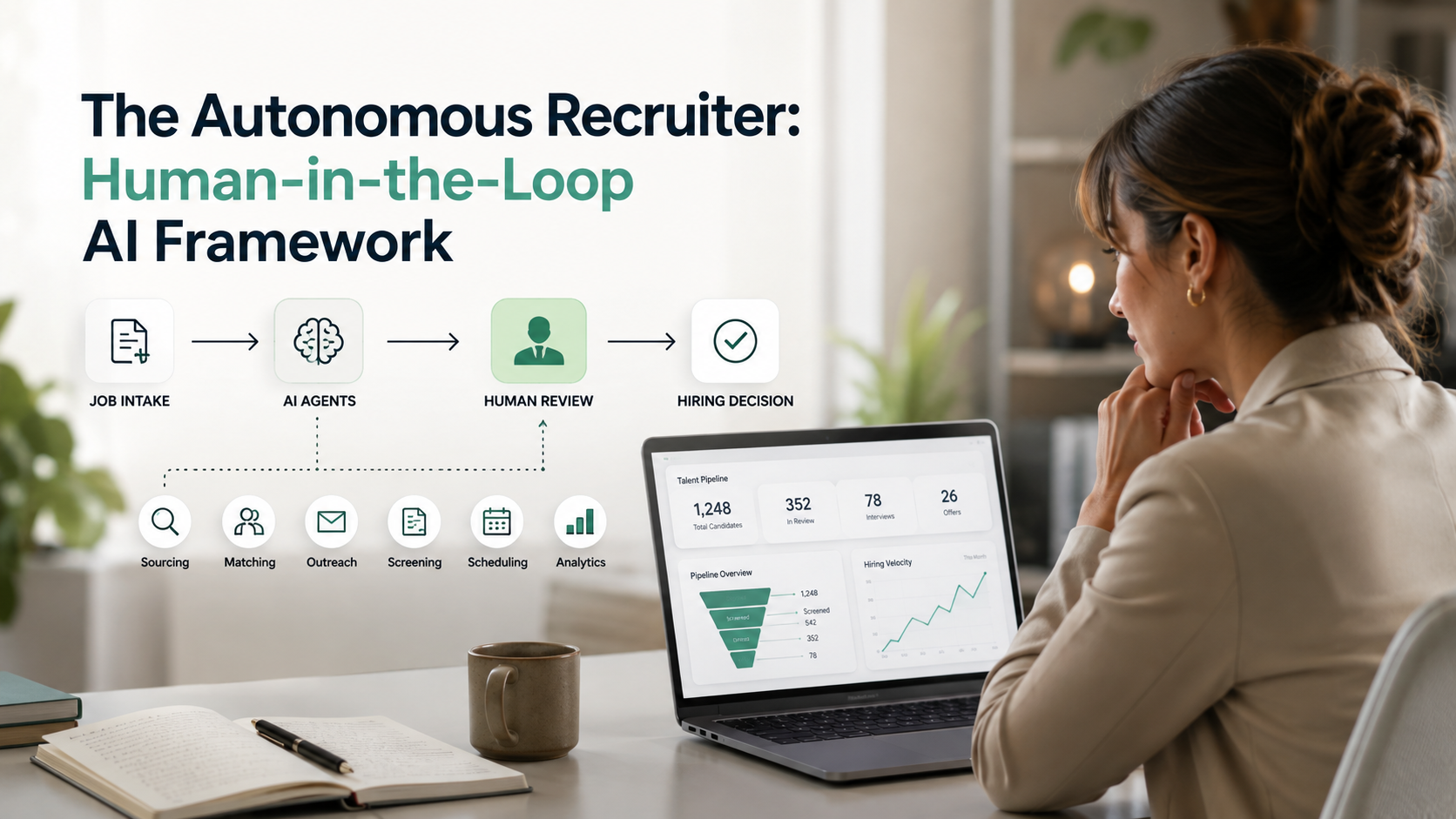
A research-based examination of how coordinated AI agents, governed by human approval and oversight, are reshaping the structure of enterprise recruiting , and what leaders need in place before adopting the model.
Autonomous Recruiting: The Operating Model for Enterprise Talent Acquisition
Executive Summary
Enterprise talent acquisition has absorbed two decades of point-solution automation , applicant tracking systems, sourcing tools, chat-based screening , without a corresponding change in how the overall recruiting workflow is structured. The result, in many organizations, is a stack of disconnected tools sitting on top of a process that still runs largely on manual coordination between them.
Autonomous Recruiting describes a different architecture: a set of specialized AI agents, each responsible for a defined task, operating under a governance layer that determines where human judgment is required and where it is not. This is distinct from full automation, which implies removing human decision-making entirely, and distinct from simple AI-assisted tools, which typically augment a single step rather than coordinate the workflow as a whole.
This paper defines the model, distinguishes it from earlier stages of recruiting technology, outlines the governance structure required to deploy it responsibly, and proposes a maturity model enterprises can use to assess where they currently stand. Platforms such as NinjaHire are referenced throughout as examples of how these principles are being applied in practice, alongside the broader body of research on enterprise AI governance from organizations including SHRM, NIST, and the OECD.
Key Findings
- Autonomous Recruiting is best understood as a workflow architecture, not a feature set , it depends on how agents, data, and human approval points are structured together.
- Human-in-the-Loop governance is the defining characteristic that separates responsible autonomous systems from fully unsupervised automation.
- Task-level automation, not role elimination, is the pattern most consistent with current evidence on AI's effect on recruiting work.
- Enterprises adopting autonomous models without a governance layer , bias monitoring, audit trails, override authority , introduce compliance and trust risk that point-solution automation did not.
- Maturity varies widely by organization; most enterprises today sit between the Automated and AI-Assisted stages, not yet at full autonomy.
Why Recruiting Needs a New Operating Model
Most enterprise recruiting functions run a similar stack today: an applicant tracking system as the system of record, one or more sourcing tools layered on top, a scheduling tool, and increasingly a screening or assessment tool. Each was adopted to solve a specific bottleneck. Few were designed to communicate with each other.
The consequence is that recruiters spend a meaningful share of their time acting as the integration layer , manually moving candidate information between systems, reconciling status updates, and re-entering data that already exists somewhere else in the stack. This is not a technology gap; it is an architecture gap. Adding another point tool to this stack tends to add coordination overhead rather than remove it.
Common Misconception
A frequent assumption is that adding more AI features to an existing ATS constitutes progress toward autonomy. In practice, autonomy depends less on the sophistication of any single feature and more on whether tasks are coordinated end-to-end with clear ownership , a structural question the underlying platform choice does not automatically resolve.
Evolution of Recruiting
| Stage | Primary Mechanism | Human Role | Typical Limitation |
|---|---|---|---|
| Traditional | Manual sourcing, paper or spreadsheet tracking | Executes every step | Does not scale beyond small volumes |
| Digital | ATS and job boards digitize records and postings | Executes most steps, aided by software | Software stores information; it does not act on it |
| Automated | Point automation , templated outreach, rules-based screening | Configures rules, still coordinates manually between tools | Automation is task-level, not workflow-level |
| Autonomous | Coordinated AI agents across the hiring workflow | Sets policy, approves decisions at defined checkpoints | Requires governance maturity to operate responsibly |
The distinction between "automated" and "autonomous" is the one enterprises most often collapse. Automation typically means a rule executes a task reliably. Autonomy implies a system reasons across a sequence of tasks and hands off context between them, with humans retained at the points where judgment or accountability is required.
What Is an Autonomous Recruiter?
The term is sometimes used loosely to suggest recruiters are no longer necessary. That is not how the model functions in the deployments studied for this paper. The "autonomous" element refers to the system's ability to move a requisition through discovery, matching, and coordination steps without manual handoffs between disconnected tools , not to the removal of human decision authority over who gets hired.
Core Characteristics
Task Coordination
Agents hand off structured context to one another rather than requiring a human to re-enter information between systems.
Defined Approval Points
Specific decisions , advancing a candidate, extending an offer , require human sign-off by design, not by default.
Auditability
Every agent action and human approval is logged, producing a record of who or what made each decision.
Continuous Learning Within Bounds
Agents refine matching and prioritization based on feedback, within limits set by governance policy.
Business Value
The value case for this model rests less on headline time-to-fill claims and more on the reduction of coordination overhead , the hours recruiters currently spend reconciling disconnected systems rather than engaging candidates or hiring managers. Organizations that have restructured workflows around coordinated agents generally report the largest gains in recruiter capacity, not in candidate volume.
Operating Principles
- Agents operate within a defined scope of authority, documented and reviewable.
- Every autonomous action is traceable to a policy decision made by a human.
- Escalation paths exist for any case outside the system's defined confidence threshold.
- Candidate-facing communication remains reviewable and correctable by a human recruiter.
Human-in-the-Loop Recruiting
Human-in-the-Loop design is what separates a responsibly governed autonomous system from unsupervised automation. It is a structural choice about where in the workflow a human signature is required, not a general assurance that "a person is involved somewhere."
Approval Layer
Defines which actions require explicit human sign-off before proceeding , typically advancing a candidate past screening, extending an offer, and any communication that could be construed as a hiring decision.
Decision Layer
Distinguishes between recommendations (agent proposes, human decides) and executions (agent proceeds, human can override). Most mature deployments keep hiring-consequential steps in the recommendation category.
Governance Layer
The policy framework that defines agent scope, escalation rules, and review cadence , typically owned jointly by talent acquisition leadership, HR compliance, and IT/security.
Compliance Layer
Maps agent actions to applicable employment law and data protection requirements across jurisdictions, which becomes more complex as autonomous systems operate across regions with different regulatory regimes.
Bias Monitoring
Ongoing statistical review of agent outputs , who gets surfaced, ranked, or advanced , to detect disparate impact that would not be visible from a single decision in isolation.
Audit Trail
A complete, timestamped record of agent actions and human approvals, retained for the period required by applicable regulation and available for internal or external review.
Autonomous Recruiting Workflow
AI Recruiting Agents
| Agent | Primary Function | Typical Human Checkpoint |
|---|---|---|
| Sourcing Agent | Identifies candidates matching role requirements | Recruiter reviews surfaced candidate pool |
| Matching Agent | Scores and ranks candidates against the role profile | Recruiter reviews ranking rationale |
| Screening Agent | Applies defined qualification criteria | Recruiter approves advancement decisions |
| Scheduling Agent | Coordinates interview logistics | Generally low-risk, minimal review needed |
| Analytics Agent | Tracks pipeline health and workflow metrics | Leadership reviews dashboards periodically |
| Compliance Agent | Flags actions against policy and regulatory rules | Compliance team reviews flagged exceptions |
| Rediscovery Agent | Re-surfaces past candidates for new requisitions | Recruiter confirms relevance before outreach |
| Hiring Manager Assistant | Summarizes pipeline status for hiring managers | Manager reviews before interview decisions |
Enterprise AI Governance
Responsible AI
A documented commitment to fairness, transparency, and accountability that governs how agents are designed and deployed, not just how outcomes are reported after the fact.
Privacy
Candidate data handling that satisfies applicable data protection law across every jurisdiction where the system operates.
Ethics
A standing review process for edge cases the governance framework did not anticipate.
Transparency
Candidates and hiring managers can understand, in plain language, what role AI played in a given decision.
Bias
Ongoing measurement of outcome disparities across protected characteristics, not a one-time model audit.
Explainability
Agent decisions are traceable to specific inputs and criteria, not a single unexplained score.
Security
Access controls and data handling that meet enterprise security standards for sensitive candidate information.
Human Override
A documented, always-available mechanism for a human to reverse or halt any agent action.
Risk Matrix
Scheduling coordination, interview logistics
Candidate ranking, outreach drafting
Advancement decisions, offer terms, rejection communication
Governance intensity should scale with risk. Low-risk tasks can generally run with lighter oversight; high-risk tasks warrant mandatory human approval regardless of system confidence level.
Enterprise Architecture
| Layer | Function |
|---|---|
| ATS | System of record for requisitions and candidate status |
| CRM | Candidate relationship history and engagement tracking |
| HRIS | Employee data connection point for onboarding handoff |
| Knowledge Graph | Structured relationships between candidates, skills, and roles |
| Memory Layer | Retains context across a candidate's full lifecycle interactions |
| Agent Layer | The coordinated task-execution agents described above |
| Workflow Engine | Sequences agent handoffs and routes exceptions |
| Analytics Layer | Tracks operational, quality, and governance metrics |
| Approval Layer | Enforces human checkpoints defined by governance policy |
Platforms such as NinjaHire, and enterprise solutions from other vendors evaluating this architecture, generally position themselves as an orchestration layer that sits across these systems rather than requiring wholesale ATS replacement , an important consideration for organizations with significant existing investment in a system of record.
Recruiter Transformation
Future Skills
- Interpreting and validating agent-generated recommendations rather than performing the underlying search manually
- Governance literacy , understanding what a system can and cannot be trusted to decide
- Advanced candidate relationship management for senior and passive talent
- Cross-functional collaboration with compliance and data teams on system oversight
Changing Responsibilities
Time previously spent on manual sourcing and status reconciliation shifts toward candidate experience, negotiation, and exception review , the tasks least suited to full automation and most tied to hiring quality.
New Career Paths
Roles such as recruiting operations analyst, AI governance lead for talent acquisition, and candidate experience strategist are emerging in organizations further along the maturity curve.
KPIs for Autonomous Recruiting
Autonomous Recruiting Maturity Model
| Level | Description | Governance Requirement |
|---|---|---|
| 1 , Manual | Spreadsheet or paper-based tracking, no system of record | Minimal; process is entirely human-executed |
| 2 , Digital | ATS in place, digitized records, limited automation | Basic data privacy controls |
| 3 , Automated | Point automation for outreach or screening tasks | Rule documentation, periodic review |
| 4 , AI-Assisted | AI tools support individual steps; humans still coordinate the workflow | Tool-level bias and explainability review |
| 5 , Autonomous | Coordinated agents run the end-to-end workflow under a governance layer | Full governance framework: approval, audit, compliance, bias monitoring |
Advancing a level should not be treated as a purely technical milestone. Each step up requires a proportional increase in governance maturity , an organization that adopts Level 5 tooling while operating Level 2 governance has taken on risk disproportionate to its oversight capacity.
Future Outlook: 2030,2035
The direction of travel across enterprise AI more broadly , regulatory frameworks like the NIST AI Risk Management Framework and the OECD AI Principles gaining adoption, and enterprise buyers increasingly asking governance questions before technical ones , suggests recruiting technology will follow a similar path. Vendors that treat governance as a core product feature, not an add-on, are likely to be better positioned as enterprise requirements mature.
Executive Recommendations
- Audit before adopting. Map your current maturity level honestly before evaluating autonomous tooling.
- Build the governance layer first. Approval authority, audit trails, and bias monitoring should exist before agents go live, not after.
- Start with low-risk tasks. Scheduling and coordination are reasonable starting points; advancement and offer decisions warrant a longer evaluation period.
- Invest in recruiter transition. Plan for how recruiter time gets reallocated, not just what tasks get automated.
- Treat vendor evaluation as a governance evaluation. Ask how a platform , including NinjaHire or any other enterprise solution under consideration , logs decisions, supports override, and monitors for bias, not only what it automates.
Glossary
| Autonomous Recruiting | An operating model combining coordinated AI agents with a human governance layer across the hiring workflow. |
| Agentic AI | AI systems composed of coordinated, task-specific agents that hand off context to one another. |
| Human-in-the-Loop | A design pattern requiring human approval at defined decision points. |
| Explainable AI | AI systems whose outputs can be traced to specific inputs and criteria. |
| Decision Intelligence | Structured evidence and reasoning presented to support, not replace, human decisions. |
| Talent Rediscovery | Re-evaluating existing candidate records against new requisitions. |
Executive FAQs
What is Autonomous Recruiting?
Autonomous Recruiting is an operating model in which coordinated AI agents handle discrete stages of the hiring workflow under a defined layer of human approval and governance, rather than a single automation tool layered onto an unchanged process.
Will AI replace recruiters?
Current evidence points toward task-level automation rather than wholesale role elimination. Recruiters shift toward judgment-intensive work , relationship management, negotiation, and governance oversight , while agents absorb coordination-heavy tasks.
How does Human-in-the-Loop Recruiting work?
It defines specific checkpoints in the workflow , typically candidate advancement and offer decisions , where a human must approve before the system proceeds, creating an auditable record of every consequential decision.
What tasks belong to AI, and what requires human judgment?
Coordination-heavy, high-volume tasks such as sourcing, scheduling, and initial matching are well suited to agents. Tasks with high consequence or ambiguity , final advancement decisions, offer terms, rejection communication , generally warrant human judgment.
How does enterprise AI governance reduce hiring risk?
By making bias monitoring, audit trails, and override authority structural requirements rather than optional practices, governance reduces the likelihood that an automated decision goes unreviewed until it becomes a compliance or reputational problem.
What is the future operating model for recruiting?
Most evidence points toward a model where fewer, more integrated platforms handle coordination end-to-end, with governance built in by default, shifting the central question from tool selection to oversight design.
References
- National Institute of Standards and Technology (NIST) , AI Risk Management Framework
- Organisation for Economic Co-operation and Development (OECD) , OECD AI Principles
- Society for Human Resource Management (SHRM) , published research and guidance on AI in HR and talent acquisition
- IBM Institute for Business Value , published research on enterprise AI adoption and workforce impact
- LinkedIn Talent Solutions , published research on talent acquisition trends
- Cornell University ILR School , published research on workplace technology and labor markets
- Journal of Information Systems Engineering and Management , peer-reviewed research on enterprise information systems
- Microsoft , published research on AI adoption in the modern workplace
- ISO/IEC AI governance standards, where applicable to enterprise AI risk management
Specific statistics are not attributed to these sources unless independently verifiable at time of publication; readers should consult primary sources directly for current data.
Conclusion
Autonomous Recruiting represents a structural change in how the hiring workflow is organized, not a rebranding of existing automation. Its value depends on the governance layer built alongside it , the approval points, audit trails, and override mechanisms that make the system accountable to the people it affects. Organizations evaluating autonomous recruiting platforms, including NinjaHire and other enterprise solutions in the category, should weigh governance maturity as seriously as technical capability. The two determine, together, whether the model earns the trust it requires to operate at enterprise scale.
Other insights
The Autonomous Recruiter: Redefining the Role of the Human-in-the-Loop






.jpg)


Subscribe to our newsletter
Want to stay up to date with news and updates about our product? Subscribe.
© Copyright 2026