.png)
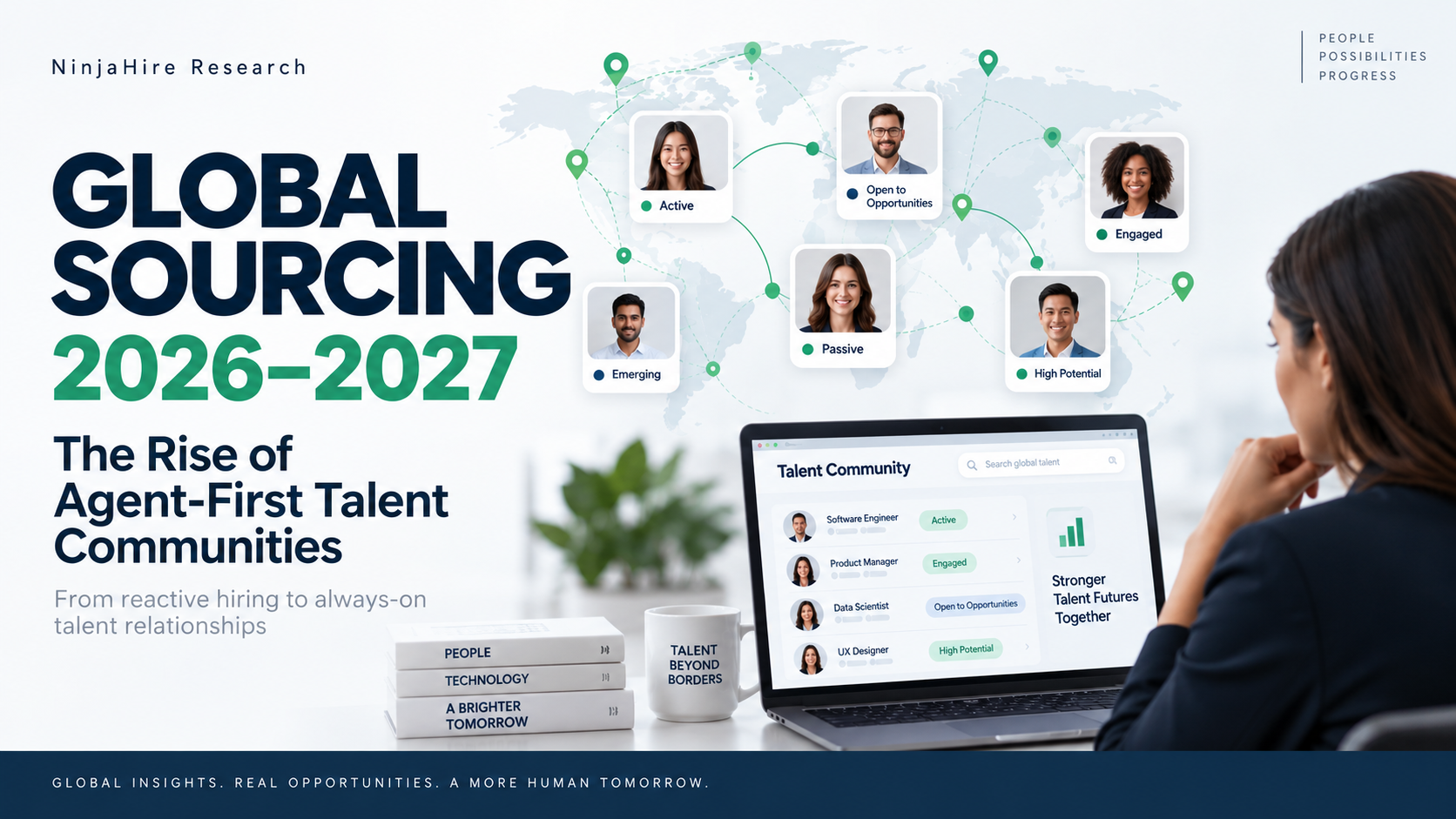
2026,2027 Global Sourcing Trends at a Glance
Talent sourcing is shifting from episodic, requisition-driven candidate searches toward continuously discovered, organized, and engaged talent ecosystems. AI systems and emerging autonomous agents increasingly take on routine, multi-step operational tasks: mapping candidate pools, contextual matching, public profile enrichment, personalized outreach staging, and initial screening. Strategic recruiters maintain control over calibration, relationship cultivation, contextual assessment, candidate experience, and hiring decisions.
This transition is driven by three operational realities across modern staffing firms and corporate recruiting functions:
- The economic limits of episodic search: Requisition-driven sourcing throws away residual candidate context after a role closes. When a new role opens, sourcing teams routinely start from zero, searching the open web or external platforms while internal applicant databases sit dormant, unindexed, and rapidly degrading in data quality.
- Inbound application volume versus signal: The widespread adoption of consumer AI writing tools and one-click job applications has caused application volumes to surge while applicant relevance has declined. Talent teams cannot manually review this volume without extending time-to-fill or overlooking qualified candidates.
- The technical evolution from point automation to goal-directed workflows: Early recruiting automation followed rigid if-then rules for scheduled emails or basic status updates. Modern recruiting agents can execute multi-step workflows across systems, such as monitoring changes in target talent pools, validating contact availability, drafting contextual outreach based on portfolio updates, and surfacing re-engagement queues for human review.
- Requisition opens triggers search from zero
- Recruiters run manual searches across external databases
- Outreach batches sent via cold templates
- Interviews conducted for near-term fit only
- Role filled; residual candidate data decays in storage
- Continuous background market discovery and enrichment
- Agent-First Talent Community continually maintained
- Immediate candidate reactivation upon role approval
- Human recruiter calibration, empathy, and judgment
- Structured feedback iteratively trains matching models
Strategic Implications by Operating Model
- Enterprise Talent Acquisition: Corporate teams must shift budget and operational attention from subscription seats on broad candidate search platforms toward data infrastructure, internal applicant tracking system (ATS) hygiene, and candidate rediscovery frameworks. Sourcing capacity shifts from manual list building to pipeline calibration and hiring manager alignment.
- Commercial and Professional Staffing Agencies: Staffing firms face compressed client delivery windows. Treating the internal candidate database as static storage leads directly to margin compression. Transforming historical candidate data into an active, continuously enriched talent community allows agencies to compress time-to-submit on recurring job orders from days to hours.
- Recruitment Process Outsourcing (RPO) and Managed Service Providers (MSP): Competitive differentiation moves away from raw headcounts of offshore sourcers toward process governance, auditability, candidate consent protocols, and measurable quality-of-hire metrics.
The mandate for talent acquisition leaders in 2026 and 2027 is neither passive resistance to automation nor uncritical adoption of autonomous software. It is the deliberate construction of supervised, agent-assisted workflows that preserve recruiter judgment while eliminating manual operational bottlenecks.
From Requisition-Driven Sourcing to Continuous Talent Discovery
The standard recruitment operating model was established during an era of information scarcity. When a hiring manager opened a job requisition, the sourcing team began an active search: building Boolean strings, querying external candidate aggregators, compiling candidate spreadsheets, sending outreach sequences, and advancing respondents into screening calls. Once the requisition closed, the project ended. Sourced candidates who were interviewed but not hired, or who expressed interest for the future, remained stored inside an applicant tracking system or customer relationship management (CRM) platform, where their profiles quickly became obsolete.
This episodic model produces systemic operational waste. According to published talent acquisition benchmarks from the Society for Human Resource Management (SHRM), traditional recruiting processes average an overall time-to-fill exceeding 40 days, with specialized technical and professional positions frequently extending beyond 60 days. A substantial portion of this cycle time consists of the cold discovery phase: locating profiles, locating contact details, and waiting for initial outreach responses.
| Dimension | Traditional Requisition-Driven Sourcing | Continuous Talent Discovery |
|---|---|---|
| Operational Trigger | Approved open requisition | Continuous market mapping and skill-pool monitoring |
| Data Asset Utilization | Open web search prioritized; internal ATS largely dormant | Internal database continuously enriched and prioritized |
| Candidate Context | Point-in-time snapshot (static resume or profile) | Dynamic trajectory (evolving skills, projects, tenure) |
| Outreach Strategy | Episodic cold messaging triggered by immediate openings | Segmented, context-aware engagement over time |
| Candidate Rediscovery | Rare; manual keyword queries against unstandardized data | Systematic; algorithmic matching against past silver medalists and vetted historical contacts |
| Primary Capacity Constraint | Recruiter operational hours spent on manual sourcing | Recruiter hours available for evaluation and interviews |
| Post-Hire Context Retained | Minimal; notes buried in unstructured candidate logs | Structured; candidate feedback feeds future matching |
Continuous talent discovery changes this workflow. Rather than initiating a cold search when an opening is approved, sourcing functions operate a continuous discovery engine. Candidate discovery, profile deduplication, multi-source enrichment, and availability monitoring occur in the background across strategic skill pools. When a job order opens, recruiters do not start with a blank search bar. They begin with an organized, historically vetted talent segment whose career trajectories, past assessments, and availability parameters have already been processed for human evaluation.
This operational shift is essential across four distinct hiring environments:
- High-Volume and Light Industrial Staffing: In branch operations and commercial staffing, order fulfillment speed determines win rates. Agencies that evaluate internal databases continuously can fill shift-based and commercial requisitions within hours, whereas agencies relying on reactive job board postings face rising advertising acquisition costs.
- Recurring Enterprise Technical Roles: Enterprise software engineering, data infrastructure, and systems engineering teams hire similar skill profiles continuously. Re-sourcing the exact same technical background every quarter represents redundant spend.
- Hard-to-Fill and Highly Regulated Professions: In clinical healthcare, aerospace engineering, risk modeling, and operational cybersecurity, qualified candidate supplies are strictly constrained. Passive professionals in these disciplines rarely respond to cold, transactional outreach sent during an active requisition crisis. They require sustained, low-frequency, contextually relevant touchpoints.
- Contingent Workforce and MSP Programs: Contingent staffing programs rely on fast time-to-submit metrics. Candidates redeployed from completed assignments yield lower onboarding costs, proven performance histories, and higher margin retention than net-new external hires.
What Is AI Sourcing?
AI sourcing refers to the application of machine learning, natural language processing, semantic models, and workflow automation to identify, evaluate, enrich, and engage prospective candidates for open or anticipated roles. Rather than relying solely on literal keyword matches entered by a human user, AI sourcing systems analyze the semantic context of a job description, identify relevant talent across internal and external data sources, infer transferable capabilities, predict candidate readiness, and assist in drafting personalized communications.
- Role Interpretation: The system extracts structural requirements from a job requisition or intake brief, parsing core technical requirements, adjacent skill sets, necessary domain depth, seniority levels, and geographic constraints.
- Candidate Discovery: Sourcing algorithms scan internal databases (ATS, CRM, past candidate pipelines) and public web records (professional platforms, open-source code repositories, research publications, patent registries) to surface relevant profiles.
- Contextual Matching: The platform moves beyond literal text matches to evaluate semantic relevance, analyzing career trajectories, project descriptions, organizational contexts, and skill adjacencies.
- Profile Enrichment: Incomplete or outdated records are cross-referenced with public web sources to refresh contact data, current titles, organizational movements, and published work.
- Candidate Ranking: Algorithms score identified profiles against job criteria, ordering candidates by relevance score for recruiter review.
- Candidate Rediscovery: Internal databases are continuously scanned to surface past applicants, previous interviewees, or past employees whose backgrounds match new openings.
- Outreach Support: Generative language models construct personalized message drafts citing specific candidate achievements, shared professional context, or portfolio contributions.
- Follow-Up Management: Systems track outreach response states, staging follow-up sequences when initial messages do not receive an answer, and pausing cadences immediately when a candidate responds.
- Calibration and Feedback Loops: Sourcing systems observe recruiter behavior (which profiles are advanced, rejected, or adjusted) to refine subsequent search and ranking parameters.
AI-Assisted Sourcing vs. Autonomous Agent-Based Sourcing
It is vital to distinguish between AI-assisted sourcing and autonomous, agent-based sourcing.
AI-assisted sourcing represents the prevailing standard in modern recruiting teams. In this setup, an AI tool functions as an inline assistant or copilot. A human recruiter creates the search criteria, clicks to run the search, reviews the candidate recommendations, approves the outreach draft, and schedules the communication sequence. The machine enhances recruiter speed, but the human initiates every discrete action.
Autonomous agent-based sourcing introduces goal-oriented execution across multiple steps. In an agentic architecture, a recruiter defines the objective, operating parameters, and boundary conditions (for example: identify 30 software engineers with distributed systems experience in the Central European time zone, verify contact data, ensure they have not been contacted within the past 90 days, draft contextual outreach referencing recent technical contributions, and queue them for recruiter review). The AI recruiting agent then executes this multi-step process autonomously, handling data transformations, system queries, and exception handling across integrated platforms without requiring step-by-step human prompts.
Critical limitations persist across both models. AI sourcing systems cannot independently verify the veracity of self-reported resume data. They struggle with deep cultural calibration, cannot assess human nuance, and risk amplifying historical biases present in training data sets if algorithmic guardrails are absent.
What Are AI Recruiting Agents?
An AI recruiting agent is a software system powered by advanced machine learning models that can independently plan, execute, and adapt multi-step recruiting tasks toward a defined goal, operating within specific business rules, security boundaries, and human oversight gates.
Unlike traditional rule-based automations that execute linear if-this-then-that scripts, an AI agent maintains an awareness of state, monitors environmental feedback, selects appropriate software tools via APIs, and adjusts its downstream actions based on intermediate results.
| Attribute | Traditional Automation | Recruiting Copilot | AI Recruiting Agent |
|---|---|---|---|
| Primary Operating Mode | Deterministic, rule-bound scripts | Interactive, prompt-response | Goal-directed, multi-step execution |
| Initiation | Triggered by rigid event (webhook) | Triggered by direct human prompt | Triggered by goal or threshold |
| Workflow Flexibility | Zero; breaks on exceptions | Moderate; guided step-by-step | High; self-corrects within bounds |
| Execution Depth | Single action (e.g., send email) | Suggestive (e.g., draft email) | End-to-end task completion |
| Context Retention | Minimal static database fields | Session-based conversational memory | Cross-system persistent memory |
| Cross-System Interop | Fixed point-to-point integrations | Limited; acts inside one UI | Multi-tool API orchestration |
| Recruiter Time Required | Low (setup only, breaks often) | High (continuous interaction) | Low (review and approval gates) |
| Final Decision Authority | Programmatic execution | Recruiter directly decides | Recruiter retains review and veto |
What AI Recruiting Agents Can Execute
Within a talent discovery workflow, a properly configured AI recruiting agent can:
- Monitor incoming requisitions, parse the requirements, and generate multi-dimensional search queries across connected platforms.
- Query internal ATS, CRM, and licensed external databases simultaneously to identify matches.
- Identify data discrepancies (such as conflicting employment dates across multiple sources) and flag profiles requiring human verification.
- Check organizational communication records to ensure a candidate is not actively in an interview process with a colleague or on a global opt-out list.
- Draft customized outreach that references specific public work, such as open-source code commits, technical blog posts, or published research papers.
- Stage candidate pipelines in the ATS and assign review tasks to the appropriate recruiter.
What Must Remain Under Human Recruiter Control
To maintain legal compliance, operational integrity, and candidate trust, talent acquisition teams must maintain strict human oversight boundaries. AI agents must never:
- Make definitive rejection decisions on job applicants without documented human recruiter review.
- Communicate formal employment offers, compensation terms, or binding contract details.
- Conduct final interview evaluations or uncalibrated qualitative scoring of candidate character.
- Operate without human approval gates on outbound messaging sequences.
- Modify compliance records, diversity logs, or equal employment opportunity (EEO) tracking categories.
Trend 1: Recruiters Are Moving Beyond Keyword Search
For nearly three decades, digital talent sourcing has depended on Boolean search. Recruiters translated hiring manager requirements into strings of keywords joined by operators: AND, OR, NOT, and field qualifiers. This methodology carried an inherent structural limitation: it relied on literal lexical matching. If a recruiter searched for "Site Reliability Engineer AND Kubernetes", the query systematically excluded candidates who listed "Distributed Systems Infrastructure" and "Container Orchestration", despite identical operational capabilities.
Query: "Java" AND "Spring Boot"
Matches only exact text strings. Systematically overlooks candidates listing modern adjacent frameworks or polyglot runtime architectures.
Intent: Microservices Backend Architecture
Maps JVM, Kotlin, Distributed Transactions, gRPC, Cloud Native services, and concurrent message queues based on actual execution scope.
Recruiting teams are shifting toward semantic and contextual search architectures. Built on vector embeddings and large language models, contextual search evaluates the meaning and intent behind a search query rather than exact phrase matches.
Contextual matching engines analyze:
- Skill Adjacencies: Recognizing that proficiency in Scala or Kotlin implies rapid adaptability to modern Java environments, or that experience building data pipelines with Apache Spark translates directly to Snowflake architectures.
- Organizational Context: Evaluating the operational scale of a candidate's past employers. Leading engineering at a high-velocity startup requires different execution capabilities than managing infrastructure within a global financial enterprise. Contextual search maps these structural environments.
- Career Trajectories and Velocity: Analyzing the progression of scope, promotion cycles, and expanding technical responsibilities across a multi-year timeline rather than viewing skills as isolated, static checklists.
What the Research Shows
According to LinkedIn's Future of Recruiting Report, talent acquisition professionals consistently report that evaluating candidates based on underlying skills and demonstrated capabilities yields a broader, more resilient talent pool than filtering strictly by past company prestige or exact job titles. Furthermore, Gartner's HR research highlights that organizations shifting to skills-based talent identification models expand their reachable candidate pools significantly compared to traditional credential-based searches.
Contextual search does not make candidate identification infallible. Machine learning models can misunderstand specific industry terminology, confuse superficial mentions of a skill with hands-on production experience, and occasionally generate inaccurate inferences regarding candidate seniority. Contextual search provides a more comprehensive, relevant initial candidate pool, but recruiter calibration remains necessary to confirm practical competence.
Trend 2: Passive Candidates Are Becoming Long-Term Talent Relationships
In competitive knowledge sectors, specialized healthcare, and mission-critical engineering, the most qualified professionals are rarely browsing active job boards. Sourcing high-performing talent requires identifying and engaging passive candidates: individuals who are gainfully employed and not actively seeking a job, but who remain open to compelling professional opportunities when presented with context and relevance.
Historically, passive candidate sourcing suffered from high operational friction and low yield. Recruiters compiled cold lists, sent generic outreach messages, logged non-responses, and discarded the data. If a passive candidate responded with "Not right now, but contact me in nine months," that record routinely vanished into an unstructured notes field in the ATS, forgotten by the time the specified window arrived.
Continuous talent discovery frameworks treat passive talent as an evolving, long-term relationship asset. Rather than discarding non-hired or passive prospects, teams maintain structured relationship histories:
- Systematic Re-Engagement Tracking: Storing candidate timing constraints, career goals, and desired compensation bands as structured metadata rather than unstructured text logs.
- Availability Signal Monitoring: Tracking public career shifts, educational completions, open-source project releases, and organizational reorganizations to identify moments when a candidate's openness to dialogue increases.
- Value-Oriented Touchpoints: Transitioning away from repetitive check-in messages toward thoughtful, value-first communications: sharing specialized industry research, technical white papers, or company milestone updates aligned with the candidate's verified interests.
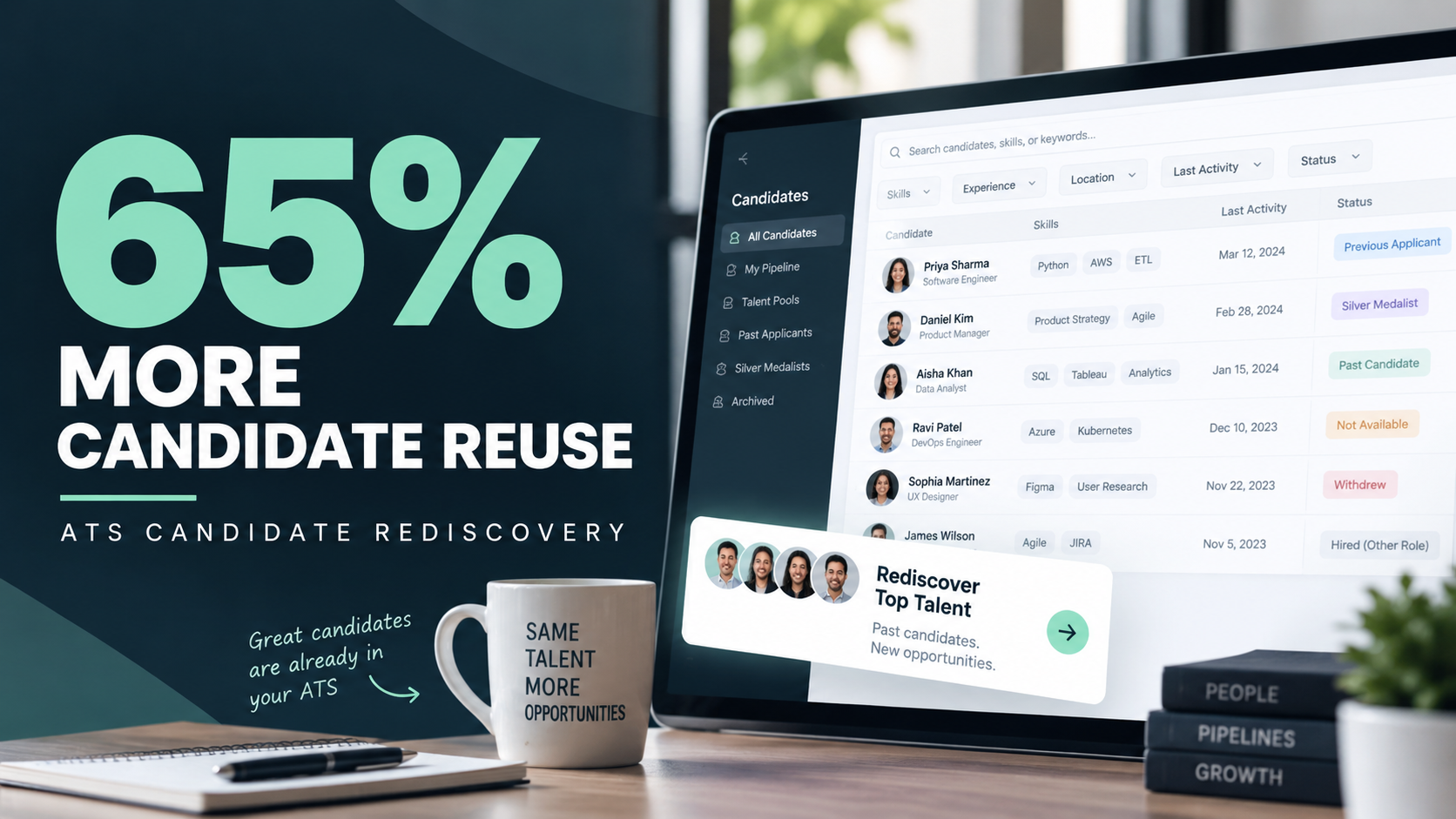
A candidate rejected at the final interview stage for a principal engineering role due to a narrow team-level calibration mismatch is frequently an exceptional fit for a subsequent architecture opening six months later. By maintaining continuous visibility over these silver medalists, sourcing teams reduce their reliance on cold external candidate discovery.







.jpg)