.png)
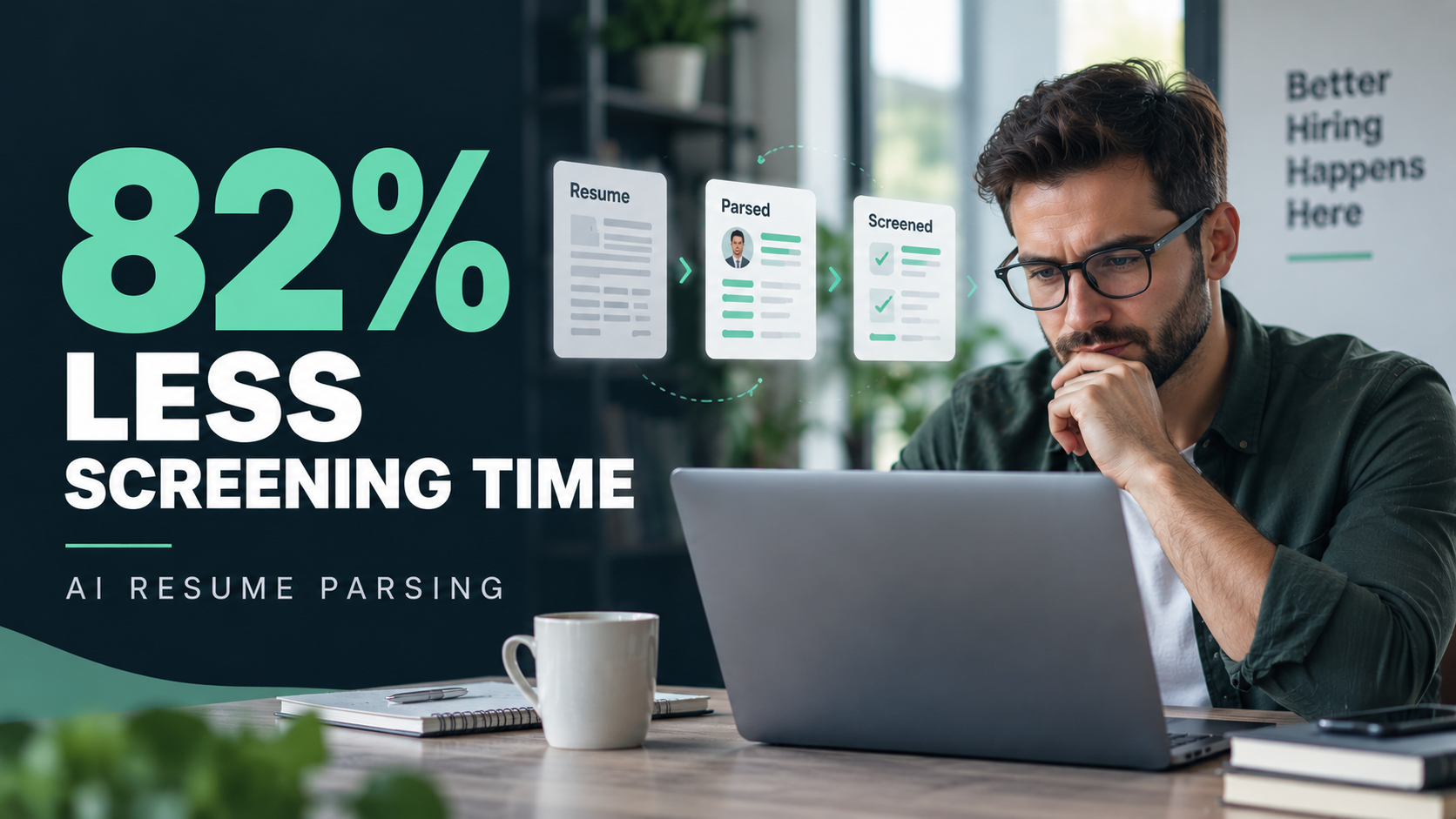
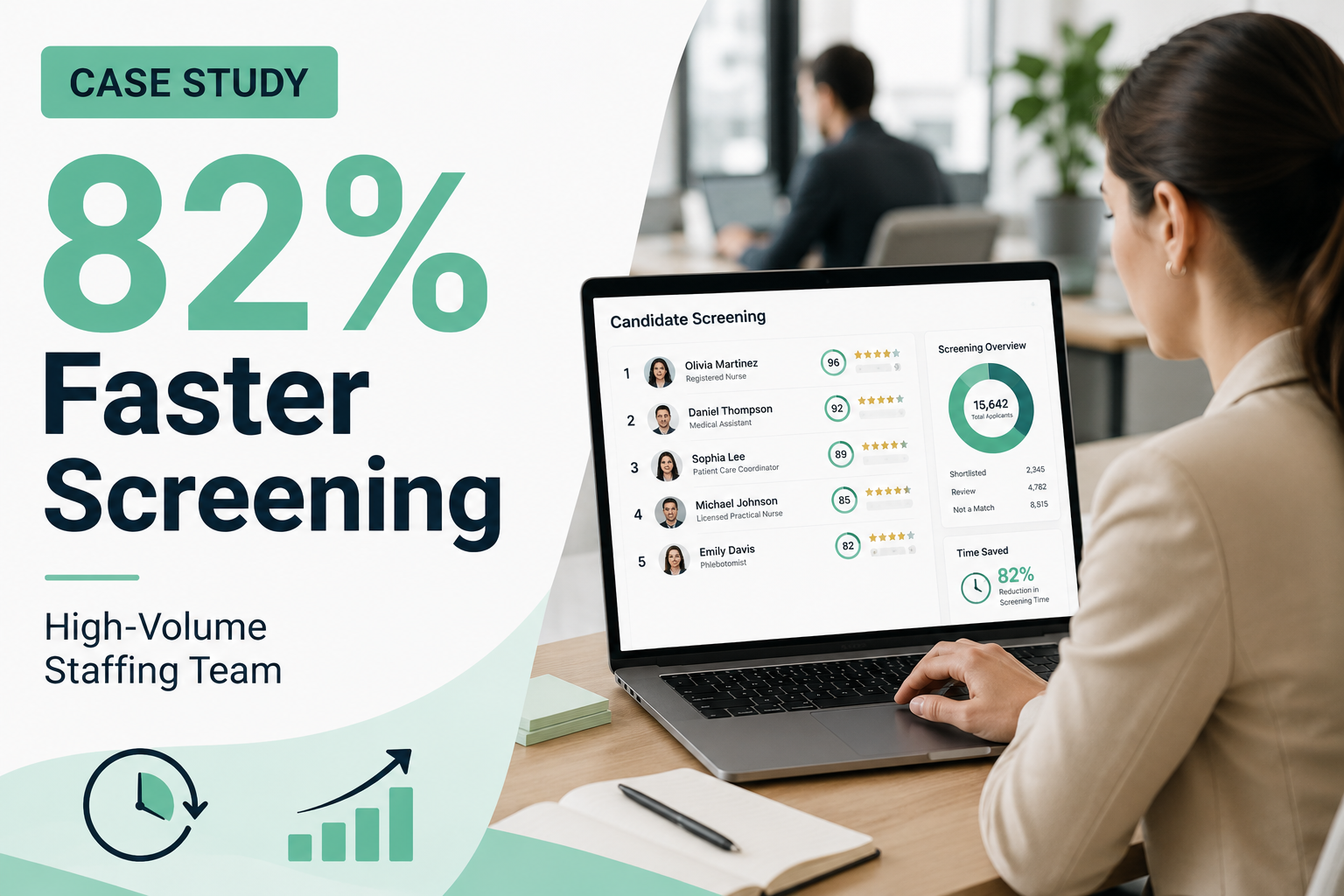
Resume screening time fell by 82% after AI resume parsing software was introduced into a recruitment workflow, replacing manual resume review and data entry with structured candidate data that recruiters could search and compare immediately. This case study looks at what actually changed in the workflow, why parsing resumes is not the same thing as screening them, and what that distinction means for the result.
Eighty-two percent is a big number, and it deserves an explanation rather than just a headline. This is not a universal guarantee, and it is not a claim that resume parsing alone decides who gets hired. It is a specific result from a specific workflow change: converting unstructured resume documents into structured candidate data earlier in the process, so screening could start from organized information instead of a stack of resumes in a dozen formats.
AI Resume Parsing Software Case Study: The 82% Result
AI resume parsing software can reduce manual resume-processing work by converting unstructured resume information into structured candidate data that is easier to search, compare, and evaluate. In this case study, changes to the resume processing and screening workflow were associated with an 82% reduction in resume screening time.
Measured against the same recruitment workflow before AI resume parsing was introduced into resume processing and screening.
| Workflow Stage | Before | After |
|---|---|---|
| Resume processing | Manual resume processing and review | AI-assisted resume processing and screening workflow |
| Candidate data | Unstructured, read individually per resume | Structured and searchable candidate profiles |
| Resume screening time | Baseline | 82% lower |
This case study does not report a specific number of hours, resumes, or recruiters, because those figures were not part of the confirmed result. What is confirmed is the direction and size of the change in resume screening time once parsing was handled by AI resume parsing software instead of manually.
The Resume Screening Problem
Before looking at what changed, it helps to understand what the process actually looked like. The bottleneck was not a lack of recruiter skill. It was volume: the amount of resume information coming in created more manual work than a recruitment team could efficiently process by hand.
Resumes Arrived in Different Formats
Resumes come in as PDFs, Word documents, plain text, and copy-pasted content from job boards, each formatted differently. There is no standard layout, so a recruiter cannot rely on information appearing in the same place twice. That inconsistency alone adds time to every resume review.
Recruiters Had to Review Resume Information Manually
Reading a resume to find relevant skills, job titles, and dates means scanning the entire document rather than jumping straight to what matters. Multiply that by every resume in a candidate pool, and the review process becomes the largest single time cost in early-stage recruiting.
Candidate Information Was Difficult to Compare
Once a recruiter has read several resumes, comparing them side by side is still manual work. Nothing about a stack of PDFs makes it easy to see, at a glance, which candidates share a certification or which have comparable years of experience in a specific skill.
Resume Review Slowed the Recruitment Workflow
Every other stage of recruiting, from shortlisting to outreach to screening calls, depends on getting through resume review first. When that stage takes longer, everything downstream is delayed along with it.
High Resume Volume Increased the Bottleneck
The more resumes a team receives, the more this manual work compounds. A recruiter managing a handful of resumes per requisition can absorb the review time. A recruiter managing hundreds cannot do the same manual review process at the same pace without something giving.
What Is AI Resume Parsing Software?
AI resume parsing software takes information from unstructured resumes, such as PDFs, Word documents, and text files, and converts it into structured candidate data that can be searched, stored, matched, and reviewed. It typically extracts fields like skills, job titles, employment history, education, and certifications, though the exact fields and level of detail vary by platform. Not every parser extracts every field with the same depth, and capabilities differ across tools.
For a broader look at how resume parsing works as a category and what it is generally used for, NinjaHire's AI resume parsing software guide covers the fundamentals in more depth. This case study focuses specifically on how parsing contributed to a measured reduction in screening time.
How AI Resume Parsing Works
Step 1: Resume Ingestion
The process starts when a resume enters the system, whether it is uploaded directly, submitted through a job application, or pulled in from an existing candidate database. The document itself is still unstructured at this point, regardless of file type.
Step 2: Information Extraction
The parser reads the resume content and identifies relevant candidate information, such as work history, skills, education, and contact details. This is the core function of a resume parser: pulling specific information out of free-form text.
Step 3: Data Structuring and Normalization
Extracted information is organized into a consistent format, so a job title, a date range, or a skill listed on one resume can be compared directly with the same fields on another. This structuring is what makes candidate data searchable rather than something a recruiter has to reread every time.
Step 4: Candidate Matching and Screening
Once candidate data is structured, it can be compared against job requirements. This is where parsing hands off to matching and screening: parsing provides the data, and matching or screening tools use that data to evaluate fit. Parsing on its own does not decide who is qualified.
Step 5: Recruiter Review
A recruiter reviews the structured candidate information and the results of matching or screening before making any decision about moving a candidate forward. Human review remains part of the process at this stage, regardless of how much of the earlier work was automated.
Resume Parsing vs. Resume Screening
These two terms get used interchangeably, but they are not the same function. Resume parsing extracts and structures information from a resume. Resume screening evaluates that information against job requirements to determine fit. Parsing happens first and makes screening faster and more consistent, but parsing by itself does not evaluate a candidate.
| Resume Parsing | Resume Screening |
|---|---|
| Extracts information from a resume document | Evaluates extracted information against job requirements |
| Produces structured candidate data | Produces a fit assessment or ranking |
| Happens before screening | Depends on data that parsing provides |
| Does not make a qualification decision | Informs a qualification decision, with recruiter review |
What is the difference between resume parsing and resume screening? Parsing turns a resume document into structured candidate data. Screening uses that structured data to evaluate how well a candidate matches a specific job requirement. Parsing is a data step; screening is an evaluation step, and it depends on parsing having already happened.
Where AI Resume Parsing Saved Time
Less Manual Data Entry
Recruiters no longer needed to manually retype or copy candidate details from a resume into a database or spreadsheet. Parsing captured that information directly from the document.
Less Resume-by-Resume Information Extraction
Instead of reading each resume individually to find relevant details, recruiters could work from structured data that had already pulled out the fields that mattered.
Faster Candidate Comparison
With candidate information in a consistent structure, comparing multiple candidates against the same criteria took less time than comparing raw resumes side by side.
Faster Candidate Search and Retrieval
Structured data is searchable in a way that a folder of PDFs is not. Finding candidates with a specific skill or certification became a search rather than a manual review of the entire database.
Faster Movement Into Screening
Because candidate data was already structured by the time screening began, screening could start sooner and rely on organized information rather than raw resume text.
Fewer Repetitive Recruiter Tasks
The repetitive work of reading, extracting, and organizing resume information by hand was reduced, which is the main reason screening time as a whole came down.
Curious how much time your team is losing to manual resume review?
See NinjaHire in ActionHow Resume Screening Time Fell by 82%
The before-and-after workflow makes the source of the time savings clear.
Before
- Resume arrives
- Recruiter opens resume
- Reads resume
- Extracts candidate information
- Reviews skills and experience
- Compares candidate with requirement
- Records information
- Decides whether to continue
After
- Resume arrives
- AI parses resume
- Candidate information becomes structured
- Matching / screening
- Recruiter reviews relevant candidate information
Several manual steps were reduced or removed rather than replaced one-for-one. Reading, extracting, and recording candidate information by hand, three separate manual steps in the before workflow, became a single automated step. Comparing candidates against a requirement moved from a fully manual review to a process that started with structured data already in place. The recruiter's review step did not go away; it moved later in the process, applied to organized information instead of raw resumes.
This result reflects one recruitment workflow and one set of workflow changes. It should not be read as a guarantee. Resume volume, role complexity, existing candidate data quality, and how a team's screening process is structured will all affect how much time a similar change might save elsewhere.
What Changed for Recruiters?
The practical effect was less time spent on manual data extraction and repetitive resume review, and less administrative work overall around getting candidate information into a usable form. That translated into faster candidate comparison, since recruiters were working with structured profiles rather than raw documents.
The time that was no longer going toward manual resume processing went toward candidate conversations, client requirements, and moving qualified candidates through the early stages of recruiting faster. This case study does not report a specific productivity percentage for recruiters individually. What is clear is that the screening stage itself became measurably faster.
Why AI Resume Parsing Matters for Staffing Agencies
Staffing agencies deal with resume volume differently than a single in-house hiring team. A desk might be working several open requisitions at once, each with its own pool of resumes, on top of an existing candidate database that already holds thousands of profiles.
AI resume parsing software for staffing agencies matters because it addresses that volume directly. High resume volume across multiple open requisitions becomes more manageable when candidate data is structured automatically rather than processed one resume at a time. Repeated candidate searches, which are common in staffing because similar roles come up again and again, become faster when the underlying data is searchable instead of buried in individual documents.
It also affects candidate submissions and short client deadlines. Faster resume processing means faster movement toward a shortlist, which matters when a client expects candidates within days rather than weeks. And because parsing structures data as it comes in, it supports better candidate rediscovery: recruiters can find qualified candidates already in the database instead of assuming they need to source new ones. Over time, this also improves overall ATS data quality, since candidate records are consistently structured rather than a mix of formats and completeness.
What Features Should AI Resume Parsing Software Have?
| Feature | Why It Matters |
|---|---|
| Resume data extraction | The core function of turning a document into usable information |
| Skills extraction | Makes it possible to search and filter candidates by specific skills |
| Employment history extraction | Supports comparison of experience level and role relevance |
| Education extraction | Confirms qualifications relevant to the role |
| Structured candidate profiles | Turns extracted data into a consistent, comparable format |
| Bulk resume processing | Handles high volume without processing resumes one at a time |
| Resume search | Lets recruiters find candidates by skill, title, or experience quickly |
| Candidate matching | Uses structured data to compare candidates against requirements |
| Screening support | Helps recruiters evaluate candidates using organized information |
| ATS integration | Keeps candidate data connected to the system recruiters already use |
| Data quality | Determines how reliable extracted information actually is |
| Human review | Keeps final decisions with recruiters, not the software |
| Security and privacy | Protects candidate data as it moves through the system |
AI Resume Parsing vs. Traditional Resume Parsing
Traditional resume parsing tends to be rule-based: it looks for specific keywords, headers, or formatting patterns to extract fields, which means it depends heavily on a resume following a predictable structure. When a resume deviates from that structure, rule-based parsing can miss information or misplace it.
AI-assisted parsing works differently. It can interpret resume information in context rather than relying only on fixed rules, which allows it to work with a wider range of resume structures and formats. That does not mean AI-assisted parsing is always more accurate, and it does not eliminate errors. No parsing approach captures every detail on every resume with complete accuracy. Buyers evaluating any resume parsing software, AI-assisted or rule-based, should test it against real resumes from their own recruiting workflow rather than relying on general claims about accuracy.
How to Measure the ROI of AI Resume Parsing Software
The 82% figure in this case study only means something because resume screening time was measured consistently before and after the workflow change. Any team evaluating AI resume parsing software should set up the same kind of comparison.
- Resume processing time
- Resume screening time
- Manual data-entry time
- Resumes processed per recruiter
- Time-to-shortlist
- Time-to-submit
- Candidate matching time
- Recruiter hours per requisition
- Candidate database completeness
- ATS data quality
In this case study, resume screening time is the metric with a confirmed result: an 82% reduction. Other metrics on this list, such as candidate database completeness or recruiter hours per requisition, are worth tracking for any team evaluating parsing software, but this case study does not report specific values for them. Comparing baseline performance against post-implementation performance on the metrics that matter most to your workflow is the most reliable way to know whether a change is actually working.
Is AI Resume Parsing Software Right for Your Staffing Agency?
This tends to matter most for teams already dealing with volume. High resume volume, multiple recruiters working from a shared candidate database, high-volume recruiting activity, repeated searches for similar roles, a significant amount of manual resume data entry, tight submission deadlines, and a heavy screening workload are all signs that manual resume processing is likely costing meaningful time.
It may be a lower priority for teams with very low resume volume, very limited hiring activity, or a resume-processing workflow that is already highly automated through other means. In those cases, the manual process may already be manageable relative to the volume involved, and the time savings from parsing software would be smaller in proportion.
Frequently Asked Questions About AI Resume Parsing Software
What is AI resume parsing software?
AI resume parsing software converts unstructured resume documents into structured candidate data, such as skills, job titles, employment history, and education, so the information can be searched, stored, and compared instead of read one resume at a time.
How does AI resume parsing work?
The software ingests a resume, extracts relevant information from the text, and organizes it into a consistent, structured format. That structured data can then be used for candidate search, matching, and screening.
What information does AI resume parsing extract?
Common fields include skills, job titles, employment history, education, and certifications. The exact fields extracted, and how thoroughly, vary by platform, so buyers should confirm what a specific parser actually captures.
What is the difference between resume parsing and resume screening?
Parsing extracts and structures information from a resume. Screening evaluates that structured information against job requirements to assess fit. Parsing happens first and provides the data that screening depends on.
Can AI resume parsing reduce resume screening time?
It can, by providing structured candidate data that is faster to review and compare than raw resumes. In this case study, that workflow change was associated with an 82% reduction in resume screening time.
How did AI reduce resume screening time by 82%?
The case study recorded an 82% reduction in resume screening time after AI resume parsing replaced manual reading, extraction, and recording of candidate information with structured, searchable data. Outcomes vary based on workflow, volume, roles, candidate data, and implementation.
Can AI resume parsing handle different resume formats?
AI-assisted parsing is generally better suited to varied resume formats than rule-based parsing, since it can interpret information in context rather than relying only on fixed patterns. Results still depend on the specific resumes and the parser used.
Does AI resume parsing integrate with an ATS?
Many resume parsing tools are designed to work alongside an ATS, feeding structured candidate data into the system recruiters already use. Specific integrations depend on the platform, so this should be confirmed during evaluation.
What should I look for in AI resume parsing software?
Look for accurate data extraction across the fields you care about, bulk processing for volume, searchable structured profiles, support for candidate matching and screening, ATS integration, data quality, and clear human review at the decision stage.
Is AI resume parsing useful for staffing agencies?
Yes, particularly for agencies handling high resume volume, large candidate databases, and repeated searches across similar roles. Structured candidate data makes it faster to search, compare, and submit candidates against tight client deadlines.
How accurate is AI resume parsing?
Accuracy varies by platform and by resume format, and no parser captures every detail on every resume perfectly. Rather than relying on general accuracy claims, buyers should test a parser against real resumes from their own recruiting workflow.
Does AI resume parsing replace recruiters?
No. Parsing structures candidate data; it does not evaluate candidates or make hiring decisions. Recruiters still review structured information, apply judgment, and make the calls on who moves forward.
How do you measure the ROI of resume parsing software?
Track metrics like resume processing time, resume screening time, manual data-entry time, time-to-shortlist, and time-to-submit before and after implementation. Comparing baseline performance to post-implementation performance is what makes a result like an 82% reduction meaningful.
The Bottom Line
The value of AI resume parsing is not simply reading resumes faster. It is turning unstructured documents into usable candidate data earlier in the recruitment workflow, so the steps that come after, matching, screening, and recruiter review, can start from organized information instead of raw text.
In this case study, that workflow change was associated with an 82% reduction in resume screening time. Parsing did not replace recruiter judgment. It removed the manual work that used to stand between a resume arriving and a recruiter being able to actually evaluate it.
See Where AI Could Save Your Recruiting Team Time
If your recruiters are still spending hours processing resumes before they can evaluate candidates, NinjaHire can help automate repetitive parts of the workflow.
See NinjaHire in Action






.jpg)