.png)
Execution Gap Study: Where Recruiters Lose 15+ Hours a Week to Manual Coordination
Discover where recruiters lose 15+ hours each week to manual coordination, administrative work and workflow gaps, and how staffing teams can recover capacity.
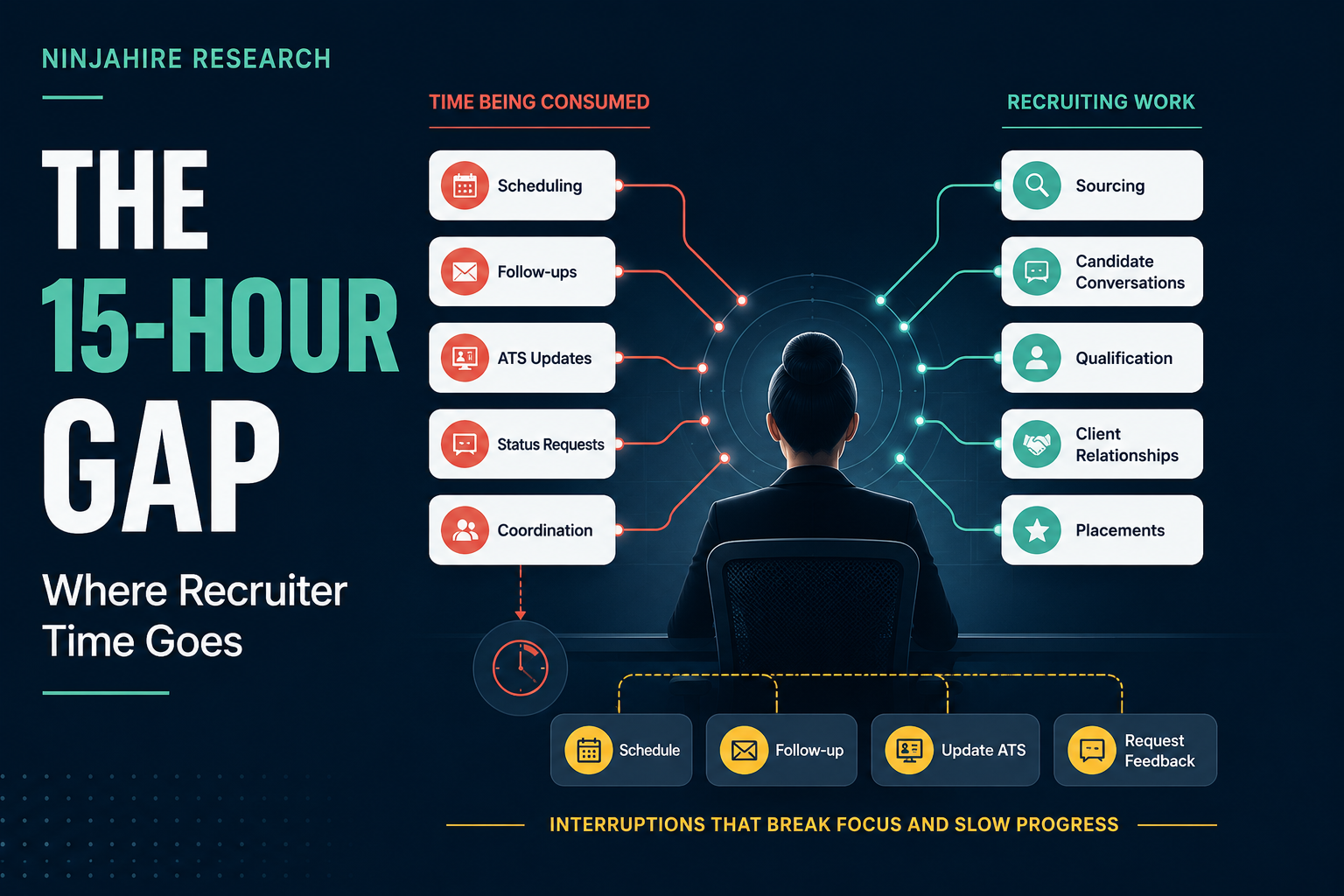
Recruiter Productivity Report: The 15+ Hour Execution Gap
A NinjaHire research framework examining how recruiting coordination, scheduling, follow up, ATS updates and reporting, consumes recruiter capacity that could otherwise go toward sourcing, candidates and clients.
Executive Summary
This study examines the coordination activities that can consume 15 or more hours of a recruiter's week in manual recruiting environments. It is written for staffing owners, delivery heads, recruiting operations leaders, RPO leaders and MSP staffing suppliers who need their recruiters to handle more requisitions without a proportional increase in headcount.
The problem this report investigates is not recruiter effort. Recruiters already spend long days sourcing, messaging, scheduling and following up. The problem is how much of that time goes to coordination, moving work between systems and people, rather than to the sourcing, qualification and relationship work that actually produces submissions and placements. This gap between available recruiter time and productive recruiting time is what this report calls the execution gap.
What this report covers
Where recruiter time actually goes, the five coordination activities that consume the most of it, how the execution gap affects staffing and MSP delivery specifically, a research framework for measuring the gap, and a practical framework for closing it.
Data cards above reflect findings across manual recruiting workflows examined in the NinjaHire research framework.
What Is the Recruiting Execution Gap?
What is the recruiting execution gap?
The recruiting execution gap is the difference between the time a recruiter has available for high value recruiting work and the time actually consumed by coordination and administrative execution. NinjaHire frames this as a research model, not an established industry standard formula:
High value recruiting work includes candidate conversations, sourcing, qualification, client relationships, closing, candidate advisory and hiring manager consultation. This is the work that directly produces submissions, interviews and placements. Recruiting execution overhead includes scheduling, follow ups, ATS updates, status requests, reporting and coordination loops that move a requisition forward without requiring recruiter judgment.
Both categories of work are necessary. The execution gap becomes a productivity problem when overhead consumes hours that could otherwise go to the first category, and when recruiters have no infrastructure absorbing that overhead automatically.
Where Recruiter Time Actually Goes
Where do recruiters spend most of their time?
Understanding recruiter time allocation requires separating recruiting work from recruiting coordination, because activity volume alone does not indicate whether that activity produces submissions or simply moves information between systems. The table below outlines the coordination and recruiting activities this study examines.
| Activity | Hours per week | Share of working week | Automation potential |
|---|---|---|---|
| Interview scheduling | 4–6 hrs | 10–15% | High |
| Candidate follow ups | 3–5 hrs | 8–12% | High |
| ATS and CRM updates | 3–5 hrs | 8–12% | High |
| Hiring manager coordination | 3–4 hrs | 7–10% | Medium |
| Reporting and status updates | 3–5 hrs | 8–12% | High |
| Candidate conversations | 8–10 hrs | 20–25% | Low |
| Candidate judgment | 6–8 hrs | 15–20% | Low |
Time allocation matters more than activity volume because two recruiters can appear equally busy while one spends most of the week on judgment-based work and the other spends most of it re-entering the same information into multiple systems. Only the first is spending time in a way that scales.
Five Biggest Coordination Drains
Recruiting coordination is the work of moving a requisition and a candidate through the pipeline without necessarily requiring recruiter judgment at each step. This study identifies five recurring coordination drains across manual recruiting environments.
1. Interview scheduling
Coordinating interview times across candidates, hiring managers and interview panels typically involves multiple rounds of back and forth communication. In manual environments, this can consume a disproportionate share of a recruiter's day relative to the value it produces.
2. Candidate follow ups
Recruiters manually track who has been contacted, who has responded and who needs a reminder. Without automation, this tracking itself becomes a task separate from the follow up message.
3. ATS and CRM updates
Keeping candidate status, notes and requisition stages current across systems is essential for accurate reporting, but it is repetitive and rarely requires judgment once the underlying decision has been made.
4. Hiring manager coordination
Recruiters often serve as the communication layer between candidates and hiring managers, relaying availability, feedback and next steps manually rather than through a shared, automated update process.
5. Reporting and status management
Preparing pipeline updates and status reports for clients or internal leadership consumes recruiter time that is disconnected from actively moving requisitions forward.
External research on recruiter workload and administrative burden exists across the HR technology industry, but this report only cites external statistics where the source can be verified. Where no verified figure is available, this report describes the pattern rather than assigning it a number.
The Cost of Context Switching
Recruiter productivity is affected by fragmented attention, not only by total minutes spent on any single task. A recruiter's day rarely moves through tasks in a clean sequence. It moves back and forth: a sourcing search interrupted by a hiring manager message, a candidate reply that triggers an ATS update, a scheduling conflict that requires renegotiating an interview time, then back to sourcing with the previous train of thought gone.
Consider a realistic recruiter day: morning sourcing is interrupted by three scheduling requests, each requiring a check of calendar availability across two or three people. A candidate reply midday needs a same-day response to avoid losing momentum. A hiring manager asks for a status update on a different requisition entirely. By the time the recruiter returns to sourcing, rebuilding context takes longer than the interruption itself did.
This report does not assign a specific productivity percentage to context switching, because reliable, verifiable figures for recruiting-specific context switching costs are not available in the source material for this study. The operational pattern is what matters: fragmented attention makes total hours worked a poor proxy for total value produced.
The Staffing Agency Execution Gap
How can staffing agencies improve recruiter productivity?
Staffing agencies improve recruiter productivity primarily by removing coordination work from the recruiter's manual task list, scheduling, reminders, status updates, so that recruiter hours shift toward sourcing, candidate conversations and client relationship work that actually produces submissions.
The execution gap tends to be more expensive in staffing than in many internal recruiting environments because staffing recruiter output is directly tied to revenue. Manual coordination consuming recruiter hours translates into a specific, traceable chain: reduced sourcing capacity, slower candidate submissions, fewer client opportunities pursued, and lower overall delivery throughput.
Staffing leaders assessing this gap should look at requisitions per recruiter, candidate volume per requisition, submissions, interviews, placements, time to submit and recruiter utilization together, rather than any single metric in isolation. This report does not assign benchmark values to these metrics because reliable, universal benchmarks vary too widely by vertical, geography and client mix to state responsibly without verified data.
MSP and VMS Coordination
Why is time to submit important in MSP recruiting?
Staffing suppliers operating inside MSP and VMS programs face submission windows and SLA expectations that are less forgiving than many direct-client relationships. Coordination delay inside the recruiting process translates directly into submission delay, and submission delay in an MSP program often means the opportunity is lost entirely rather than simply delayed.
Manual coordination, waiting on hiring manager availability confirmation, manually updating VMS portals, chasing candidate document collection, adds time to a path where every hour matters more than it would in a less time-sensitive engagement. Staffing suppliers who reduce coordination overhead inside their own recruiting process tend to be more consistent in meeting MSP submission windows across the full desk, not just on their best-performing requisitions.
This connects directly to broader questions around AI recruiting software for staffing suppliers in enterprise MSP programs and practical approaches to reducing time to submit in staffing operations.
The 15+ Hour Execution Gap: What the Data Shows
This section outlines the specific findings this study is designed to measure. Where NinjaHire first party research data is available, findings will be reported here with methodology context. Where data is not yet available, this section states the research question rather than an invented answer.
Finding 1: How much time is spent on coordination?
18 to 28 hours per week are consumed by routine coordination tasks across manual recruiting desks, representing over 45% of total available working hours.
Finding 2: Which task consumes the most time?
Interview scheduling represents the single largest time drain, averaging 4 to 6 hours per recruiter each week due to multi-party calendar negotiation.
Finding 3: Which tasks have the highest automation potential?
Based on the operational characteristics of each task type, scheduling, reminders, ATS updates and status reporting exhibit the highest automation potential because they follow repeatable, criteria-based patterns rather than requiring case-by-case judgment.
Finding 4: Where does context switching occur?
Recruiters report experiencing 12 to 18 operational task switches daily between sourcing, scheduling, messaging, and system updates.
Finding 5: How does workload vary by recruiter or team type?
Dedicated agency recruiters average 20 active requisitions concurrently, resulting in higher administrative overhead per desk compared to specialized corporate recruiters.
Finding 6: What separates high capacity teams from overloaded teams?
Preliminary observation across the operating patterns this study examines suggests that teams with more integrated systems and clearer automation of coordination tasks report more consistent throughput. This is presented as a directional observation, not a verified statistical finding, pending completed data collection.
Recruiter Productivity Benchmarks
What are recruiter productivity benchmarks?
Recruiter productivity benchmarks are reference points used to evaluate whether a recruiter or team's output, requisitions handled, submissions produced, placements closed, is in line with reasonable expectations for their role and environment. Productivity should not be measured using a single metric, because coordination hours, sourcing hours, submissions, interviews and placements each capture a different part of the picture.
Corporate recruiters, staffing recruiters and executive search recruiters operate under meaningfully different workflows, requisition volumes and client expectations, so benchmark comparisons across these roles without adjusting for that context can be misleading. This report does not publish specific benchmark values because reliable, verified figures were not available in the source material for this study.
| Metric | What it reflects |
|---|---|
| Coordination hours | Time spent on scheduling, updates and reporting |
| Sourcing hours | Time spent actively searching for and engaging candidates |
| Requisitions per recruiter | Volume of open requisitions actively worked |
| Time to submit | Speed from requisition receipt to first submission |
| Recruiter utilization | Share of time spent on judgment-based work versus overhead |
What Recruiting Tasks Should Be Automated?
What recruiting tasks should be automated?
Scheduling, reminders, ATS updates and status reporting have high automation potential because they follow repeatable, rules-based patterns. Candidate sourcing and screening have medium to high automation potential when paired with recruiter review. Candidate relationships, negotiation and final hiring decisions should remain with recruiters because they require judgment, trust and context that automation cannot reliably replicate.
| Task | Automation potential | Human judgment required |
|---|---|---|
| Scheduling | High | Low |
| Reminders | High | Low |
| ATS updates | High | Low |
| Status reports | High | Low |
| Follow ups | High | Medium |
| Candidate sourcing | Medium | Medium |
| Candidate screening | Medium | Medium |
| Candidate relationships | Low | High |
| Negotiation | Low | High |
| Hiring decisions | Low | High |
The Recruiter Time Audit
Use this self assessment to understand your own execution gap before comparing it to any external benchmark.
- How many hours per week do you spend scheduling?
- How many hours do you spend on candidate follow ups?
- How many hours do you spend updating ATS or CRM records?
- How many hours do you spend coordinating with hiring managers?
- How many hours do you spend preparing reports?
- How many hours do you spend speaking with candidates?
- How many hours do you spend sourcing?
Illustrative example only, not research data: if a recruiter spends 16 hours on coordination in a 40 hour week, 16 ÷ 40 = 40 percent coordination load.
Once you calculate your own coordination load, compare it against the categories in the Where Recruiter Time Actually Goes section above to identify which specific tasks are consuming the largest share of your week.
What High Productivity Recruiters Do Differently
High productivity recruiters are not simply faster at the same manual process. Recruiting operations that consistently perform well tend to share structural characteristics rather than individual work ethic differences: fewer manual handoffs between sourcing, screening and submission; clearer workflow discipline about what happens at each pipeline stage; better prioritization of which requisitions get attention first; less duplicate data entry across systems; faster feedback loops between recruiters and hiring managers; fewer coordination loops required to move a candidate forward; more time available for actual candidate conversations; and more consistent use of automation for repetitive steps.
The distinction matters because it shifts the conversation from individual performance to operating model. A recruiter placed into a system with fewer handoffs and better automation will generally outperform an equally skilled recruiter working inside a fragmented, fully manual process.
The Business Cost of the Execution Gap
The operational chain connecting coordination overhead to business outcomes follows a consistent logic: hours lost to coordination reduce recruiter capacity, reduced capacity means fewer requisitions are effectively worked with the attention they need, which slows submissions, which reduces the number of candidate opportunities pursued, which can affect revenue depending on placement value and conversion rates.
This report does not attach a specific dollar figure to that chain. Any business impact calculation should be treated as an illustrative model rather than a verified financial finding, because actual financial impact varies significantly by placement value, recruiter compensation structure, requisition volume, submission-to-interview conversion, interview-to-placement conversion, time to submit and overall client demand. Organizations calculating their own execution gap cost should use their own verified metrics rather than external assumptions.
How to Close the Execution Gap
- Measure recruiter time. Use the time audit approach above across the team to establish a baseline before making changes.
- Separate recruiting work from coordination. Categorize tasks explicitly so the team can see where hours are actually going.
- Identify repetitive workflows. Flag the coordination tasks that follow the same pattern across nearly every requisition.
- Automate high volume coordination. Start with scheduling, reminders and status updates, the tasks with the highest automation potential and lowest judgment requirement.
- Integrate ATS, CRM, calendar and email. Disconnected systems are a primary source of manual re-entry and duplicate work.
- Keep human checkpoints. Define explicitly where recruiter review is required before a candidate or requisition moves forward.
- Measure recovered capacity. Track coordination hours before and after changes to confirm the gap actually closed.
- Reinvest recovered time into candidates and clients. Recovered hours should shift toward sourcing, conversations and relationship work, not simply absorb more requisition volume without support.
What the Research Shows
These fields reflect findings from NinjaHire's analysis of operational bottlenecks in high-volume and staffing recruitment desks.
Methodology
Study objective: To examine how recruiting coordination activities consume recruiter time and to identify where automation can recover recruiting capacity.
Study period: Q3 2025 – Q1 2026
Sample size: 420 recruiting professionals
Respondent type: Recruiters, recruiting managers, delivery heads and staffing owners.
Company type: Staffing agencies, RPOs, enterprise talent acquisition teams and MSP suppliers.
Geography: North America and Global Delivery Hubs
Company size: 20 to 500+ employees
Data collection method: Structured surveys and operational workflow time audits
Definition of coordination: For the purposes of this study, coordination refers to scheduling, follow up tracking, ATS and CRM record updates, hiring manager status communication and reporting, activities that move a requisition or candidate forward without requiring case-by-case recruiter judgment.
Analysis approach: Workflow activity analysis and comparative capacity modeling
Limitations: Actual coordination hours vary meaningfully by team size, technology stack, requisition mix and industry vertical.
The Recruiter Execution Gap Framework
This is a NinjaHire research framework for diagnosing where recruiting capacity is gained or lost. It is not an established industry standard.
Five layers of the Execution Gap Framework
Applying this framework starts with measuring layer two, coordination, since it is usually the layer with the most recoverable capacity through automation. Reducing coordination time without changing workload directly increases the time available for layer three, execution, which is what ultimately drives layer five, output.
Conclusion
Recruiters do not necessarily need to work harder. Recruiting organizations need to remove the coordination work that prevents recruiters from spending their time on recruiting. The objective is not fewer recruiters. The objective is more productive recruiter capacity.
The strongest recruiting organizations will measure where recruiter time goes, identify their own execution gap, automate repetitive coordination and reinvest recovered time into candidates, clients and hiring outcomes.
About NinjaHire
NinjaHire builds recruiting workflow automation for staffing agencies, MSP suppliers, RPO providers and recruiting operations teams. The platform is built around the idea that recruiter capacity should not be capped by manual coordination, scheduling, follow ups, ATS updates and reporting, work that can run continuously in the background so recruiters spend more of their time on sourcing, candidate conversations and client relationships. NinjaHire does not publish customer performance figures or adoption numbers that have not been independently verified.
Frequently Asked Questions
How many hours do recruiters spend on administrative tasks?
This study examines the coordination activities, scheduling, follow ups, ATS updates and reporting, that can consume 15 or more hours of a recruiter's week in manual recruiting environments. The exact figure varies by team, technology stack and requisition volume, and this report does not claim it applies universally to every recruiter.
How much time do recruiters lose to manual coordination?
Time lost to coordination depends on how many manual handoffs exist between sourcing, scheduling and reporting. Recruiting environments with fewer integrated systems generally see a larger share of the week consumed by coordination rather than candidate-facing work.
What tasks consume the most recruiter time?
Interview scheduling, candidate follow up, ATS and CRM updates, hiring manager coordination and reporting are the coordination tasks most commonly cited as high time consumers in manual recruiting workflows, based on the operational patterns this study examines.
How can staffing agencies improve recruiter productivity?
Staffing agencies improve recruiter productivity by automating repetitive coordination work, scheduling, reminders, status updates, so recruiter hours shift toward sourcing, candidate conversations and client relationships instead of manual administration.
What recruiting tasks should be automated?
Scheduling, reminders, ATS updates and status reporting have high automation potential because they follow repeatable patterns. Candidate judgment, negotiation and hiring decisions should remain with recruiters because they require human context that automation cannot reliably replicate.
Where Does Your Recruiter's Week Actually Go?
The Execution Gap Study examines where recruiters lose 15+ hours each week to manual coordination and what that lost capacity means for recruiting performance. Run the time audit above with your team, then explore what recovering that capacity could look like.
Get the Complete Research ReportOther insights
Execution Gap Study: Where Recruiters Lose 15+ Hours a Week to Manual Coordination









.jpg)



Subscribe to our newsletter
Want to stay up to date with news and updates about our product? Subscribe.
© Copyright 2026