.png)
The State of AI Recruiting in Staffing 2026: Trends, Statistics & Technology Adoption Report
Explore the State of AI Recruiting in Staffing 2026 with industry trends, verified statistics, technology adoption insights, recruiter benchmarks, and expert analysis.
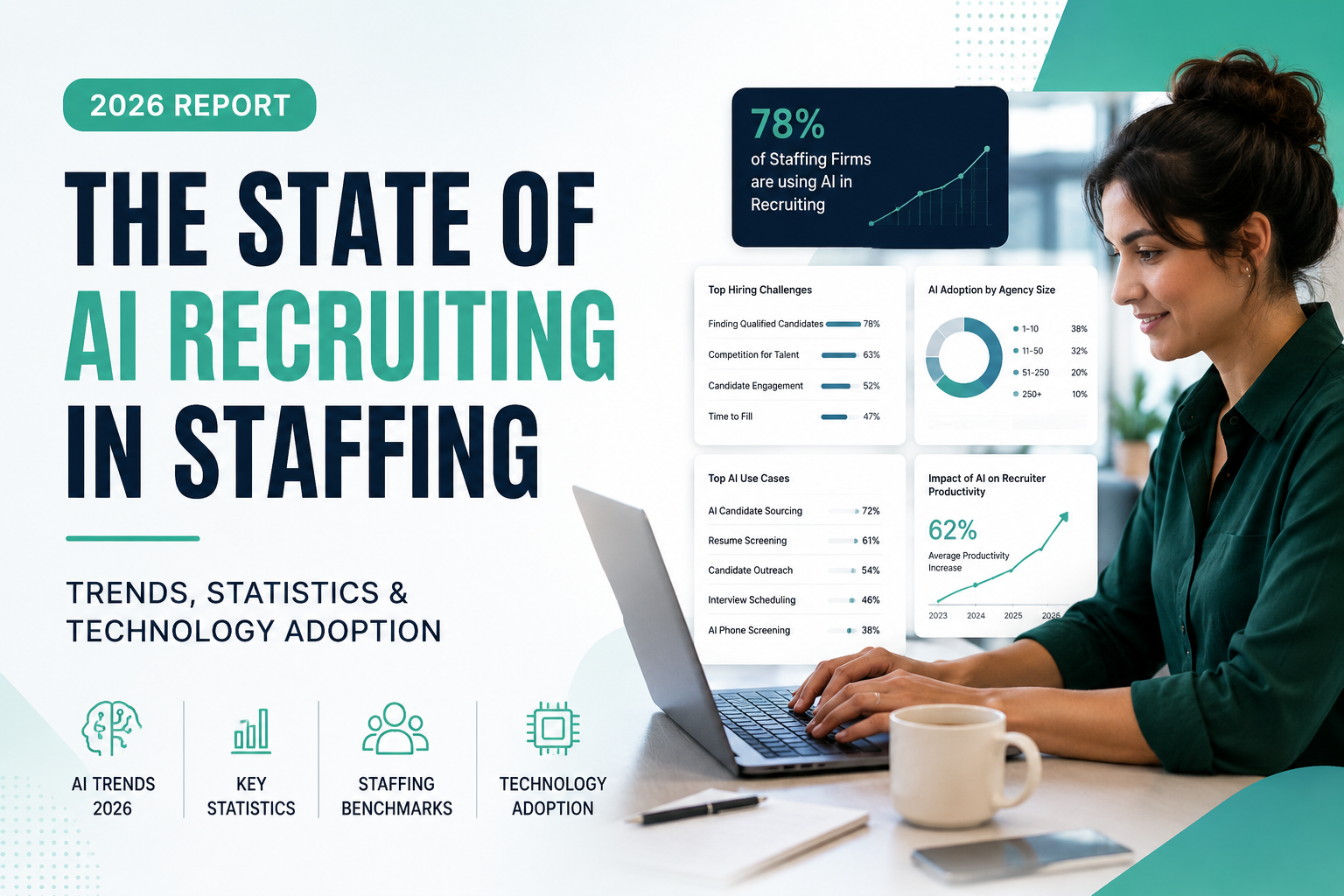
How AI Is Reshaping Staffing Agencies, Recruiter Productivity and Candidate Engagement
Published by NinjaHire | 2026 Edition
Table of Contents
- Executive Summary
- Introduction
- The Current State of Staffing Recruitment
- AI Adoption in Staffing
- Technology Landscape
- Recruiting Workflow Evolution
- Market Trends
- Technology Adoption by Agency Size
- Recruiter Productivity
- Candidate Experience
- Staffing Technology Stack
- Future Outlook (2027–2030)
- Recommendations
- Methodology
- Frequently Asked Questions
- References
1. Executive Summary
Staffing has spent three years absorbing a labor market that no longer behaves the way it did before 2020. Requisition volume has become spikier, client expectations around time-to-fill have tightened even as candidate responsiveness has declined, and the recruiter-to-req ratio at most firms has not kept pace with demand. Against that backdrop, artificial intelligence has moved from a topic discussed at industry conferences to a line item in agency technology budgets.
This report examines where that shift actually stands in mid-2026 — not where vendors say it stands, but where the operating data, public disclosures, and agency-level observations suggest it stands. The picture is more uneven than the marketing narrative around "AI recruiting" implies.
Key findings:
- AI adoption in staffing is now mainstream at the point-solution level (resume parsing, sourcing assistance, scheduling) but still early at the workflow level (end-to-end candidate journeys managed with minimal human touch).
- Recruiter productivity gains are concentrated in the top-of-funnel: sourcing, initial screening, and outreach drafting. Gains further down the funnel — negotiation, relationship management, offer stages — remain limited, and most agency leaders do not expect that to change materially in the near term.
- Mid-market agencies are adopting AI tools faster, relative to headcount, than either small independents or the largest enterprise staffing firms, largely because they have both the budget flexibility and the operational urgency that very small and very large firms lack.
- The ATS and VMS layer remains the system of record for nearly every firm in this market, and most AI tooling in 2026 is being adopted as an overlay or integration rather than a replacement.
- Candidate experience — specifically speed and transparency of communication — has become a more visible differentiator between agencies than in prior years, as candidates increasingly compare their experience across concurrent processes.
- Compliance and data governance concerns, rather than cost, are now the most commonly cited barrier to broader AI adoption among agencies with 50+ recruiters.
This report is organized to separate three categories of claim: verified public data, industry-wide observations drawn from public reporting and practitioner discussion, and forward-looking predictions. Section 14 (Methodology) explains how each category was sourced and should be read alongside the rest of the report.
NinjaHire, an AI-driven sourcing and recruiting automation platform, is referenced at points in this report as one example of the category of tools discussed. It is not the subject of the report, and its inclusion does not imply an endorsement of any single vendor as representative of the category.
2. Introduction
What is AI recruiting, and why has it become a board-level topic in staffing?
AI recruiting refers to the application of machine learning, natural language processing, and increasingly agentic automation to the tasks that make up the recruiting funnel: sourcing, screening, engagement, scheduling, and — in a smaller number of cases — early-stage matching and ranking. In staffing specifically, the term covers everything from resume parsing tools embedded in an ATS to standalone sourcing agents that search, filter, and draft outreach without recruiter involvement at each step.
The reason this has become a strategic conversation rather than a tooling conversation is structural. Staffing firms operate on thin per-placement margins and compete on speed and quality of match simultaneously. Historically, those two variables traded off against each other — faster submissions often meant less vetting. AI tooling is one of the first categories of technology that plausibly addresses both variables at once, which is why it has attracted attention from firms that are otherwise conservative technology buyers.
At the same time, staffing is not a single market. A five-person boutique agency and a 2,000-recruiter enterprise staffing firm face different constraints, and the AI adoption patterns of each look meaningfully different, as this report details in Section 8.
This report does not attempt to answer whether AI recruiting is a positive or negative development for the profession. It attempts to describe, as precisely as the available evidence allows, what is actually happening across the industry in 2026, what is changing recruiter workflows in practice, and what staffing leaders are telling analysts and each other about what comes next.
3. The Current State of Staffing Recruitment
How are staffing agencies performing on the core operating metrics that AI adoption is meant to address?
Before AI adoption can be evaluated, it is worth establishing the operating conditions it is responding to. Four conditions recur across public commentary from staffing associations, agency leadership interviews, and practitioner forums in 2025–2026.
Candidate shortages remain concentrated, not universal
The "talent shortage" framing common in staffing marketing oversimplifies a more specific reality: shortages are acute in a narrow band of skill categories — certain healthcare licensures, specialized IT and cybersecurity roles, and select skilled trades — while many other categories have seen candidate supply loosen relative to 2021–2022. Agencies working primarily in the acute-shortage categories describe sourcing as the binding constraint on growth. Agencies working in higher-supply categories more often describe throughput and speed as the binding constraint instead. This distinction matters because it means "AI will solve the talent shortage" is true for only a subset of the market — for the rest, AI's value proposition is closer to operational efficiency than access to scarce supply.
Recruiter workload has not normalized
Requisition-per-recruiter ratios at most mid-sized firms remain above pre-2020 levels, driven by a combination of leaner headcount following 2022–2023 hiring slowdowns in the staffing industry itself and clients requesting more concurrent open positions per account. Recruiters report that the administrative share of their day — logging activity, updating ATS records, chasing internal approvals — has not meaningfully declined even where sourcing tools have been introduced, because the administrative burden and the sourcing burden are largely separate problems.
VMS pressure continues to compress margins on the contingent side
Vendor Management System-mediated business, a significant share of enterprise contingent staffing volume, continues to exert downward pressure on bill rates and markup through competitive tiering and rate card enforcement. This has pushed a subset of firms to treat internal efficiency — including AI-assisted sourcing and screening — as one of the few remaining margin levers available to them, since rate competition is largely fixed by the VMS structure itself.
Time-to-fill and recruiter burnout are increasingly discussed together
Industry commentary from 2025–2026 increasingly links time-to-fill pressure directly to recruiter attrition, rather than treating them as separate topics. The logic offered by agency leaders is straightforward: compressed timelines push recruiters toward higher submission volume per requisition, which increases hours worked without proportionally increasing placement fees, which in turn is cited as a contributor to burnout and turnover within recruiting teams themselves — a dynamic several staffing leaders now describe as a second, internal talent shortage sitting underneath the client-facing one.
Table 1 summarizes how these four pressures map to the categories of AI tooling discussed later in this report.
Table 1: Operating Pressures and Corresponding AI Tooling Categories
| Operating Pressure | Primary Symptom | AI Tooling Category Most Often Applied |
|---|---|---|
| Concentrated candidate shortages | Low sourcing yield in scarce-skill categories | AI sourcing software, passive candidate identification |
| Elevated recruiter workload | High administrative time share | Recruitment automation, ATS-integrated workflow tools |
| VMS-driven margin compression | Reduced per-placement profitability | Recruiter productivity tooling, submission-to-interview ratio improvement |
| Time-to-fill / burnout linkage | Recruiter attrition | AI phone screening, scheduling automation, workload redistribution tools |
4. AI Adoption in Staffing
How are staffing agencies actually using AI in 2026, and how mature is that adoption?
Adoption in staffing has followed a pattern common to enterprise software categories: point-solution use precedes workflow-level use, and workflow-level use precedes anything resembling autonomous operation. Most agencies in 2026 sit in the first category.
Current adoption
The most widely adopted AI use cases, based on public agency commentary, vendor disclosures, and staffing technology conference programming through 2025–2026, are:
- Resume parsing and structured data extraction — now close to universal among agencies using a modern ATS, to the point that it is barely discussed as "AI" anymore.
- AI-assisted sourcing — identifying and ranking candidates against a requisition using semantic rather than pure keyword matching, adopted broadly among mid-market and enterprise firms.
- Outreach drafting — generating first-draft candidate messages that recruiters edit before sending, adopted widely but with meaningful recruiter-level variation in how much editing actually happens.
- Scheduling automation — coordinating interview logistics without recruiter back-and-forth, adopted at moderate rates, held back mainly by client-side calendar system fragmentation.
- AI phone screening — automated or semi-automated initial candidate screening calls, still early but growing quickly in high-volume, lower-complexity staffing categories such as light industrial and call center staffing.
Agency maturity
Agency maturity with AI tooling tends to cluster into three informal tiers, echoed consistently across staffing technology commentary:
- Experimenting — one or two point tools in pilot with a subset of recruiters, no firm-wide standard.
- Standardizing — a defined AI tooling stack rolled out across most or all recruiting teams, usually anchored to the ATS/CRM.
- Integrating — AI tooling embedded into workflow such that it materially changes how recruiter time is allocated, with measurement in place to track the effect.
Most firms self-report as being in the "Standardizing" tier as of 2026, with a smaller but growing share describing themselves as "Integrating."
Challenges
The challenges cited most consistently by staffing leaders are not primarily about the technology's capability:
- Data quality — AI tooling built on top of years of inconsistent ATS data entry underperforms expectations, and cleaning that data is a larger project than most firms initially budget for.
- Change management — recruiter adoption lags tool rollout in many firms, particularly among tenured recruiters whose personal sourcing methods predate the tooling.
- Compliance and client requirements — a growing number of enterprise clients and MSPs now ask staffing vendors direct questions about AI use in candidate evaluation, particularly around adverse impact and disclosure, which has slowed adoption of anything touching candidate scoring or ranking.
- Integration fragmentation — many firms run a patchwork of point tools that do not share data cleanly with each other or with the core ATS.
Opportunities
The clearest opportunity identified across agency commentary is not replacing recruiters but reallocating their time — shifting hours away from low-judgment administrative tasks and toward the relationship-driven work (client management, candidate negotiation, offer-stage handling) that agencies consistently describe as harder to automate and more directly tied to placement outcomes.
Answer block — What is AI recruiting? AI recruiting is the use of machine learning and automation to perform or assist with recruiting tasks such as sourcing, screening, and candidate communication. In staffing specifically, it typically appears as ATS-integrated tools that parse resumes, rank candidates against open requisitions, draft outreach messages, and schedule interviews. Most staffing agencies in 2026 use AI at the point-solution level — individual tools handling individual tasks — rather than through a single unified AI-driven workflow. The technology is best understood as augmenting recruiter capacity in the top of the funnel rather than replacing recruiter judgment further downstream.
5. Technology Landscape
What does the staffing technology stack actually look like once AI tooling is layered in?
The staffing technology landscape in 2026 is built around a handful of system categories, each of which AI capability is being added to at a different pace.
Table 2: Technology Category Overview
| Category | Core Function | AI Maturity in 2026 | Representative Systems |
|---|---|---|---|
| ATS (Applicant Tracking System) | System of record for candidates and requisitions | Mature — parsing and basic matching standard | Bullhorn, JobDiva, CEIPAL |
| CRM | Client and candidate relationship management | Moderate — engagement scoring emerging | Bullhorn CRM, Crelate |
| VMS (Vendor Management System) | Manages contingent labor programs for enterprise buyers | Low direct AI, high indirect pressure on suppliers | Beeline, SAP Fieldglass |
| AI Sourcing | Identifies and ranks candidates, including passive candidates | High and growing quickly | NinjaHire, HireEZ, SeekOut |
| Voice AI / Phone Screening | Conducts or assists initial candidate screening calls | Early but accelerating | Category-specific point tools |
| Interview AI | Structures, records, or assists interview evaluation | Early, concentrated in higher-volume roles | Category-specific point tools |
| Analytics | Reporting on funnel performance and recruiter productivity | Moderate | Native ATS reporting, BI overlays |
| Scheduling | Interview logistics automation | Moderate to high | Calendar-integrated scheduling assistants |
| Compliance | OFCCP, EEO, and adverse-impact tracking | Low direct AI use, high scrutiny | Native ATS compliance modules |
The ATS remains the anchor system for nearly every firm in this market — a pattern that has not shifted meaningfully even as AI-native point tools have proliferated around it. This matters for buyers: most AI tooling in 2026 succeeds or fails in an agency based on how cleanly it integrates with whichever ATS the firm already runs, more than on the sophistication of the AI model underneath it.
Answer block — What technologies are staffing agencies adopting? Staffing agencies are layering AI-driven point tools around their existing ATS and CRM rather than replacing those systems outright. The categories seeing the fastest adoption are AI-assisted sourcing (identifying and ranking candidates, including passive ones) and scheduling automation. Voice AI for phone screening and AI-assisted interview tools are adopted less broadly but are growing quickly in high-volume staffing categories such as light industrial and contact center work. Compliance and analytics tooling remain largely native to the ATS rather than delivered through standalone AI products.
6. Recruiting Workflow Evolution
How does the recruiter's job change as AI moves from assisting to managing parts of the workflow?
It is useful to describe workflow evolution as a three-stage progression, while being explicit that most staffing firms in 2026 sit between stages one and two, not at stage three.
Traditional workflow: Recruiter manually sources candidates, manually screens resumes, manually drafts outreach, manually schedules, and manually tracks funnel status in the ATS. Recruiter judgment is applied at every step, and recruiter time is the primary constraint on throughput.
AI-assisted workflow: AI tooling handles first-pass sourcing and ranking, drafts outreach for recruiter review, and automates scheduling logistics. The recruiter's role shifts toward review, judgment calls on ambiguous matches, and relationship management — the work becomes more supervisory over the top of the funnel while remaining hands-on further down it.
Autonomous workflow: AI tooling manages sourcing, initial outreach, and initial screening with minimal recruiter involvement until a candidate reaches a defined qualification threshold, at which point the recruiter engages directly. This stage is uncommon in staffing today and, per agency leadership commentary, is viewed with more caution than enthusiasm — largely because staffing's value proposition to clients rests partly on recruiter judgment and relationship management, which is harder to automate credibly than the sourcing step.
Table 3: Traditional vs. AI-Assisted vs. Autonomous Recruiting Workflow
| Workflow Stage | Sourcing | Screening | Outreach | Scheduling | Recruiter Role |
|---|---|---|---|---|---|
| Traditional | Manual | Manual | Manual | Manual | Executes every step |
| AI-Assisted | AI-ranked, recruiter-reviewed | AI-flagged, recruiter-confirmed | AI-drafted, recruiter-edited | Automated | Supervises top of funnel, hands-on below it |
| Autonomous | AI-managed | AI-managed to threshold | AI-managed | Automated | Engages only past qualification threshold |
Recruiter responsibilities in the AI-assisted stage — where most of the industry currently sits — shift measurably toward judgment and relationship tasks and away from repetitive execution. This is discussed further in Section 9 (Recruiter Productivity), including where the time savings are and are not materializing in practice.
Answer block — Can AI replace recruiters? Current evidence does not support the claim that AI is replacing recruiters in staffing. Adoption data shows AI tooling concentrated in sourcing, screening support, and scheduling — tasks that are repetitive and rules-based. The judgment-heavy parts of staffing recruiting, including client relationship management, candidate negotiation, and offer-stage handling, remain recruiter-led at nearly every agency studied. Most staffing leaders describe AI's role as reallocating recruiter time rather than eliminating recruiter positions, though firms differ on how much headcount growth AI adoption offsets going forward.
7. Market Trends
What are the observable trends in AI recruiting for staffing in 2026, and which of these are predictions rather than current fact?
The list below separates trends already observable in 2026 from forward-looking predictions, which are marked accordingly. A fuller set of forecasts appears in Section 12 (Future Outlook).
Observed trends (2025–2026):
- AI-assisted sourcing has moved from early-adopter to mainstream status among mid-market and enterprise agencies.
- Enterprise clients and MSPs are beginning to ask staffing vendors formal questions about AI use in candidate evaluation.
- Voice AI for phone screening is growing fastest in high-volume, lower-complexity staffing verticals.
- Data quality, not tool capability, is the most commonly cited blocker to AI adoption among firms with legacy ATS data.
- Recruiter time savings are concentrated at the top of the funnel; little measurable time savings has appeared in offer-stage or negotiation work.
- Candidate-facing communication speed has become a more explicit differentiator in how agencies market themselves to clients.
- A growing share of staffing technology budgets is being redirected from headcount growth toward tooling, particularly at mid-market firms.
- Boolean search skill, while still taught, has declined in relative importance as semantic and AI-assisted sourcing tools handle more of that function.
- Integration quality between AI point tools and core ATS platforms (Bullhorn, JobDiva, CEIPAL) has become a stated purchasing criterion, not an afterthought.
- Compliance teams are increasingly involved earlier in AI tooling purchase decisions than in prior technology cycles.
- Smaller agencies are more likely to adopt AI sourcing tools before AI screening tools, reversing the order some larger firms have followed.
- Recruiter turnover concerns are increasingly cited as a business case for AI adoption, alongside efficiency and cost arguments.
- Passive candidate engagement — reaching people not actively applying — has become a primary use case for AI sourcing tools, rather than a secondary one.
- Agencies report more internal debate over AI disclosure to candidates than over AI use itself.
- VMS-mediated business continues to be the segment where margin pressure most directly drives internal AI adoption decisions.
Predictions (forward-looking, not yet observed at scale):
- (Prediction) Autonomous, threshold-based recruiting workflows will see meaningful adoption among high-volume staffing verticals before they see adoption in specialized or executive search-adjacent staffing.
- (Prediction) Client-side AI disclosure requirements will become a standard clause in MSP and enterprise staffing contracts within the next two to three years.
- (Prediction) Recruiter compensation models will begin to shift to reflect judgment-and-relationship output rather than activity volume, as activity volume becomes easier to automate.
- (Prediction) A subset of staffing technology vendors will consolidate AI sourcing, screening, and scheduling into single platforms, reducing the current point-tool fragmentation.
- (Prediction) Regulatory scrutiny of AI use in candidate evaluation will extend from direct employers to staffing intermediaries more explicitly than it has to date.
8. Technology Adoption by Agency Size
Does AI adoption in staffing look different for small, mid-market, and enterprise firms , and why?
Agency size shapes AI adoption more than any other single variable observed in this market, and the relationship is not simply "bigger firms adopt more." Each segment faces a distinct combination of budget, risk tolerance, and operational urgency.
Small agencies (roughly 1,20 recruiters). Adoption here is opportunistic and tool-by-tool rather than programmatic. Small firms tend to adopt whichever single AI tool most directly reduces the founder's or lead recruiter's own workload , most often sourcing or outreach drafting , because there is rarely a dedicated technology budget or a champion to run a broader rollout. Cost sensitivity is high, and integration with existing systems matters less because the existing stack is often minimal to begin with.
Mid-market agencies (roughly 20,200 recruiters). This segment shows the fastest adoption relative to headcount. Mid-market firms typically have enough budget flexibility to invest in a defined AI tooling stack, enough operational pain (recruiter workload, VMS margin pressure) to justify the investment, and enough organizational simplicity to roll a new tool out across the whole recruiting team without the multi-quarter change management process larger firms face. Mid-market leaders are also more likely to describe AI adoption as a competitive differentiator against larger, slower-moving competitors.
Enterprise staffing firms (roughly 200+ recruiters). Adoption is broad in terms of total tooling but slower in terms of rollout speed, because enterprise firms carry more legacy ATS data, more compliance review overhead, and more internal stakeholders who must sign off before a tool reaches recruiter desktops. Enterprise firms are, however, the segment most likely to have dedicated staffing technology or innovation roles driving a structured AI roadmap, which means adoption tends to be slower to start but more thoroughly measured once it happens.
Table 4: Technology Adoption Patterns by Agency Size
| Agency Size | Adoption Speed | Adoption Driver | Primary Barrier | Typical Entry Point |
|---|---|---|---|---|
| Small (1,20 recruiters) | Fast, narrow | Founder/lead recruiter workload | Cost, lack of dedicated budget | Sourcing or outreach tool |
| Mid-market (20,200 recruiters) | Fastest relative to headcount | Competitive differentiation, margin pressure | Change management across teams | Defined stack (sourcing + scheduling) |
| Enterprise (200+ recruiters) | Slower to start, broad once underway | Structured technology roadmap | Compliance review, legacy data quality | Pilot program, then phased rollout |
Answer block , How are staffing agencies of different sizes adopting AI differently? Small staffing agencies tend to adopt a single AI tool that reduces the workload of the founder or lead recruiter, without a broader technology strategy behind it. Mid-market agencies, roughly 20 to 200 recruiters, show the fastest adoption relative to headcount because they combine budget flexibility with clear operational pain points such as recruiter workload and VMS margin pressure. Enterprise staffing firms adopt more total tooling but move more slowly due to compliance review requirements and legacy ATS data quality issues, though their rollouts tend to be more thoroughly measured once complete.
9. Recruiter Productivity
Where do staffing agencies actually lose recruiter time, and where is AI creating measurable efficiency?
Recruiter productivity is the single most commonly cited justification for AI adoption in staffing, but the evidence for where gains actually appear is more specific than the general claim "AI makes recruiters more productive."
Where time is lost
Agency time-tracking studies and recruiter self-reports converge on a consistent pattern: a substantial share of recruiter time goes to administrative and low-judgment tasks , logging activity in the ATS, manually formatting and reformatting resumes for client submission, chasing internal approvals, and repetitive Boolean-style searching across multiple sourcing channels for the same requisition. This administrative layer is frequently cited as the largest single drag on recruiter capacity, ahead of time spent in direct candidate or client conversation.
Where AI creates measurable efficiency
The clearest, most consistently reported efficiency gains are:
- Sourcing throughput , AI-assisted sourcing tools reduce the time to build an initial qualified candidate list for a requisition, particularly for roles with well-defined skill requirements.
- First-draft outreach , drafting time for candidate outreach messages drops meaningfully when a tool generates a first draft for recruiter editing, even though total review-and-send time does not drop by the same margin.
- Scheduling coordination , automated scheduling removes a substantial share of the back-and-forth previously required to lock in interview times, particularly for multi-stakeholder client interviews.
- Resume formatting , automated reformatting of candidate resumes into client-required templates, a small but persistent time cost, is one of the more completely automated tasks in the current stack.
Where gains have not materialized
Gains are notably smaller or absent in negotiation, offer-stage management, and client relationship work , the tasks agency leaders consistently describe as requiring judgment, trust-building, and situational read that current AI tooling is not positioned to replace. This is consistent with the workflow evolution described in Section 6: AI is compressing the top of the funnel more than the bottom of it.
Table 5: Recruiter Time Allocation , Reported Impact of AI Tooling
| Task Category | Share of Recruiter Time (Pre-AI, Typical) | Reported AI Impact |
|---|---|---|
| Sourcing | High | Significant reduction in time-to-list |
| Administrative / ATS logging | High | Modest reduction |
| Outreach drafting | Moderate | Significant reduction in drafting time |
| Scheduling coordination | Moderate | Significant reduction |
| Screening / initial calls | Moderate | Growing reduction, category-dependent |
| Negotiation / offer stage | Moderate to high (relationship-driven) | Minimal reduction |
| Client relationship management | High (senior recruiters) | Minimal reduction |
Answer block , How does AI improve recruiter productivity? AI improves recruiter productivity primarily by compressing time spent on repetitive, top-of-funnel tasks: building initial candidate lists, drafting outreach messages, and coordinating interview scheduling. These are the areas with the most consistently reported time savings across staffing agencies in 2026. Productivity gains are smaller in judgment-heavy work such as candidate negotiation, offer-stage management, and client relationship building, where agency leaders report that recruiter involvement remains largely unchanged. The net effect for most firms is not fewer recruiter hours worked, but a different allocation of those hours toward higher-judgment tasks.
10. Candidate Experience
How is AI adoption changing what candidates actually experience during a staffing agency's recruiting process?
Candidate experience has become a more explicit competitive variable in staffing marketing over the past two years, and AI tooling is a direct contributor to that shift in four specific areas.
Communication. Automated status updates and faster initial response times, enabled by scheduling and outreach tooling, have raised candidate expectations around communication frequency. Candidates who are simultaneously in process with multiple agencies increasingly compare response speed across them, which has made communication lag a more visible weakness for agencies that have not adopted this tooling.
Speed. Reduced time between application and first meaningful contact is one of the more measurable candidate-facing effects of AI-assisted screening and scheduling. This matters disproportionately in competitive, high-volume categories where candidates commonly have more than one active process running.
Transparency. A growing minority of agencies now disclose, in some form, that AI tools are used somewhere in the recruiting process, driven partly by candidate expectation and partly by anticipatory compliance in jurisdictions where AI-in-hiring disclosure rules are emerging. This is described further in Section 14 given the variation in how "disclosure" is currently defined and applied.
Personalization. AI-assisted outreach can incorporate more candidate-specific detail into a first message than a recruiter working at volume typically has time to include manually, though agency leaders are split on whether this reads as genuinely personalized or as a more sophisticated form of templated outreach , candidate feedback on this point is mixed in the commentary reviewed for this report.
Answer block , How is candidate experience changing in AI-driven staffing recruitment? Candidate experience in staffing is shifting most visibly around communication speed and transparency. AI-assisted scheduling and outreach tools have shortened the time between a candidate's initial application and first meaningful contact, and candidates increasingly notice and compare this speed across concurrent processes with different agencies. A growing number of agencies are also disclosing AI use within their recruiting process, driven by both candidate expectations and emerging regulatory requirements. Personalization from AI-assisted outreach is a more contested area, with agency and candidate views on its effectiveness still mixed.
11. Staffing Technology Stack
What does a modern AI-augmented staffing technology architecture actually look like in 2026?
A representative modern stack, based on the technology categories described in Section 5, layers as follows:
Core layer: ATS/CRM (system of record) , Bullhorn, JobDiva, CEIPAL, or comparable platforms remain the anchor. Nearly all other tooling connects into or around this layer rather than replacing it.
Sourcing layer: AI-assisted sourcing and passive candidate identification tools sit above the ATS, feeding candidate data into it. This is where AI recruiting software and AI candidate sourcing software categories are most active, including platforms such as NinjaHire that specialize in this layer.
Engagement layer: Outreach drafting, AI phone screening, and scheduling automation sit alongside the sourcing layer, often as a connected suite rather than standalone tools, forming what is increasingly marketed as recruitment automation software.
Analytics layer: Funnel and productivity reporting, increasingly expected to show recruiter-level and requisition-level impact of the AI tooling above it, not just headline placement metrics.
Compliance layer: Native ATS compliance modules remain the primary system for EEO and adverse-impact tracking; AI-specific compliance tooling is nascent and largely manual in 2026.
Table 6: Modern Staffing Technology Stack by Layer
| Layer | Function | Adoption Status (2026) |
|---|---|---|
| Core (ATS/CRM) | System of record | Universal |
| Sourcing | Candidate identification and ranking | Broad, fast-growing |
| Engagement | Outreach, screening, scheduling | Broad, uneven by sub-category |
| Analytics | Funnel and productivity reporting | Moderate |
| Compliance | Regulatory and adverse-impact tracking | Early, mostly manual |
12. Future Outlook (2027,2030)
What is likely to change in AI recruiting for staffing over the next several years?
Everything in this section is a prediction, not a current finding, and should be read as such. Predictions are grounded in the trend trajectory described in Section 7 but represent editorial judgment about where those trajectories lead.
2027. Expect AI phone screening to move from a high-volume-vertical tool into a broader mainstream tool used across most staffing categories with structured, repeatable role requirements. Expect the first wave of formal AI-disclosure clauses to appear in enterprise MSP contracts, initially concentrated among clients with the most exposure to hiring-discrimination litigation risk.
2028. Expect a consolidation wave among point-tool vendors, as agencies increasingly prefer a smaller number of integrated platforms over a large stack of single-purpose tools. Expect recruiter compensation conversations to begin shifting, at a subset of forward-leaning firms, away from pure activity metrics and toward outcomes more directly tied to judgment and relationship work, as activity becomes easier to automate and therefore a weaker signal of recruiter contribution.
2029. Expect the first credible, scaled examples of threshold-based autonomous workflows (Section 6) in high-volume staffing categories, likely light industrial and contact center staffing first, given the more standardized nature of screening criteria in those categories. Expect continued regulatory attention to extend more explicitly to staffing intermediaries rather than remaining concentrated on direct employers.
2030. Expect the "AI recruiting agent" framing to be largely retired as a marketing term, in the same way "cloud-based" stopped being a differentiator once it became a baseline expectation , by this point, AI-assisted sourcing and engagement will likely be assumed infrastructure rather than a selling point, with competitive differentiation having moved elsewhere, most plausibly to data quality, integration depth, and client-side trust in AI-assisted candidate evaluation.
13. Recommendations
What should staffing leaders actually do with this information, based on the size and maturity of their firm?
For small agencies: Prioritize a single, well-integrated AI sourcing tool rather than assembling several disconnected point solutions. The clearest return at this scale is time saved on initial candidate list-building, not a broader platform overhaul. Evaluate any tool primarily on integration quality with whichever ATS is already in place, since a fragmented stack costs a small firm disproportionately more in the absence of dedicated technology staff.
For growing (mid-market) agencies: This is the segment best positioned to build a defined AI tooling stack across sourcing, engagement, and scheduling, and the data in Section 9 suggests the clearest productivity returns sit at exactly this combination. Invest in measurement early , track recruiter time allocation before and after rollout , so that the return on the investment is demonstrable to leadership and, where relevant, to clients evaluating the agency's technology sophistication as part of vendor selection.
For enterprise staffing firms: Address data quality before layering additional AI tooling on top of the existing ATS; the most commonly cited reason for underperforming AI pilots at this scale is inconsistent historical data rather than tool limitations. Bring compliance stakeholders into the tooling evaluation process at the outset rather than after a pilot is underway, given that client and MSP scrutiny of AI-in-evaluation practices is increasing (Section 7) and is likely to formalize further by 2027 (Section 12).
Across all segments: Treat AI adoption as a reallocation of recruiter time toward judgment and relationship work, not as a headcount reduction strategy. The productivity data in Section 9 does not support the latter framing, and agency leaders who have marketed AI adoption internally as a cost-cutting measure report more recruiter resistance to rollout than those who have framed it as capacity reallocation.
14. Methodology
How was this report compiled, and how should readers weigh different claims within it?
This report draws on four categories of source material, each held to a different evidentiary standard:
Verified public data. Figures and facts that can be traced to a named, citable public source , a government labor statistics release, a public company disclosure, a named industry association report. Where this report references a specific figure of this kind, it is marked for sourcing in the References section below with a placeholder for the exact citation to be added once verified against the original publication.
Public reports and industry publications. Findings drawn from staffing industry association research, analyst commentary (in the style of organizations such as Staffing Industry Analysts), and public statements from staffing technology vendors. These are treated as directionally informative but are not assumed to be independently verified by this report's authors.
Industry observations. Patterns described in this report based on aggregated commentary from staffing agency leadership, recruiter practitioner discussion, and staffing technology conference content, without a single citable source. These are presented as observed patterns, not as statistically verified findings, and are worded accordingly throughout the report (for example, "agency leaders describe" rather than "data shows").
Editorial analysis and predictions. Sections 12 and portions of Sections 7 and 13 represent this report's own analytical judgment about where current trends are likely to lead. These are explicitly labeled as predictions throughout and should not be read as established fact.
Readers using this report for internal planning or external citation are encouraged to treat Sections 3, 4, 7 (observed trends only), 8, 9, and 10 as the report's most evidence-grounded sections, and Sections 7 (predictions) and 12 as the report's most speculative sections.
This report will be updated annually. Where verified data sources are added or corrected in future editions, prior editions will be noted for comparison.
15. Frequently Asked Questions
1. What is AI recruiting? AI recruiting is the use of machine learning and automation to perform or assist with recruiting tasks such as sourcing, screening, and candidate communication, typically integrated into an existing ATS or CRM.
2. How is AI recruiting different from traditional recruiting automation? Traditional recruiting automation generally refers to rules-based workflows (auto-replies, status triggers), while AI recruiting adds pattern recognition and generation , semantic candidate matching, drafted outreach content, and increasingly conversational screening.
3. Can AI replace recruiters in staffing? Current adoption data does not support that conclusion. AI is concentrated in top-of-funnel tasks; judgment-heavy work like negotiation and client relationship management remains recruiter-led.
4. What is the difference between an ATS and AI recruiting software? An ATS is the system of record for candidates and requisitions. AI recruiting software typically sits alongside or feeds into the ATS, handling sourcing, ranking, or engagement tasks rather than replacing the system of record itself.
5. How are staffing agencies using AI sourcing software? Primarily to identify and rank both active and passive candidates against open requisitions faster than manual Boolean search across multiple channels allows.
6. What is passive candidate sourcing, and how does AI change it? Passive candidate sourcing means identifying people not actively applying to roles. AI tooling makes this more scalable by using semantic matching across broader data sets than a recruiter could search manually in the same time.
7. Is Boolean search still relevant given AI sourcing tools? Boolean search skill remains useful, particularly for niche or highly specific searches, but its relative importance has declined as semantic AI-assisted sourcing handles more of the general matching task.
8. What is AI phone screening, and how accurate is it? AI phone screening uses automated or semi-automated calls to conduct initial candidate screening. Adoption is growing fastest in high-volume, standardized-criteria roles; accuracy and candidate reception vary by use case and are less established in complex or specialized roles.
9. Do candidates need to be told an AI is involved in their recruiting process? Disclosure practices vary by agency and jurisdiction. A growing number of agencies disclose AI involvement voluntarily, and this is increasingly shaped by emerging regulation in some regions.
10. How does AI recruiting software integrate with Bullhorn? Most AI sourcing and engagement tools integrate with Bullhorn through its API layer, syncing candidate and requisition data so that AI-sourced candidates and AI-drafted communications appear within the existing ATS record.
11. How does AI recruiting software integrate with CEIPAL? Similarly, integration typically occurs via API, allowing AI sourcing and screening data to flow into CEIPAL's existing candidate and requisition records rather than operating as a separate system.
12. How does AI recruiting software integrate with JobDiva? JobDiva integrations generally follow the same pattern , API-based data sync so recruiters continue working primarily within JobDiva while AI tooling supplies sourcing or engagement data behind the scenes.
13. Is AI recruiting software a replacement for LinkedIn Recruiter? Not typically. Most agencies use AI sourcing tools alongside LinkedIn Recruiter rather than instead of it, since each draws on different candidate data sources and channels.
14. What are the main barriers to AI adoption in staffing agencies? Data quality within the existing ATS, recruiter change management, integration fragmentation across point tools, and increasing compliance scrutiny from enterprise clients and MSPs.
15. Which agency size adopts AI fastest? Mid-market agencies (roughly 20,200 recruiters) show the fastest adoption relative to headcount, combining budget flexibility with clear operational pain points.
16. Do small staffing agencies benefit from AI tools? Yes, though typically through a single well-integrated tool addressing the founder's or lead recruiter's own workload rather than a full technology stack.
17. What is the biggest productivity gain from AI in staffing recruiting? The most consistently reported gain is reduced time-to-build for an initial qualified candidate list, followed by reduced outreach drafting time.
18. Does AI reduce recruiter workload or just shift it? Evidence suggests reallocation more than reduction , recruiter hours shift away from administrative and sourcing tasks toward review, judgment, and relationship work rather than disappearing.
19. How is candidate experience affected by AI recruiting tools? Most visibly through faster initial response times and more consistent communication, which candidates increasingly notice and compare across concurrent processes with different agencies.
20. What is a VMS, and how does it relate to AI adoption? A Vendor Management System manages contingent labor programs for enterprise buyers. VMS-driven rate pressure has pushed some agencies to treat internal AI-driven efficiency as one of the few remaining margin levers available to them.
21. What compliance issues does AI recruiting raise for staffing agencies? Primarily around adverse impact in candidate evaluation and disclosure requirements, both of which enterprise clients and MSPs are increasingly asking staffing vendors about directly.
22. Will AI recruiting agents fully automate the staffing workflow? Not in the near term, based on current adoption patterns. Full automation (an "autonomous workflow," Section 6) is uncommon today and viewed cautiously by agency leadership, given staffing's reliance on recruiter judgment and client trust.
23. What is the difference between AI-assisted and autonomous recruiting workflows? AI-assisted workflows use AI to support recruiter-led tasks, with a human reviewing outputs at each stage. Autonomous workflows would allow AI to manage some tasks independently until a defined qualification threshold is reached, without step-by-step recruiter involvement.
24. How should a staffing agency measure ROI on AI recruiting tools? By tracking recruiter time allocation before and after adoption (Section 9), rather than relying solely on placement volume, since the more consistently measurable effect is time reallocation rather than headcount reduction.
25. What role does data quality play in AI recruiting success? A significant one. Agencies with inconsistent historical ATS data commonly see AI tools underperform expectations, since matching and ranking quality depends heavily on the underlying data being accurate and complete.
26. Are AI recruiting tools regulated? Regulation is emerging and uneven by jurisdiction, with more attention currently focused on direct employers than staffing intermediaries, though several staffing leaders expect that to shift over the next few years.
27. What is recruitment automation software, and how does it differ from AI recruiting software? Recruitment automation software often refers to rules-based workflow automation (status triggers, auto-responses), while AI recruiting software adds pattern recognition and generative capability on top of that automation layer.
28. How is AI changing the staffing technology stack overall? Primarily by adding a sourcing and engagement layer around the existing ATS/CRM core, rather than replacing the core system of record itself.
29. What should a growing agency prioritize first when adopting AI tools? A defined, integrated stack across sourcing, engagement, and scheduling, with measurement built in from the start to demonstrate return on the investment.
30. Is this report updated annually? Yes. This is intended as an evergreen, annually updated report, with prior editions retained for year-over-year comparison as verified data sources are added.
Other insights
The State of AI Recruiting in Staffing 2026: Trends, Statistics & Technology Adoption Report






.jpg)


Subscribe to our newsletter
Want to stay up to date with news and updates about our product? Subscribe.
© Copyright 2026